


The most rewarding investment opportunities along the Adriatic coast often remain entirely invisible to the public eye. While the allure of a stone villa overlooking the turquoise waters of Hvar or Split is undeniable, the process of buying property in Croatia as a foreigner frequently feels like navigating a labyrinth of “unclean” titles and opaque tax obligations. You’re right to feel cautious about the complexities of the 3% real estate transfer tax or the hidden risks of local bureaucracy. It’s a high-stakes environment where the difference between a secure asset and a legal burden often comes down to the caliber of the professional stewardship guiding your hand.
This strategic 2026 guide provides a secure, expert-led framework designed to help you acquire premium coastal assets with absolute confidence. We’ll show you how to navigate the market using a model that costs the buyer nothing while granting access to exclusive off-market developer pricing and pre-sale opportunities. You’ll gain a comprehensive understanding of the full legal roadmap, ensuring your path to a high-appreciation villa is transparent and protected. We’ll examine every critical phase of the acquisition, from the initial OIB application to the final, seamless key handover of your Mediterranean retreat.
Key Takeaways
- Analyze the 2026 market landscape to understand why the Adriatic coast remains a premier choice for sophisticated international investors.
- Evaluate the unique investment profiles of Dalmatia and Istria to determine which region best aligns with your lifestyle and financial objectives.
- Explore a strategic advisory model that provides comprehensive legal and financial support for your acquisition at no direct cost to the buyer.
- Navigate the procedural complexities of buying property in Croatia as a foreigner, ensuring every transaction is backed by a verified, “clean” title.
- Access exclusive pre-sale and off-plan developer deals to secure the highest potential for capital appreciation in the current property cycle.
The 2026 Landscape of Croatia Real Estate: Market Trends and Opportunities
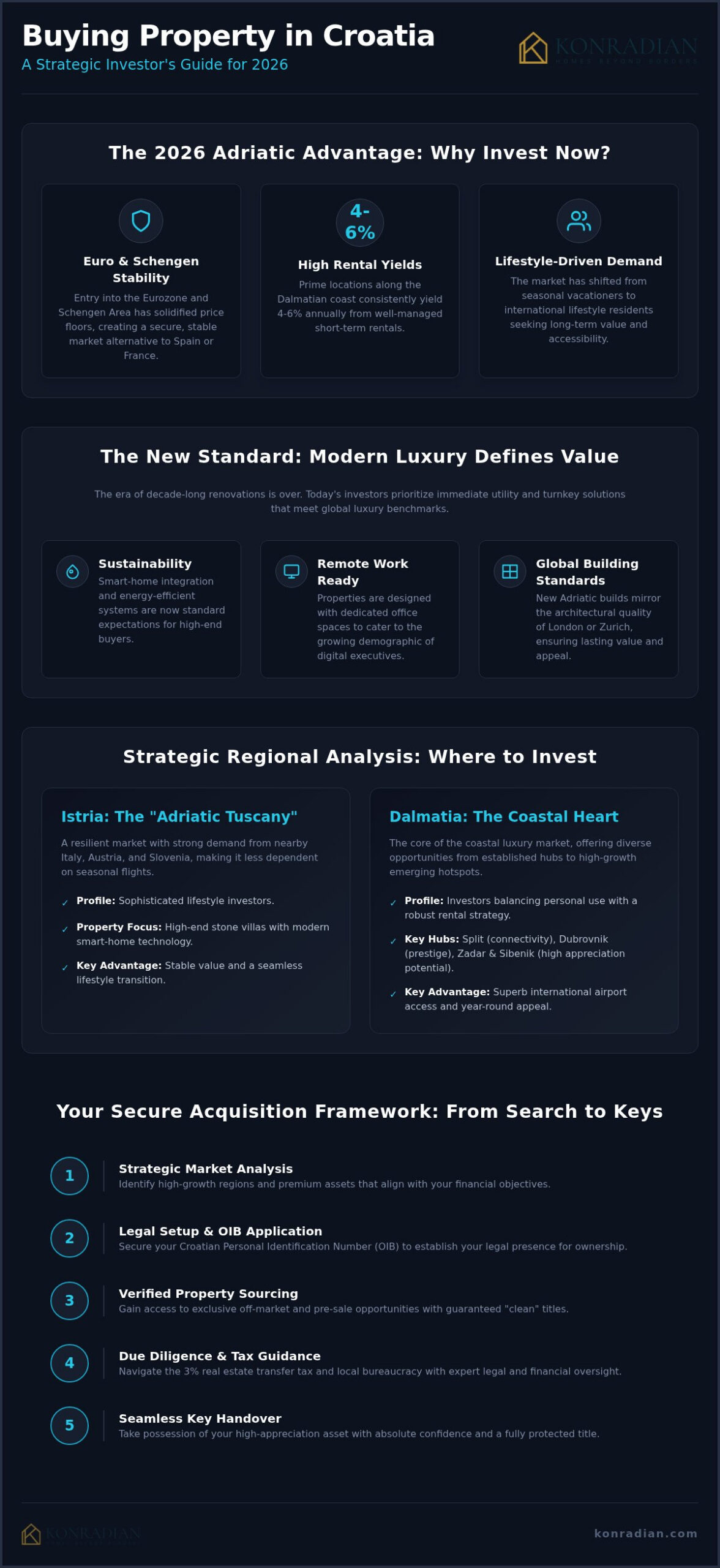
Entering 2026, the Croatian property market has transitioned into a sophisticated European hub. It’s no longer just an emerging market; the adoption of the Euro and entry into the Schengen Area several years ago have solidified price floors across the Dalmatian coast. Investors from the United States and Northern Europe now view the Adriatic not as a speculative frontier, but as a stable alternative to the saturated markets of Spain or France. For many, buying property in Croatia as a foreigner is no longer a bureaucratic hurdle but a streamlined entry into a high-yield asset class. Understanding Croatia’s economic landscape reveals a tourism-heavy sector that directly fuels the demand for high-end residential assets. This growth is underpinned by a permanent shift in how global citizens live and work.
Post-Schengen Appreciation: A New Era for the Coast
The removal of border checks has fundamentally altered the buyer profile. We’ve seen a transition from seasonal vacationers to lifestyle residents who value the ability to move freely between Central Europe and their coastal retreats. This accessibility ensures that buying property in Croatia as a foreigner remains a strategic move for those seeking capital preservation. While other Mediterranean regions face volatility, premium zones in Split and Dubrovnik have maintained a trajectory of steady value increase. The 2026 investment climate is characterized by a high demand for prime locations where well-managed short-term rentals yield between 4% and 6% annually.
The Shift Toward Modern Luxury Developments
The era of purchasing crumbling stone ruins for decade-long renovations has largely passed. Modern investors prioritize efficiency and immediate utility. There’s a clear movement toward turnkey, high-spec villas that offer international-standard comfort from day one. Quality now dictates value.
- Sustainability: High-end buyers now demand smart-home integration and energy-efficient cooling systems as standard features.
- Remote Work: Properties are increasingly designed with dedicated office spaces to cater to the growing demographic of digital executives.
- Building Standards: New Adriatic builds now mirror the architectural rigor found in London or Zurich, moving away from local vernacular toward global luxury benchmarks.
This evolution reflects a broader trend toward professionalized development. Buyers seek lock-up-and-leave security alongside architectural excellence. By focusing on these modern assets, investors can bypass the traditional pitfalls of local construction and secure a property that meets the expectations of the 2026 rental market.
Strategic Regional Analysis: Where to Buy in Croatia for Maximum Value
Selecting the right geography is the most critical decision when buying property in Croatia as a foreigner. The Adriatic coastline isn’t a monolith; it offers diverse micro-markets, each with distinct risk-reward profiles and liquidity levels. While Dubrovnik remains the gold standard for prestige and limited supply, investors seeking high-yield alternatives are increasingly turning toward Zadar and Sibenik. These emerging hotspots offer modern infrastructure and lower entry points, providing a compelling case for capital appreciation as the market matures in 2026. Dalmatia, centered around Split and Trogir, continues to be the heart of the coastal luxury segment. Its international airport and year-round connectivity make it an ideal choice for those balancing personal use with a robust rental strategy.
Istria: The Strategic Investor’s Favorite
Istria has carved out a unique niche as the “Tuscany of the Adriatic.” Its geographic proximity to Italy, Austria, and Slovenia creates a resilient demand base that’s less dependent on seasonal flight connectivity than the southern coast. This region attracts a sophisticated demographic looking for high-end stone villas that blend traditional aesthetics with contemporary smart-home technology. For those prioritizing a seamless lifestyle transition and stable value, exploring Istria real estate for sale offers a clear path to high-spec assets. The rental season here is notably extended by gourmet tourism and wellness retreats, ensuring consistent performance for well-managed properties throughout the year.
Dalmatian Islands: Exclusive Seclusion
The islands of Brac, Hvar, and Korcula represent the pinnacle of exclusivity in the 2026 luxury segment. Waterfront properties in these locations command a significant premium due to their scarcity and the strict “first line to the sea” regulations. While island logistics can present challenges for independent buyers, the rewards of owning a secluded Mediterranean retreat are unmatched. These locations offer a level of privacy and natural beauty that mainland developments often struggle to replicate. In the current cycle, we see a strong preference for Brac’s accessibility and Hvar’s established high-end reputation. Identifying a secure asset in these competitive archipelagos requires deep local insight and a proactive approach. If you’re ready to explore these exclusive enclaves, our team at konradian.com can guide you through the nuanced selection process to ensure your investment is both safe and profitable.
The Konradian Model: Sophisticated Buyer Advisory at No Direct Cost
Investors often approach international markets with a healthy degree of skepticism regarding service costs. When buying property in Croatia as a foreigner, you’ll find that the most sophisticated advisory doesn’t come with a direct invoice to the buyer. This is because the Croatian developer market operates on a seller-paid commission structure. Our role is to serve as your protective partner, leveraging an LSE-educated mindset to scrutinize every detail of a potential acquisition. We prioritize your security. While a traditional listing agent is contractually bound to the seller’s interests, we provide a necessary counterweight, focusing exclusively on your long-term capital appreciation and the seamless integration of your Adriatic asset.
End-to-End Stewardship: From Consultation to Closing
Our process begins with a deliberate, free video consultation designed to map your specific investment goals and risk profile. We don’t believe in a one-size-fits-all approach. Instead, we provide a methodical journey from that first discovery call to the final key handover. This includes providing the legal support buying property abroad that is essential for a clean transaction. We handle the heavy lifting of bureaucratic coordination, ensuring your focus remains on the lifestyle benefits of your new home rather than the complexities of the filing process. Our team remains your single point of contact, providing a sense of ease that is often missing in high-stakes international transactions.
Eliminating the “Foreigner Premium” through Professional Negotiation
There’s a persistent risk in any international market that buyers without local representation may face inflated pricing or unfavorable contract terms. We eliminate this “foreigner premium” by acting as a professional buffer between you and the developer. Our expertise ensures total transparency when buying property in Croatia as a foreigner, specifically focusing on:
- Developer Due Diligence: We verify the financial stability and historical track record of every builder we recommend.
- Contractual Precision: We ensure that developer obligations, construction timelines, and technical specifications are clearly defined and enforceable.
- Price Benchmarking: We use real-time market data to ensure the price you pay reflects the true value of the asset, not an “international buyer” markup.
We replace emotional impulse with data-driven strategy. This ensures that every euro invested aligns with the highest international standards of quality and value. By leveling the playing field, we provide the peace of mind that your entry into the Croatian market is as profitable as it is prestigious.
The Secure Acquisition Framework: Your Step-by-Step Guide
Securing an Adriatic asset requires a methodical approach to local bureaucracy. The first essential step in buying property in Croatia as a foreigner is obtaining a Personal Identification Number, known locally as an OIB. This number is the foundation for all legal transactions, from opening a bank account to signing a sales contract. Once your OIB is active, the focus shifts to property selection, where the paramount concern is the verification of “clean” title deeds. We ensure that every asset we recommend has been rigorously vetted to confirm that the seller has the undisputed right to transfer ownership. This prevents the legal entanglements that often plague unrepresented buyers.
The transaction itself typically moves through two formal stages. First, a Preliminary Contract (Predugovor) is signed, accompanied by a 10% deposit known as Kapara. This step legally binds both parties to the sale while final due diligence is completed. Following this, the Final Sales Contract is executed and notarized. The process concludes with the formal entry of your ownership into the Land Registry (Zemljišne knjige). This final registration is the definitive moment you become the legal owner of your Croatian retreat, providing the ultimate security for your investment.
Legal Safeguards and Title Verification
Title verification in Croatia centers on the “Vlastovnica,” which is the proprietary section of the land registry extract. Checking this document is the most critical step in the due diligence process. It reveals any existing mortgages, liens, or third-party rights that could compromise your ownership. While the Public Notary (Javni bilježnik) plays a vital role in verifying signatures and ensuring the contract meets legal standards, they don’t provide the comprehensive title insurance common in other markets. This is why our legal partners provide an additional layer of oversight. We streamline the verification of building permits and usage certificates, ensuring the physical structure aligns perfectly with its legal documentation.
Financial Logistics: Taxes and Fees
Budgeting for an acquisition in 2026 requires a clear understanding of the local tax regime. For resale properties, buyers must account for the 3% Real Estate Transfer Tax, which is calculated based on the market value determined by the Tax Administration. You should also set aside funds for notary fees, certified translations of documents, and court registration costs, which typically range between 1% and 2% of the purchase price. Properties purchased as new-builds from VAT-registered developers are exempt from the 3% real estate transfer tax, as the value-added tax is already integrated into the purchase price. This distinction makes new developments particularly attractive for those looking to optimize their initial capital outlay.
Navigating these requirements is significantly easier with a dedicated advisor who understands the nuances of the 2026 market. If you’re ready to begin your journey with a partner who prioritizes your security, we invite you to explore our end-to-end acquisition services to ensure a seamless transition to Adriatic ownership.
Maximizing ROI: Exclusive Pre-Sale and Off-Plan Opportunities
The most significant capital gains in the 2026 market are rarely found in the resale sector. While existing villas offer immediate utility, buying property in Croatia as a foreigner with an eye for appreciation requires a shift toward the primary market. Accessing developments during their “Phase 0” or pre-sale period allows investors to capture the full value curve as the project moves from ground-breaking to completion. These opportunities are often off-market, reserved for a select circle of advisors who maintain direct relationships with the country’s leading developers. By the time a project reaches public listing platforms, the most desirable units with unobstructed sea views have typically been secured by proactive international investors.
Investing in off-plan assets necessitates a rigorous approach to risk mitigation. We focus on developer vetting as a primary safeguard, examining financial solvency and project delivery history to ensure your capital is protected. This intellectual rigor is essential for navigating the 2026 landscape. It’s not just about finding a beautiful rendering; it’s about verifying that the technical specifications and building standards meet the high-spec requirements of a global luxury audience. We handle the due diligence on your behalf, ensuring that every contract includes enforceable timelines and quality guarantees.
The Pre-Sale Advantage
Securing a property at pre-sale pricing offers a distinct strategic advantage. This entry point represents the lowest price per square meter available during the property’s lifecycle. As construction milestones are reached, the developer incrementally raises prices, providing early buyers with built-in equity before the keys are even handed over. Additionally, early-stage involvement allows for a level of customization that is impossible with finished builds. Investors can often influence interior layouts, material selections, and smart-home integrations, ensuring the final product perfectly aligns with their specific aesthetic and functional requirements.
Building Your Adriatic Portfolio
A sophisticated investment strategy often involves diversifying across different Croatian micro-locations. Balancing the high-yield tourism potential of the Dalmatian islands with the stable, year-round appeal of Istria creates a resilient portfolio. It’s also helpful to benchmark these opportunities against other established European markets. While buying property in Spain remains a popular choice for many, Croatia’s 2026 market offers a unique growth trajectory characterized by lower luxury supply density and recent Eurozone stability. This creates a window of opportunity for those seeking to diversify their European holdings with high-appreciation Adriatic assets.
Your journey toward a secure and profitable Croatian acquisition begins with a clear, data-driven strategy. If you’re ready to explore exclusive pre-sale opportunities and navigate the Adriatic market with absolute confidence, we invite you to book a free strategic consultation. Let us handle the heavy lifting while you focus on the rewards of a premier Mediterranean investment.
Securing Your Adriatic Legacy in 2026
The Croatian property market in 2026 offers a rare convergence of European stability and high-growth potential. Successfully buying property in Croatia as a foreigner requires more than just capital; it demands a strategic alignment with the right geography and a rigorous approach to legal due diligence. By focusing on “clean” title verification and leveraging the tax advantages of new-build developments, you can transform a complex international transaction into a seamless, high-value acquisition. The Adriatic coast remains one of the most prestigious asset classes in the Mediterranean. Quality dictates value.
Our LSE-educated advisory team is here to provide the intellectual rigor and local expertise necessary to navigate this landscape. We offer a model that’s entirely free for the buyer, providing you with direct access to exclusive developer pre-sales and end-to-end transaction support. This ensures your investment is protected from the first consultation to the final key handover. We invite you to take the next step toward your Mediterranean retreat with confidence and clarity.
Book your free video consultation for Croatia real estate with Konradian and secure your place in the Adriatic’s most exclusive developments.
Frequently Asked Questions
Can foreigners buy property in Croatia in 2026?
Yes, foreigners can buy property in Croatia in 2026. Citizens of the EU, EEA, and Switzerland enjoy the same rights as Croatian nationals, allowing them to purchase residential assets without additional permits. Non-EU citizens can also acquire property, provided a reciprocity agreement exists between Croatia and their home country. These buyers must obtain consent from the Ministry of Justice, a process that our advisory team streamlines to ensure a secure transition.
What are the hidden costs when buying real estate in Croatia?
Beyond the purchase price, you should budget for closing costs ranging from 3.5% to 8%. This includes the 3% real estate transfer tax for resale properties, notary fees, and land registry costs. You’ll also encounter expenses for certified translations of documents and independent legal oversight. When buying property in Croatia as a foreigner through our advisory, we help you calculate these figures precisely to avoid any financial surprises during the closing phase.
How long does the property buying process take in Croatia?
The timeline for a standard acquisition typically spans two to six months. This duration accounts for the initial OIB application, thorough title verification, and the execution of the final sales contract. For non-EU investors, the process may extend slightly due to the Ministry of Justice consent requirement. We manage these administrative milestones proactively to ensure the timeline remains predictable and mirrors the pace of a well-organized professional transaction.
Is an OIB number required for foreigners to purchase property?
Yes, an OIB is a mandatory requirement for any property transaction. This personal identification number is used by the Croatian Tax Administration to track your investment and is necessary for signing contracts or paying taxes. We handle the application process on your behalf during the initial stages of our stewardship, ensuring your legal foundation is established before you commit to a specific Adriatic asset.
Do I need a local bank account to buy property in Croatia?
While it’s possible to transfer funds directly from an international account for the purchase, opening a local account is highly beneficial. A Croatian account simplifies the ongoing management of your property, including the payment of utilities and municipal taxes. It also provides a level of financial integration that supports your status as a sophisticated property owner. We can guide you through the documentation required to establish this local banking relationship with ease.
What is the difference between agricultural and building land in Croatia?
Building land is designated for construction, whereas agricultural land is strictly protected for farming and nature. Buying property in Croatia as a foreigner is generally limited to building zones for residential or commercial use. Agricultural land is subject to specific restrictions and pre-emption rights that often exclude international buyers. We focus our sourcing efforts exclusively on building land with verified permits to ensure your investment has a clear path to development.
How much is the real estate transfer tax in Croatia for 2026?
The real estate transfer tax remains at 3% for the 2026 calendar year. This tax applies to the purchase of resale properties and is calculated based on the market value assessed by the local tax authorities. It’s important to remember that new-build properties sold by VAT-registered developers are exempt from this specific tax. This exemption often makes modern developments a more capital-efficient choice for investors looking to minimize their entry costs.
Can I buy property in Croatia remotely without traveling?
You can complete a property purchase remotely by granting a Power of Attorney to a trusted legal representative. This document must be notarized and, depending on your home country, may require an apostille to be legally recognized in Croatia. This approach allows you to secure prime Adriatic real estate without the need for immediate travel. We frequently coordinate these remote transactions for our global clients, maintaining rigorous oversight at every step.
