


The most lucrative opportunities for Dalmatian coast Croatia property for sale are often claimed before they ever reach a public listing. In a 2026 market where Split has officially surpassed Zagreb as the nation’s most expensive residential hub, the difference between a standard purchase and a strategic investment lies in exclusive, early-stage access. You likely recognize that the Adriatic’s rugged beauty is no longer a secret. It’s also true that the complexity of foreign land registries and the nuances of maritime domain laws can make the prospect of buying here feel daunting. You deserve a transition that’s as smooth as the coastline itself.
This expert-led guide provides you with the professional stewardship needed to unlock exclusive developer deals and secure a premium beachfront asset with absolute confidence. We’ll navigate the latest 2026 market dynamics together, breaking down the updated tax frameworks and the essential steps for a seamless transaction. From identifying high-yield off-market opportunities to managing the final legal details, we’ll show you how to transform a complex international acquisition into a refined lifestyle investment that delivers consistent rental income and long-term security.
Key Takeaways
- Learn why the convergence of Mediterranean lifestyle and stable EU growth makes 2026 the optimal window for securing high-yield Adriatic assets.
- Identify the most strategic locations for your portfolio, from the high-liquidity urban hubs of Split to the emerging value-seekers’ markets in Zadar.
- Gain exclusive access to off-market listings for Dalmatian coast Croatia property for sale, ensuring you see premium seafront villas before they reach public portals.
- Master the essential steps of the Croatian acquisition roadmap, including the critical Land Registry audit and obtaining your personal identification number.
- Discover how professional stewardship alleviates the complexities of foreign negotiation, providing a seamless path from initial consultation to key handover.
The Allure of Dalmatia: Why the Adriatic Coast is 2026’s Premier Investment
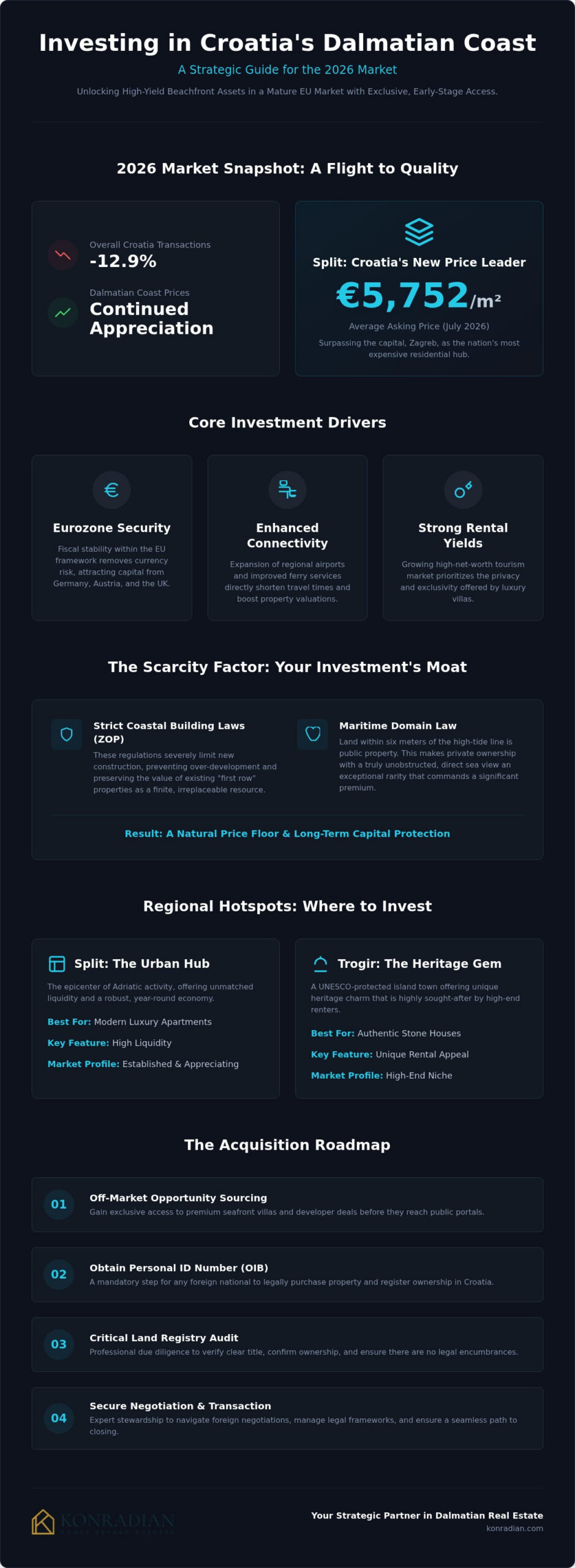
The historical charm of Dalmatia has evolved into a sophisticated marketplace for discerning global investors. By 2026, the region has transitioned from a seasonal retreat into a primary destination for capital preservation within the Eurozone. While property transactions across Croatia saw a 12.9% decrease in early 2026, prices in coastal strongholds continued to appreciate. This divergence signals a flight to quality. Investors aren’t just looking for a holiday home; they’re seeking high-liquidity assets in a stable, EU-backed environment. Transitioning from a holiday-maker to a strategic owner means recognizing that the Adriatic is no longer an emerging market, it’s a mature one where timing and access are everything.
The Macro-Economic Appeal of Coastal Croatia
The Scarcity Factor: Why “First Row” Always Wins
The Adriatic’s most valuable feature is its fundamental lack of supply. Strict coastal building regulations, known as the ZOP (Protected Coastal Area) laws, prevent the over-development seen in other parts of Europe. These regulations ensure that “first row” properties remain a finite resource. Because the Maritime Domain law designates land within six meters of the high-water mark as public property, owning a home with an unobstructed view is a rare privilege that commands a premium. Strict environmental protections and the physical limitations of the karst landscape ensure that the limited coastline creates a natural price floor, protecting your capital against market volatility.
Capital appreciation in hubs like Split, where average asking prices reached approximately €5,752 per square meter in July 2026, is driven by this scarcity. When looking for Dalmatian coast Croatia property for sale, the emotional value of an Adriatic sunset is matched only by the financial security of owning an asset that cannot be replicated. It’s a market where professional stewardship is essential to identifying the few remaining opportunities that offer both lifestyle and long-term yield.
Regional Breakdown: Where to Buy on the Dalmatian Coast
Selecting the right location for your investment requires a move beyond simple aesthetics into a detailed analysis of regional micro-markets. While the broader Croatia’s economic overview highlights national stability and EU-backed growth, the Adriatic coast operates on its own distinct supply-and-demand curve. Each sub-region caters to a specific investor profile. Whether you prioritize the high-liquidity urban centers of the central coast or the emerging value plays in the north, understanding these nuances is the first step toward a successful acquisition. When evaluating Dalmatian coast Croatia property for sale, your choice between an island villa and a city apartment will define your long-term yield profile.
Split and Trogir: The Heart of the Adriatic
Split has officially become the most expensive city for residential property in 2026. Average asking prices reached approximately €5,752 per square meter in July 2026, surpassing even the capital city of Zagreb. This urban hub offers unmatched liquidity and a year-round economy that few other coastal cities can match. Investors are increasingly drawn to modern apartment corridors in developing luxury districts. Nearby, the UNESCO-protected town of Trogir offers a different kind of value. Authentic stone houses within its historic core provide a unique heritage charm that remains highly sought after by high-end renters. For those weighing these central options against northern alternatives, our Istria real estate guide offers a useful strategic comparison of market dynamics.
Zadar: The Gateway to Northern Dalmatia
Zadar’s growing importance as an investment hub is supported by its excellent travel links. If you are planning a visit to explore the local market, you can discover E-Tours d.o.o. to find the most efficient flight options to Northern Dalmatia.
Zadar remains the premier choice for value-oriented investors who seek modern amenities at a lower entry point than Split or Dubrovnik. The city’s superior airport connectivity is a primary driver for short-term rental ROI, as it provides easy access for European travelers. You’ll find several developing residential projects here that offer contemporary design and sea views without the “prestige tax” found in more famous hubs. The growth potential in the nearby Šibenik archipelago shouldn’t be overlooked either. As the central coast becomes more saturated, Šibenik is emerging as a sophisticated alternative for those who value privacy and proximity to national parks.
South Dalmatia continues to be the territory of prestige and ultra-luxury. Dubrovnik remains a global brand, with average asking prices around €5,107 per square meter as of mid-2026. Meanwhile, islands like Brač, Hvar, and Korčula offer a distinct lifestyle investment, though they require more complex logistics for construction and maintenance. Navigating these regional nuances is simpler when you have an expert on the ground. Consulting with a dedicated advisor ensures your portfolio aligns with local market realities and secures the most promising off-market opportunities.
Property Types: From Authentic Stone Houses to Modern Villas
The 2026 market offers a diverse range of assets, yet each requires a distinct strategic approach to maximize ROI. For many investors, the search for Dalmatian coast Croatia property for sale begins with a choice between the sleek efficiency of a new build and the timeless character of a stone house. While apartments in urban centers like Split provide high-yield liquidity, the most significant capital appreciation is currently found in off-plan and pre-sale opportunities. Securing equity before completion allows you to bypass the 25% VAT often applied to new builds while ensuring you have first choice of the most desirable units in a developer’s portfolio.
The Modern Villa Investment Framework
A modern villa is the gold standard for generating passive income in the luxury rental market. To remain competitive in 2026, these properties must feature infinity pools, integrated smart technology, and sustainable energy solutions. The “First Row to the Sea” premium is more than just a marketing phrase; it’s a structural guarantee of value. Because the maritime domain laws prevent private ownership within six meters of the coastline, properties that sit directly behind this public zone are effectively impossible to replicate. Maintaining these assets from abroad is simplified by our end-to-end stewardship, which ensures that your property remains in pristine condition for the high-yield summer season.
Renovating Heritage: Risks and Rewards
Traditional stone houses offer an emotional connection to the Adriatic’s history, but they come with unique renovation complexities. If you’re looking at property in UNESCO-protected areas like Trogir, you’ll need to navigate strict conservation laws that dictate everything from window materials to roof tiles. Calculating the real cost of renovation in Dalmatia involves more than just labor and materials. You must also account for the time required to secure permits and the specialized craftsmanship needed for historical stone work.
An equity trap occurs when the combined cost of acquisition and historical restoration exceeds the property’s eventual market value due to unforeseen structural or bureaucratic delays. To avoid this, we prioritize thorough due diligence before any purchase. For those who prefer a more predictable financial path, modern apartments in urban luxury corridors offer a streamlined alternative. These units benefit from the 12% rental income tax rate and consistent demand from both international tourists and the growing local professional class. Whether you’re drawn to heritage or modernism, the key is to align the property type with your long-term wealth preservation goals.
The Acquisition Roadmap: Buying Property in Croatia Safely
Securing Dalmatian coast Croatia property for sale requires a methodical approach to administrative compliance. Your first priority is obtaining an OIB (Osobni identifikacijski broj), a personal identification number required for all financial and legal activities in Croatia. This is the foundation upon which your entire transaction rests. Without it, you cannot open a local bank account or sign a binding contract. The process typically follows a two-stage structure. First, a Pre-contract (Predugovor) is signed, usually accompanied by a 10% deposit. This binds both parties while final due diligence occurs. The Main Contract follows once all conditions are met, leading to the final transfer of funds and title registration.
Tax obligations depend on the property’s status. Resale properties incur a 3% Real Estate Transfer Tax (RETT) based on the market value. Conversely, new builds purchased directly from a developer are subject to 25% VAT, which is typically included in the purchase price. Understanding this distinction is crucial for accurate budgeting. You should also account for notary and land registry fees, which generally range between 0.5% and 1% of the purchase price, plus a standard court fee of approximately €33.
Due Diligence: Eliminating Legal Risk
An audit of the “Zemljišne Knjige” (Land Registry) is non-negotiable. You must verify a “Clean Title” and ensure no historical encumbrances, such as unresolved family disputes or hidden debts, remain attached to the property. The Public Notary acts as an impartial witness to the signatures and ensures the documents meet legal standards for registration, but they don’t conduct the deep due diligence a buyer requires. For a deeper dive into these safety protocols, consult our legal support guide. We ensure every document is translated and verified before you commit any capital.
Financial Planning for International Buyers
Currency management is a vital part of your strategy. While Croatia is in the Eurozone, international buyers should coordinate with specialized brokers to manage exchange rates and timing effectively. At Konradian, we utilize a “Free for Buyer” model. Because our commissions are paid by the sellers, you receive our full suite of advisory services at zero cost to you. Post-purchase, you’ll need to manage annual property taxes on second homes, which range from €0.60 to €8.00 per square meter depending on the municipality, and handle utility transfers. To begin your search with the security of professional stewardship, schedule a consultation with our advisory team.
Strategic Partnership: How Konradian Unlocks Dalmatia
Acquiring a high-value asset in a foreign market requires more than a simple search through public listings. It demands a level of intellectual rigor and local insight that generic portals cannot provide. At Konradian, our LSE-educated advisory team treats real estate as a sophisticated wealth preservation tool rather than a mere transaction. We bring over five years of international experience to every negotiation, ensuring your interests are protected by a partner who understands both the macro-economic landscape and the micro-level nuances of the Adriatic coast. Our approach is designed to provide you with the peace of mind that comes from professional stewardship, taking the heavy lifting off your shoulders from the first inquiry to the final signature.
Direct Developer Access and Pre-Sale Advantages
The most promising opportunities for Dalmatian coast Croatia property for sale are frequently secured before they ever reach the open market. Through our direct relationships with top-tier Croatian developers, we provide our clients with exclusive pre-sale access to off-market deals. This tactical advantage allows you to select premium units and secure early-stage pricing that public buyers simply never see. We conduct rigorous construction quality audits and reliability checks on every developer we partner with, ensuring that your investment is built on a foundation of integrity. This proactive representation is essential in a competitive market where the best seafront land is finite and highly sought after.
Your Concierge to the Adriatic
Our involvement is a start-to-finish commitment that encompasses sourcing, legal verification, and administrative handover. We recognize that the complexities of Croatian bureaucracy can be a significant barrier for international buyers. Our local experts handle the intricacies of the land registry and utility transfers, providing a seamless experience that respects your time and your goals. We tailor our property sourcing to your specific investment profile, whether you’re seeking a high-liquidity urban apartment or a secluded island villa.
One of the most distinct advantages of our service is our “Free for Buyer” model. In the Croatian market, our professional fees are paid by the sellers, meaning you receive our full suite of elite advisory and concierge services at zero cost to you. This transparency ensures our interests are aligned with your long-term success. You don’t have to navigate this journey alone or guess at the reliability of a distant listing. To begin your acquisition with the security of a trusted global partner, we invite you to book a free video consultation to discuss your specific vision for an Adriatic portfolio.
Securing Your Legacy on the Adriatic
The 2026 market presents a rare window where Eurozone stability meets a finite supply of premium coastal land. Success in this landscape requires a shift from viewing property as a simple purchase to treating it as a strategic wealth tool. By prioritizing scarcity and verifying legal status through a rigorous Land Registry audit, you protect your capital against market volatility. Finding the right Dalmatian coast Croatia property for sale doesn’t have to be a source of stress when you have professional stewardship managing every detail.
Our LSE-educated advisors provide the strategic market analysis and direct access to pre-sale developer listings you need to stay ahead of the curve. We manage the entire process at no cost to the buyer, ensuring a seamless experience from initial consultation to the handover of your keys. You’re ready to transition from a global observer to a sophisticated owner in one of Europe’s most exclusive regions. Explore Exclusive Dalmatian Coast Properties with Konradian and begin your journey toward a secure lifestyle investment today.
Frequently Asked Questions
Can foreigners buy property on the Dalmatian Coast easily?
EU and EEA citizens can purchase property under the same conditions as local citizens with no special approvals. For those seeking Dalmatian coast Croatia property for sale from outside the EU, such as US citizens, acquisition is based on reciprocity agreements and requires Ministry of Justice approval. This administrative process typically takes several months, but our team provides the professional stewardship needed to navigate these legal nuances efficiently.
What are the hidden costs of buying property in Croatia?
Beyond the acquisition price, you should budget for total closing costs ranging from 4% to 8%. This includes the 3% property transfer tax for resale homes, legal fees between 1% and 1.5%, and notary fees of approximately 0.5% to 1%. There’s also a mandatory land registry court fee of around €33. We provide a detailed financial breakdown early in our partnership to ensure complete transparency.
Is it better to buy a traditional stone house or a modern villa?
Modern villas are the gold standard for passive income and luxury, offering easier maintenance and higher rental yields. Traditional stone houses provide unique character but involve complex renovation risks and strict conservation laws. Your choice should align with whether you prioritize immediate liquidity or long-term heritage preservation. We help you evaluate the structural integrity and investment potential of both property types before you commit.
How much is the real estate transfer tax in Croatia in 2026?
In 2026, the real estate transfer tax remains 3% for resale properties based on their market value. If you purchase a new build from a developer, you’ll pay 25% VAT, which is generally included in the purchase price. Additionally, be aware of the annual tax on non-primary residences, which municipalities set between €0.60 and €8.00 per square meter, implemented to manage the growing popularity of second homes.
Do I need to be physically present in Croatia to buy a property?
You don’t need to be in Croatia for every step of the acquisition. We utilize video consultations and specialized power of attorney documents to handle negotiations and signings on your behalf. This allows you to manage your investment from anywhere in the world while we provide the necessary boots-on-the-ground stewardship, ensuring your peace of mind throughout the entire professional process.
What is an OIB and why do I need one for real estate?
An OIB is a personal identification number required for any legal or financial activity in Croatia. You’ll need it to sign contracts, open a local bank account, and pay taxes. We handle the application process for you as part of our start-to-finish support, ensuring your entry into the market is seamless. This number is essential for linking your identity to the official land registry records.
Why are Konradian’s services free for the property buyer?
Our advisory services are free for the buyer because our professional commissions are paid by the sellers or developers. This established model ensures you receive elite expertise and direct access to off-market Dalmatian coast Croatia property for sale without any added expense. We combine the intellectual authority of a strategic consultant with the personalized care of a concierge to protect your interests throughout the entire transaction.
Which Dalmatian island offers the best rental yields?
Hvar and Brač currently offer some of the most consistent rental yields due to their global brand recognition and established tourism infrastructure. In July 2026, Hvar’s average asking price reached €4,575 per square meter, reflecting strong international demand. These islands attract high-net-worth travelers who seek the exclusive, tranquil lifestyle that defines the region, making them excellent choices for a lifestyle investment that yields consistent income.
