


A successful Florida real estate investment is often won or lost not at the point of purchase, but at the moment of exit when the IRS claims 15% of your gross sale price. Understanding property taxes for foreign owners in Florida requires a sophisticated perspective that balances local county assessments with complex federal mandates. It’s natural to feel a sense of trepidation when faced with the intersection of local millage rates, FIRPTA withholding, and shifting state legislation like SB 264. This guide provides the strategic clarity you need to handle these financial complexities with the composure of a seasoned global investor.
We’ll explore the 2026 tax landscape by examining annual county obligations, the potential impact of Amendment 3, and the specific methods used to mitigate federal withholding. You’ll gain a clear roadmap to secure your US assets and ensure your international portfolio remains both compliant and profitable. From initial acquisition to the eventual handover of keys, professional stewardship ensures your investment journey is marked by precision and peace of mind.
Key Takeaways
- Distinguish between local county millage rates and federal IRS requirements to build a comprehensive financial strategy for your Florida assets.
- Navigate property taxes for foreign owners in Florida by mastering the critical difference between annual assessments and the 15% FIRPTA withholding triggered at the point of sale.
- Discover the specific IRS elections that allow you to shift from a default 30% gross withholding on rental income to a more efficient tax on net profits.
- Secure your investment by understanding the latest 2026 legal shifts, including ownership restrictions near critical infrastructure mandated by Florida Senate Bill 264.
- Identify how leveraging direct developer access can mitigate entry-year tax spikes and provide a seamless transition into the US real estate market.
The Dual-Layer Tax Framework for Foreign Investors in Florida
Foreign ownership in the Sunshine State is characterized by a dual-layer structure. You aren’t just dealing with a single entity; you’re managing relationships with both the local county and the federal government. This complexity often leads to the “Non-Resident” myth. Many investors assume that being a non-resident of Florida is the same as being a foreign national. In reality, a US citizen living in New York faces entirely different tax obligations than a European investor. For the international buyer, property taxes for foreign owners in Florida involve interfacing with the U.S. Property Tax System at the local level while simultaneously adhering to Internal Revenue Service (IRS) mandates.
The investment lifecycle follows three distinct phases. During acquisition, you’ll manage transfer taxes and initial documentation. The hold period requires annual attention to local assessments to ensure your carry costs remain predictable. Finally, the disposition or exit stage triggers federal withholding mechanisms that can significantly impact your liquidity if not structured correctly from the start. Florida’s lack of state income tax makes it a premier global investment hub, but this advantage is only fully realized when you understand how these layers interact.
State vs. Federal: Who Gets Your Money?
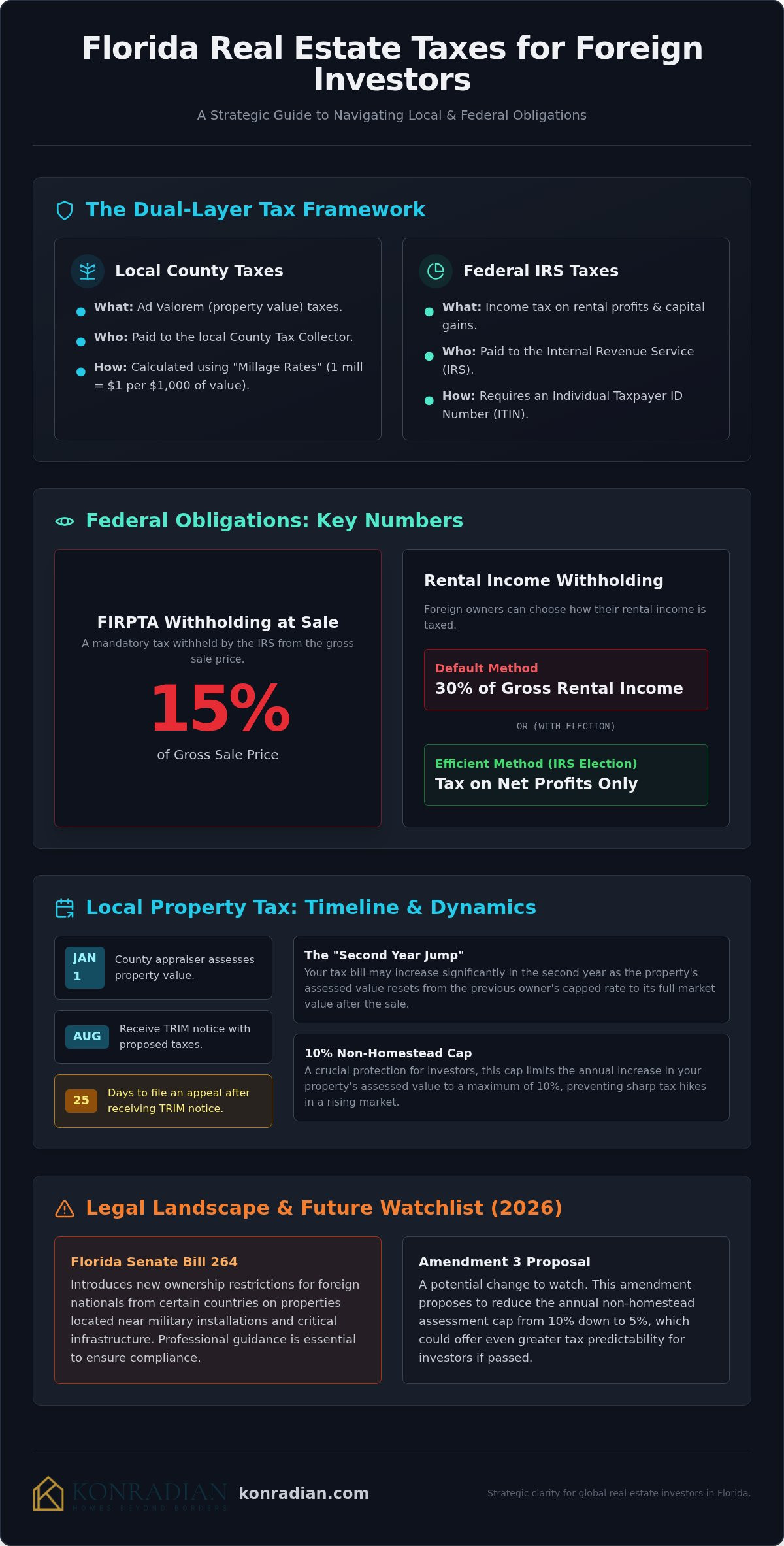
Your financial obligations are split between two distinct jurisdictions. The local County Tax Collector oversees Ad Valorem taxes, which are based on millage rates set by local authorities and tied directly to the property’s assessed value. Conversely, the IRS manages federal income tax on rental profits and capital gains. To operate within this system, foreign owners require an Individual Taxpayer Identification Number (ITIN). This unique identifier acts as your primary link to the US tax system, allowing you to file federal returns and claim treaty benefits that can reduce your overall liability.
Why Florida is Tax-Efficient for International Wealth
Florida remains a destination of choice for global capital because of its favorable tax climate. The state doesn’t levy a personal income tax, meaning rental profits are only taxed at the federal level. Additionally, Florida has no state-level inheritance or estate tax, which allows for more efficient wealth preservation across generations. For the European investor, Florida serves as a tax-neutral gateway where the absence of state-level levies ensures that your capital works harder within the US market. This streamlined environment removes the layers of state-level taxation found in competing markets like California or New York.
Local Property Tax Mechanics: Millage Rates and Assessment Caps
Florida’s local tax system operates on an “Ad Valorem” basis, meaning taxes are levied according to the property’s assessed value. Every year on January 1st, the county property appraiser re-evaluates each parcel. This cycle determines your “millage rate,” where one mill equals one dollar of tax for every $1,000 of assessed value. Mastering the nuances of property taxes for foreign owners in Florida allows you to forecast long-term returns with confidence. For many, the first year of ownership provides a pleasant surprise. This occurs because the tax bill often reflects the previous owner’s capped assessment. However, the value resets to full market value upon the transfer of title. This “reset” can lead to a significant jump in the second year, a reality that requires careful budgeting during the acquisition phase.
In August, you’ll receive a Truth in Millage (TRIM) notice. This document is your primary tool for transparency. It outlines the proposed taxes, the prior year’s value, and the current assessment. If the valuation feels unaligned with market realities, you have exactly 25 days to file an appeal. Managing these timelines is a hallmark of professional stewardship.
The 10% Non-Homestead Assessment Cap
While Florida’s famous “Save Our Homes” provision limits assessment increases to 3% for primary residents, foreign investors aren’t left without protection. You benefit from a 10% annual assessment cap on non-homestead properties. This cap ensures that even in a surging market, your assessed value cannot rise by more than 10% per year. Looking toward the late 2026 landscape, investors should monitor Amendment 3, which proposes to reduce this cap further to 5% for non-homestead properties. There’s also a subtle nuance known as the “Recapture Rule.” If your property’s assessed value is significantly lower than its market value due to previous years’ caps, the assessment can still rise by the maximum allowed percentage even if the market remains flat. This continues until the assessed value reaches the market value.
Millage Rates: A County-by-County Comparison
Tax burdens vary across the state. Miami-Dade County currently sees an average effective rate near 1.02%, while Broward and Palm Beach counties often hover slightly lower. These rates aren’t uniform; they’re a patchwork of county levies, school board requirements, and special district fees. Properties in “unincorporated” areas typically escape municipal-level taxes, offering a more attractive bottom line for the cost-conscious investor. While you manage these local nuances, don’t lose sight of the federal horizon. Just as local caps protect your hold period, FIRPTA Withholding Rules define your exit strategy. Partnering with a refined investment guide ensures you navigate these variables with absolute precision.
Federal Obligations: Rental Income and the FIRPTA Exit
While local millage rates manage your annual hold costs, federal obligations dictate your operational cash flow and final investment yield. The Internal Revenue Service (IRS) imposes a default 30% withholding tax on the gross rental income generated by foreign owners. For many, this represents a significant liquidity hurdle that can stifle the performance of a high-end portfolio. However, sophisticated investors recognize that this is merely a starting point. Managing property taxes for foreign owners in Florida requires a proactive approach to federal filings to ensure you aren’t overpaying on your recurring income. Beyond the operational phase, the eventual disposition of your asset triggers the Foreign Investment in Real Property Tax Act (FIRPTA), a mechanism designed to ensure capital gains taxes are captured before funds leave US borders.
The 871(d) Election: Taxing Rentals on Net Basis
The 871(d) election is a vital tool for the international investor. It allows you to treat rental income as “Effectively Connected Income” (ECI), which shifts the tax basis from gross revenue to net profit. By making this election, you can deduct legitimate expenses such as mortgage interest, property depreciation, and professional management fees. This strategy is non-negotiable for those pursuing US real estate investment from Europe, as it aligns your US tax burden with actual economic performance rather than arbitrary gross percentages. It’s a hallmark of professional stewardship that transforms a potentially heavy tax load into a manageable, transparent cost of doing business.
Navigating the 15% FIRPTA Withholding
When you decide to sell your Florida property, the buyer is generally required to withhold 15% of the gross sales price and remit it to the IRS. It’s essential to understand that FIRPTA is a withholding mechanism, not the final tax liability. If your actual capital gains tax is lower than the 15% withheld, you’re entitled to a refund. To avoid tying up significant capital for months, you can apply for a “Withholding Certificate” (Form 8288-B) before the closing date. This document proves to the IRS that your actual tax obligation is lower, allowing the title agent to withhold a reduced amount. There are also specific exceptions; for instance, no withholding is required if the sale price is $300,000 or less and the buyer intends to use the property as a primary residence.
As you refine your exit strategy, consider the role of a 1031 Exchange. This provision allows you to defer capital gains taxes by reinvesting the proceeds into a “like-kind” US property, effectively compounding your wealth without immediate tax erosion. While navigating these federal mandates, investors must also remain mindful of state-level shifts like Florida Senate Bill 264, which has introduced new registration requirements for certain foreign nationals. Balancing these federal incentives with local legal compliance ensures your Florida portfolio remains a secure and high-performing asset.
Recent Legal Shifts: Florida SB 264 and Restricted Ownership
Florida’s investment appeal remains exceptionally strong, yet the legislative landscape has become more nuanced with the implementation of Senate Bill 264. This law, which became effective in mid-2023, restricts certain foreign principals from acquiring property near critical infrastructure or military installations. While managing property taxes for foreign owners in Florida remains a primary financial consideration, legal compliance regarding ownership eligibility is now equally critical to your success. Investors from specific countries of concern face strict prohibitions within 10 miles of designated sites, including power plants, water treatment facilities, and airports. Understanding these geographic boundaries is essential to protecting your capital and ensuring your acquisition meets state standards before you commit to a purchase.
The Registration Process for Restricted Nationalities
The law specifically identifies individuals and entities from China, Russia, Iran, North Korea, Cuba, Venezuela, and Syria as foreign principals. If you hold an interest in Florida real estate and hail from these regions, mandatory registration with the Florida Department of Commerce is not optional. Failing to meet state-mandated deadlines can result in significant daily fines or even the forced divestment of your asset. The registration process requires a high level of transparency regarding the location and value of your holdings. Konradian provides specialized legal support buying property abroad to ensure every regulatory checkbox is marked with precision, allowing you to focus on the growth of your portfolio rather than administrative hurdles.
Strategic Workarounds and Legal Compliance
Compliance isn’t just about nationality; it’s about your legal status and the structure of your purchase. For instance, individuals residing in the US with valid visas, such as E-2 or EB-5 investors, often find more flexibility within the current legal framework. There’s also a specific exception for a single residential property under two acres, provided it isn’t within five miles of a military installation. Some investors explore using US-based entities to hold title, but the definition of a “foreign principal” remains broad and often looks through the corporate veil to the ultimate beneficial owner. Your legal domicile plays a defining role in how these restrictions apply to your specific situation.
Professional buyer representation has transitioned from a luxury to a necessity in this environment. Navigating the intersection of local property taxes for foreign owners in Florida and new state-level ownership restrictions requires a partner who understands the macro-level shifts and the micro-level details of each parcel. This proactive oversight ensures that your investment remains a source of tranquility rather than a legal complication. Secure your Florida investment strategy by partnering with a guide who handles the heavy lifting of compliance and tax optimization.
Optimizing Your Florida Portfolio with Konradian
Managing the intersection of federal mandates and property taxes for foreign owners in Florida requires more than just an accountant. It demands a strategic partner who understands the global implications of every local transaction. Konradian acts as your dedicated concierge, providing the intellectual authority of a London School of Economics (LSE) educated team combined with five years of specialized international brokerage experience. We recognize that the inherent stress of high-stakes cross-border investing can be alleviated through professional stewardship and a methodical, transparent process. Our role is to handle the heavy lifting, from initial market analysis to the final delivery of your keys.
One of the most effective ways we protect your yield is through direct access to developer pre-sales. As discussed earlier, Florida properties undergo a tax assessment reset upon transfer. By securing pre-construction opportunities, you can often mitigate the immediate impact of these entry-year tax spikes and secure a more predictable financial trajectory. Our “Zero-Cost” buyer model ensures that these elite advisory services are accessible to you without additional fees, as our compensation is provided by the seller or developer. This allows you to leverage high-level expertise and connections to specialized Florida tax attorneys at no extra expense to your capital stack.
End-to-End Acquisition Support
Our service is designed specifically for the European investor who requires a seamless, remote acquisition process. We begin with a comprehensive video consultation to align with your long-term wealth objectives. From there, we identify neighborhoods that offer the best balance of lifestyle appeal and tax efficiency, such as the unincorporated areas that avoid municipal levies. In high-demand coastal markets, specialized local agents like Krissy in the Keys (Krissy Carnahan, Realtor) provide the necessary on-the-ground perspective to ensure every acquisition is sound and tax-efficient. We coordinate every aspect of the legal and financial transaction, ensuring that your ITIN applications and 871(d) elections are handled with absolute precision. This start-to-finish oversight provides the peace of mind that comes from knowing your US real estate investment is being managed by experts who understand your cultural and financial context.
Despite recent regulatory shifts like SB 264, 2026 remains a strategic window for Florida real estate. The state’s lack of personal income tax and the robust demand in markets like Miami, Orlando, and the Gulf Coast continue to attract global capital. We provide exclusive access to listings that are often unavailable to the general public, ensuring your portfolio includes only the most secure and high-performing assets. Our proactive approach ensures that every property taxes for foreign owners in Florida concern is addressed long before the closing date, allowing you to invest with quiet confidence.
Your journey toward a secure US real estate portfolio begins with a single conversation. We invite you to experience a level of service that combines cosmopolitan savvy with personalized care. Book a free consultation with Konradian to discuss your Florida strategy and discover how we can refine your approach to the American market.
Strategic Mastery of the Florida Market
Success in the US real estate market requires more than just capital; it demands a precise understanding of the dual-layer tax environment. Precision is paramount. By mastering the nuances of property taxes for foreign owners in Florida, you transform a complex regulatory landscape into a predictable, high-performing asset. This involves balancing local county millage rates with federal FIRPTA obligations and staying ahead of state-level legislative shifts like SB 264.
Our LSE-educated advisory team brings over five years of cross-border transaction expertise to your portfolio. We provide direct developer pre-sale access to help you mitigate initial tax resets while ensuring every legal and financial detail is handled with absolute care. It’s about the long-term tranquility of your international wealth and the security of your global footprint. We handle the heavy lifting so you don’t have to.
Secure your Florida investment with a free strategic consultation.
Florida remains one of the world’s most compelling investment hubs. With the right professional stewardship, your path to US property ownership is both clear and rewarding.
Frequently Asked Questions
Do foreign owners have to pay property tax in Florida?
Yes, foreign nationals are subject to the same local property tax rates as US citizens. These are known as Ad Valorem taxes, which are levied annually by the county where your asset is located. For those managing property taxes for foreign owners in Florida, it’s essential to recognize that these local payments are separate from federal income tax obligations. Your bill is calculated based on the property’s assessed value and the local millage rate.
What is FIRPTA and how much is the withholding for foreign sellers?
FIRPTA stands for the Foreign Investment in Real Property Tax Act. It requires the buyer to withhold 15% of the gross sales price when purchasing from a foreign seller. This isn’t the final tax, but a security deposit for the IRS to ensure capital gains are paid. You can often reduce this amount by applying for a withholding certificate if your actual tax liability is lower than the 15% default rate.
Can a non-US citizen get the Homestead Exemption in Florida?
Most foreign investors are ineligible for the Homestead Exemption because it requires Florida to be your permanent, primary residence. You generally need a Green Card or a specific long-term visa to qualify for this assessment reduction. However, international owners still benefit from the 10% annual assessment cap on non-homestead properties. This protection ensures your tax basis doesn’t spiral out of control during periods of rapid market appreciation in the Sunshine State.
How much are property taxes in Florida for a $1 million home?
For a $1 million property, you should budget between $9,000 and $11,000 for annual property taxes. While rates vary by county, the average effective rate in Florida typically hovers around 0.9% to 1.1% of the assessed value. It’s important to remember that your first year’s bill might be lower if it reflects a previous owner’s capped assessment. The value typically resets to the full market price after the title transfer occurs.
Does Florida have a “Buyer Ban” for international investors?
Florida doesn’t have a universal ban on international buyers, but Senate Bill 264 imposes specific restrictions. Individuals from countries of concern, including China, Russia, and Venezuela, cannot own agricultural land or property within 10 miles of military bases or critical infrastructure. There are exceptions for small residential plots and individuals with valid US visas. Professional guidance is essential to ensure your chosen location complies with these evolving state regulations and registration requirements.
Is there an inheritance tax for foreign owners of Florida property?
Florida has no state-level inheritance or estate tax, which is a significant benefit for wealth preservation. However, foreign owners must still navigate the federal estate tax. For non-resident aliens, the federal exemption is limited to $60,000 for US-based assets. Any value above this threshold could be taxed at rates up to 40%. Sophisticated investors often use corporate structures or specific legal entities to mitigate this potential federal exposure and protect their heirs. For investors whose estate planning spans multiple jurisdictions, particularly between Germany and Russia, Адвокатское бюро Кобрель offers the specialized international inheritance law expertise required to navigate these complex legal bridges.
The most effective way to manage your bill is to review the Truth in Millage (TRIM) notice sent every August. You have a 25-day window to contest the property appraiser’s valuation if it exceeds the actual market value. Additionally, ensuring you’ve correctly applied for the 10% non-homestead cap is vital for property taxes for foreign owners in Florida. This cap limits how much your assessed value can increase each year regardless of market growth.
What is an ITIN and why do I need one for Florida real estate?
An ITIN is an Individual Taxpayer Identification Number issued by the IRS for those ineligible for a Social Security Number. You need one to file US tax returns, report rental income, and apply for FIRPTA withholding certificates. Without an ITIN, you cannot claim treaty benefits or effectively manage your federal tax obligations. It serves as your primary financial identity within the US system and is a prerequisite for any serious international real estate investor.
