


What if the most expensive part of your international investment isn’t the property itself, but the line items you never saw coming? For many seasoned investors, the sticker price is a deceptive starting point that often ignores the substantial hidden costs buying property abroad. Whether you’re eyeing a historic estate in Hungary or a modern villa in Croatia, failing to account for local fiscal liabilities can quickly erode your projected ROI. It’s natural to feel a sense of trepidation when faced with unfamiliar tax codes and shifting legal requirements in a foreign jurisdiction.
You’ve worked hard to build your capital; you deserve a transaction that’s as transparent as it is secure. This guide provides the sophisticated clarity you need to master the financial complexities of the 2026 market, ensuring your investment remains profitable from the first signature. We’ll provide a precise percentage-based breakdown of extra costs across key regions, establish a reliable legal framework for your acquisition, and show you how to calculate your true return on investment with absolute confidence.
Key Takeaways
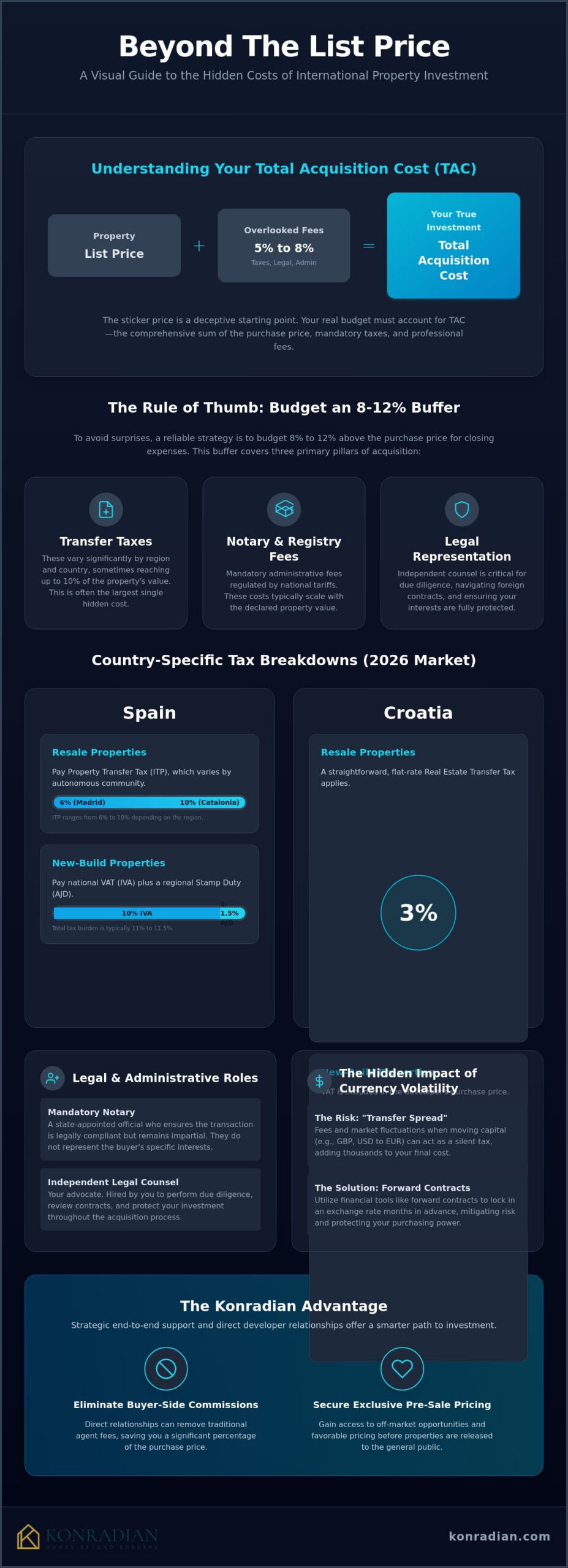
- Define your Total Acquisition Cost (TAC) to move beyond deceptive list prices and account for the 5-8% margin often overlooked by international investors.
- Identify the specific regional tax nuances, from Spain’s ITP variations to Croatia’s 3% transfer tax, to accurately assess the hidden costs buying property abroad.
- Distinguish the role of a mandatory notary from that of independent legal counsel to ensure your interests are protected throughout the transaction.
- Project long-term profitability by factoring in post-acquisition obligations, including non-resident income taxes and local communal fees.
- Discover how strategic end-to-end support and direct developer relationships can eliminate traditional buyer-side commissions and secure exclusive pre-sale pricing.
Understanding the Total Acquisition Cost: Why List Prices Are Deceptive
The price tag on a glossy property brochure is rarely the final figure on your settlement statement. It’s a marketing baseline; a point of entry that often obscures the genuine financial commitment required to secure an international asset. To invest with precision, you must look beyond the list price and define your Total Acquisition Cost (TAC). This metric represents the comprehensive sum of the purchase price, mandatory fiscal contributions, and the professional fees necessary to ensure a secure transfer of title. It’s the only number that truly matters for your balance sheet.
Sophisticated investors often find themselves underprepared for the 5-8% discrepancy between their initial budget and the final closing costs. This gap typically arises from a focus on the tangible asset rather than the intricate regulatory landscape of the host country. In the 2026 market, administrative burdens have evolved, shifting certain costs onto the buyer that were previously negotiable. While a property may appear to be a bargain in a high-tax jurisdiction, the associated hidden costs buying property abroad can significantly alter your projected return on investment if they aren’t calculated with intellectual rigor from the outset.
The 10% Rule of Thumb for International Real Estate
A reliable strategy for maintaining financial equilibrium is to budget between 8% and 12% above the purchase price for closing expenses. This range provides a necessary buffer for the primary pillars of acquisition:
- Transfer Taxes: These vary significantly by region, such as Spain’s ITP which can reach 10% in certain autonomous communities.
- Notary and Registry Fees: These are often regulated by national tariffs and scale with the property value.
- Legal Representation: Independent counsel is essential for navigating foreign contracts and ensuring your interests are protected.
New-build properties often demand a higher budget due to Value Added Tax (VAT) requirements, whereas resale properties may benefit from lower transfer tax rates depending on the specific location.
The Hidden Impact of Currency Volatility
The cost of your investment is never static until the final payment is cleared. When moving capital between currencies like GBP, USD, and EUR, the “transfer spread” charged by traditional banks can act as a silent tax on your capital. These conversion fees, combined with market fluctuations, can add thousands to your hidden costs buying property abroad within a matter of days. To mitigate this risk, seasoned investors utilize forward contracts to lock in exchange rates months in advance. Timing your payment with professional guidance ensures that currency volatility doesn’t erode your purchasing power at the eleventh hour.
Country-Specific Tax Breakdowns: Spain, Croatia, and the USA
The 10% rule of thumb mentioned earlier takes on a more nuanced shape when we examine specific borders. Each jurisdiction operates with its own fiscal logic, often surprising investors who assume a uniform global standard. In 2026, the delta between a profitable acquisition and a financial burden lies in your ability to navigate these local levies with precision. These hidden costs buying property abroad are not merely administrative hurdles; they are fundamental components of your capital allocation strategy.
Spain: The Fiscal Landscape for Expats
Spain’s tax system is notably decentralized, meaning your liability shifts depending on the autonomous community. For resale properties, the Property Transfer Tax (ITP) ranges from 6% in Madrid to 10% in regions like Catalonia and the Valencian Community. If you are purchasing a new-build, you will instead pay a national Value Added Tax (IVA) of 10%, plus a regional Stamp Duty (AJD) that typically sits between 1% and 1.5%. These distinctions are vital for accurate budgeting. For a deeper dive into these regional nuances, consult The Comprehensive Guide to Spanish Property Acquisition.
Croatia: Coastal Investment Realities
The Croatian market offers a straightforward but firm tax structure. As of 2026, the Real Estate Transfer Tax is a flat 3% of the market value for resale properties. However, new-builds purchased from developers include a 25% VAT within the purchase price, which exempts the buyer from the 3% transfer tax. Beyond the tax itself, you must factor in the administrative costs of acquiring an OIB (Personal Identification Number), which is a prerequisite for any transaction. You can explore specific regional fee structures in our guide to Istria Real Estate for Sale.
In the United States, the focus shifts toward closing costs and federal compliance. While foreign nationals face no restrictions on ownership, the Foreign Investment in Real Property Tax Act (FIRPTA) requires a 15% withholding of the gross sale price when you eventually sell. This acts as a prepayment of capital gains tax and must be factored into your exit strategy from day one; to optimize this stage, you might explore Residential Listing Services that leverage professional presentation to boost ROI. Meanwhile, in Hungary, the standard property acquisition duty remains 4%, though certain exemptions for first-time buyers or specific development zones can provide relief if navigated correctly.
Understanding these variables ensures that your hidden costs buying property abroad are accounted for well before you reach the notary’s office. If you are considering a move into these markets, our team provides the strategic financial oversight necessary to ensure every decimal point aligns with your long-term goals.
Legal and Administrative “Gotchas” You Cannot Ignore
Beyond the fiscal levies discussed previously, the administrative machinery of a foreign country introduces its own set of financial requirements. These procedural expenses are often overlooked because they feel secondary to the asset, yet they’re the gatekeepers of a successful title transfer. Many investors mistake mandatory officials for personal advocates, a nuance that can lead to significant oversights during the closing process. Precision in these administrative steps is what separates a secure acquisition from a legal entanglement.
A notary is not your lawyer. This distinction is critical for any international transaction. While their presence is mandatory to witness the signing of the public deed, their primary duty is to the state and the law, not to your personal investment strategy. They verify identities and ensure the document’s form is correct, but they won’t warn you about a disadvantageous clause. This is why independent legal representation is essential. Budgeting approximately 1% of the purchase price for your own solicitor ensures that someone is looking out for your interests alone. These professional fees are part of the hidden costs buying property abroad that act as a necessary insurance policy for your capital.
Securing your title also involves Land Registry fees and the often-underestimated cost of “foreigner paperwork.” To complete a sale, most jurisdictions require sworn translations of your home-country documents and international apostilles to verify their authenticity. These individual fees are small, but they accumulate quickly when multiple documents require certification. When combined with registry costs, which scale based on the property value, these administrative line items can add several thousand euros or dollars to your final settlement statement.
Mandatory Identification and Resident Numbers
You can’t buy property without a local tax identity. In Spain, obtaining the NIE (Número de Identidad de Extranjero) is your first hurdle; it involves modest government fees but can take weeks of processing time. Similarly, Croatia requires an OIB (Personal Identification Number) before you can even open a local bank account to transfer funds. For those investing in the United States, an EIN or ITIN is often required for tax compliance. Handling these applications through a representative involves administrative costs that must be factored into your early-stage budget.
The Importance of a Security Audit
A property’s history can hold financial liabilities that don’t appear on a standard listing. A comprehensive security audit is required to check for “hidden” debts such as tax liens, unpaid utility bills, or community fee arrears that, in many countries, attach to the property rather than the previous owner. You must also verify that all building permits are in order and that a certificate of habitability exists. Utilizing professional legal support buying property abroad mitigates these risks by conducting thorough due diligence before any funds are committed. This proactive stewardship ensures that the hidden costs buying property abroad don’t include someone else’s old debts.
Post-Acquisition: The Costs of Owning Abroad
Handing over the keys is a milestone, but it doesn’t signal the end of your financial commitment. True investment transparency requires a long-term view of the fiscal and operational burdens that follow the purchase. These ongoing obligations are often the real hidden costs buying property abroad, as they persist long after the initial transaction fees have been settled. Maintaining a property across borders demands a proactive approach to annual taxation and local maintenance to preserve the asset’s value and your peace of mind.
Ownership brings a shift from acquisition taxes to holding taxes. While the initial percentages are a one-time hurdle, annual levies can erode your net yield if they aren’t factored into your original ROI calculations. In 2026, many jurisdictions have tightened their reporting requirements for foreign owners, making professional fiscal representation a necessity rather than a luxury. This ensures you remain compliant with local laws while optimizing your global tax position.
Annual Fiscal Responsibilities for Non-Residents
In Spain, non-residents are subject to the Impuesto sobre la Renta de No Residentes (IRNR). Even if you don’t rent out the property, you’re taxed on “deemed rental income.” This is a unique fiscal concept where the state assumes a financial benefit from your second home, calculated as a percentage of the property’s cadastral value. Similarly, you’ll encounter the Impuesto sobre Bienes Inmuebles (IBI), which is the local property tax paid to the town hall. In Croatia, communal fees and water management taxes fulfill a similar role, funding the local infrastructure that supports your investment.
Wealth taxes represent a more complex tier of ownership cost. In certain Spanish regions or specific US jurisdictions, high-value assets may trigger additional annual levies based on the total value of your holdings. Structuring your ownership through a legal entity or a specific trust can often minimize these liabilities, but this requires strategic foresight during the acquisition phase. Failing to plan for these hidden costs buying property abroad can lead to unexpected annual outlays that disrupt your cash flow.
Utility Connections and Community Fees
Don’t overlook the immediate costs of making a property functional. Connection fees for high-speed fiber, electricity, and water can be surprisingly high for new developments that require first-time meter installations. If you’ve invested in a Spanish apartment complex, you’ll be part of the “Comunidad de Propietarios.” These monthly fees cover shared amenities like pools, gardens, and security. They’re mandatory and vary significantly based on the level of luxury provided. Insurance is another variable; coastal properties or high-value estates require bespoke coverage that accounts for specific environmental risks.
Budgeting for these post-acquisition realities ensures your investment remains a source of tranquility rather than stress. To ensure your purchase is structured for long-term fiscal efficiency, explore our Legal and Financial Transaction Support for expert oversight from day one.
The Konradian Advantage: Eliminating Buyer-Side Commissions
The financial landscape of international real estate often feels like a series of mounting obligations. As we have explored, the hidden costs buying property abroad can quickly accumulate through taxes, legal fees, and administrative levies. However, the largest variable in your acquisition budget is often the agent’s commission. While many international sourcing firms charge the buyer an additional 3% fee for their services, our model is designed to protect your capital. In most of our primary markets, including Spain, Croatia, Hungary, and the USA, our comprehensive end-to-end support is provided at no cost to the buyer.
Our firm operates on a sophisticated brokerage and partnership model where our compensation is typically covered by the seller or developer. This ensures that your investment capital remains focused on the asset rather than being diluted by secondary service fees. We act as a protective partner, handling the heavy lifting of the transaction. This includes the logistical coordination of obtaining your NIE in Spain or OIB in Croatia, as well as facilitating the opening of local bank accounts. By removing these administrative friction points, we provide a seamless path to ownership that maintains total price transparency.
Free Consultations and Strategic Selection
Our approach combines the intellectual rigor of a strategic consultancy with the personalized care of a dedicated concierge. Every engagement begins with a deep analysis of market ROI, led by LSE-educated experts who understand global economic shifts. We prioritize a methodical selection process, often starting with a comprehensive video consultation to refine your criteria before you ever board a flight. This deliberate pace ensures that when you do visit a location, every property on the itinerary has been vetted for its financial viability and legal integrity. For those looking specifically at the UK market, we offer a dedicated sourcing service where fees are clearly defined and agreed upon at the outset, ensuring no surprises at the closing table.
When you reach the stage of an in-person inspection, choosing a base that reflects the quality of the market is essential. For investors investigating urban opportunities in Central America, staying at a centrally located luxury venue like Hotel Castillo in San José provides the necessary comfort and proximity to conduct thorough on-site due diligence.
Accessing Exclusive Pre-Sale Inventory
Our deep-rooted relationships with leading developers provide our clients with a distinct market edge. By securing access to pre-sale inventory, we enable you to lock in prices before they are released to the general public. This is particularly advantageous in high-growth corridors like Malaga or the Istrian coast, where off-plan purchases can offer significant capital appreciation. Because our commissions are handled by the developer, we maintain a position of neutrality, focusing solely on the strategic value of the development for your portfolio. This model effectively eliminates one of the most significant hidden costs buying property abroad while providing you with premium market positioning. To begin your journey with a clear financial roadmap, contact us for a tailored real estate buyer consultation.
Achieving Total Financial Clarity in Your Next Acquisition
Navigating the international real estate market requires more than just capital; it demands intellectual rigor. You now understand that the true cost of an asset includes a complex layer of regional taxes, administrative gatekeepers, and ongoing fiscal obligations. By accounting for these hidden costs buying property abroad from the very first calculation, you transform a high-stakes transaction into a controlled, strategic investment. This level of foresight is what ensures your capital remains protected across borders and your ROI remains intact.
Our team brings over five years of international expertise and the strategic oversight of LSE-educated advisors to every partnership. We provide the end-to-end stewardship necessary to navigate these complexities, offering you direct developer access and exclusive pre-sale opportunities that aren’t available to the general public. Your path to a secure, profitable global portfolio is built on transparency and professional precision. Book a Free Video Consultation with our International Property Experts today to begin your journey with absolute confidence.
Frequently Asked Questions
What is the most expensive hidden cost when buying property abroad?
The most significant financial burden beyond the purchase price is almost always the property transfer tax or Value Added Tax (VAT). In jurisdictions like Spain, the Property Transfer Tax can reach 10% depending on the region, while Croatia applies a flat 3% rate. These levies represent the largest portion of the hidden costs buying property abroad, often requiring a substantial capital allocation that many first-time international investors fail to anticipate during their initial budgeting phase.
Do I have to pay the real estate agent if I am the buyer?
Payment structures for real estate professionals vary significantly by border. In Croatia, it’s common for buyers to pay a commission of 2% to 3%, whereas in the United States, these fees have become highly negotiable following recent regulatory shifts. Many investors find peace of mind by working with a partner that eliminates buyer-side commissions through direct developer relationships, ensuring that your capital is directed toward the asset rather than administrative brokerage fees.
How much should I budget for legal fees in Spain vs. Croatia?
You should generally allocate approximately 1% of the purchase price for independent legal representation in both Spain and Croatia. While this is a professional expense, it’s a necessary safeguard for your investment. In Croatia, you must also factor in an additional 25% VAT on top of the legal fee. This ensures that your contracts are vetted and your title is secured by a professional who is solely dedicated to your interests.
Are there taxes for non-residents who do not rent out their property?
Yes, several countries impose taxes on non-residents even if the property remains for personal use only. Spain, for example, utilizes the IRNR system to tax “deemed rental income,” which is a fiscal calculation based on the property’s cadastral value. These annual obligations are part of the hidden costs buying property abroad that must be factored into your long-term ownership strategy to avoid unexpected liabilities or interest penalties from local tax authorities.
What is the FIRPTA tax in the USA and does it affect me?
The Foreign Investment in Real Property Tax Act (FIRPTA) requires a 15% withholding of the gross sale price when a non-resident sells a US property. This isn’t an additional tax, but rather a prepayment of capital gains tax sent directly to the IRS. While it primarily affects you at the point of exit, it’s a critical liquidity factor that sophisticated investors must understand before they even commit to an initial purchase.
Can I buy a property abroad remotely without paying extra fees?
Remote acquisition is entirely possible through a Power of Attorney (POA), though it does involve specific administrative expenses. You’ll need to account for notary fees and the cost of apostilles to verify your signature in your home country. While these aren’t “extra” fees in the sense of a penalty, they are necessary procedural costs. Digital tools and video consultations now allow for a seamless selection process without the need for multiple international flights.
Is it cheaper to buy property through a company or as an individual?
The decision to purchase as an individual or through a legal entity depends on your long-term fiscal goals and the specific wealth tax laws of the host country. Holding property through a company can sometimes offer advantages for inheritance planning or liability protection, but it often comes with higher annual maintenance costs and corporate tax filings. We recommend a strategic analysis of your global portfolio to determine which structure offers the most efficient path for your capital.
What happens if the exchange rate changes between the deposit and completion?
Currency fluctuations can significantly alter your final acquisition cost if you’re transferring funds from a different base currency. If the exchange rate shifts unfavorably between the deposit and completion, you may find yourself needing more capital than originally planned. To mitigate this risk, many seasoned investors use forward contracts to lock in a specific rate. This proactive strategy provides price certainty and protects your budget from the volatility of the global currency markets.
