


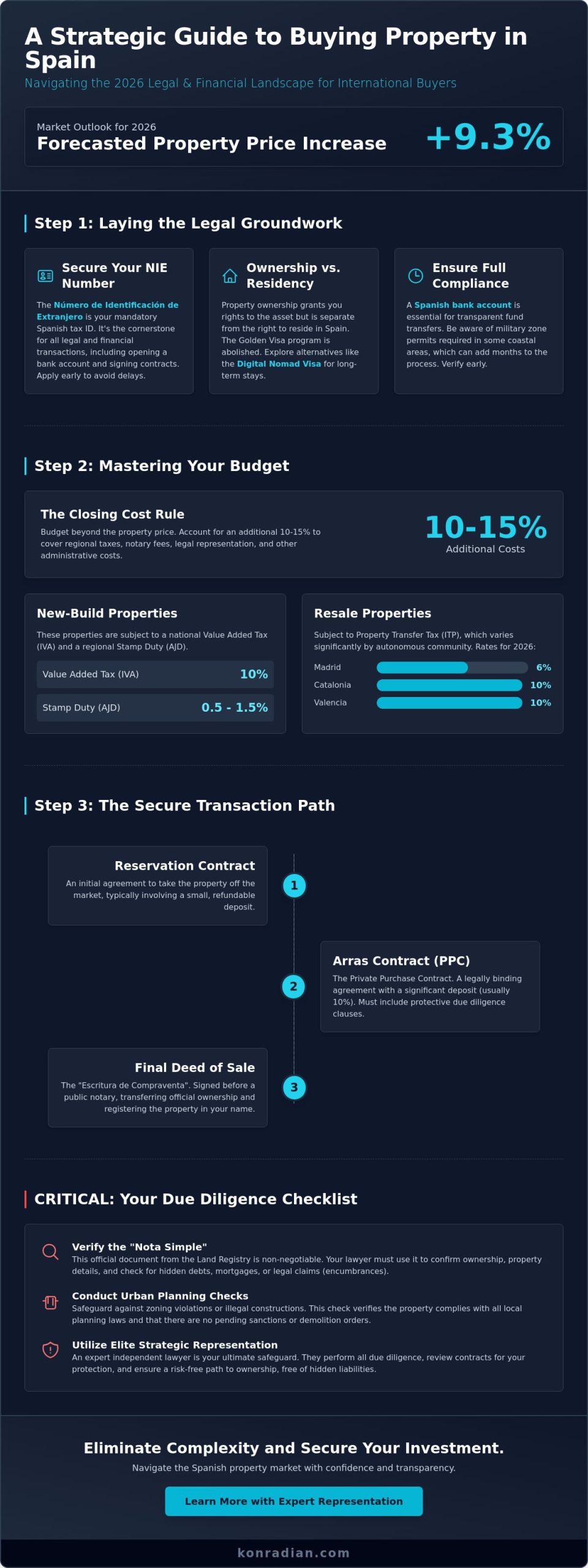
With Spanish property prices forecasted to rise by 9.3% in 2026, the financial stakes for international buyers have reached a new peak. While the opportunity for appreciation is significant, the complexity of the acquisition process often creates a sense of hesitation. You’re likely concerned about the nuances of regional tax variations or the implications of the abolished Golden Visa program. Understanding how to buy property in Spain legally is no longer just about following a checklist; it’s about executing a precise strategy that prioritizes transparency and long-term security.
We recognize that high-stakes transactions require more than just paperwork; they demand a sophisticated level of professional stewardship. In this guide, we promise to clarify the legal intricacies of the Spanish market, from the initial reservation fee to the final signing before a notary. You’ll gain a clear roadmap that includes predictable closing costs and a risk-free path to ownership. We will explore the specific 2026 tax rates across regions like Andalusia and Catalonia, the mandatory role of the NIE, and the essential due diligence your lawyer must perform to ensure your new Mediterranean sanctuary is free of hidden liabilities.
Key Takeaways
- Budget effectively for your acquisition by accounting for the 10-15% closing cost rule, which encompasses regional tax variations and administrative fees.
- Establish your Spanish tax identity early with a NIE to ensure a seamless transition from initial interest to official legal ownership.
- Learn how to buy property in Spain legally by navigating the essential phases of the Reservation and Arras contracts with protective due diligence clauses.
- Verify the legal integrity of any asset using the “Nota Simple” and urban planning checks to safeguard against hidden encumbrances or zoning issues.
- Utilize elite strategic representation and direct developer transparency to eliminate the complexities of the secondary market and secure a premium investment.
Legal Prerequisites for International Buyers in 2026
The path to Spanish property ownership in 2026 requires administrative precision. While the Mediterranean lifestyle is the ultimate goal, the entry point is a series of legal formalities that ensure your investment is protected. Understanding how to buy property in Spain legally involves mastering the prerequisites that separate a casual viewer from a serious investor. With property prices expected to rise by 9.3% this year, acting with a clear, strategic roadmap is more important than ever to secure your position in a competitive market.
The NIE: Your Digital Key to Spanish Real Estate
The NIE (Número de Identificación de Extranjero) is the cornerstone of your transaction. You can’t sign a reservation contract, open a bank account, or pay taxes without this number. The NIE serves as a permanent administrative identifier for all financial transactions and legal procedures within the Spanish territory. You can apply through the Spanish Consulate in your home country or at a local police station once you arrive in Spain. It’s a straightforward process, but it requires meticulous documentation to avoid delays in your acquisition timeline. We recommend securing this early to ensure you’re ready to act when the right opportunity appears.
Residency vs. Ownership: Managing Expectations
It’s vital to distinguish between the right to own land and the right to reside in the country. Following the abolishment of the Golden Visa program in April 2025, purchasing real estate no longer provides a direct route to residency. Ownership itself is governed by the fundamental principles of property law, which grant you full rights to use and enjoy your asset regardless of your nationality. However, if you intend to spend more than 90 days out of every 180 in Spain, you’ll need to explore alternative pathways like the Digital Nomad Visa or the Non-Lucrative Visa. Your tax residency status is also separate from your physical residency, a distinction that carries significant financial implications.
Financial and Regulatory Compliance in 2026
A Spanish bank account is a practical necessity for a transparent transfer of funds. It ensures that all payments, from the initial deposit to utility bills, are documented and compliant with anti-money laundering regulations. Additionally, non-EU buyers must still navigate military zone permits in specific regions. While many urban areas are exempt, certain coastal regions and islands require a permit from the Ministry of Defence before a sale can be finalized. This process can add several months to the closing period, so early verification is essential. By handling these requirements proactively, you build a stable foundation for a secure and transparent acquisition.
Navigating the Financial Landscape: Taxes, Fees, and Compliance
Mastering the financial architecture of your acquisition is just as critical as selecting the right location. When determining how to buy property in Spain legally, you must look beyond the sticker price and account for the 10-15% closing cost rule. This margin covers a range of regional taxes, administrative fees, and legal protections that ensure your title is unassailable. While generic guides often suggest a flat 10% budget, the reality of the 2026 landscape requires a more nuanced calculation. Consulting official guidance for foreign buyers provides a baseline, but local regional variations remain the primary driver of your final expenditure.
New-Build vs. Resale: A Fiscal Comparison
The fiscal path diverges significantly depending on the property’s history. New developments attract a national Value Added Tax (IVA) of 10%, supplemented by a regional Stamp Duty (AJD) that ranges from 0.5% to 1.5%. Conversely, resale properties are subject to the Property Transfer Tax (ITP), which is determined by the autonomous community where the asset is located. As of June 2026, these rates vary from 6% in Madrid to 10% in Catalonia and Valencia, representing a significant difference in your total outlay. For a comprehensive breakdown of how these taxes when buying property in Spain apply across different regions and property types, our dedicated fiscal guide provides the percentage-based clarity you need to budget with confidence.
| Region | Tax Type | Tax Rate (2026) | Tax Amount on €500,000 |
|---|---|---|---|
| Madrid | ITP (Resale) | 6% | €30,000 |
| Andalusia | ITP (Resale) | 7% | €35,000 |
| Catalonia | ITP (Resale) | 10% | €50,000 |
| National | IVA (New Build) | 10% + AJD | €50,000 + regional stamp duty |
Ongoing Costs of Spanish Property Ownership
Ownership brings a set of predictable recurring obligations that require careful budgeting. The Real Estate Tax (IBI) is a local council levy based on the property’s cadastral value, typically ranging from 0.4% to 1.1%. Additionally, the Non-Resident Income Tax (IRNR) is mandatory even if you don’t rent out the property. For non-EU residents, the 2026 rate stands at 24%, while EU/EEA residents benefit from a lower 19% rate. We believe that expert transaction support is the most effective way to navigate these costs while ensuring every euro is spent toward a secure and transparent title. Beyond taxes, you must also account for community fees for shared amenities and general maintenance to protect the long-term value of your investment.
Professional fees form the final layer of your initial investment. Notary fees are regulated by the state and typically range between €600 and €1,000, while Land Registry fees generally fall between €400 and €700. Legal representation, which is indispensable for conducting thorough due diligence, usually costs between 1% and 1.5% of the purchase price. By understanding these figures upfront, you eliminate the anxiety of hidden costs and move forward with the confidence of a sophisticated global investor.
The Three Pillars of a Secure Spanish Real Estate Transaction
Securing a property in Spain is a structured journey that transforms an initial interest into a legally binding reality. While many guides offer a simplified four-step overview, a sophisticated acquisition strategy requires a deeper understanding of the contractual milestones. Knowing how to buy property in Spain legally means recognizing that each phase is designed to protect your capital while providing the seller with the assurance of your intent. This methodical progression ensures that no funds are committed without the appropriate legal safeguards in place.
The process typically begins with a Reservation Contract (Documento de Reserva). This involves a modest payment, often between €3,000 and €6,000, to take the property off the market and freeze the price. It’s imperative that this document includes a “subject to due diligence” clause. Without this protection, your deposit could be at risk if legal encumbrances or zoning issues are discovered later. We ensure this initial step acts as a temporary safeguard, allowing our legal team to verify the asset’s integrity before you commit to a larger deposit.
The Arras Contract: Protecting Your Deposit
Once preliminary checks are complete, the parties sign the Arras Contract (Contrato de Arras). This is a formal private agreement where the buyer typically pays 10% of the purchase price. It’s vital to distinguish between confirmatory, penal, and penitential deposits, as each carries different legal weights. A penitential deposit allows withdrawal at the cost of the deposit amount. Under this common Spanish framework, if you walk away, you lose the 10%; however, if the seller withdraws, they must pay you double the amount. This balanced penalty system provides a high level of security and discourages “gazumping” in high-demand markets.
The Notary’s Role and the Final Deed
The finalization of the sale occurs at the office of a Public Notary (Notaría), where the Public Deed (Escritura de Compraventa) is signed. You must understand that the Notary is a neutral state official who authenticates the transaction rather than your personal legal advisor. They verify that the regional taxes are settled and the identities of both parties are correct, but they don’t conduct the exhaustive due diligence your lawyer provides. During the signing, the Notary will read the deed aloud, and the final payment is typically made via a guaranteed bank draft.
After the signing, the deed must be presented to the Land Registry (Registro de la Propiedad). This final step is what officially transfers the legal title and protects you against any future third-party claims. Once the registry processes the filing, you’ll receive an updated “Nota Simple” that confirms you as the sole owner. By following this start-to-finish oversight, you ensure that how to buy property in Spain legally is a question answered by a risk-free, transparent path to ownership.
Due Diligence: Protecting Your Investment from Legal Pitfalls
Due diligence is the intellectual rigor that separates a successful acquisition from a costly legal entanglement. While the emotional appeal of a Mediterranean villa is undeniable, your priority must remain the verification of the property’s legal pedigree. The most critical tool in this phase is the “Nota Simple”, an official extract from the Land Registry that provides a transparent snapshot of the property’s status. It identifies the current owner, the exact boundaries, and any existing encumbrances, such as mortgages or judicial seizures. Mastering how to buy property in Spain legally requires you to look beyond the aesthetic and scrutinize these administrative foundations.
Key documents to verify during this phase include:
- The Nota Simple for title and lien verification.
- The IBI (Property Tax) receipts for the last four years to ensure no outstanding local debt.
- The Energy Efficiency Certificate (CEE), which is mandatory for all 2026 transactions.
- The Cédula de Habitabilidad to guarantee the property meets occupancy standards and utility access.
Uncovering Hidden Liens and Debts
In Spain, financial liabilities are often attached to the property rather than the individual owner. This means that if you acquire a home with outstanding local property taxes or unpaid community fees, you become responsible for those debts. We prevent this by demanding a “Certificado de Deudas” signed by the administrator of the community of owners. This document confirms that all communal obligations are settled up to the date of sale. Additionally, we verify that utility bills are cleared and that the “Cédula de Habitabilidad” is valid. Without this certificate, you’ll find it impossible to contract basic services like water and electricity in your own name.
Zoning Scrutiny and the Coastal Law
Properties located in rural areas or near the shoreline require an even higher level of strategic oversight. Rural land, or “suelo rústico”, often carries strict limitations on construction; many country homes were built without the necessary municipal permits, a risk amplified by the current housing shortfall of 600,000 properties. Similarly, the Spanish Coastal Law (Ley de Costas) establishes a “Servidumbre de Protección” zone. If a property falls within this area, your rights to modify or even maintain the structure may be severely restricted by the state. You can find more detail on these specific regional challenges in our guide to Spanish Property Acquisition.
Our role is to act as your protective partner, handling the heavy lifting of urban planning checks and administrative verification. We ensure that your investment isn’t just beautiful, but also compliant with all regional and national regulations. If you’re ready to secure a property with absolute peace of mind, our tailored legal support provides the security you need in a complex market. By addressing these potential pitfalls before the Arras contract is signed, you protect your capital and ensure a seamless transition to ownership.
Strategic Acquisition: Why Expert Representation is the Ultimate Safeguard
Mastering the mechanics of how to buy property in Spain legally is a fundamental requirement, yet true investment success is found in the strategic “where” and “when.” In a market where property prices are expected to rise by 9.3% in 2026, simply following the law isn’t enough to secure a premium asset. The Konradian philosophy combines LSE-educated strategic rigor with deep local market fluency to transform a complex legal process into a seamless acquisition. We act as a protective partner, ensuring that your capital is deployed with precision and your interests are defended at every turn.
Our end-to-end service model is designed for the sophisticated global citizen who values both intellectual authority and personalized care. We manage the entire lifecycle of the transaction, moving methodically from an initial consultation to the final delivery of keys. This comprehensive oversight eliminates the fragmentation often found in international real estate, providing a single point of accountability for your legal, financial, and lifestyle requirements.
Developer Direct: The Safest Path to New-Builds
The secondary market in Spain often involves layers of intermediaries that can obscure transparency and increase risk. We prioritize direct developer relationships to eliminate these “middle-man” complexities. This direct access allows us to verify the validity of building licenses and the financial health of the developer before any commitment is made. For those looking for the most secure entry point, we provide a selection of houses for sale in spain that have passed our rigorous internal vetting process.
When engaging in off-plan acquisitions, legal security starts at the source. We ensure that every stage payment is protected by a mandatory bank guarantee, providing a fail-safe for your investment during the construction phase. For investors seeking to maximize returns by locking in early-access pricing, our comprehensive guide to Spanish developer pre-sale property details the precise mechanics, buyer protections, and tiered pricing strategies available in 2026. This proactive approach to risk management is essential in a landscape where the housing deficit exceeds 600,000 properties, making high-quality, legally sound new-builds a rare and valuable commodity.
A Sophisticated Approach to International Wealth
We understand that our clients expect a level of service that mirrors their global lifestyle. Our international mindset bridges the gap between local Spanish administrative requirements and the high expectations of global investors. We handle the heavy lifting of the 2026 tax landscape and regional variations, allowing you to focus on the aspirational benefits of your new Mediterranean sanctuary. This concierge-style brokerage ensures that you’re never just another transaction; you’re a partner receiving dedicated, high-level stewardship.
Security in the Spanish market isn’t just about reactive paperwork; it’s about proactive strategy. If you’re ready to master the intricacies of this market with a trusted advisor by your side, we invite you to take the first step toward a secure acquisition. Schedule your free video consultation with Konradian today and discover a more refined path to property ownership in Spain.
Securing Your Mediterranean Future with Strategic Precision
The 2026 Spanish property market offers exceptional opportunities for growth, provided your acquisition is anchored in legal transparency. By accounting for regional tax variations and executing rigorous due diligence on everything from zoning laws to hidden liens, you protect your capital from unforeseen liabilities. Mastering how to buy property in Spain legally requires a shift from reactive paperwork to a proactive, source-led strategy. This involves verifying titles via the Land Registry and securing bank guarantees for new-build developments to ensure your path to ownership is entirely risk-free.
At Konradian, we combine the intellectual rigor of LSE-educated strategic advisors with over five years of international brokerage excellence. Our direct developer access provides you with exclusive pre-sale security and a level of transparency that the middle-man market simply cannot match. We handle the administrative heavy lifting, from initial NIE applications to the final signing before a Public Notary, ensuring a seamless end-to-end experience. Begin your secure Spanish property journey with a free expert consultation. We look forward to helping you secure your sanctuary with absolute confidence.
Frequently Asked Questions
Can a foreigner buy property in Spain legally without residency?
Foreigners can absolutely buy property in Spain regardless of their residency status. There are no general restrictions on ownership for international buyers, whether they’re from the EU or elsewhere. However, you must obtain a NIE and open a local bank account to manage the transaction and subsequent tax obligations. This ensures you understand how to buy property in Spain legally while maintaining full compliance with national regulations.
How much are the total legal and tax fees when buying a house in Spain?
You should budget between 10% and 15% of the purchase price to cover all associated costs. This includes regional Transfer Tax (ITP) for resales, which ranges from 6% in Madrid to 10% in regions like Valencia. For new builds, you’ll pay 10% VAT plus Stamp Duty. Additional expenses include notary fees typically between €600 and €1,000, property registry fees of €400 to €700, and legal fees usually averaging 1% to 1.5% plus VAT. Our detailed guide to taxes when buying property in Spain provides a full breakdown of every acquisition cost and ongoing levy you should anticipate in 2026.
What is an NIE number and do I need it before making an offer?
The NIE is your mandatory foreigner identification number used for all administrative and tax purposes in Spain. While you don’t strictly need it to view a home, you’ll require it to sign a reservation contract, open a bank account, or pay any associated taxes. We recommend applying through a Spanish Consulate or local police station well in advance to avoid any delays when you’re ready to make a formal offer.
Is it safe to buy off-plan property in Spain in 2026?
Buying off-plan is secure in 2026 provided you verify that the developer has secured mandatory bank guarantees for every stage payment. These guarantees protect your capital if the project isn’t completed or the developer faces insolvency. Your legal representative must also confirm that the developer holds a valid building license and that the land is correctly registered in their name before any funds are transferred.
What happens if I sign an Arras contract and then change my mind?
If you withdraw from a penitential Arras contract after signing, you’ll typically forfeit your entire 10% deposit. This contract is a binding commitment that provides security to both parties. Conversely, if the seller decides to withdraw, they’re legally required to pay you double the deposit amount as compensation. This balanced penalty system is designed to discourage last-minute cancellations in a competitive market.
What is the “Nota Simple” and why is it critical for legal security?
The “Nota Simple” is an official extract from the Land Registry that confirms the legal status of a property. It’s critical for security because it identifies the true owner and lists any outstanding mortgages, liens, or judicial encumbrances attached to the asset. Obtaining a fresh copy, usually dated within the last 24 hours, is a non-negotiable step in the due diligence process to ensure you’re acquiring a “clean” title.
Are there any restrictions on non-EU citizens buying property in Spain?
There are no general restrictions on non-EU citizens, though certain strategic locations may require a military permit. This regulation applies to specific coastal areas and islands where the Ministry of Defence must approve the sale to a non-EU national. While this is a standard administrative procedure, it can add several months to the closing timeline, so it’s essential to verify if your chosen property falls within a restricted zone early on.
Does buying a property in Spain automatically give me a visa?
No, property ownership doesn’t grant an automatic visa or residency rights as of 2026. The Golden Visa program was officially abolished in April 2025, removing the direct link between real estate investment and residency. If you intend to stay in Spain for longer than 90 days in any 180-day period, you must apply for a separate visa, such as the Non-Lucrative Visa or the Digital Nomad Visa.
