


The rumor of a 100% tax on non-EU property buyers has sent ripples of concern through the international investment community, yet the reality of the 2026 market is far more nuanced and strategic. You’ve likely felt the weight of these headlines, coupled with the genuine complexity of navigating regional variations and the various taxes when buying property in Spain. It’s natural to seek clarity when the fiscal goalposts seem to shift between the high-rises of Madrid and the villas of the Mediterranean. This guide will empower you to master the fiscal landscape of the Spanish real estate market through a comprehensive breakdown of acquisition taxes, residency levies, and ongoing ownership costs.
We’ll provide the clear, percentage-based budget you need to move forward with absolute confidence. We’ll explore the critical differences between new-build VAT and resale transfer taxes, while explaining why the stalled 100% tax proposal shouldn’t derail your investment strategy. From the specific tax reductions taking effect in the Valencian Community on June 1, 2026, to the national “Solidarity Tax” thresholds, you’ll gain the intellectual authority to transform regulatory complexity into a seamless and secure acquisition experience.
Key Takeaways
- Apply the “10-15% Rule” as a strategic benchmark to budget for the total cost of acquisition, including government levies and mandatory professional fees.
- Navigate the primary taxes when buying property in Spain by identifying whether your investment follows the IVA path for new-builds or the regional ITP structure for resales.
- Gain clarity on the 2026 regulatory environment, specifically debunking the 100% tax proposal for non-EU residents with verified legal analysis.
- Prepare for sustainable ownership by incorporating annual obligations like IBI and Non-Resident Income Tax (IRNR) into your long-term financial strategy.
- Secure your transaction through professional coordination that handles the complexity of regional tax variations and ensures complete fiscal compliance.
Budgeting for Acquisition: The Total Cost of Property in Spain
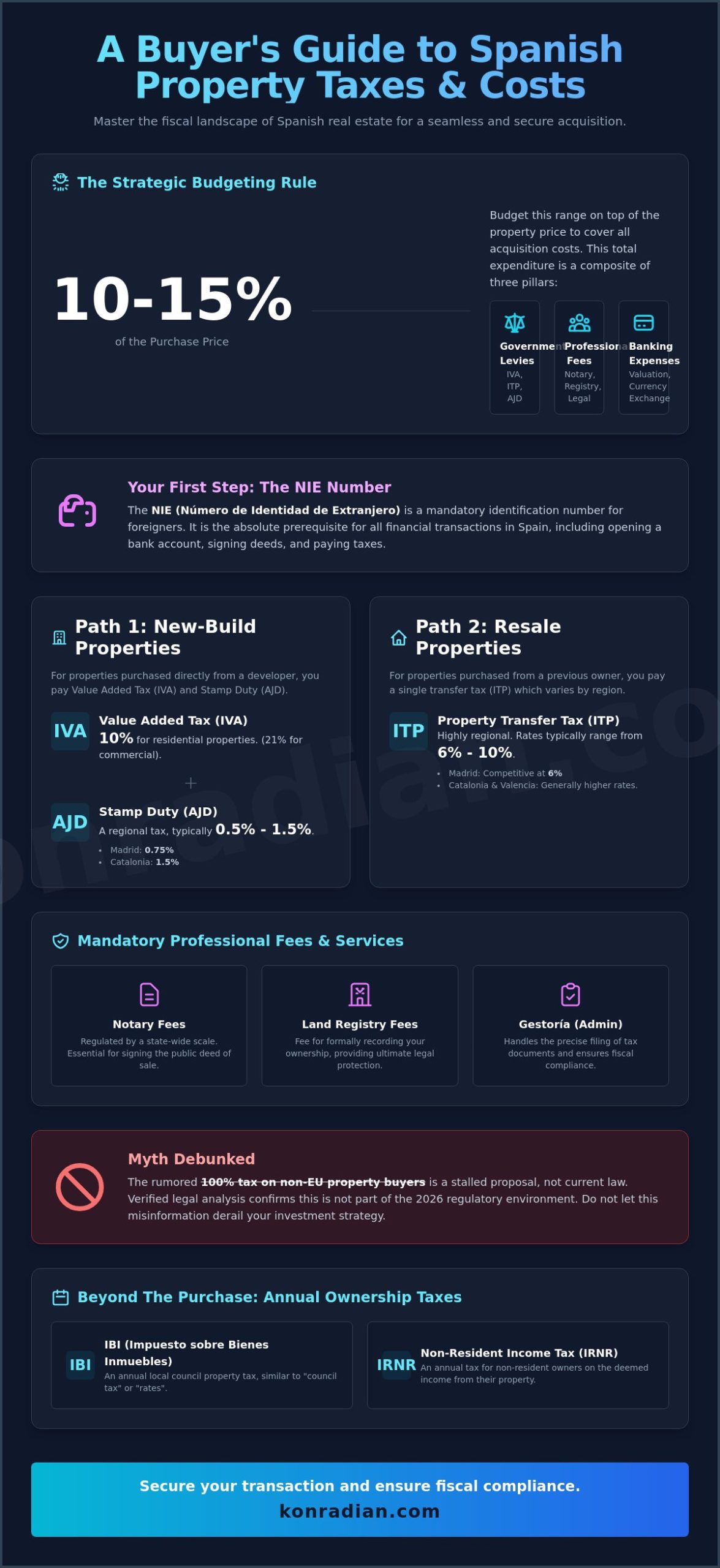
A successful acquisition begins with a clear financial map. While historical data often suggests budgeting 8% to 13% of the purchase price, the 2026 strategic standard has shifted to a more conservative 10% to 15% range. This buffer accounts for the intricate layers of taxes when buying property in Spain, alongside essential professional services and administrative costs. This total expenditure isn’t a flat rate; it’s a composite of three distinct pillars: government levies, mandatory professional fees, and banking expenses. Each component plays a vital role in securing your investment and ensuring long-term peace of mind.
Spain operates with significant regional autonomy, meaning your final budget depends heavily on where you choose to invest. For a deeper look at the broader fiscal framework, a Spanish Tax System Overview reveals how these regional powers influence everything from transfer taxes to wealth levies. For instance, the Valencian Community is implementing tax reductions effective June 1, 2026, which may lower the entry cost for savvy investors in that region. Before any of these payments can be processed, you must obtain your NIE (Número de Identidad de Extranjero). This identification number is the prerequisite for all financial transactions in Spain; it’s the key that unlocks your ability to sign deeds and settle your fiscal obligations.
Mandatory Professional Fees Beyond Taxes
Beyond the headline tax figures, several mandatory services ensure your investment is legally sound. Notary fees are regulated by a state-wide scale, though the final cost reflects the property’s value and the complexity of the public deed. Once signed, the Land Registry (Registro de la Propiedad) charges a fee to formally record your ownership, providing the ultimate legal protection for your title. Most international investors also engage a gestoría. These administrative specialists handle the precise filing of tax documents, ensuring you remain in full compliance with local authorities and avoiding the stress of missed deadlines or incorrect declarations.
The Impact of Financing on Your Tax Budget
If you’re securing a mortgage, your budget must accommodate additional lender-mandated steps. A formal property valuation, or tasación, is required by law to determine the loan-to-value ratio. A significant benefit for modern buyers is that the AJD (Stamp Duty) on mortgage deeds is now primarily the responsibility of the bank, not the borrower. However, non-Euro investors should remain mindful of currency exchange volatility. The cost of transferring significant capital into Euros can fluctuate; it’s a variable that requires proactive management to avoid unexpected budget gaps at the moment of closing.
Transactional Taxes: New-Build IVA vs. Resale ITP
Choosing between a sleek new-build and a charming resale villa involves more than just architectural preference; it dictates the fundamental structure of the taxes when buying property in Spain. For new properties, you’ll navigate the Value Added Tax (IVA) system, while resale properties fall under the Property Transfer Tax (ITP) regime. Understanding this fork in the road is essential for precise financial planning. While residential IVA is generally 10%, commercial property IVA is 21%, a distinction that significantly impacts mixed-use or office investments. This distinction ensures that your tax strategy aligns with your asset type from the very first day of the search.
Buying New: IVA and AJD Explained
New-build acquisitions carry a standard 10% IVA in 2026. This national tax is paired with the Stamp Duty (AJD), a regional levy that typically ranges from 0.5% to 1.5% depending on the autonomous community. For example, investors in Madrid benefit from a lower 0.75% AJD, while those in Catalonia face 1.5%. Because AJD applies only to new-build transactions, these properties often carry a higher total tax-and-fee burden than resales. It’s a premium often justified by the security of first-time occupancy and modern construction standards. We ensure our clients understand these cumulative costs early in the process to prevent any surprises at the notary. Investors seeking to minimize this premium while still accessing new construction should explore how a Spanish developer pre-sale property allows you to lock in early-access pricing before the broader market reacts.
Buying Resale: The Regional ITP Scale
Resale properties offer a different fiscal profile defined by regional ITP rates. Madrid remains highly competitive at 6%, while Catalonia and the Valencian Community maintain rates at 10%, though the latter is introducing specific reductions for certain buyers in mid-2026. ITP is a regional tax on the transfer of used assets that must be paid within 30 days. A critical factor in this calculation is the Reference Value (Valor de Referencia). This is the minimum taxable base set by the Cadastre; if your purchase price is lower, the authorities will likely tax you on this higher “market” value. This prevents under-valuation but requires investors to be proactive to avoid unexpected tax assessments after the sale.
As discussed in the 2026 Regulatory Shift for Foreign Buyers, these regional nuances are becoming increasingly central to investment strategy. Securing your transaction through expert property acquisition support ensures you don’t overpay due to regional valuation discrepancies. This professional stewardship provides the peace of mind that your investment remains both compliant and financially optimized.
The 2026 Regulatory Shift: Taxes for Non-EU and Non-Resident Buyers
Sensationalist media reports have recently highlighted a draft proposal for a 100% property purchase tax targeting non-EU, non-resident buyers. It’s essential to view these headlines with professional detachment. As of June 2026, this proposal remains a stalled bill that hasn’t been debated in the Spanish parliament. Given the current minority government and the potential for significant legal challenges, experts consider its passage in its current form highly improbable. However, the existence of such a proposal signals a shifting political focus toward foreign investment. Strategic investors must look beyond the noise and focus on the verified taxes when buying property in Spain that currently define the market.
Understanding your classification is the first step in fiscal optimization. There’s a sharp distinction between legal residency and tax residency. You become a tax resident only if you spend more than 183 days in Spain during a calendar year. For UK and US citizens, navigating this distinction has become more complex following the 2026 phase-out of the Golden Visa program. Without this streamlined residency path, investors must be more precise in how they structure their presence in Spain to avoid unintended tax liabilities. This categorization directly influences your Non-Resident Income Tax (IRNR) rates, which stand at 19% for EU/EEA residents and 24% for those from outside the bloc.
Non-Resident Income Tax (IRNR) at Acquisition
A critical technicality arises when you purchase a property from a seller who doesn’t reside in Spain. In these transactions, the buyer is legally obligated to withhold 3% of the purchase price, known as the retención. This amount must be paid directly to the Spanish Tax Agency within one month of the sale. This withholding acts as a guarantee against the seller’s potential capital gains tax. If you fail to withhold and pay this 3%, the tax authorities can hold you liable for the seller’s unpaid taxes, effectively making the property the guarantee for the debt. You can find a detailed breakdown of these obligations in this comprehensive guide to Spanish property taxes.
Strategic Considerations for Non-EU Investors
Strategic acquisition for non-EU investors involves leveraging bilateral tax treaties to prevent double taxation. For citizens of the US and UK, these treaties are vital; they ensure that taxes paid to the Spanish treasury can often be credited against tax liabilities in your home country. Structuring your purchase correctly from the start minimizes exposure to shifting non-resident levies and ensures long-term fiscal health. To understand the broader compliance landscape, we recommend reviewing our guide on How to Buy Property in Spain Legally: The 2026 Strategic Guide. This proactive approach allows you to move forward with the confidence that your investment is both legally secure and tax-efficient.
Beyond the Purchase: Annual Ownership Taxes and Fiscal Obligations
Securing the keys to your villa or apartment marks the successful conclusion of the acquisition phase, yet it initiates a new cycle of fiscal stewardship. While much of your early focus likely centered on the taxes when buying property in Spain, long-term success requires a clear understanding of the annual levies that sustain your ownership status. These recurring costs are manageable when anticipated with precision, ensuring that your lifestyle investment remains a source of tranquility rather than administrative stress. Each year, you’ll engage with both local and national authorities to settle these obligations.
IBI: The Local Property Tax
The Impuesto sobre Bienes Inmuebles, or IBI, is the Spanish equivalent of council tax or property tax. It’s a local levy collected by the municipality where your property is located. The calculation is based on the cadastral value (valor catastral), an administrative value assigned to the property that is typically lower than the market price. Annual costs vary significantly between urban centers and rural retreats, reflecting the local infrastructure and services provided. Before finalizing any purchase, it’s vital to verify that the previous owner has settled all IBI debts. Unpaid taxes attach to the property itself, meaning the new owner could inherit the liability if due diligence is overlooked. Most owners set up a standing order to ensure this tax is paid automatically, avoiding the risk of late payment penalties.
Imputed Income Tax for Non-Residents
A common surprise for international owners is the “Deemed Income” tax, a component of the Non-Resident Income Tax (IRNR). Even if your property sits empty for your exclusive personal use, the Spanish state views it as a source of potential benefit. You’re taxed on this “imputed income,” calculated as either 1.1% or 2% of the cadastral value, depending on when that value was last updated. This amount is then taxed at the standard non-resident rates of 19% for EU/EEA residents or 24% for those from the UK, US, and other non-EU nations. Filing Form 210 (Modelo 210) is the annual requirement to settle this obligation. If you choose to rent your property as a short-term holiday let, the tax structure shifts to a quarterly declaration of actual net income. Non-EU residents should be aware that they’re currently restricted from deducting property-related expenses, a factor that significantly impacts net yields.
For high-value acquisitions, the Wealth Tax and the national Solidarity Tax on Large Fortunes come into play. While the standard state threshold is €700,000, regional exemptions vary; for example, the Valencian Community increased its threshold to €1 million in 2026. Managing these overlapping layers of local and national obligations requires a proactive partner. You can ensure complete fiscal compliance and protect your long-term interests by engaging our legal and financial transaction support services. This end-to-end oversight allows you to enjoy the Spanish lifestyle while we handle the heavy lifting of your annual tax coordination.
Strategic Acquisition: Navigating Spanish Tax Law with Konradian
The intricate layers of taxes when buying property in Spain demand more than a cursory understanding; they require a high level of strategic foresight. Navigating regional autonomy and shifting national proposals can be a significant source of stress for the international investor. We recognize that your goal is to secure a premier asset with absolute fiscal clarity. Our approach to Spanish property acquisition is designed to transform this administrative complexity into a streamlined, professional experience. We handle the heavy lifting of fiscal coordination, ensuring that every detail, from the 3% non-resident withholding to the nuances of regional ITP scales, is managed with precision and care.
A central advantage of our service is the seller-paid commission model. This structure allows us to provide dedicated buyer-side advocacy at no extra cost to you. We act as your protective partner, prioritizing your long-term interests and emotional well-being without the conflicts of interest found in traditional brokerage. By positioning ourselves as your strategic advisor, we ensure that your investment is optimized from both a lifestyle and a financial perspective. We lead you through the process with the quiet confidence that comes from deep market experience and professional stewardship.
Expert Coordination and Pre-Sale Access
We don’t simply identify properties; we build the legal and financial bridge to successful ownership. This involves connecting our clients with a curated network of specialized Spanish tax lawyers and gestorías who share our commitment to elite expertise. These professionals ensure your filings are correct and your title is secure. Furthermore, our deep roots in the market provide the advantage of pre-sale access. This allows you to review prime listings and lock in prices before potential tax-base adjustments or regional rate changes occur. For investors looking to maximize this timing advantage, our dedicated guide on Spanish developer pre-sale property acquisitions in 2026 outlines the full mechanics of securing high-yield assets at early-access pricing. Konradian provides a seamless bridge between international investment goals and local Spanish tax compliance.
Your Global Partner for Secure Investment
Our LSE-educated team brings a level of intellectual rigor and global awareness that is essential for managing cross-border wealth. We’re uniquely positioned to advise on the specific taxes when buying property in Spain and how they interact with your broader financial strategy. This is a concierge-level property search that prioritizes your peace of mind above all else. You can explore the full breadth of our methodology and oversight in The Comprehensive Guide to Spanish Property Acquisition. We invite you to schedule a free consultation to discuss your Spanish property strategy and discover how we can facilitate a seamless transition into the Spanish market.
Securing Your Future in the Spanish Market
Mastering the 10-15% budgeting rule and the regional nuances of ITP and IVA ensures your acquisition rests on a solid financial foundation. By distinguishing between legal and tax residency, you can effectively navigate the 2026 regulatory shifts and protect your assets from unnecessary levies. Understanding the multifaceted nature of taxes when buying property in Spain is the final step in transforming a complex international transaction into a seamless success. It’s time to move from strategic research to tangible reality.
With over five years of international brokerage experience and a team of LSE-educated strategic advisors, we provide the intellectual authority required for such high-stakes investments. Our direct developer access offers you exclusive pre-sale opportunities that align perfectly with your long-term wealth goals. Secure your Spanish investment with a free expert consultation today. Your vision of a refined Mediterranean lifestyle is well within reach when supported by dedicated professional stewardship.
Frequently Asked Questions
Is it better to buy a new-build or a resale property in Spain for tax purposes?
Your choice depends largely on the region’s specific transfer tax rates. Resale properties usually attract a lower tax burden in areas like Madrid, where the ITP is just 6%. Conversely, new-builds require a flat 10% IVA plus a regional Stamp Duty (AJD) that can reach 1.5%. While new-builds offer modern standards, the cumulative taxes when buying property in Spain for these assets often exceed the costs of a resale transaction.
Do I need a Spanish bank account to pay property taxes?
Yes, maintaining a local Spanish bank account is essential for seamless fiscal management. While your legal representative might handle the initial transactional taxes from their escrow account, recurring obligations like IBI and non-resident income tax are best managed via direct debit. This setup ensures you don’t miss deadlines, which is critical since the Spanish tax authorities prioritize automated collection for annual ownership levies.
What is the “Reference Value” and how does it affect my ITP tax?
The Reference Value, or Valor de Referencia, acts as the minimum taxable base for your property as determined by the Cadastre. When calculating ITP, you’re required to pay tax on whichever is higher: the actual purchase price or this administrative value. It’s a measure introduced in 2022 to prevent tax base erosion. We always recommend checking this value before signing a contract to ensure your tax budget remains accurate.
Can I claim tax deductions on my Spanish property if I am a non-resident?
Deduction eligibility is strictly tied to your country of residence. EU and EEA residents are permitted to deduct property-related expenses, such as maintenance and insurance, from their rental income tax. However, non-EU residents, including those from the UK and US, must pay tax on the gross rental income without any deductions. This distinction significantly impacts the net yield for investors outside the European bloc.
What happens if I don’t pay my Spanish property taxes on time?
Missing tax deadlines triggers immediate surcharges and late-payment interest. These penalties typically start at 5% and can escalate to 20% if the delay persists. Beyond financial surcharges, the tax office has the authority to embargo bank accounts or place a formal lien against the property title. Such encumbrances can complicate future sales or financing, making proactive fiscal coordination a vital part of your ownership strategy.
Are there specific tax benefits for buying property in certain regions of Spain?
Regional autonomy allows for significant tax competition across the country. Madrid remains a favorite for its 6% ITP and generous wealth tax exemptions. Meanwhile, the Valencian Community is implementing a reduction in both ITP and AJD rates starting June 1, 2026. These regional incentives can drastically change the total cost of acquisition, making the property’s location a primary factor in your overall tax strategy.
Is the 100% tax for non-EU residents currently in effect?
No, the proposal for a 100% purchase tax on non-EU, non-resident buyers isn’t currently law. Although a draft bill was submitted in May 2025, it hasn’t reached the parliamentary debate stage as of June 2026. Experts view the bill as unlikely to pass in its current form. It’s a reminder that while political rhetoric exists, the actual taxes when buying property in Spain remain governed by established regional and national scales.
How much should I budget for legal and notary fees on top of the taxes?
You should generally budget an additional 1% to 2% of the purchase price for mandatory professional fees. This includes notary charges and Land Registry costs, which are both regulated by official state scales. It also covers the essential services of a lawyer or gestoría. This administrative budget, when added to your tax obligations, ensures you have a comprehensive view of the total capital required for a secure acquisition.
