


What if your Mediterranean investment stalled indefinitely because of a single “aktivna plomba” hidden in the fine print? It’s a scenario that keeps even the most seasoned investors awake, particularly as the market grows more competitive with prices rising 14.3% year-on-year. Navigating the legal steps to buying property in Croatia requires more than just capital; it demands intellectual rigor and a strategic eye for detail. You want a transaction that feels like a seamless transition rather than a bureaucratic hurdle.
We understand that the complexity of foreign land registries and language barriers can feel overwhelming. This guide provides a clear, risk-free path to ownership, taking you from the initial OIB application to the final land registry entry. We’ll break down the 3% real estate transfer tax, explain the current reciprocity rules for 2026, and outline how to avoid the hidden encumbrances that often trap the unwary. You’re about to discover how a professional partnership can handle the heavy lifting, leaving you with nothing but the keys to your new Adriatic home.
Key Takeaways
- Identify the specific reciprocity requirements for US, UK, and third-country citizens to ensure a legally sound path to ownership in 2026.
- Navigate the essential legal steps to buying property in Croatia, starting with the acquisition of your OIB and the selection of a specialized solicitor for rigorous due diligence.
- Gain clarity on the ‘Predugovor’ stage and the critical role of the ‘Tabularna Isprava’ in ensuring a clean and final title transfer.
- Understand the total financial landscape of your investment, including the 3% real estate transfer tax and the nuances of VAT on new builds.
- Discover the benefits of a professional advisory model that leverages LSE-educated expertise to provide end-to-end support, often at no cost to the buyer.
The Legal Framework: Who Can Buy Property in Croatia in 2026?
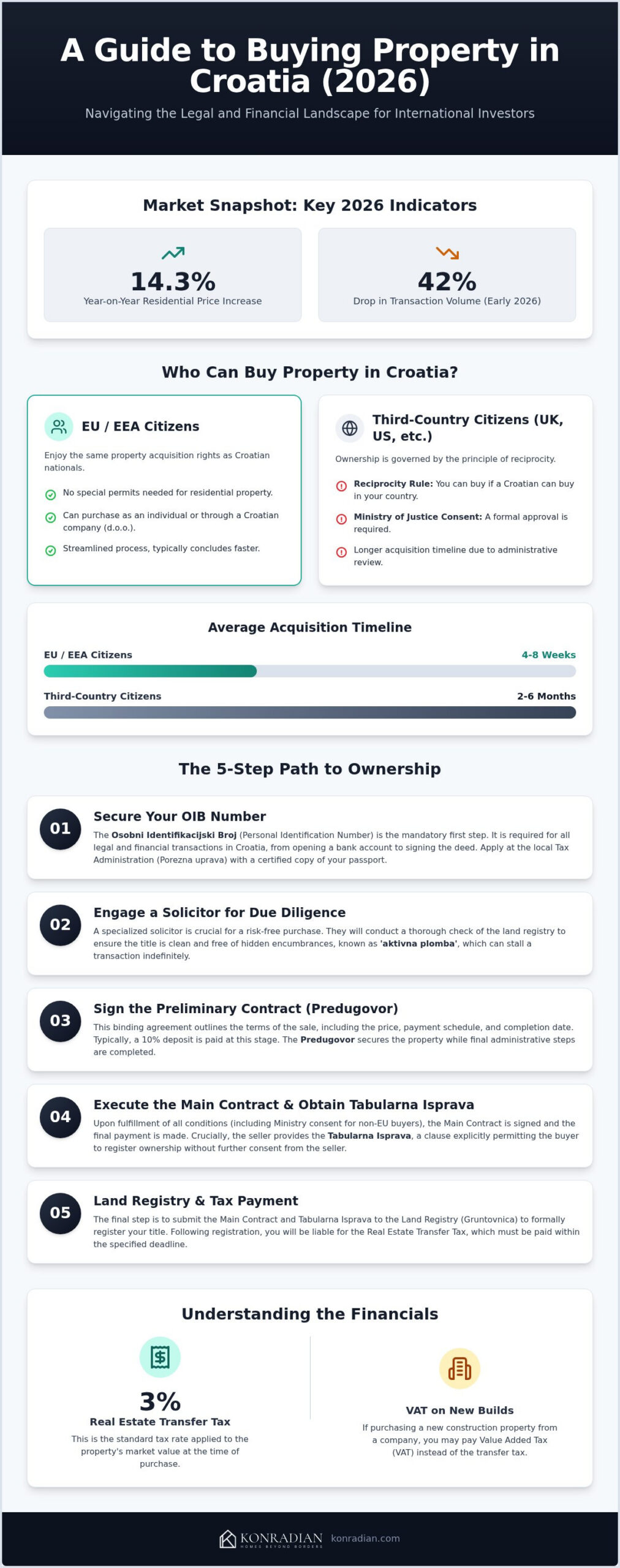
By 2026, the Croatian property market has reached a state of institutional maturity. Following the successful integration of the Euro and the Schengen Area, the Croatian legal system has harmonized its property laws to provide a secure, transparent environment for international capital. This stability is reflected in the market’s performance; despite a 42% drop in transaction volume in early 2026, residential prices continued their upward trajectory with a 14.3% year-on-year increase. Understanding the legal steps to buying property in Croatia begins with identifying your specific status within this refined regulatory landscape.
EU and EEA Citizens: Equal Footing
If you hold citizenship in an EU or EEA member state, you enjoy the same acquisition rights as a Croatian national. This means you can purchase residential homes, apartments, and construction land without seeking special permits from the Ministry of Justice. The process is streamlined, typically concluding within 4 to 8 weeks. For citizens of the Swiss Confederation, the rules are slightly more nuanced, often requiring evidence of permanent residence or specific stay requirements to mirror the reciprocity offered to Croatians in Switzerland.
When structuring your portfolio, you’ll need to decide between purchasing as an individual or through a Croatian legal entity (d.o.o.). While individuals benefit from straightforward ownership, some investors opt for a company structure to manage multiple assets or to potentially mitigate future tax liabilities. In 2026, the long-standing moratorium on EU citizens purchasing agricultural land has expired, though non-EU nationals still face significant restrictions in this category. It’s a strategic distinction that requires careful planning if your interests lie in rural estates or vineyards.
Third-Country Citizens and the Reciprocity Rule
For citizens of the UK, US, and other non-EU nations, the path to ownership is governed by the principle of reciprocity. This means you can buy property in Croatia if a Croatian citizen can do the same in your home country. For UK citizens, the post-Brexit landscape has settled into a predictable rhythm; you’re treated as a third-country national but benefit from established reciprocity agreements. The primary administrative difference is the requirement for formal consent from the Ministry of Justice. This step extends the acquisition timeline to between 2 and 6 months, making early preparation essential.
Establishing your legal presence starts with the ‘OIB’ (Osobni identifikacijski broj). This personal identification number is the cornerstone of every transaction, from opening a local bank account to signing the final deed. Without it, the legal steps to buying property in Croatia cannot proceed. While the Ministry of Justice review adds a layer of bureaucracy, it serves as a final safeguard, ensuring the property is free of ‘aktivna plomba’ and that the transaction aligns with national interests. It’s a methodical process that, when handled with professional precision, leads to a secure and undisputed title.
Administrative Prerequisites: Preparing for Your Purchase
Before you can proceed with the formal acquisition, you must establish your administrative foundation within the Croatian system. This phase is less about the property itself and more about your status as a legitimate participant in the national economy. Successful investors recognize that the legal steps to buying property in Croatia are sequential; rushing the search before securing your prerequisites often leads to missed opportunities in a market where prime listings move swiftly. By 2026, the integration of digital services at the Tax Administration has streamlined these early requirements, yet the need for precision remains absolute.
Securing Your OIB (Osobni Identifikacijski Broj)
The OIB serves as the primary identifier for all tax and legal actions in Croatia. Whether you’re signing a utility contract or a multi-million Euro deed, this eleven-digit number is mandatory. For individual investors, the application at the local Tax Administration (Porezna uprava) is straightforward, requiring only a certified copy of your passport. If you’re purchasing through a corporate entity, the documentation becomes more complex, necessitating an excerpt from your home country’s commercial register, translated by an official Croatian court interpreter.
While it’s possible to apply for an OIB via post or email, many sophisticated buyers prefer to have their legal representative handle the application in person. This ensures that the certificate is issued without the delays often associated with international correspondence. Once issued, your OIB remains yours for life, acting as the bridge between your global portfolio and your Croatian assets.
Banking and Financing in the Eurozone
Since Croatia’s full adoption of the Euro, the financial friction of cross-border transactions has significantly decreased. However, opening a local bank account remains a strategic advantage. While you can technically transfer funds from any SEPA-compliant account, a local presence simplifies the payment of the 3% real estate transfer tax and the final settlement required for the ‘Tabularna Isprava’. It also positions you more favorably if you’re exploring the conservative 2026 mortgage market for non-residents, where lenders often look for a demonstrated commitment to the local banking ecosystem.
Managing currency risk is another vital consideration for those investing from outside the Eurozone, such as US or UK nationals. Fluctuations between the Pound or Dollar and the Euro can impact your total acquisition cost by thousands during the months-long acquisition sequence. Securing a dedicated transaction partner to oversee these financial nuances can protect your capital and ensure that your liquidity is ready precisely when the ‘Predugovor’ demands it. This level of professional stewardship transforms a complex administrative burden into a structured, predictable process.
Finally, your choice of legal counsel is the most critical preparatory step. A specialized real estate solicitor will perform the essential due diligence, checking the Land Registry (Zemljišne knjige) and the Cadastre (Katastar) for any encumbrances. They’ll ensure the property has a valid ‘Uporabna dozvola’ (Usage Permit), which is vital for both legal security and future resale value in a market where average residential prices now exceed €2,900 per square meter.
The Acquisition Sequence: From Offer to Pre-Contract
Once your administrative foundation is secure, the transition from property search to formal acquisition begins. In a market where average residential prices have reached approximately €2,900 per square meter, the margin for error is slim. The legal steps to buying property in Croatia at this stage focus on transforming a verbal agreement into a binding, legally protected commitment. Successful investors prioritize legal security over speed, ensuring that every negotiation point is reflected in the documentation before any capital is committed.
Drafting a Bulletproof Pre-Contract
The ‘Predugovor’ (Pre-Contract) is arguably the most critical document you’ll sign. It outlines the terms of the sale and typically requires a 10% deposit, known as ‘kapara’. This isn’t merely a down payment; it’s a legal instrument of security. Under the Croatian Law of Obligations, if you as the buyer withdraw without legal cause, the seller retains the deposit. Conversely, if the seller defaults, they’re legally obligated to return double the amount to you. This reciprocal penalty ensures both parties remain committed to the timeline established for the final contract.
A sophisticated Pre-Contract goes beyond the price. It must explicitly state the deadlines for the main contract, the exact date of possession, and a clear mandate for the removal of any existing encumbrances. We ensure that every ‘Predugovor’ we oversee includes specific clauses regarding the ‘Tabularna Isprava’, protecting your right to register the title once the full price is paid. This methodical approach eliminates the ambiguity that often leads to post-purchase disputes.
Advanced Due Diligence: Beyond the Title
Your solicitor’s primary task during this sequence is a rigorous examination of the ‘Vlasnički list’ (Ownership certificate). They’re looking for the dreaded ‘aktivna plomba’ (active seal). This notation indicates a pending legal action or a third-party claim that hasn’t yet been resolved by the court. Purchasing a property with an active seal is a high-stakes gamble; it effectively means the title is in flux. A clean ‘Vlasnički list’ is the only acceptable baseline for a secure investment.
Beyond the title, you must verify the ‘Uporabna dozvola’ (Use Permit). This document confirms that the property was built according to the approved architectural plans and is legally fit for its intended use. In coastal regions, additional layers of due diligence are required to check for historical or cultural heritage protections. For instance, those exploring Istria real estate for sale often encounter stone villas with strict renovation restrictions. Verifying these details early prevents the frustration of discovering your Mediterranean retreat cannot be modernized as planned.
By treating the ‘Predugovor’ as the ultimate safeguard, you create a transparent roadmap for the finalization of the deal. This stage is where professional stewardship provides the most value, handling the heavy lifting of bureaucratic verification so you can focus on the strategic growth of your portfolio.
Legal Finalization: The Main Contract and Registration
Signing the Main Contract (Ugovor o kupoprodaji) represents the culmination of your strategic planning and the final transition of capital into a tangible Mediterranean asset. At this stage, the legal steps to buying property in Croatia move from negotiation to formal execution. While the Pre-Contract secured the intent, the Main Contract serves as the definitive legal instrument that the Land Registry will use to update the ownership records. By 2026, the synchronization between Croatian notaries and the digital Land Registry has reached peak efficiency, allowing for a more transparent finalization process than in previous decades.
The Notary’s Role and the Tabular Statement
The Notary Public (Javni bilježnik) is a mandatory participant in every Croatian property transaction. It is vital to understand that the notary’s primary responsibility is the verification of the signatures on the contract, not a guarantee of the property’s legal status or title quality. This distinction is why independent legal due diligence remains non-negotiable. The notary ensures the document meets formal legal standards, but they do not act as your personal advisor or protector against hidden encumbrances.
The most critical document produced during this phase is the Tabularna Isprava (Tabular Statement). This document is typically issued only after the seller has received the full purchase price in their account. The Tabularna Isprava is the seller’s explicit consent for the buyer to register ownership. Without this specific statement, either included within the Main Contract or as a separate notarized document, the Land Registry will not finalize the transfer of title. We ensure this document is held in escrow or released precisely upon confirmation of payment to protect our clients’ interests during the final settlement.
Taxes and Registration Fees
Understanding the tax implications is essential for accurate capital allocation. For resale properties, the Real Estate Transfer Tax (RETT) is 3% of the market value as determined by the Tax Administration. This tax is paid by the buyer and is typically due within 15 days of receiving the tax assessment. If you are purchasing a new build from a developer, the transaction is often subject to 25% VAT, which is usually included in the advertised price. In these cases, the 3% RETT does not apply, preventing double taxation on the same acquisition.
The final step is the entry into the Land Registry (Zemljišne knjige). In 2026, the registration fee remains modest, approximately €33 to €35. For EU citizens, the approval is relatively swift, often appearing in the registry within 4 to 8 weeks. For non-EU citizens, the timeline extends to 2 to 6 months while the Ministry of Justice verifies reciprocity. Once the ‘Vlasnički list’ reflects your name without any active seals, your ownership is absolute and protected under Croatian law. To ensure every detail of your finalization is handled with LSE-educated precision, partner with our expert acquisition team for end-to-end transaction support.
Strategic Stewardship: Why Professional Guidance is Essential
Navigating the legal steps to buying property in Croatia is a process that rewards intellectual rigor and punishes oversight. While the technical requirements of the Land Registry and the Tax Administration are now clear, the execution of a high-stakes transaction requires more than just a checklist. It demands a partner who understands the nuances of the local market while maintaining a sophisticated global investment perspective. Professional stewardship transforms what could be a complex bureaucratic exercise into a secure, lifestyle-defining acquisition.
A significant advantage for investors in the Croatian market is the ‘Free for the Buyer’ model. In many transactions, the professional commission is settled by the seller, allowing you to leverage elite expertise without increasing your total acquisition costs. At Konradian, we combine this structural benefit with LSE-educated advisory to ensure your interests are protected at every turn. Our team provides direct access to pre-sale developer listings, often securing opportunities before they reach public portals. This exclusive pipeline is essential in a market where prime coastal assets are increasingly scarce and demand remains high.
The ‘Heavy Lifting’ Model
We act as your dedicated concierge, managing the intricate web of local solicitors, notaries, and tax authorities on your behalf. Our role is to alleviate the inherent stress of Mediterranean bureaucracy through quiet confidence and methodical oversight. From the initial video consultation to the final key handover, we handle the friction of the acquisition sequence. This end-to-end involvement ensures that the due diligence discussed in earlier sections is not just performed, but scrutinized with a strategic eye for long-term value and legal safety.
Our approach is proactive rather than reactive. We don’t wait for an ‘aktivna plomba’ to appear; we investigate the historical records to ensure such encumbrances never threaten your timeline. By managing the communication between all parties, we ensure that every document, from the OIB certificate to the Tabularna Isprava, is handled with precision. This concierge-level service allows you to focus on the aspirational aspects of your investment while we manage the administrative weight.
Securing Your Adriatic Investment
The 2026 market dynamics, characterized by rising prices and evolving reciprocity rules, make professional legal support buying property abroad the most effective insurance policy for your capital. We don’t just facilitate sales; we provide a refined guide for international investors who value transparency and precision. Understanding the legal steps to buying property in Croatia is the foundation, but having a proactive partner to execute those steps is what guarantees a risk-free path to ownership.
Your journey toward a secure Croatian home begins with a conversation about your specific goals and risk profile. We invite you to schedule your free Croatia property consultation with Konradian to begin your journey with professional precision and peace of mind.
Securing Your Adriatic Legacy in 2026
The Croatian market in 2026 offers exceptional opportunities for those who approach acquisition with intellectual rigor. You’ve seen how critical the administrative foundation is, from securing your OIB to navigating the reciprocity requirements for non-EU citizens. By mastering the sequence from the initial Pre-Contract to the final Tabular Statement, you transform a complex transaction into a secure addition to your global portfolio.
Mastering the legal steps to buying property in Croatia doesn’t have to be a solo endeavor fraught with bureaucratic friction. Our LSE-educated advisory team brings over five years of Adriatic market expertise to handle the heavy lifting on your behalf. Since our services are often provided at no cost to the buyer through seller-paid commissions, you gain elite protection without impacting your investment capital.
Your Mediterranean retreat is within reach when guided by professional precision. Take the first step toward a seamless ownership experience today. Secure your Croatian investment with a free consultation and let us guide you home with quiet confidence.
Frequently Asked Questions
Can a foreigner buy property in Croatia in 2026?
Yes, foreigners can purchase property, though the specific conditions depend on your citizenship. EU and EEA citizens enjoy the same rights as Croatian nationals, allowing for a streamlined acquisition of residential homes. Non-EU citizens, such as those from the US or UK, must follow the principle of reciprocity and obtain formal consent from the Ministry of Justice. This is a standard part of the legal steps to buying property in Croatia for international investors.
What is an OIB and do I need one to buy a house in Croatia?
The OIB is a personal identification number that is mandatory for every legal and fiscal action in the country. You cannot sign a purchase contract, open a bank account, or pay the required taxes without this eleven-digit number. It serves as your permanent identifier within the Croatian system. We typically assist our clients in obtaining their OIB from the Tax Administration as the first step in their investment journey.
How much are the closing costs and taxes when buying in Croatia?
Buyers should budget for a 3% Real Estate Transfer Tax on resale properties, which is due after the tax assessment is issued. If you purchase a new build from a developer, 25% VAT is usually included in the price, which exempts you from the 3% transfer tax. Other typical costs include lawyer fees of 1% to 1.5%, notary fees ranging from €30 to €800, and a modest land registry fee of approximately €35.
Is it safe to buy property in Croatia without a local agent?
While you can technically navigate the market alone, it’s not a recommended strategy for high-stakes transactions. A professional partner provides the intellectual authority needed to identify hidden encumbrances and manage complex language barriers in legal documents. Our advisory team handles the heavy lifting of due diligence, ensuring your acquisition is handled with the precision and security that LSE-educated expertise provides.
How long does the legal process of buying property in Croatia take?
The acquisition timeline is primarily determined by your nationality. EU and EEA citizens can generally expect the process to conclude within 4 to 8 weeks. For non-EU citizens, the timeline extends to between 2 and 6 months. This additional time is required for the Ministry of Justice to process the mandatory consent application, a necessary step to ensure the transaction meets all reciprocity requirements.
Do I need a Croatian bank account to purchase real estate?
A local bank account isn’t strictly mandatory for the transaction itself, but it’s highly recommended for ongoing ownership. It simplifies the payment of the 3% transfer tax and future utility bills. Since Croatia is fully integrated into the Eurozone, having a local account also makes it easier to manage liquidity and demonstrates a commitment to the local economy if you’re seeking financing in the future.
Can I buy property in Croatia and get residency?
Owning residential property can serve as a basis for a temporary residence permit in Croatia. This permit is typically granted for up to one year and can be renewed, though it doesn’t automatically include the right to work. It’s an excellent option for digital nomads or retirees. This process is separate from the legal steps to buying property in Croatia and requires its own set of administrative filings with the Ministry of the Interior.
What is an ‘aktivna plomba’ and why does it matter?
An ‘aktivna plomba’ is an active seal in the Land Registry that indicates a pending legal action or a third-party claim against the property. It matters because it means the title is not currently clear, and the ownership status could change based on a court’s decision. You should never sign a main contract or transfer full payment until your solicitor confirms that all seals have been resolved and the registry is clean.
