


What if the most significant risk to your international portfolio isn’t a market downturn, but a single mistranslated clause in a foreign contract? You’ve likely felt the weight of that uncertainty while eyeing a villa on the Costa del Sol or a coastal retreat in Croatia. The fear of title deed fraud or the headache of managing 2026 tax obligations can turn an aspirational investment into a source of profound stress. It’s a common concern for the global investor; the complexity of foreign bureaucracy often feels designed to exclude the uninitiated.
This guide is designed to replace that anxiety with quiet confidence. You’ll learn how comprehensive legal support buying property abroad transforms a labyrinth of local regulations into a streamlined, secure path to ownership. We’ll provide a clear roadmap for verifying property titles, understanding regional tax shifts like the 7% ITP rates in Andalusia, and securing a partner who handles the heavy lifting of foreign legalities on your behalf. By the end of this article, you’ll have the strategic foundation needed to protect your global wealth with absolute precision.
Key Takeaways
- Understand why secure acquisition requires an exhaustive audit of property history and current legal standing to prevent future title disputes.
- Identify the critical differences between independent legal support buying property abroad and the biased advice often provided by seller-side agents.
- Navigate the specific administrative hurdles of 2026, from Spain’s Gestoria system to the unique OIB requirements for non-EU investors in Croatia.
- Learn how to leverage a professional stewardship model that combines high-level investment strategy with local expertise to handle complex foreign bureaucracy.
What is Legal Support for Buying Property Abroad?
Acquiring a high-value asset in a foreign jurisdiction is rarely a matter of simple paperwork. It’s a strategic maneuver that requires a sophisticated framework of due diligence, contract verification, and regulatory compliance. Comprehensive legal support buying property abroad acts as your intellectual shield, ensuring that every signature moves you closer to a secure legacy rather than a legal entanglement. While domestic conveyancing often follows a predictable path of title transfer, international acquisition demands a deeper understanding of local nuances. It isn’t enough to simply review a contract; you must ensure the document aligns with your long-term tax obligations and residency goals.
This specialized support provides the quiet confidence that comes from having an advocate who is fluent in both the local language and the intricate language of law. It’s about more than just checking boxes. It involves interpreting how foundational property law applies to your specific investment profile in a market where you don’t have the home-field advantage. Having a trusted partner to manage the heavy lifting of foreign bureaucracy allows you to focus on the aspirational aspects of your purchase while your capital remains protected by professional stewardship.
The Core Components of International Legal Stewardship
True legal stewardship is exhaustive and proactive. It begins with title deed verification to ensure the seller possesses the undisputed right to transfer the asset. Without this, you risk purchasing a property with a clouded history. We also prioritize rigorous debt and encumbrance checks. In many European jurisdictions, debts can be attached to the property itself rather than the individual, meaning you could inadvertently inherit the previous owner’s tax liabilities or mortgages. Finally, we analyze compliance with local zoning and urban planning laws. This confirms that your intended use of the property, whether for personal residence or rental income, is legally permitted and won’t be disrupted by future municipal developments.
While legal compliance is the priority, understanding market valuation is a critical secondary step. For those exploring the French market, tools like Cmonbien allow investors to compare valuations between neighboring towns, ensuring the purchase price reflects the true market potential.
Why DIY Legal Research is a Risk to Your Capital
Relying on automated translation for binding legal documents is a dangerous gamble with your capital. Nuances in phrasing can change the entire meaning of a liability clause, and software often misses these subtle legal distinctions. Local customs also frequently override what appears to be a “standard” written contract, making local expertise indispensable. It’s also vital to understand that a foreign Notary Public represents the state’s interests and the procedural legality of the transaction, not your personal interests as a buyer. Without independent legal support buying property abroad, you’re essentially entering a high-stakes negotiation without a dedicated strategist to balance the scales in your favor.
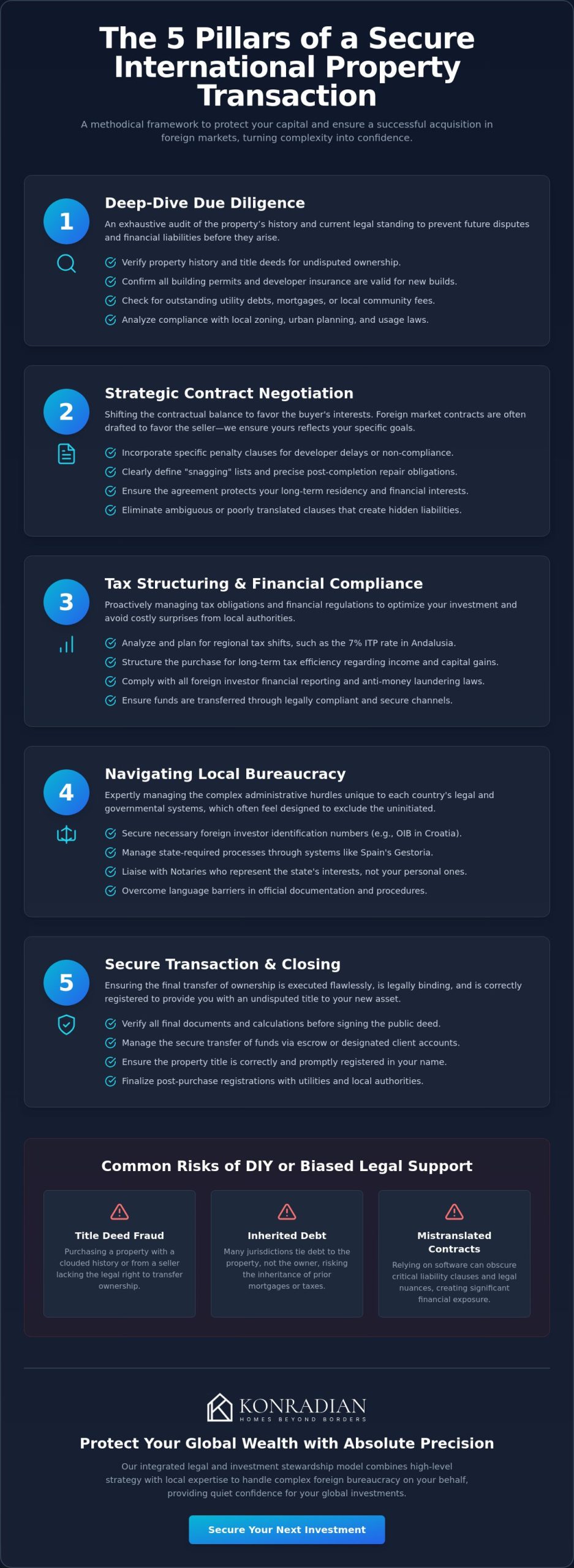
The 5 Pillars of a Secure International Property Transaction
A secure international acquisition is never accidental; it is the result of a methodical framework built on five essential pillars. These pillars ensure that your capital is not just spent, but strategically invested. Professional legal support buying property abroad provides the oversight necessary to manage these moving parts simultaneously. Without this integrated approach, an investor risks falling into the common traps of foreign bureaucracy that can stall or even jeopardize a transaction.
Pillar 1: Deep-Dive Due Diligence
The first pillar involves an exhaustive audit of the property’s history and current standing. For off-plan or newly constructed assets, this means verifying that all building permits are valid and that the developer has the requisite insurance in place. We also conduct thorough checks for outstanding utility debts or local community fees that could otherwise become your responsibility upon completion. Due diligence serves as the primary preventative measure against future litigation by identifying legal discrepancies before they become financial liabilities.
Pillar 2: Strategic Contract Negotiation
Contracts in foreign markets are often drafted to favor the developer or the seller. Strategic negotiation shifts that balance back toward the buyer. It is vital to include specific penalty clauses for developer delays and clearly define “snagging” lists and repair obligations within the contract. Understanding how to avoid mistakes buying property abroad starts with ensuring the purchase agreement reflects your specific interests, not just the seller’s standard terms.
Pillar 3: Tax Structuring and Financial Compliance
Taxation varies significantly by region and property type. In Spain, for example, the Property Transfer Tax (ITP) for resale properties can range from 6% in Madrid to 10% in Catalonia as of early 2026. For new builds, you must account for VAT (IVA) and Stamp Duty. Understanding these nuances, along with future capital gains liabilities, is critical for long-term wealth preservation. Expert legal support buying property abroad ensures your tax structure is optimized from the moment of acquisition. For a comprehensive overview of how these financial and legal considerations fit into a broader acquisition strategy, our international property buyer guide provides a methodical, start-to-finish framework for sophisticated investors.
Pillars 4 & 5: Residency Alignment and Fund Security
Your property purchase should align with your broader lifestyle goals, such as residency or visa requirements. Many investors find that UK government guidance on buying property abroad highlights the necessity of independent advice to navigate these complex overlaps between property law and immigration status. Finally, ensuring fund security through escrow services or secure bank guarantees protects your capital until the keys are physically in your hand. If you’re ready to secure your next investment, you might explore our Spanish Property Acquisition services for a seamless, end-to-end experience.
Solicitors vs. Buyer Representatives: Who Should You Trust?
Understanding who truly represents your interests is the most critical decision in any cross-border transaction. While a local solicitor provides essential legal scrutiny, their scope is often restricted to the letter of the law rather than the overall success of your investment. Conversely, the seller’s agent operates with a clear mandate to protect the developer’s margins, not your capital. This creates a representation gap that many investors fail to recognize until a conflict arises. The most effective way to bridge this gap is through an international real estate investment advisor who acts as a strategic lead, coordinating the entire acquisition process from a buyer-centric perspective.
Professional buyer consultations serve as the vital first step toward a secure purchase. This initial alignment ensures that the legal support buying property abroad is tailored to your specific financial profile and long-term goals. An advisor doesn’t just find a property; they curate a team of experts to ensure every aspect of the transaction is handled with precision. This proactive stewardship removes the burden of managing multiple foreign entities, providing a seamless transition from selection to ownership.
The Conflict of Interest Trap
You should never accept a lawyer recommended by a seller or developer without independent verification. This scenario often masks a conflict of interest where the legal professional may be incentivized to overlook minor discrepancies to ensure the deal closes. To identify “arm’s length” legal advice, look for professionals who have no prior financial ties to the selling party. A dedicated advisor provides immense value here by vetting and coordinating multiple legal and financial experts on your behalf. This ensures that every voice in the room is working exclusively for you, providing a level of protection that a standard solicitor cannot offer alone.
Cost Comparison: Fees vs. Integrated Service
Navigating the financial side of legal support can be confusing. Traditional solicitors in markets like Spain and Croatia typically charge fees based on a percentage of the property value or a flat hourly rate, which can add significant overhead to your acquisition. In contrast, an end-to-end property buying service integrates these costs into a broader stewardship model. Konradian’s approach in many markets is commission-based; the seller pays the fee while you receive elite-level support at no additional cost. This removes the financial barrier to securing expert legal support buying property abroad, allowing you to invest with the highest level of protection without depleting your initial capital.
Country-Specific Legal Requirements: Spain, Croatia, and Beyond
Every jurisdiction presents a unique set of administrative hurdles that demand localized expertise. In Spain, the process begins with obtaining a NIE (Foreigner Identity Number), which is a prerequisite for any financial transaction. However, the true complexity often lies in the role of the Gestoria, an administrative professional who bridges the gap between the investor and the Spanish bureaucracy. Without dedicated legal support buying property abroad, these nuances can delay a closing by weeks or months. In Croatia, the equivalent is the OIB number, but non-EU citizens face the additional layer of “reciprocity” checks, where the Ministry of Justice must approve the purchase based on agreements with the buyer’s home country.
Hungary mandates that a lawyer must counter-sign every real estate sales contract for it to be valid at the land registry. This provides a high level of procedural security but requires an advocate who understands international fund flows. The United Kingdom, by contrast, often confuses international buyers with its distinction between leasehold and freehold titles. A leasehold is essentially a long-term rental from a freeholder, requiring specialized sourcing to ensure ground rents and service charges don’t erode the asset’s value. If you’re ready to explore these markets with absolute security, book a consultation for our Hungarian Property Brokerage or other European services.
Buying in Spain: The Golden Visa and Beyond
As of early 2026, legal support buying property abroad is more critical than ever in Spain due to shifting residency regulations. While the government has moved toward ending the real estate option for the Golden Visa, legislation is still being finalized, and alternative residency paths remain viable for high-net-worth individuals. The final step of any Spanish purchase is the signing of the Escritura (public deed) before a Notary. It’s important to remember that the Notary verifies the legality of the document but does not negotiate on your behalf. For a deeper look at these requirements, refer to our guide on Spanish Property Acquisition.
Croatia and Hungary: The Emerging Market Advantage
Croatia and Hungary offer significant growth potential, but they require a different strategic approach. In the Adriatic, having a real estate agency with developer access is critical for securing off-plan assets safely. Croatian law also maintains strict restrictions on agricultural land for certain non-EU buyers, which can catch the unwary off guard. In contrast, the Hungarian land registry is known for its efficiency, often processing transactions faster than its Western European counterparts. This speed is an advantage, provided your legal counsel has performed the necessary due diligence before the contract is submitted.
The Konradian Approach: Integrated Legal and Investment Stewardship
The Konradian approach redefines the acquisition journey by treating legal security as an inherent part of the investment strategy. We combine the intellectual rigor of LSE-educated analysts with the practical, hands-on insights of local experts in every market we serve. This dual perspective ensures that legal support buying property abroad is never a secondary consideration but a foundational element of our stewardship. Our “Free for Buyer” model in Spain, Croatia, the USA, and Hungary ensures you receive this elite level of protection without additional financial burden. In these jurisdictions, the seller or developer covers our professional fees, yet our loyalty and fiduciary duty remain exclusively with you. To understand how these models work in major markets like Florida, you can explore Real Estate Brokerage Commissions and how they impact your purchase. This end-to-end oversight spans from the initial video consultation to the moment you receive your keys, ensuring your capital is protected through direct, vetted relationships with the region’s most reputable developers.
From Consultation to Closing
A successful transaction begins long before the final deed is signed. Our process starts with a real estate buyer consultation designed to align your portfolio goals with local legal realities. We vet developers through a rigorous internal audit process before any asset is presented to our clients, ensuring that only the most secure opportunities reach your desk. This meticulous oversight allows for a seamless remote property purchase abroad, providing full legal security even if you are thousands of miles away. We handle the heavy lifting of foreign bureaucracy, coordinate with local notaries, and manage the flow of funds to ensure your investment is anchored in solid ground.
Your Global Property Partner
Sophisticated investors require a partner who speaks the language of global finance and understands the cultural nuances of local markets. Our international mindset allows us to navigate complex bureaucracy with ease, projecting a sense of tranquility throughout the entire process. By choosing a proactive legal strategy, we identify potential risks before they manifest, protecting your wealth through every stage of the acquisition lifecycle. We don’t just facilitate a sale; we act as your dedicated concierge for global real estate. The peace of mind we provide is rooted in a commitment to your long-term well-being and financial security. Secure your international investment with Konradian’s expert stewardship today and experience the refinement of professional property acquisition.
Securing Your Global Legacy
Navigating the complexities of international real estate in 2026 requires more than just a keen eye for location; it demands a strategic foundation built on absolute legal certainty. By prioritizing deep-dive due diligence and understanding the administrative nuances of markets like Spain and Croatia, you transform a potentially stressful transaction into a seamless acquisition. Integrated legal support buying property abroad is the most effective way to eliminate the risks of title fraud and administrative delays while ensuring your capital is positioned for long-term growth.
Our LSE-educated advisory team brings over five years of international brokerage experience to every transaction, providing direct access to vetted developer pre-sales and a sophisticated stewardship model. We handle the heavy lifting of foreign bureaucracy so you can focus on the lifestyle and financial benefits of your new asset. It’s time to move forward with the quiet confidence that comes from expert representation. Before taking that step, sophisticated investors will find it valuable to consult our international property buyer guide to ensure their capital deployment strategy is fully aligned with 2026’s evolving market conditions. Book a Free Video Consultation with Our International Experts and take the first step toward a secure global portfolio. Your vision of international ownership is well within reach, and we’re here to ensure it’s realized with precision and ease.
Frequently Asked Questions
Do I need a local lawyer when buying property abroad if I use an agency?
Independent legal counsel is a necessity to ensure your interests remain the primary priority throughout the transaction. While an agency facilitates the search and negotiation, a dedicated legal professional performs the forensic audit of the title and ensures the contract is balanced. This separation of duties prevents potential conflicts of interest, particularly when an agency has a long-standing relationship with a specific developer or seller.
Can I buy property abroad remotely without being physically present for the legal signing?
Remote acquisition is entirely possible through a Power of Attorney (PoA), which allows a representative to sign the final deeds on your behalf. This legal instrument is frequently used in Spain and Croatia to streamline the process for international investors. You’ll typically need to have the PoA notarized and apostilled in your home country to ensure it’s recognized by foreign authorities and the local land registry.
What are the most common legal mistakes people make when buying overseas?
The most frequent error is accepting a “standard” contract without tailoring it to protect the buyer’s specific interests. Many investors also fail to verify that the seller has settled all municipal taxes and community fees before the transfer. Because these liabilities often attach to the property itself, the new owner can become responsible for the previous owner’s debts if they aren’t cleared during the due diligence phase.
Is it safe to buy off-plan property from a developer abroad?
Off-plan purchases are secure provided you have a bank guarantee or an insurance policy that protects your staged payments. These instruments ensure that your capital is returned if the developer fails to complete the project or enters insolvency. Comprehensive legal support buying property abroad involves verifying that these guarantees are active and legally binding before you transfer any funds to the developer’s account.
How much should I budget for legal fees and taxes when buying internationally?
You should generally budget between 8% and 13% of the property’s purchase price for taxes and associated fees. In Spain, for example, the Property Transfer Tax for resale homes is currently 7% in Andalusia but reaches 10% in the Valencia region. These regional variations, combined with notary and registry fees, can significantly impact the total capital required for your acquisition.
What is the role of a Notary Public in a foreign property transaction?
A foreign Notary Public acts as an impartial state official who ensures the transaction adheres to local procedural laws and witnesses the signing of the public deed. They verify the identities of the parties and confirm the property’s description in the land registry. It’s vital to remember that the Notary doesn’t provide legal advice or act as your advocate; their role is to ensure the state’s requirements are met.
How do I verify that a foreign property has no outstanding debts or liens?
Verification is achieved through a formal request to the local Land Registry for a current title certificate, such as the Nota Simple in Spain or the Vlasnički list in Croatia. This document reveals any registered mortgages, liens, or legal disputes that could affect your ownership. This search is a core component of the legal support buying property abroad that protects your investment from unforeseen liabilities.
What legal protections do I have if a developer fails to complete a project?
Your primary protection comes from the inclusion of specific performance clauses and bank-backed guarantees within the purchase agreement. These legal safeguards allow you to reclaim your investment or seek damages if the project isn’t completed by the agreed date. Professional oversight ensures these protections are robust and enforceable in local courts, providing a necessary safety net for your international capital.
