


Purchasing a luxury villa in Marbella or a high-yield asset in New York isn’t a vacation; it’s a high-stakes capital deployment that demands the same intellectual rigor as a corporate merger. You likely recognize that the allure of global real estate often comes with a shadow of complexity. It’s natural to feel uneasy about interpreting foreign tax codes or trusting local agents who may not prioritize your long-term interests. The fear of a misstep in a secondary jurisdiction is a valid concern for any sophisticated investor seeking to grow their portfolio abroad.
This international property buyer guide provides the professional framework you need to move from uncertainty to total command. We’ll show you how to secure your investment and gain access to exclusive, off-market developer deals while avoiding common pitfalls like the now-closed Spanish Golden Visa or unexpected FIRPTA withholdings in the United States. We’ll walk through a methodical, start-to-finish approach to sourcing and securing property across Spain, Croatia, and the US. This guide ensures your next acquisition is as tranquil as it is strategically sound, providing the peace of mind that comes from expert stewardship.
Key Takeaways
- Shift your perspective from lifestyle-driven purchases to a multi-dimensional wealth strategy that treats international property as a sophisticated strategic asset.
- Utilize this international property buyer guide to master a structured five-step framework for sourcing, securing, and optimizing global real estate investments.
- Identify critical legal and financial safeguards to protect your capital from cross-border tax complexities and emotional decision-making pitfalls.
- Compare the investment potential of established luxury markets like Spain with emerging high-growth opportunities in Croatia and the United States.
- Learn how professional representation provides exclusive access to off-market developer deals while ensuring a secure, end-to-end transaction experience.
The Strategic Logic of International Property Acquisition in 2026
In the 2026 market, international property acquisition has evolved beyond the simple purchase of a second home. It’s now a multi-dimensional wealth diversification strategy that requires the same level of intellectual rigor as a private equity deal. Investors are no longer looking for a “tourist” experience; they’re seeking a strategic asset that provides a buffer against domestic volatility. This international property buyer guide treats cross-border real estate as a sophisticated tool for capital preservation and long-term growth.
The shift from “holiday home” to “strategic asset” is driven by a need for stability in an increasingly interconnected global economy. A property in a secondary jurisdiction isn’t just a place to stay. It’s a hedge against currency fluctuations, a vehicle for tax optimization, and a potential gateway to new markets. Success in this environment requires an international mindset that looks past local aesthetics to analyze macro-economic trends and shifting regulatory landscapes. Relying purely on local agents who lack this global perspective can lead to missed opportunities or unforeseen liabilities. Professional stewardship bridges this gap, offering the high-level expertise needed to alleviate transaction anxiety and ensure a seamless, end-to-end experience.
Portfolio Diversification and Currency Hedging
Owning assets in different jurisdictions protects your capital from localized economic downturns and political shifts. If your primary market faces a recession, a well-positioned property in a growing European or North American region can stabilize your total net worth. Varying legal frameworks and rules around foreign ownership of property can significantly impact the liquidity and security of your investment. By holding real estate in different currencies, you create a natural hedge that protects your purchasing power over time. Geographical diversification is a critical risk-mitigation tool for 2026 that ensures your wealth isn’t tied to the fate of a single nation’s economy.
Lifestyle Engineering vs. Pure Investment
Navigating the Global Real Estate Lifecycle: A 5-Step Framework
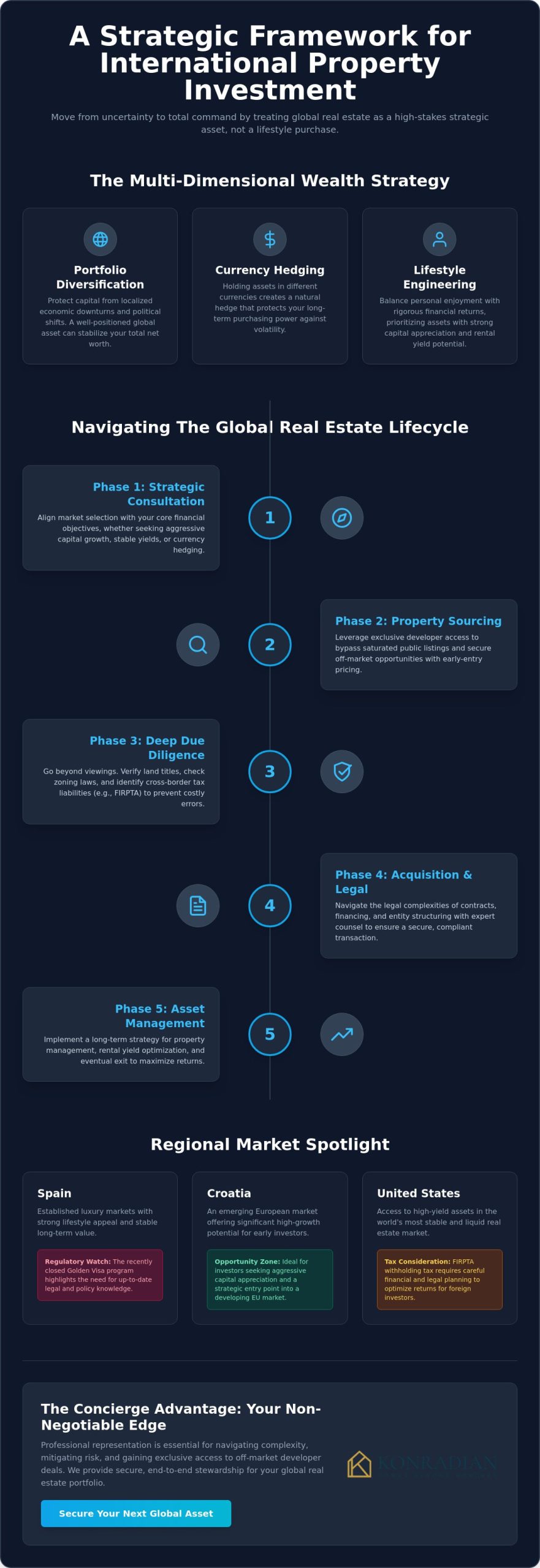
Executing a cross-border transaction requires a departure from the casual search methods used for local residential moves. A sophisticated international property buyer guide must prioritize a methodical lifecycle that addresses the unique risks of foreign jurisdictions. This process is designed to move you from broad market interest to a secured, high-performing asset through five distinct phases. By following this structured path, you replace the anxiety of the unknown with the confidence of professional stewardship.
- Phase 1: Strategic Consultation. We begin by aligning market selection with your specific financial goals, whether you seek aggressive capital growth or stable currency hedging.
- Phase 2: Property Sourcing. This stage leverages a real estate agency with developer access to bypass saturated public listings and secure early-entry pricing.
- Phase 3: Deep Due Diligence. We move far beyond the surface-level “viewing.” This involves verifying land registry titles, checking local zoning for future developments, and avoiding common overseas property investment mistakes that often derail unadvised buyers.
- Phase 4: Legal and Financial Execution. This phase manages the intricate details of local tax IDs, verified escrow accounts, and secure remote signing protocols.
- Phase 5: Post-Acquisition Management. The journey concludes with a professional key handover and the establishment of local utility and tax management systems.
Sourcing Beyond Public Portals
In prime markets like Marbella or the Croatian coast, the most lucrative deals rarely reach the public eye. By the time a property appears on a global portal, the most favorable pricing and prime units are often already sold. Accessing the “investor’s edge” requires direct developer relationships. This allows you to secure pre-sale opportunities where equity is built into the purchase price from day one. Identifying these opportunities before they are marketed globally is the hallmark of a strategic acquisition. Aligning your search with professional oversight is the first step toward a secure, off-market portfolio.
The Mechanics of Remote Acquisition
Modern technology has streamlined the ability to purchase property from anywhere in the world. High-definition video consultations and immersive virtual tours provide a transparent initial screening of the asset without the need for immediate travel. When you’re ready to proceed, a legally vetted Power of Attorney (PoA) allows your representatives to handle local formalities on your behalf. Executing a remote property purchase abroad relies on digital document verification and secure payment structures. This approach ensures that your capital is protected while removing the logistical burden of international travel during the middle of a transaction.
Mitigating Risk: Legal and Financial Safeguards for Cross-Border Buyers
One of the greatest hazards in cross-border real estate is the “margarita effect.” This phenomenon occurs when buyers, swept up in the charm of a Mediterranean sunset or the energy of a global city, sign binding agreements while on an emotional high. A professional international property buyer guide serves as a necessary anchor, ensuring that logic prevails over impulse. You should never commit to a transaction without independent legal support buying property abroad. An attorney who is unaffiliated with the seller or developer provides the unbiased scrutiny required to protect your capital and your peace of mind.
Understanding the full financial scope of an acquisition is equally vital. Beyond the sticker price, you must identify and quantify the hidden costs buying property abroad, which can significantly alter the investment’s profile. In Spain, for example, total closing costs including taxes and fees typically range between 10% and 13% of the purchase price. Navigating specific contract types requires precision; for instance, Spain’s “Arras” agreement can lead to the loss of a substantial deposit if strict deadlines aren’t met. In Croatia, non-EU buyers must navigate reciprocity agreements that can delay ownership for several months, making expert guidance non-negotiable.
The “Security Audit” for International Transactions
A comprehensive security audit begins at the local land registry. We verify property titles and check for any existing encumbrances, liens, or debts that could legally transfer to the new owner. It’s a common misconception that the local notary acts as your personal advocate. While the notary witnesses the signing and ensures the process meets statutory standards, they don’t perform the deep, protective due diligence an independent lawyer provides. Establishing a clear timeline for fund transfers is also essential. In 2026, international banking regulations are increasingly stringent; unvetted transfers can trigger “money laundering” red flags that freeze transactions and cause unnecessary stress.
Strategic Tax and Residency Planning
Your acquisition strategy must account for long-term tax implications and shifting residency regulations. While Spain officially closed its Golden Visa program on April 3, 2025, alternative routes like Digital Nomad Visas or entrepreneurship visas offer new opportunities for global mobility. You must also prepare for annual obligations, such as the flat 24% capital gains tax for non-EU residents in Spain or the 15% FIRPTA withholding on US property sales. In most European jurisdictions, spending more than 183 days within the country during a single calendar year typically triggers full tax residency, subjecting your worldwide income to local taxation. Proper structuring ensures your property remains a sound financial asset rather than a complex liability.
Regional Market Analysis: Spain, Croatia, and the USA
Selecting the right jurisdiction is the cornerstone of any international property buyer guide. You aren’t just buying bricks; you’re buying into a legal system and an economic trajectory. While the Mediterranean coastline offers a familiar allure, the emerging Adriatic markets present a different set of opportunities for those willing to look past the marquee names. Balancing your portfolio across these diverse regions requires a deep understanding of local market cycles and regulatory shifts.
The landscape of Spanish Property Acquisition remains a benchmark for established luxury. Despite the 10% to 13% closing costs, the region’s mature infrastructure and consistent demand from northern European buyers ensure long-term stability. In contrast, Croatia represents an emerging growth story. With an average price per square meter of approximately €3,400 and residential property prices growing by 2% each quarter, it’s a market that rewards early entry. For those seeking cross-continental wealth, the US market remains a powerhouse. Foreign buyers purchased $56 billion in residential properties between April 2024 and March 2025, with Florida continuing to serve as a primary magnet for European capital.
Central Europe and the UK offer distinct tactical advantages. High-yield opportunities are particularly prevalent in urban hubs like Budapest, where the Hungarian property market provides a lower entry point for sophisticated investors. Meanwhile, the UK’s prime residential sector demands a specialized approach. For non-residents, a dedicated London property sourcing service is essential to navigate the competitive off-market landscape and secure assets that offer true “Safe Haven” protection. To begin your journey with a partner who understands these regional nuances, explore our global acquisition services.
Investment Climate: Yield vs. Appreciation
Your choice of market should align with your primary financial objective. Coastal Croatia currently offers some of the most attractive short-term rental yields, driven by a booming tourism sector and limited high-quality inventory. If your focus is long-term capital appreciation, prime Spanish coastal regions like the Costa del Sol continue to show resilience. Investors seeking liquidity and security often gravitate toward the US and UK. These markets act as global anchors, preserving capital through economic cycles and providing a reliable exit strategy when needed.
Local Market Nuances for 2026
Success in 2026 requires an eye for detail and local expertise. In Spain, we’re seeing a significant rise in sustainable building trends, where “Green” certifications are becoming a prerequisite for premium resale value. In Croatia, the market is bifurcated; you must distinguish between modern new-builds and the authentic “stone house” market in Dalmatia, which requires specialized restoration knowledge. To avoid mistakes buying property abroad, you must also understand local zoning laws. A property with a stunning view today could lose its value tomorrow if you haven’t verified the future development plans in the local land registry.
The Concierge Advantage: Why Professional Representation is Non-Negotiable
The final piece of the acquisition puzzle isn’t the property itself; it’s the team you choose to lead the transaction. While this international property buyer guide has detailed the “what” and “where” of global investing, the “how” depends entirely on professional stewardship. Attempting to assemble a disjointed team of local bankers and lawyers on your own often leads to communication gaps and overlooked risks. A trusted real estate agency abroad acts as a central intelligence hub, ensuring every moving part of the lifecycle aligns with your broader financial objectives.
Many investors are surprised to learn that elite representation is often available at no direct cost to them. Under the Seller-Paid Commission model prevalent in many prime markets, the developer or seller covers the advisory fees. This means you can access high-level strategic counsel, data-driven market analysis, and rigorous negotiation support without increasing your acquisition costs. It’s a strategic advantage that allows you to level the playing field against local sellers who have spent years mastering their domestic market nuances.
Our LSE-educated team brings a level of intellectual rigor to real estate that goes far beyond simple brokerage. We analyze macro-economic data, currency trends, and complex contract structures to ensure your investment is resilient. An end-to-end property buying service manages the entire process on your behalf. From the initial strategy session and remote video screenings to the final key handover and utility setup, we handle the “heavy lifting” so you can focus on the rewards of global ownership.
The Role of the International Real Estate Investment Advisor
A true advisor moves past the role of a “salesperson” to become a long-term strategic partner. We don’t just show properties; we filter thousands of global listings to present only the top 1% that meet our strict criteria for quality, legality, and growth potential. Engaging in professional buyer consultations is the most effective way to set realistic expectations for the 2026 market. This collaborative approach ensures that your search is targeted, efficient, and grounded in current market realities rather than outdated portal data.
Next Steps for the Global Investor
Beginning your journey requires a shift from passive searching to active preparation. We recommend preparing a clear “Investor Profile” that outlines your capital goals and preferred jurisdictions; this makes you a priority for international developers holding exclusive off-market inventory. The most effective starting point is an initial video consultation to define your 2026 strategy and identify which markets align with your risk profile. Whether you’re targeting the Adriatic coast or a prime US asset, Konradian’s bespoke sourcing services provide the refined guidance necessary for a secure and successful acquisition.
Securing Your Global Portfolio in 2026
Mastering the complexities of cross-border real estate is no longer a matter of chance; it’s a matter of strategy. This international property buyer guide has outlined a clear path from initial market selection to secure key handover. By shifting your focus toward professional due diligence and off-market developer access, you ensure your capital remains protected in a shifting regulatory landscape. You’ve seen how a methodical framework can transform a high-stakes transaction into a seamless experience of wealth preservation and growth.
Our LSE-educated advisory team brings over five years of cross-border experience to every transaction. We provide exclusive direct access to top-tier developers across Spain, Croatia, and the USA. Because our comprehensive end-to-end service is often available at zero cost to the buyer, you can secure elite representation without adding to your acquisition budget. This level of professional stewardship ensures your interests are prioritized at every stage of the lifecycle.
Book a Free Video Consultation with our International Investment Team to begin defining your 2026 acquisition strategy. Your journey toward a sophisticated global portfolio starts with a single, well-informed decision. We’re here to ensure that every step you take is grounded in precision and total peace of mind.
Frequently Asked Questions
Is it safe to buy property abroad without visiting the country first?
It’s entirely safe to purchase property remotely provided you utilize high-definition video consultations and immersive virtual tours alongside a legally vetted Power of Attorney. This methodical approach allows your representatives to handle local formalities while you maintain oversight from your home jurisdiction. Secure escrow accounts and digital document verification provide the necessary layers of protection for your capital throughout the lifecycle.
How do real estate commissions work for international buyers?
In many prime international markets, the commission is typically handled through a “Seller-Paid” model. This means the developer or seller covers the advisory fees, allowing you to access elite representation without increasing your acquisition costs. It’s a strategic advantage that provides you with high-level advocacy and market analysis at no direct expense to your investment capital.
What are the most common hidden costs when buying property in Europe?
Beyond the sticker price, you must account for property transfer taxes, VAT on new builds, and notary fees. In Spain, these closing costs total between 10% and 13%, while Croatia applies a flat 3% transfer tax on resale properties. You should also budget for annual “imputed” income taxes and local municipal levies that vary by autonomous community or region.
Can I get a mortgage in a foreign country as a non-resident?
Non-residents can obtain mortgages in foreign jurisdictions, though lenders usually require a higher down payment than they would for domestic citizens. Most international banks offer a Loan-to-Value (LTV) ratio between 60% and 70% for foreign investors. We recommend initiating the pre-approval process early to establish a clear budget for your international property buyer guide strategy.
How does the “Golden Visa” program work for property investors in 2026?
As of 2026, the era of passive real estate investment for residency has shifted significantly across Europe. Spain’s popular Golden Visa program was officially closed to new applicants on April 3, 2025, forcing investors to seek alternative routes. You should now explore Digital Nomad Visas or active entrepreneurship programs if residency or long-term mobility is a primary objective of your acquisition.
What is the difference between a local agent and a buyer’s sourcing specialist?
A local agent is contractually bound to the seller’s interests, whereas a sourcing specialist acts exclusively as your fiduciary partner. While the local agent focuses on moving specific inventory, a specialist filters the entire market and leverages developer relationships to find the top 1% of assets. This distinction ensures that your financial interests and long-term capital growth remain the sole priority.
How do I ensure the property title is clean in countries like Croatia or Spain?
Verifying a clean title requires a thorough audit of the local land registry to check for any existing encumbrances, liens, or debts. In Spain, this involves obtaining a “Nota Simple,” while in Croatia, your attorney must verify the “Vlasnički list.” Independent legal counsel is essential to ensure these documents are current and that the seller has the undisputed right to transfer ownership.
What happens if I don’t speak the local language during the contract signing?
You aren’t required to speak the local language, as notaries typically mandate the presence of an official translator for any non-fluent signatories. Alternatively, many global investors prefer to execute the transaction via a Power of Attorney. This allows a bilingual legal representative to handle the signing on your behalf, ensuring every clause is fully understood and verified before the final handover.
