


In 2026, Miami real estate is no longer just a luxury purchase. It’s a strategic hedge against global volatility that requires a sophisticated, multi-jurisdictional acquisition framework. You likely recognize that while the Florida coastline remains a premier destination, the regulatory environment for a Miami real estate investment for foreigners has become increasingly intricate. Navigating the recent enforcement of Senate Bill 264 and the 15% FIRPTA withholding can feel like a daunting barrier, especially when you’re managing a high-stakes transaction from another continent.
This guide provides the clarity you need to master these legal and tax complexities, ensuring your acquisition is both secure and high-yielding. We’ll examine the current 2026 market data, where median prices have stabilized at $625,000, and explore tax-efficient ownership structures that protect your global interests. From understanding the buyer affidavit requirements at closing to securing pre-sale access through direct developer relationships, we’ll preview a seamless path to property ownership. You’ll gain a clear roadmap for a hassle-free transition into one of the world’s most resilient property markets, supported by a framework designed for the discerning international investor.
Key Takeaways
- Understand why Miami remains a premier safe haven for capital in 2026, offering a robust hedge against global economic volatility through dollar-denominated assets.
- Navigate the updated legal landscape of Miami real estate investment for foreigners, including the latest compliance requirements for Florida Senate Bill 264.
- Learn how to structure your acquisition to manage FIRPTA withholdings and capital gains taxes effectively, ensuring a tax-efficient international portfolio.
- Identify high-growth districts like Brickell and Edgewater that are currently dominating the rental market and attracting global tech talent.
- Discover a seamless, concierge-style acquisition process that allows international buyers to secure prime US assets with zero commission fees.
The Allure of the Magic City: Why Miami Leads U.S. Foreign Investment in 2026
Miami has transitioned from a seasonal retreat into a global financial powerhouse. In 2026, the city’s real estate market demonstrates a resilience that outpaces other Tier-1 U.S. cities like San Francisco or Chicago. This stability is driven by a unique “Safe Haven” effect. For European investors, acquiring U.S. dollar-denominated assets serves as a critical hedge against Eurozone volatility. Understanding U.S. foreign investment laws is the first step in leveraging this stability to preserve and grow international wealth in an environment that prioritizes asset security.
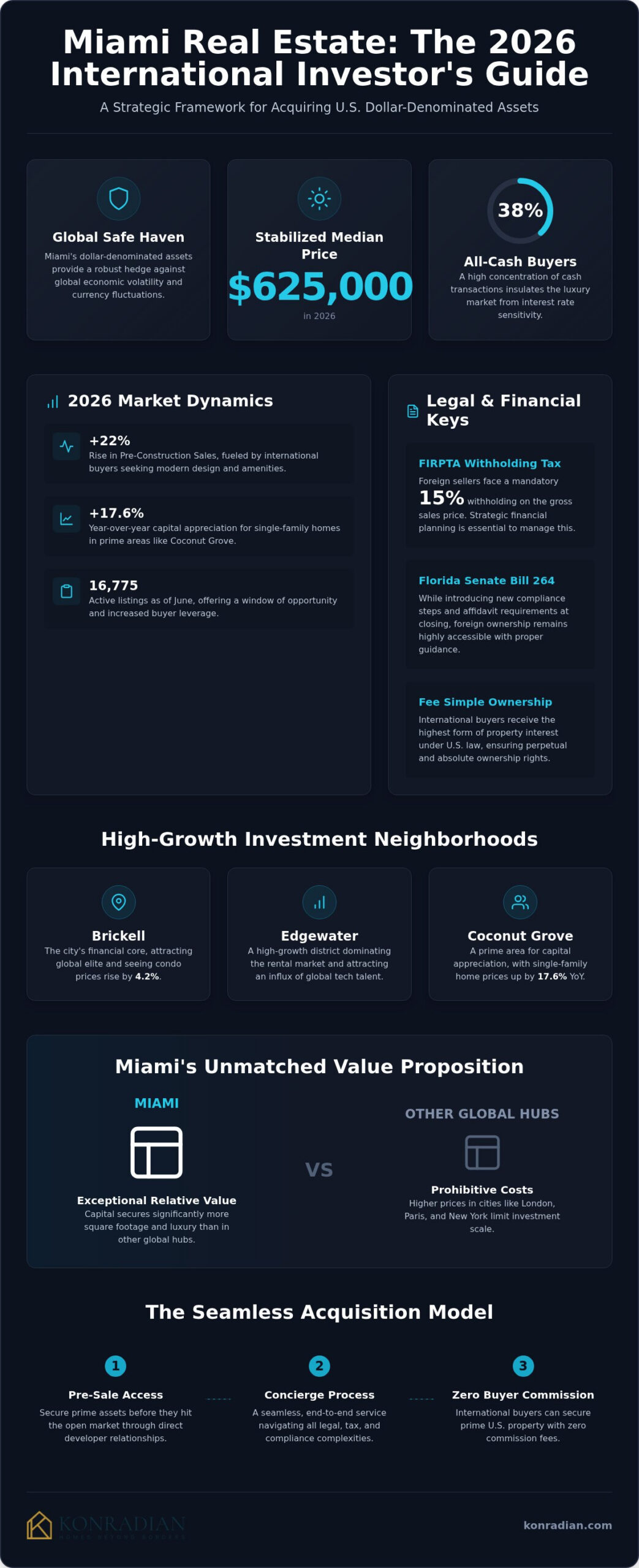
The 2026 data reveals a sophisticated dual-track economy. While the traditional, interest-rate-sensitive market faces national headwinds, Miami’s luxury sector remains insulated. This is largely due to a high concentration of all-cash buyers, who accounted for 38% of all transactions in the first quarter of the year. Capital appreciation in prime areas like Coconut Grove remains robust, with the price per square foot for single-family homes increasing by 17.6% year-over-year. This blend of steady growth and strong rental demand makes Miami real estate investment for foreigners a cornerstone of modern portfolio diversification, particularly as capital from Latin America and Europe continues to reshape the skyline.
Miami vs. Other Global Hubs
When compared to the prohibitive costs of London, Paris, or New York, Miami offers exceptional relative value. Investors often find that their capital secures significantly more square footage in a Miami high-rise than in a comparable Manhattan development. This value proposition is bolstered by massive infrastructure growth, including the continued expansion of the Brightline rail and Miami International Airport. These connections have turned South Florida into a permanent primary residence for the global elite, driving a “lifestyle ROI” that traditional metrics often overlook. The shift is visible in the rising demand for condos in Brickell, which saw a 4.2% price increase even as inventory levels reached a more balanced state in mid-2026.
The 2026 Investment Climate
The current climate is defined by a distinct shift toward new construction, where inventory is more readily available and technologically advanced than in the existing home market. Pre-construction sales rose by 22% in early 2026, fueled by international buyers seeking the latest in architectural design and amenities. The Miami Premium is defined as the price gap between South Florida and the national average. For those pursuing a Miami real estate investment for foreigners, the focus has moved from speculative flipping to the long-term stewardship of high-quality assets. With over 16,775 active listings in June 2026, the market offers a window of opportunity for buyers to negotiate with a level of leverage not seen in previous years.
Legal Frameworks: Understanding Florida’s Foreign Ownership Regulations
The short answer to whether a non-resident can acquire property in Florida is a definitive yes. Miami remains one of the most accessible and protected markets for global capital. While the headlines often focus on shifting regulations, the fundamental rights afforded to international buyers remain some of the strongest in the world. Fee simple ownership represents the highest form of property interest recognized by U.S. law, granting the owner absolute rights to the land and any improvements upon it in perpetuity. This legal clarity is a primary driver for Miami real estate investment for foreigners, providing a level of security that few other global jurisdictions can match.
Ownership Rights for International Citizens
In the U.S. market, you generally choose between two primary residential asset classes: condominiums and single-family homes. While both offer fee simple title, the legal nuances differ. Single-family homes provide total autonomy over the land, whereas condominiums involve a shared interest in common areas governed by an association. Throughout either process, the Florida Real Estate Commission (FREC) serves as a regulatory shield, ensuring that licensed professionals adhere to strict ethical and legal standards. This institutional oversight maintains the integrity of Miami foreign real estate investment, protecting your capital from the moment an offer is signed until the final deed is recorded. For those seeking a guided entry into this market, our team offers specialized legal and financial transaction support to ensure every detail is handled with precision.
Impact of Recent Legislation
Navigating Florida Senate Bill 264 is essential for any modern investor. As of 2026, this law restricts property acquisitions by “foreign principals” from seven specific countries: China, Russia, Iran, North Korea, Cuba, Venezuela, and Syria. These restrictions primarily target agricultural land and properties located within 10 miles of military installations or critical infrastructure. Chinese nationals face the most significant limitations, while citizens from the other six countries are generally prohibited from purchasing the specific types of “critical” land mentioned above.
It’s vital to recognize that for the vast majority of European and South American investors, these restrictions don’t apply to standard residential purchases in Miami’s urban core. However, every buyer in Florida, regardless of nationality, must now sign a Buyer Affidavit at closing. This document is a formal attestation that the purchaser isn’t a prohibited foreign principal under the law. Because these regulations are strictly enforced, securing title insurance and local legal counsel is no longer optional; it’s a strategic necessity. These professionals verify that the title is “clear and marketable,” protecting you against any future claims or legal discrepancies that could arise from a high-stakes international transaction.
Financial Architecture: Navigating Taxes, FIRPTA, and Acquisition Structures
Precision is the hallmark of a successful international acquisition. For a Miami real estate investment for foreigners, the financial architecture is just as critical as the property’s location. You must first account for the Foreign Investment in Real Property Tax Act, or FIRPTA. This federal law requires a standard withholding of 15% of the gross sales price when a foreign person sells U.S. real estate. It’s not a final tax liability, but rather a prepayment to ensure capital gains obligations are met. In 2026, capital gains rates for non-residents remain aligned with federal brackets, though exemptions are significantly more limited compared to domestic owners.
Carrying costs in Miami-Dade County are predictable but require careful calculation. The average effective property tax rate ranges from 1.94% to 2.0% of the assessed value. If you pay early in November, you can secure a 4% discount, which gradually decreases to 1% by February. Managing these obligations effectively requires a U.S. Taxpayer Identification Number (ITIN). This is a foundational requirement for any international investor looking to maintain a compliant and professional presence in the U.S. tax system.
Choosing the Right Ownership Structure
Choosing the right vehicle for your investment is a strategic decision that impacts both liability and taxes. While individual ownership is simple, it exposes your global assets to U.S. legal claims and triggers significant estate tax risks. Non-resident aliens only receive a $60,000 exemption for U.S. based assets. Anything above this threshold can be taxed at rates up to 40%. Many sophisticated investors utilize a domestic LLC, often nested within a foreign holding company, to mitigate this “death tax” trap and enhance privacy. This structure provides a layer of asset protection that shields your broader portfolio from property-specific issues. For a deeper look at securing your transaction, consult our guide on Legal Support Buying Property Abroad.
Financing Options for Non-Residents
Financing is readily available for international buyers, though it requires higher equity than domestic loans. Standard foreign national mortgages in 2026 typically demand a down payment of 30% to 40%. Interest rates generally sit 0.5% to 2% higher than those for U.S. residents. We’ve also seen a rise in private lending, which offers faster closing times and more flexible underwriting for cosmopolitan investors with complex income streams. Despite Florida’s Foreign Ownership Regulations becoming more defined, the lending appetite for Miami assets remains strong, reflecting the city’s status as a premier global collateral hub.
Strategic Selection: High-Growth Neighborhoods for International Portfolios
Successful Miami real estate investment for foreigners relies on matching specific geographical strengths with your long-term portfolio goals. In 2026, the market isn’t monolithic. Each district serves a distinct purpose, from high-yield rental units to prestigious legacy assets. Brickell, often called the “Wall Street of the South,” continues to dominate the high-rise rental sector. With a median condo price of $620,000 in early 2026, it remains a powerhouse for urban living, attracting young professionals and global financial firms. Its 4.2% year-over-year price increase reflects a steady, reliable growth pattern that appeals to conservative international capital.
For those seeking higher appreciation potential, Edgewater and Wynwood have matured into essential hubs for tech-focused and creative tenants. These neighborhoods offer a contemporary lifestyle that caters to the city’s expanding workforce. Conversely, if your strategy prioritizes stability and prestige, Coral Gables and Coconut Grove are the gold standard. Coconut Grove has seen remarkable growth, with the price per square foot for single-family homes reaching $1,087 in 2026. This represents a 17.6% increase from the previous year, driven by a scarcity of inventory and a permanent shift toward luxury South Florida residency.
Condo vs. Single-Family Investment
The choice between asset classes often dictates your management experience. Luxury condos offer “lock-and-leave” convenience, where maintenance fees cover the operational complexities of building upkeep. This is ideal for the remote owner. While single-family homes in prime districts often yield higher long-term appreciation, they require more hands-on oversight or professional management. Accessing pre-construction opportunities allows you to secure developer deals before they reach the open market, often providing a price advantage that offsets initial carrying costs. To explore current pre-sale opportunities in these high-growth zones, you can schedule a video consultation with our advisory team.
Emerging 2026 Hotspots
Infrastructure projects continue to redefine the city’s value map. The Underline, a 10-mile linear park, has significantly boosted property values for adjacent developments by creating walkable, green urban corridors. For value-add investors, North Miami and Little River represent the next frontier. These areas offer entry points into neighborhoods undergoing rapid cultural and economic transformation. For investors coordinating a US Real Estate Investment from Europe, these emerging pockets provide the highest potential for capital growth in a market that is becoming increasingly balanced. Miami Beach also remains a top-tier choice, though you must navigate specific zoning laws to capitalize on the lucrative short-term rental market.
Executing Your Investment: The Konradian End-to-End Acquisition Model
Securing a prime asset in South Florida shouldn’t be a source of friction. Our model is specifically designed to streamline Miami real estate investment for foreigners by removing the traditional barriers of distance and complexity. One of the most significant advantages for our international clients is that our service is free for the buyer in the USA market. Commissions are paid entirely by the developer or seller, which means you receive elite, LSE-educated advisory at no additional cost to your capital outlay. This structure allows us to act as your dedicated advocate, ensuring your interests are protected from the initial search to the final signature.
We bridge the gap between major European hubs like London and the fast-paced Miami market with a level of rigor that few can match. Our team applies sophisticated financial analysis to every opportunity, leveraging over five years of international brokerage experience to filter out market noise. Through our “Direct-to-Developer” network, we provide exclusive access to pre-sale and off-market deals, often securing units before they’re available to the general public. This proactive approach ensures you’re positioned at the forefront of the 2026 market’s most promising developments, particularly in sectors where pre-construction sales rose by 22% in early 2026.
The Step-by-Step Acquisition Journey
Your journey begins with a private consultation to define your investment thesis, risk tolerance, and long-term goals. We then move into a curated remote selection process. You’ll receive high-definition video tours and granular market reports that provide a transparent view of the property and its surrounding neighborhood. Our team handles the heavy lifting of legal and financial coordination, working with specialized counsel to manage the closing process. You won’t need to travel to Miami to secure your deed; we’ve designed our workflow to be entirely manageable from your home country, ensuring a secure and efficient transaction.
Post-Acquisition Support
Our involvement doesn’t end when the transaction is finalized. We manage the key handover and facilitate introductions to vetted local property managers who handle the daily operations of your new asset. To ensure your portfolio continues to perform as expected, we provide periodic reviews and market updates tailored to your specific holdings. This end-to-end stewardship offers the peace of mind that comes from knowing your international assets are under professional care. If you’re ready to explore the possibilities of the South Florida market, schedule a free consultation for your Miami investment today.
Securing Your Legacy in the Magic City
The 2026 market offers a rare window of opportunity where rising inventory meets sustained global demand. While the complexity of U.S. tax laws and recent Florida legislation may seem daunting, they’re manageable hurdles when you have the right framework in place. Successful Miami real estate investment for foreigners requires a move beyond simple property selection toward a comprehensive strategy that prioritizes asset protection and long-term yield. By mastering the nuances of FIRPTA withholdings and identifying high-growth districts like Coconut Grove, you transform a cross-border transaction into a secure cornerstone of your global portfolio.
At Konradian, we provide the intellectual rigor and personalized care necessary to navigate this landscape with confidence. Our LSE-educated advisory team offers direct developer access to exclusive pre-sale deals, ensuring you enter the market with a distinct competitive advantage. Because our end-to-end service is provided at zero cost to the buyer, you can focus on your investment goals while we handle the heavy lifting. The path to a sophisticated Miami portfolio is now more accessible than ever. We invite you to Explore Miami Investment Opportunities with Konradian and take the first step toward a seamless international acquisition.
Frequently Asked Questions
Can a foreigner buy property in Miami without a US visa?
Yes, you can purchase and hold title to U.S. real estate without a visa. Property ownership is not tied to residency status or immigration standing. Foreigners can complete the entire acquisition process as individuals or through legal entities like an LLC. While a visa is necessary if you intend to reside in the property, a Miami real estate investment for foreigners is strictly a financial and legal transaction independent of your travel documents.
How much is the FIRPTA withholding tax for foreign sellers in 2026?
The standard FIRPTA withholding rate for 2026 is 15% of the gross sales price. This is a federal requirement designed to ensure the IRS collects potential capital gains taxes from non-resident sellers. It’s important to remember that this is a prepayment, not a final tax amount. If your actual tax liability is lower than the 15% withheld, you can file a U.S. tax return to claim a refund of the difference.
Do I need to travel to Miami to close on a property purchase?
No, you don’t need to be physically present in Florida to complete your purchase. Modern real estate transactions utilize remote online notarization or “mail-away” closings coordinated through U.S. embassies or local notaries in your home country. We manage the logistical coordination between lenders, title companies, and legal counsel. This ensures a seamless closing process that respects your schedule and eliminates the need for international travel during the final stages of acquisition.
What are the best neighborhoods in Miami for high rental yields?
Brickell and Edgewater currently offer some of the most consistent rental yields in the city. Brickell’s status as a global financial hub creates a steady pool of corporate tenants, while Edgewater’s luxury developments attract young professionals seeking a modern urban lifestyle. These districts benefit from high occupancy rates and robust demand. Investors often find these areas provide a reliable balance of monthly cash flow and long-term capital appreciation in a competitive 2026 market.
Can I get a mortgage in the US as a non-resident foreigner?
Yes, financing is readily available through specialized “Foreign National” loan programs. These typically require a down payment between 30% and 40% of the purchase price. Lenders evaluate your liquid assets and international credit profile rather than a traditional U.S. credit score. While interest rates are generally 0.5% to 2% higher than domestic loans, they remain a popular tool for investors looking to leverage their capital while securing a Miami real estate investment for foreigners.
What are the annual costs of owning a condo in Miami for a foreigner?
Annual carrying costs typically include property taxes, insurance, and monthly condominium association (HOA) fees. In Miami-Dade County, property taxes average approximately 2% of the assessed value. HOA fees vary by building and cover amenities, security, and common area maintenance. You should also budget for professional property management if you aren’t residing in the unit. Calculating these predictable expenses is a vital step in determining the net ROI for your international property portfolio.
How does the 2026 Florida foreign land law affect European investors?
Most European investors are unaffected by the “Interests of Foreign Countries” act when purchasing standard residential properties. The law primarily restricts acquisitions by principals from seven specific countries near military sites or critical infrastructure. While every buyer in Florida must sign a mandatory affidavit at closing to confirm they aren’t a prohibited “foreign principal,” European citizens generally face no restrictions for residential investments in Miami’s urban core. We provide the legal oversight to ensure full compliance.
Why is Konradian’s service free for the buyer?
Our advisory services are free for the buyer because we’re compensated through commissions paid by developers or sellers. This is a standard practice in the U.S. real estate market. It allows you to access our LSE-educated expertise and direct developer network without increasing your acquisition costs. We act as your dedicated concierge and strategic partner, providing end-to-end support from the initial video consultation to the final key handover at no additional cost to you.
