


The difference between securing your dream villa on the Costa Blanca and watching it slip away isn’t your bank balance; it’s a single, nine-digit administrative code. You’ve likely spent months scouting the perfect Mediterranean retreat, only to find that the bureaucratic reality of the NIE number for property purchase Spain feels like a sudden, opaque barrier. It’s frustrating to face conflicting advice from online forums or the looming threat of language barriers when you’re on the verge of a life-changing investment. We understand that the administrative heavy lifting shouldn’t overshadow the excitement of your acquisition.
This guide provides the professional clarity you need to master this essential requirement with seamless precision. You’ll gain a clear roadmap for the 2026 application process, from understanding specific fees like the €10.71 Tasa 790 to seeing exactly how this number integrates into your final deed-signing at the notary. We’ll explore the strategic steps to outsource the complexity, ensuring you remain a sophisticated investor rather than a frustrated applicant. By the end, you’ll have the confidence to move forward, knowing your path to Spanish property ownership is secure and professionally managed.
Key Takeaways
- Identify the NIE as the essential link between foreign investors and the Spanish administrative system, serving as your permanent tax identification for life.
- Distinguish between the permanent identification number and the physical TIE residency card to clarify your legal standing and long-term obligations in Spain.
- Compare the strategic advantages of applying via Spanish consulates versus in-person appointments to optimize your property acquisition timeline.
- Master the 2026 documentation checklist to ensure your NIE number for property purchase Spain is secured without bureaucratic setbacks or application rejections.
- Learn how professional concierge stewardship can manage the administrative burden, providing a seamless and stress-free transition to Mediterranean ownership.
What is the NIE and Why is it Essential for Real Estate?
The Spanish real estate market offers unparalleled lifestyle and investment opportunities, yet it operates on a foundation of strict administrative precision. At the heart of this system lies the Número de Identidad de Extranjero, or NIE. This unique tax identification number serves as your permanent digital signature within the Spanish state. It’s the mandatory identifier for any foreigner with economic, social, or professional interests in Spain. Without this code, the gears of your transaction simply cannot turn. Obtaining an NIE number for property purchase Spain is your first strategic step toward a successful acquisition.
The Legal Necessity of the NIE in 2026
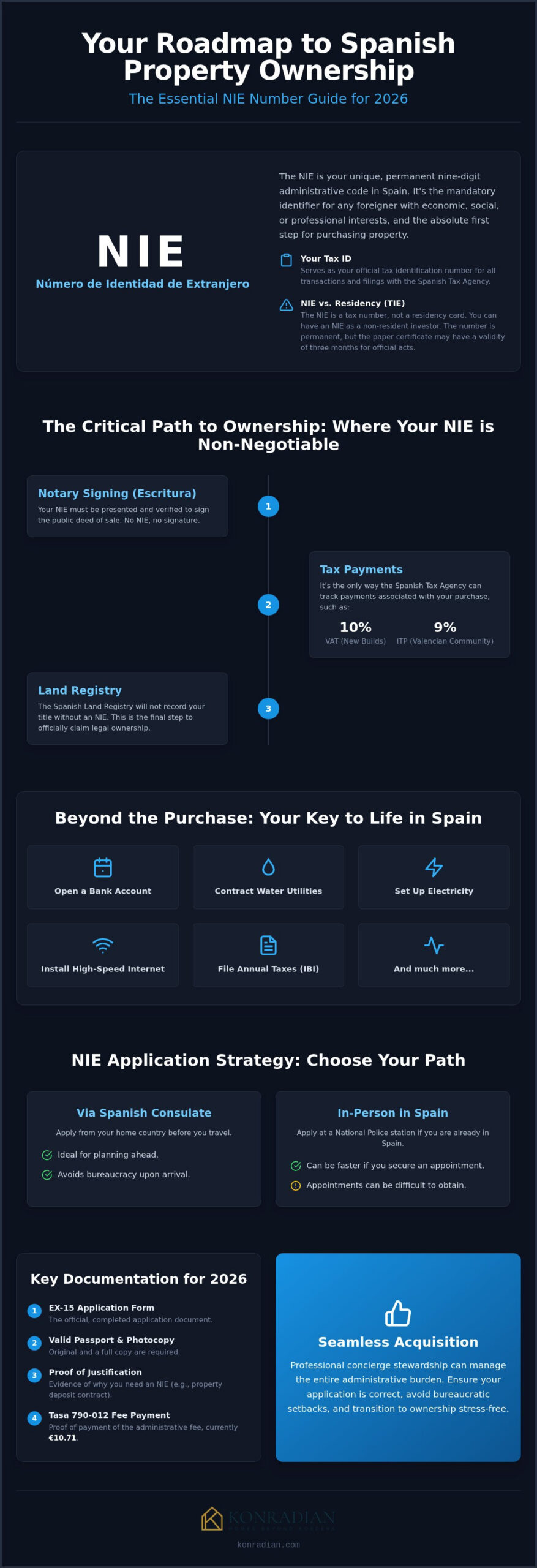
In the context of a 2026 property acquisition, the NIE is a non-negotiable legal requirement at every critical milestone. When you stand before the notary to sign the public deed, known as the Escritura, your NIE must be present and verified. It’s the only way the Spanish Tax Agency can track the necessary payments associated with your purchase. Whether you’re paying the 10% VAT on a new build or the recently reduced 9% Property Transfer Tax (ITP) in the Valencian Community, the transaction requires this number for legal validity. Finally, the Spanish Land Registry won’t record your title without an NIE; you can’t officially claim ownership of the asset until this administrative key is in place.
Beyond the Purchase: Everyday Uses for Property Owners
The utility of your NIE extends far beyond the initial signing ceremony. It’s the cornerstone of your life as a property owner in the Mediterranean. You’ll need it to open a Spanish bank account, which is essential for managing mortgage payments and local expenses. It’s also required to contract basic utilities like water and electricity. If you’re looking to enjoy high-speed fiber internet, providers will demand your NIE before installation. Additionally, it’s the identifier used for your annual tax obligations, including the IBI council tax and your non-resident income tax filings. By securing your NIE number for property purchase Spain early, you ensure these logistical transitions are handled with the same sophistication as the purchase itself.
Think of the NIE as the passport to your Spanish lifestyle. It connects you to the local infrastructure, allowing you to move from being a visitor to a stakeholder in the community. While the process can seem daunting, understanding its foundational role is the first step toward a seamless transition. Our approach ensures this requirement is met long before it becomes a bottleneck for your investment goals.
Navigating the NIE Landscape: Temporary vs. Resident Options
Understanding your NIE number for property purchase Spain starts with a fundamental distinction: the number is yours for life, but the document you hold has a shelf life. Once assigned, this nine-digit alphanumeric code remains your permanent tax identifier regardless of whether you eventually become a resident or sell your assets. It’s common for investors to confuse the NIE with residency status. They aren’t the same. The NIE is merely a tracking tool for the Spanish tax authorities, whereas residency involves a much deeper legal commitment to the state.
Your citizenship dictates the specific path you’ll take through the administrative landscape. EU citizens generally follow a streamlined process, often obtaining a green A4 certificate that combines the NIE with a registration on the central register of foreigners. For non-EU citizens, the path is more structured, requiring strict adherence to official government requirements through a consulate or an in-person appointment at a National Police station in Spain. This distinction is critical for setting realistic expectations regarding your transaction timeline.
The Non-Resident NIE for International Investors
For the majority of our clients, the “Non-Resident NIE” is the appropriate strategic tool. It’s designed specifically for those who wish to invest in the Spanish market without relocating. While your assigned number never changes, the physical white A4 certificate issued to non-residents is technically valid for only three months for administrative presentations. This doesn’t mean your number expires; it simply means that for certain official acts, such as the final signing at the notary, you may need a recently issued copy if your original is older than 90 days. This nuance often causes confusion in online forums, but it’s easily managed with proactive planning.
The TIE and Residency: When the NIE is Not Enough
If your lifestyle goals involve spending more than 183 days per year in Spain, the NIE is merely the precursor to the TIE (Tarjeta de Identidad de Extranjero). The TIE is a physical plastic card that serves as your residency permit. Transitioning from a non-resident investor to a legal resident involves proving financial self-sufficiency and healthcare coverage. For high-net-worth individuals, a property purchase exceeding €500,000 can open doors to the “Golden Visa” program, simplifying the residency path significantly. This route transforms your property from a simple asset into a gateway for European living.
Choosing the right path depends entirely on your long-term vision for your Mediterranean home. Whether you’re seeking a seasonal retreat or a permanent lifestyle change, having a trusted advisor to manage these timelines ensures your property acquisition remains a source of pleasure rather than a bureaucratic burden. Success in the Spanish market isn’t just about finding the right villa; it’s about aligning your administrative status with your investment strategy from the very beginning.
Obtaining Your NIE: Consulate vs. In-Person
Choosing the right method to secure your NIE number for property purchase Spain is a strategic decision that directly impacts your transaction timeline. There are three primary avenues available, each offering a different balance of personal involvement and administrative speed. Whether you prefer to handle the paperwork from your home country or finalize everything once you land in the Mediterranean, understanding the nuances of these paths is essential for a frictionless experience. We prioritize a methodical approach that aligns with your specific travel schedule and investment goals.
Applying via the Spanish Consulate Abroad
Investors often choose to initiate their application through the Spanish Consulate in their country of residence. This method allows you to secure your documentation before you even begin your physical property search. However, the appointment systems can be notoriously competitive. You’ll need to strictly follow the Official NIE Application Requirements, ensuring every form is perfectly executed to avoid rejection. In 2026, processing times typically range from two to six weeks, depending on the specific consulate’s volume. While this route offers the comfort of home, it requires early planning to avoid delays in your purchase agreement.
The In-Person Application in Spain
If you’re already in Spain, applying at a National Police station (Oficina de Extranjería) is the most direct route. This process requires a “Cita Previa,” an online appointment that can be difficult to secure in high-demand areas like the Costa Blanca, where international buyers represent nearly 45% of the market. The advantage here is speed; once you attend the appointment with your documents, the NIE is often issued on the spot or within a few days. It’s a high-precision task that demands local knowledge of which stations have the best availability and the most efficient processing times.
The Power of Attorney (POA) Advantage
For the sophisticated investor, the “Concierge Route” via Power of Attorney is the most efficient choice. This allows our legal partners to act on your behalf, removing the need for you to navigate police stations or wait in consulate lines. By granting a specific POA, the entire process of obtaining an NIE number for property purchase Spain is handled remotely. This service is seamlessly integrated into our broader legal support buying property abroad, ensuring that your administrative requirements are managed with the same rigor as your financial transaction. It’s the ultimate way to eliminate the “heavy lifting” and focus on the lifestyle benefits of your new acquisition without the stress of bureaucratic hurdles.
The NIE Application Checklist: Essential Documents for 2026
Meticulous preparation is the only safeguard against administrative rejection in the Spanish system. When applying for an NIE number for property purchase Spain, the margin for error is razor-thin. Spanish authorities demand absolute consistency between your identification documents and your application forms. Any discrepancy, no matter how minor, can lead to delays that jeopardize your purchase timeline. For documents issued outside of Spain, you must ensure they meet specific legal standards, often requiring an Apostille or sworn translations (traducciones juradas) performed by a professional registered with the Spanish Ministry of Foreign Affairs.
To ensure a successful submission, prioritize these five core items:
- Completed Form EX-15: The official application for non-resident identifiers, which must be completed in Spanish.
- Valid Passport: Your original travel document along with a full set of high-quality photocopies of every page.
- Proof of Economic Interest: A signed Arras contract, a deposit agreement, or a formal letter of intent from a developer.
- Form Modelo 790 (Code 012): Valid proof of the €10.71 administrative fee payment with a clear bank stamp.
- Power of Attorney (Optional): If you aren’t attending in person, a notarized and translated POA document.
The Core Document Set
The EX-15 form is your primary point of contact with the administration. It must be filled out with precision to ensure your personal details match your passport exactly. While the form itself is standard, the “justification” is where many applications falter. For property investors, this means providing a clear link to your intended acquisition. A private purchase contract or a letter from a notary is typically sufficient, but it must be current and legally binding. If your documents are in English or another foreign language, a sworn translation is non-negotiable to maintain the intellectual rigor of your file.
Administrative Fees and Proof of Payment
The financial component of your application involves the Modelo 790, specifically Code 012. This form is the vehicle for paying the mandatory €10.71 government tax. You must present this form at a Spanish bank to pay the fee before your appointment. The bank will provide a receipt or a stamp directly on the document. This physical proof of payment is essential; without a clearly visible bank stamp, your application will be paused immediately. It’s a small but critical detail that reflects the methodical nature of the Spanish bureaucracy.
Navigating these requirements is a standard part of our service. If you’d prefer to bypass the administrative friction, you can delegate your Spanish property acquisition to our expert team. We oversee every document, ensuring your application is bulletproof from the moment it reaches the authorities.
Seamless Acquisition: How Professional Stewardship Simplifies the Process
Securing your NIE number for property purchase Spain is a vital milestone, yet it represents just one component of a broader, more intricate journey. True investment success requires a bird’s-eye view of the entire transaction, from the initial site visit to the final registration in the Land Registry. We view this process through the lens of a comprehensive guide to Spanish property acquisition, where every administrative detail is handled with professional foresight. Our LSE-educated team provides the intellectual rigor necessary to manage these complexities, ensuring that your journey is defined by tranquility rather than technical friction.
The role of a trusted advisor is to act as a protective barrier between you and the bureaucratic hurdles of a foreign system. By providing a dedicated concierge for both legal and financial advice, we ensure that you’re never left deciphering conflicting forum advice or struggling with language barriers. This level of stewardship guarantees that your Spanish investment is secure from the very first signature to the moment the keys are placed in your hand. It’s a start-to-finish commitment to excellence that prioritizes your long-term interests and emotional well-being.
The Konradian End-to-End Service
Our approach is built on the principle of professional stewardship. We don’t just point you toward the right forms; we oversee the entire administrative timeline. This includes coordinating between lawyers, notaries, and banks to ensure that your funds and documents arrive in perfect synchronization. Through our exclusive partnerships, clients gain direct access to Spanish developer pre-sale property, often before these listings reach the general market. These opportunities are paired with free consultations designed to map out your investment journey with absolute clarity, removing the stress of high-stakes international transactions.
Your Next Steps in the Spanish Market
In a market where international buyers account for nearly 45% of transactions in regions like the Costa Blanca, speed is a strategic advantage. High-demand listings move quickly, and having your NIE ready can be the difference between securing an asset and losing it to a faster bidder. Applying early isn’t just a recommendation; it’s a tactical necessity for the serious investor. By leveraging our expertise, you ensure that every legal and financial safeguard is in place long before you reach the notary’s office. If you’re ready to master the Spanish real estate market with a dedicated concierge by your side, you can schedule a free consultation to begin your Spanish property journey today. Our commitment is to provide a seamless, end-to-end experience that protects your interests and your peace of mind.
Securing Your Mediterranean Legacy
Mastering the administrative landscape is the final hurdle between your current vision and the keys to your new home. By understanding the permanent nature of the NIE and the precision required for a successful application, you’ve already mitigated the primary risks of delay. Your NIE number for property purchase Spain serves as more than just a tax code; it’s the foundation of your future lifestyle and financial security in the Mediterranean.
Transitioning from an interested buyer to a confident owner is a journey best taken with expert stewardship. Our LSE-educated advisory team provides comprehensive end-to-end support at no cost to the buyer, handling every legal and financial nuance on your behalf. Through exclusive direct developer access and a commitment to seamless execution, we ensure your acquisition is as tranquil as the lifestyle you’re seeking. You don’t have to navigate the complexities of Spanish bureaucracy alone. Begin your seamless Spanish property acquisition with a free expert consultation and step into your new investment with absolute certainty. The sun-drenched lifestyle you’ve envisioned is well within reach.
Frequently Asked Questions
Can I buy property in Spain without an NIE number?
No, you cannot legally finalize a property transaction in Spain without an NIE. While you can sign a reservation agreement or a private contract, the public deed requires this identifier for the notary to authorize the sale. It’s also essential for paying the mandatory purchase taxes and registering your ownership at the Land Registry. Attempting to proceed without one will lead to significant delays and potential breach of contract.
How long does it typically take to get an NIE number in 2026?
The timeline depends heavily on your chosen application method. Obtaining an NIE number for property purchase Spain via a consulate typically takes between two and six weeks in 2026. In-person applications at a National Police station can provide the number almost immediately, though securing the necessary appointment can take several weeks in high-demand regions. Utilizing a Power of Attorney remains the most predictable route for international investors seeking a coordinated timeline.
Does the NIE number expire after the property purchase?
Your assigned NIE number is permanent and stays with you for life. It never expires, even if you sell your Spanish assets or change your residency status. However, the physical white A4 certificate is often required to be current for specific administrative acts. Many notaries and banks request a copy issued within the last 90 days to ensure your data remains updated in the central registry system.
Can my real estate agent get an NIE for me?
A real estate agent can only obtain the number on your behalf if you grant them a formal Power of Attorney. This legal document must be signed before a notary and translated if executed abroad. While many agents offer this, sophisticated buyers often prefer utilizing a dedicated legal concierge. This ensures the application is integrated into a broader framework of transaction security and professional stewardship.
Do I need a separate NIE for my spouse if we buy the property together?
Yes, every individual whose name appears on the property deed must have their own unique NIE. If you and your spouse are purchasing the asset as joint owners, the Spanish Tax Agency requires separate identifiers for each party to track individual tax liabilities. This requirement also applies to any other family members or business partners who will hold a percentage of the legal title after the acquisition.
Is the NIE number the same as tax residency in Spain?
No, holding an NIE number for property purchase Spain does not automatically make you a tax resident. The NIE is purely an identification tool for administrative and tax purposes. Tax residency is determined by different criteria, such as spending more than 183 days per year in the country or having your primary center of economic interests in Spain. You can remain a non-resident owner while possessing a permanent NIE.
What happens if I lose my NIE certificate?
If you lose your original certificate, you must apply for a duplicate using the same EX-15 form and paying the administrative fee again. Since your number is permanent and recorded in the national database, the process is straightforward but requires a new appointment. Keeping a high-quality digital scan of your original document is a vital step for any international property owner to avoid unnecessary bureaucratic friction.
Can I apply for an NIE number online without a representative?
No, the current Spanish system does not allow for a completely digital application without a physical component. You must either attend an appointment in person at a consulate or police station, or appoint a representative via Power of Attorney to submit the physical documentation on your behalf. While some systems are becoming more digital, the verification of your original passport still requires a face-to-face interaction or a legally authorized surrogate.
