


Could a property that looks perfect on paper actually be tethered to a socialist-era legal dispute you won’t discover until it’s too late? With Budapest house prices surging by 26.2% in 2025, the allure of the Hungarian market is undeniable. However, the sophisticated investor knows that high returns often come with intricate risks. Understanding the potential pitfalls of buying property in Hungary is the difference between a flourishing portfolio and a costly legal entanglement.
You’re likely concerned about the volatility of the Forint or the bureaucratic maze of non-EU purchase permits. These anxieties are valid in a market where local regulations, like the two-year short-term rental moratorium in Budapest, can shift the ground beneath your feet. It’s a complex environment that requires more than just local knowledge; it demands strategic, international-standard oversight to ensure your interests remain protected throughout the transaction.
This guide provides the professional foresight needed to secure your acquisition with absolute confidence. We’ll explore how to protect your capital against currency fluctuations, navigate the mandatory legal requirements, and account for the total cost of acquisition. From the Protection of Local Identity Act to the latest Land Registry processing times, you’ll gain a clear roadmap for a secure, legally sound investment.
Key Takeaways
- Implement a rigorous five-step due diligence framework to uncover legal encumbrances and ensure a secure, transparent title transfer.
- Master the strategies required to navigate the pitfalls of buying property in Hungary, from managing Forint volatility to understanding municipal pre-emption rights.
- Identify why local agency conflicts of interest can jeopardize your ROI and how to access professional brokerage at no cost to the buyer.
- Account for the total cost of ownership by identifying the specific technical requirements and hidden maintenance liabilities of historic Budapest estates.
The Hungarian Real Estate Opportunity vs. Bureaucratic Reality
Hungary remains a compelling destination for international capital in 2026. While many investors originally looked at Central Europe for “cheap” entry points, the market has matured significantly. Strategic acquisition has now replaced simple bargain hunting. Success in this environment requires a deep understanding property law and the local administrative framework that governs high-stakes transactions. It’s no longer about finding the lowest price; it’s about identifying assets with clean titles and sustainable growth potential.
The Földhivatal, or Land Registry, is the primary safeguard for your investment. It acts as the final arbiter of ownership and legal status. However, the process is rarely instantaneous. In 2026, processing times can fluctuate, making professional oversight essential to ensure your application doesn’t stall in a bureaucratic queue. A Hungarian lawyer is a legal requirement for any property transfer. They draft the final contract and handle the formal submission to the registry. Their expertise helps you avoid the common pitfalls of buying property in Hungary by verifying that the title is clear of “socialist-era” encumbrances or hidden municipal claims.
The Allure of Budapest and Beyond
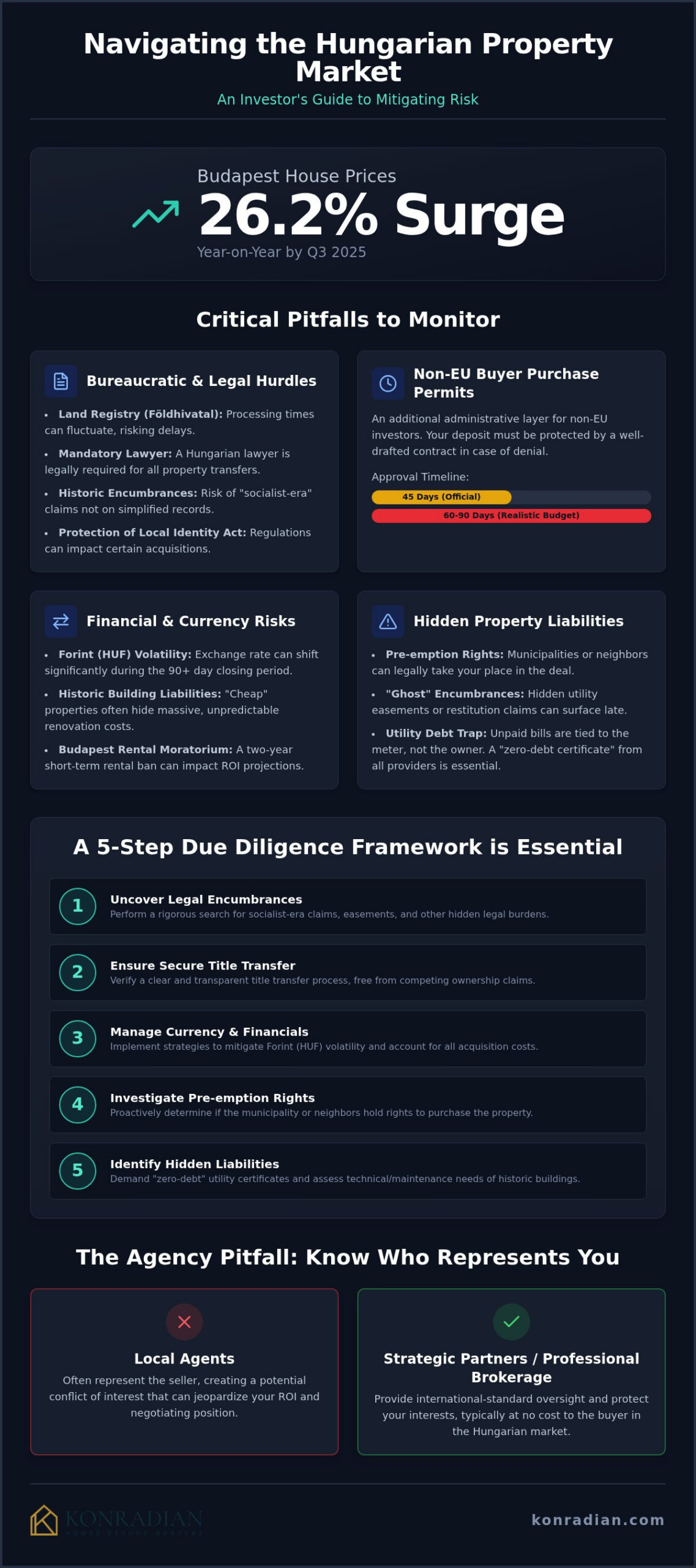
Budapest’s inner districts continue to lead the market, with house prices in the capital rising by 26.2% year-on-year by Q3 2025. District V remains the gold standard for prestige, while Districts VI and VII offer robust rental demand from a cosmopolitan tenant base. However, savvy investors are looking toward District VIII, where gentrification is driving rapid value increases. You must be wary of the “cheap” property trap. A low price in a historic Pest building often masks significant structural liabilities. Renovation costs in these protected structures can be unpredictable, quickly turning a perceived bargain into a financial burden.
The Non-EU Buyer’s Hurdle: Purchase Permits
Investors from outside the European Union face an additional layer of administration: the mandatory purchase permit. While the official statutory deadline is 45 days, you should realistically budget for a 60 to 90 day waiting period for government approval. Rejection is uncommon, but it can happen if the purchase is deemed to conflict with local interests. It’s critical to structure your purchase contract so that your deposit is fully protected. A well-drafted agreement ensures your funds are returned if the permit is denied. Navigating these pitfalls of buying property in Hungary is a standard part of our end-to-end support, which, in the Hungarian market, is provided at no cost to the buyer.
Critical Financial and Legal Pitfalls to Monitor
Financial security in the Hungarian market requires more than just a liquid balance sheet. It demands a proactive defense against structural risks that can derail an investment. One of the most overlooked pitfalls of buying property in Hungary is the “pre-emption right.” In specific districts, particularly those with historic significance, the local municipality or even immediate neighbors may hold a legal right to step into your position at the agreed price. If they choose to exercise this right, your deal can vanish after months of due diligence, leaving you to start the search from scratch.
Beyond human intervention, the property itself may carry “ghost” encumbrances. These often include socialist-era utility easements that might not appear on simplified digital records or complex restitution claims from former owners. Equally dangerous is the utility debt trap. In Hungary, certain debts attach to the utility meter rather than the individual owner. Without a verified “zero-debt certificate” from every provider, including water, gas, and electricity, you could inherit significant unpaid liabilities that become your legal responsibility the moment the title transfers.
Exchange Rate Risk: Timing Your Conversion
The Hungarian Forint (HUF) is known for its volatility compared to the Euro or US Dollar. Since the closing period for a transaction can span 90 days or more, a sudden shift in the exchange rate can significantly alter your final purchase price in your home currency. According to the Hungarian National Bank’s housing market analysis, the market is currently characterized by accelerating dynamics, yet currency fluctuations remain a primary concern for international capital. You can mitigate this risk by using forward contracts to lock in rates or by structuring Euro-denominated payments, though this requires precise legal wording in the purchase agreement.
Title Deed Scrutiny: Beyond the Surface
Every secure transaction begins with a deep analysis of the Tulajdoni lap (Title Deed). It’s a vital document, but it requires expert interpretation. A frequent error involves purchasing property classified as Zártkert, or restricted garden plots. these areas have strict development limitations and much longer closing times due to agricultural land laws. Additionally, you must verify that all structural changes, such as loft conversions or internal wall removals, were completed with the proper permits. Unrecorded changes can lead to heavy fines or even a mandate to restore the property to its original state. Our team at Konradian provides the strategic oversight needed to identify these red flags before you commit your capital.
The Agency Pitfall: Local Agents vs. Strategic Partners
The traditional agency model in Central Europe often operates on a fundamental conflict of interest. When you enter the Budapest market, you’ll find that many local agents prioritize high-volume turnover over your long-term return on investment. This misalignment is one of the primary common pitfalls for expat buyers who assume the person showing them the property is an advocate for their capital. In reality, a local agent’s loyalty is almost always tethered to the seller, who provides the inventory and dictates the pace of the sale.
This dynamic often results in what seasoned investors call the “Foreigner Premium.” Without independent representation, international buyers frequently face inflated pricing or properties with structural issues that a local buyer would immediately reject. Language barriers exacerbate this risk. Technical nuances in the contract can be glossed over during the negotiation phase, leading to a lack of clarity on your rights as an owner. One of the most significant pitfalls of buying property in Hungary involves the commission structure. You shouldn’t pay a buyer’s fee in this market. Professional brokerage services should be seller-paid, and any request for a “finder’s fee” from an agent is a major red flag.
The Local Agent Model
Local agencies typically focus on the speed of the transaction. Their business model relies on moving as many units as possible, which leaves little room for the rigorous due diligence an international portfolio requires. You’ll often find these agents have limited access to truly lucrative opportunities, such as off-market deals or direct pre-sales from developers. Dual-representation is also common. This means the same agent might represent both the buyer and the seller, making it impossible for them to negotiate the best possible price for you. This lack of transparency can lead to missed red flags regarding the property’s legal or technical status.
The Konradian Advantage: Elite Buyer Advocacy
Konradian provides a sophisticated alternative to the traditional model. Our LSE-educated advisors act as strategic partners, offering an international mindset that bridges the gap between global expectations and local realities. We handle the heavy lifting, from initial video consultations to the final key handover. Our team leverages direct relationships with Hungarian developers to secure premium inventory that rarely reaches the public market. Most importantly, our brokerage services are entirely free for the buyer. We ensure your investment is protected by professional stewardship while the developer or seller covers the costs. This removes the conflict of interest and aligns our goals directly with your successful acquisition.
A 5-Step Due Diligence Framework for 2026
Sophisticated investors don’t rely on luck; they rely on a repeatable, data-driven process. To avoid the most common pitfalls of buying property in Hungary, you must move beyond the surface level of a property’s aesthetic appeal. A rigorous framework ensures that your capital is protected from the moment you sign the letter of intent until the final utility meter is transferred to your name. This methodical approach transforms a complex international transaction into a manageable, secure professional process.
Step 1 & 2: The Foundation of Security
The first line of defense is an up-to-the-minute Title Deed (Tulajdoni lap) extract. It’s not enough to see a copy from last month. You need to verify that the property is per- és tehermentes, meaning it’s entirely free of litigation, mortgages, or hidden encumbrances. Simultaneously, a technical inspection is non-negotiable for Budapest’s historic stock. You’re not just buying an apartment; you’re buying into a building’s collective liability. A specialist must assess:
- Antiquated wiring and plumbing systems common in 19th-century builds.
- Rising damp or structural cracks that could indicate foundation issues.
- The condition of common areas, as roof or elevator repairs often lead to “special levies” for all owners.
Furthermore, when modernizing the utilities of an older property, many owners choose to address water quality issues directly; you can explore Jednorazové poplatky za predaj a inštaláciu filtračných systémov to see how professional filtration can be integrated into your renovation plans.
Identifying these liabilities early allows you to negotiate the price or walk away before committing a deposit. In a market where house prices in Budapest rose by 26.2% in 2025, ensuring the physical asset matches the valuation is critical for your long-term ROI.
Step 3 to 5: Closing with Confidence
Once the physical and legal foundations are clear, the focus shifts to the transaction structure. In Hungary, the lawyer acts as a neutral counter-signer (Ellenjegyzés). They ensure the contract complies with national standards while protecting both parties. You’ll also need to budget for the standard 4% Property Acquisition Tax (Illeték), which is typically invoiced by the tax authority several months after the purchase is finalized. For properties exceeding HUF 1 billion, be aware that an additional 2% charge applies to the amount above that threshold.
The process concludes with the Birtokbaadási jegyzőkönyv, a formal handover protocol. This document records the exact state of the property and all meter readings at the moment of transfer. Failing to execute this correctly is one of the frequent pitfalls of buying property in Hungary, as it can leave you liable for the previous owner’s utility arrears. Our team at Konradian provides the Legal and Financial Transaction Support necessary to manage these steps with total precision, ensuring your investment remains secure from start to finish.
Conclusion: Securing Your Hungarian Portfolio with Konradian
Hungary remains a cornerstone of strategic Central European investment. With Budapest’s house prices having climbed by 26.2% in 2025, the market offers a rare combination of capital appreciation and robust rental yields. However, as we have explored, the transition from a casual observer to a successful owner is paved with administrative and financial hurdles. Navigating the pitfalls of buying property in Hungary requires more than just capital; it demands a partner who understands the intersection of local regulation and global investment standards.
The complexities of the Földhivatal, the nuances of municipal pre-emption rights, and the volatility of the Forint can be overwhelming for those operating without local expertise. Konradian was established to provide this missing layer of professional stewardship. We believe that a high-stakes international transaction should be characterized by ease and precision rather than stress. By acting as your dedicated advocate, we handle the heavy lifting of due diligence and negotiation, ensuring your portfolio is built on a foundation of legal and technical security.
Our sophisticated approach eliminates the primary pitfalls of buying property in Hungary at no cost to you. Because our brokerage services are seller-paid, you receive elite, independent representation without the conflict of interest found in traditional local agencies. We don’t just find properties; we secure assets that align with your long-term wealth objectives, providing a seamless experience from the first video consultation to the final handover of keys.
Your Global Partner in Hungary
Working with an LSE-educated team means your investment is backed by intellectual rigor and market savvy. We provide our clients with exclusive access to developer-direct pre-sales and off-market opportunities that never reach the public portals. This insider access is paired with a deep understanding of the cosmopolitan investor’s needs, from tax structuring to currency risk mitigation. For a broader view of the market’s trajectory, we invite you to read our Property Investment in Hungary: A Strategic Guide for International Investors in 2026.
Start Your Strategic Consultation
The journey toward a secure Hungarian acquisition begins with a conversation. We invite you to book a free video call to discuss your specific portfolio goals and explore how our end-to-end support can protect your capital. Experience the quiet confidence that comes from professional stewardship and ensure your next move is both legally sound and financially optimized. Secure your Hungarian investment with Konradian today and step into the 2026 market with a proactive, protective partner by your side.
Elevating Your Investment Strategy in 2026
The Hungarian market presents a rare opportunity for growth; yet, the path to a successful acquisition is defined by the quality of your foresight. You’ve seen that securing a high-yield asset requires more than just capital. It demands a rigorous due diligence framework that accounts for “ghost” encumbrances and the technical liabilities of historic Budapest estates. By mastering the pitfalls of buying property in Hungary, you move from a position of uncertainty to one of strategic control.
Our LSE-educated advisory team is here to manage the heavy lifting, providing the end-to-end legal and financial support your portfolio deserves. We take pride in offering a zero-cost service for buyers, ensuring your interests remain the sole priority throughout the transaction. It’s a level of professional stewardship that allows you to navigate complex regulations with ease and quiet confidence. By aligning with a partner who understands the local landscape through a global lens, you protect your capital and your peace of mind.
Book a free consultation for your Hungarian property acquisition and let us transform your international investment vision into a secure, tangible reality.
Frequently Asked Questions
Can a foreigner buy property in Hungary without a local company?
Yes, foreign individuals can acquire residential real estate in their own name. While EU citizens enjoy the same rights as locals, non-EU investors must obtain a government permit. Setting up a local company is an option but isn’t a requirement for most residential acquisitions. This flexibility allows for a straightforward ownership structure, though agricultural land remains strictly reserved for domestic and EU farmers.
What are the hidden costs of buying property in Hungary besides the purchase price?
Beyond the purchase price, you must budget for the 4% Property Acquisition Tax and mandatory legal fees. Legal representation usually costs between 1% and 1.5% of the asset value. Additional expenses include Land Registry filing fees and, for non-EU buyers, an administrative permit fee of approximately HUF 65,000. Navigating these costs is part of identifying the financial pitfalls of buying property in Hungary before you commit capital.
Is it safe to buy a property in Budapest for renovation?
Purchasing for renovation is safe provided you conduct a rigorous technical inspection first. Historic buildings in districts like VI or VII often hide structural issues, such as antiquated plumbing or rising damp. You must also verify if the property is under heritage protection, as this significantly impacts your renovation timeline and budget. Professional stewardship ensures you don’t inherit a liability disguised as a bargain.
How long does the property buying process take in Hungary for non-EU citizens?
The timeline for non-EU citizens typically spans 90 to 120 days from the initial offer to final registration. While the statutory deadline for the government permit is 45 days, the administrative process often takes longer in practice. EU citizens can move much faster, often closing within 30 days. We manage this timeline meticulously to ensure your funds remain secure throughout the waiting period.
Do I need to be physically present in Hungary to close the deal?
You don’t need to be physically present to finalize your acquisition. By granting a Power of Attorney to your Hungarian lawyer, they can sign the necessary documents on your behalf. This is a common practice for our international clients, allowing for a seamless transaction without the need for multiple trips to Budapest. It’s a sophisticated way to handle high-stakes transactions with ease and efficiency.
What happens if my purchase permit is rejected by the Land Registry?
If a permit is rejected, the purchase contract becomes void. A professionally drafted agreement will always include a clause ensuring the immediate and full return of your deposit in this scenario. While rejection is statistically rare, this contractual safeguard is a vital component of our protective strategy. It’s one of the ways we mitigate the pitfalls of buying property in Hungary for non-EU investors.
Are there any specific property taxes for foreign owners in Hungary?
Hungary doesn’t impose additional or discriminatory taxes on foreign property owners. You’ll pay the standard 4% acquisition tax upon purchase and any local municipality taxes applicable to the specific district. Some districts in Budapest charge a modest annual communal tax based on the size of the property. These costs are predictable and transparent when accounted for during the initial strategic planning phase.
How do I ensure the property I am buying has no hidden debts?
Security is achieved by demanding a “zero-debt certificate” from all utility providers before the final payment. Your lawyer will also pull a fresh Title Deed extract to verify that no mortgages, tax liens, or utility-related encumbrances are registered against the property. We oversee this process from start to finish, ensuring that your new asset is delivered entirely free of third-party claims or inherited financial burdens.
