


What if the greatest risk to your global wealth isn’t the volatility of the market, but the invisible borders of your own investment portfolio? Many aspiring investors view the prospect of international real estate with a mix of excitement and deep-seated apprehension. You might feel that the dream of a Mediterranean retreat or a high-yield urban asset is perpetually out of reach due to hidden legal costs or the nuances of local market cycles. It’s natural to feel protective of your capital when faced with language barriers and unfamiliar regulatory frameworks.
This 2026 guide is designed to bridge that gap, offering a professional framework for property investment abroad for beginners that prioritizes security and long-term growth. We’ll show you how to move beyond the “tourist dreaming” phase and adopt the mindset of a strategic global steward. You’ll learn how to identify emerging opportunities in markets like Spain, Hungary, and the United States while avoiding common pitfalls that trap the unadvised. We’ll preview a structured approach to acquisition that ensures your transition into international ownership is seamless, transparent, and rewarding.
Key Takeaways
- Understand how to navigate the 2026 global interest rate landscape to identify resilient markets that offer long-term capital protection.
- Learn to bypass retail markups by utilizing direct developer access, ensuring you secure maximum value through exclusive pre-sale opportunities.
- Master a professional framework for property investment abroad for beginners that incorporates essential legal safeguards like escrow accounts and independent counsel.
- Discover the strategic advantage of the “zero-cost” buyer model, where elite brokerage services are funded by sellers in markets such as Spain and the USA.
- Transition from a tourist perspective to a strategic investor mindset by leveraging LSE-educated analysis to align your global assets with your residency or income goals.
Demystifying Property Investment Abroad: The 2026 Beginner’s Landscape
International real estate has evolved from a luxury reserved for the elite into a sophisticated tool for wealth diversification. For many, property investment abroad for beginners represents more than a financial transaction; it’s a strategic move to secure a global lifestyle and hedge against domestic economic shifts. In 2026, the landscape is defined by a transition toward professional stewardship. We’ve moved past the era of speculative bubbles into a period where market resilience and legal transparency are the primary drivers of value. Understanding real estate investing fundamentals is the first step toward protecting your capital in this increasingly interconnected environment.
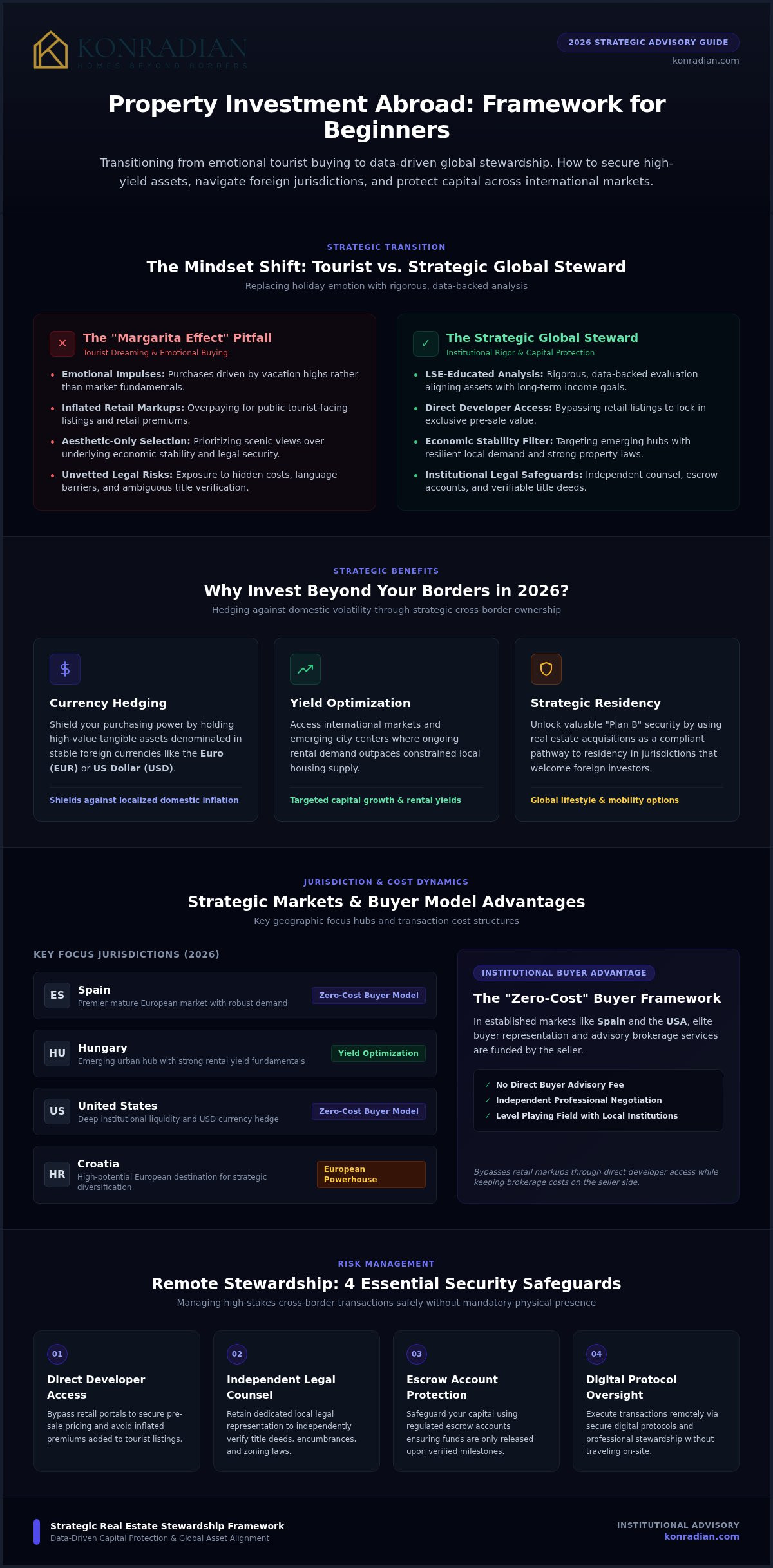
The greatest threat to a beginner’s capital isn’t usually the market itself, but what’s known as the “Margarita Effect.” This occurs when the emotional high of a holiday leads to an impulsive, overpriced purchase. To succeed, you must replace tourist sentiment with rigorous, data-driven analysis. The 2026 outlook favors those who can identify emerging hubs that offer genuine growth rather than just aesthetic appeal. Successful investors now prioritize markets with strong internal demand and direct developer access to ensure they aren’t paying a premium for retail listings.
Why Invest Beyond Your Borders in 2026?
Diversifying your holdings across different currencies acts as a vital shield against localized volatility. While some domestic markets may feel stagnant, specific hubs in Spain, Hungary, and the United States continue to offer attractive yields. Investing internationally also provides a “Plan B” benefit, often opening doors to residency or long-term lifestyle options that a domestic-only portfolio cannot match.
- Currency Hedging: Protect your purchasing power by holding assets in diverse currencies like the Euro or US Dollar.
- Yield Optimization: Access markets where rental demand outpaces local supply, particularly in emerging European city centers or high-demand coastal destinations, such as those served by Baltic Apartments – apartamenty w Świnoujściu.
- Strategic Residency: Use your acquisition as a secure path toward residency in jurisdictions that value foreign investment.
Common Beginner Misconceptions vs. Market Reality
A frequent myth is that you must reside in a country to effectively manage an investment there. In reality, modern professional stewardship models allow you to oversee high-stakes transactions from anywhere in the world. Remote Stewardship in 2026 is defined as the secure management of international assets through digital transaction protocols, independent legal counsel, and professional brokerage that ensures your interests are protected without requiring your physical presence. By leveraging an LSE-educated advisory team, you can handle the complexities of property investment abroad for beginners with the same precision as a local institutional buyer.
Selecting Your Market: Strategic Criteria for High-Yield Diversification
Choosing the right jurisdiction is the most critical decision in property investment abroad for beginners. You shouldn’t simply look for beautiful vistas; you must prioritize economic stability and the strength of local property laws. High-level investors use these as primary filters to ensure their title deeds are secure and their capital is protected. It’s helpful to consult government guidance on buying property abroad to understand the baseline requirements for title verification and legal safeguards in foreign territories.
Direct developer access is another cornerstone of a professional acquisition strategy. By bypassing retail listings, you avoid the inflated markups often found on public portals, effectively neutralizing the “Margarita Effect” where emotional premiums are added to tourist-facing properties. This approach allows you to secure pre-sale value and gain access to exclusive inventory before it reaches the general market. Whether you’re targeting high-traffic tourism zones or stable urban hubs, the goal is to align the asset with your specific financial objectives, such as long-term capital appreciation or immediate yield.
The European Powerhouses: Spain, Croatia, and Hungary
Spain remains a premier choice for those seeking a mature market that balances lifestyle benefits with consistent capital growth. Its legal framework is well-established, providing a sense of security for first-time international buyers. For a deeper analysis of regional trends, refer to The Comprehensive Guide to Spanish Property Acquisition. In contrast, Croatia offers high-growth potential along the Adriatic coast, where limited supply and increasing demand drive value. In both markets, our “buyer-free” model ensures that commissions are handled by the seller, allowing you to allocate more of your capital directly into the asset.
The Anglo-American Opportunity: USA and UK Markets
In the United States, investors are increasingly looking beyond urban centers toward regions that offer high-yield potential and lifestyle appeal. For those targeting the luxury mountain home market, NC High Country Real Estate provides specialized local expertise in the Blue Ridge region, helping international buyers secure premium assets.
The US market is often viewed as a vital portfolio balancer due to its unparalleled economic scale and potential for high-yield passive income. For those looking across the Atlantic, US Real Estate Investment from Europe provides a strategic roadmap for navigating this complex but rewarding environment. Meanwhile, the UK offers specialized sourcing opportunities in high-demand residential zones, particularly for investors focused on long-term stability.
It’s vital to understand the varying fee structures across these regions. While the US and Spain typically follow a model where the seller pays the brokerage fees, the UK market often requires a different approach to sourcing. Navigating these nuances is where professional stewardship becomes invaluable. If you’re ready to explore how these markets fit into your broader strategy, you might consider booking a free strategy consultation to align your goals with current global opportunities.
Navigating Legalities and Financial Safeguards in Foreign Jurisdictions
Securing your capital requires more than a keen eye for location; it demands a robust legal “Safety-Net.” For those exploring property investment abroad for beginners, this framework consists of three essential pillars: the notary, independent legal counsel, and the strategic use of escrow accounts. These safeguards ensure that every Euro or Dollar you commit is protected by enforceable contracts and verified title deeds. Establishing this foundation early alleviates the inherent stress of cross-border transactions and projects a level of professional rigor that sellers respect.
Off-plan projects often offer the highest growth potential, yet they carry inherent delivery risks that must be managed. Conducting thorough due diligence on developers is non-negotiable. You should verify their historical track record, insurance bonds, and current planning permissions before signing any reservation agreement. It’s helpful to consult government guidance on buying property abroad to understand how to verify local land registry entries and developer guarantees effectively. In 2026, tax landscapes for non-residents have become increasingly nuanced. Understanding your liabilities for capital gains and rental income is vital for calculating true net returns. Without specialized legal support buying property abroad, it’s easy to overlook local wealth taxes or reporting requirements that can impact your long-term profitability.
The Role of the Local Notary vs. Your Private Counsel
A frequent error among first-time buyers is assuming the local notary acts as their personal advisor. While the notary is a public official whose duty is to the state and the formal legality of the document, your private counsel’s sole duty is to protect your specific interests. You should never rely on a lawyer recommended by the developer or the seller. Your independent representative must meticulously verify the title deeds, habitability certificates, and ensure the property is free of any undisclosed debts or liens before you proceed to completion.
Financial Logistics: Moving Capital Across Borders
Moving capital internationally involves more than a simple bank transfer. You’ll typically need to open local bank accounts and obtain specific tax identification numbers, such as the NIE in Spain, to finalize any acquisition. Managing currency risk is equally vital, as fluctuations during the closing period can significantly impact your final purchase price. To mitigate these risks, professional investors often use structured payment schedules. An Escrow account functions as a neutral third-party repository that holds and regulates payment of the funds required for two parties involved in a given transaction, ensuring money only changes hands once all legal conditions are met.
The Step-by-Step Acquisition Journey for First-Time Overseas Investors
The transition from initial interest to successful ownership requires a methodical approach that balances global strategy with local precision. For those embarking on property investment abroad for beginners, the journey begins with an initial strategy session. These free video consultations serve to align your specific financial goals with current market opportunities, ensuring your investment thesis is sound before any capital is committed. Whether your priority is high rental yield, long-term capital appreciation, or a lifestyle hedge, this foundational step establishes the roadmap for a secure acquisition.
From Consultation to Reservation
Once your goals are defined, the selection phase focuses on curating exclusive listings that meet your criteria. A significant advantage for beginners is gaining access to direct developer pre-sale deals. These opportunities allow you to secure assets at lower price points before they’re launched to the general public, effectively capturing early-stage growth. When a suitable property is identified, a formal reservation agreement is drafted. This typically involves a standard reservation fee, which should legally secure the property and remove it from the market while your legal counsel conducts final due diligence. It’s essential that this fee is handled through secure channels to protect your initial outlay.
The viewing protocol has evolved significantly, offering a blend of efficiency and depth. While physical site visits remain valuable for final confirmation, sophisticated virtual tours and high-definition video walkthroughs allow you to filter options without unnecessary travel. This streamlined approach ensures that when you do travel, it’s to inspect a property that already meets the majority of your requirements. Negotiation is then conducted with professional oversight, ensuring that the final contract reflects the true market value and includes all necessary developer guarantees.
Completion and Key Handover
The final phase of your journey is the completion ceremony, where the title deed is officially transferred. For remote buyers, Power of Attorney (PoA) options allow your legal representative to sign on your behalf, ensuring the process remains seamless regardless of your location. Following the signing, your post-purchase obligations begin, including the settlement of local taxes and the setup of utilities and community fees. The final handover is a meticulous process where the property is inspected to ensure it matches the contract specifications in every detail. If you’re ready to begin this structured path to ownership, you can schedule a consultation with our advisory team to discuss your 2026 investment goals.
Professional Stewardship: Managing the End-to-End Investment Process
Success in property investment abroad for beginners often depends on the quality of representation you have on the ground. Most first-time investors mistakenly believe they must navigate foreign brokers who primarily represent the seller’s interests. In markets such as Spain, Croatia, and the USA, we utilize a ‘Zero-Cost’ Buyer Model where the seller handles the brokerage fees. This allows you to benefit from elite, buyer-side representation without additional financial burden. It’s a strategic advantage that ensures your interests are the sole priority throughout the transaction.
Our approach is grounded in a level of intellectual rigor that goes beyond simple property sales. With an LSE-educated advisory team, we provide a strategic market analysis that evaluates assets based on macroeconomic trends and long-term stability. This high-level perspective is particularly vital when integrating a UK property sourcing service into a high-net-worth portfolio. While the UK market doesn’t follow the same fee structure as Spain or the US, its complexity makes dedicated sourcing specialists essential for identifying high-yield residential opportunities that aren’t visible to the general public.
The Advantage of International Mindset with Local Expertise
Bridging the gap between international standards and local market quirks is where professional stewardship provides the most value. We act as a dedicated concierge, handling the “heavy lifting” of administrative hurdles and cultural nuances that often cause investor anxiety. Our direct developer relationships are a cornerstone of this model. These connections provide exclusive access to inventory and pre-sale opportunities, ensuring you aren’t competing for retail listings that have already been marked up for the tourist market.
Your Next Steps: Building a Global Portfolio
The journey toward a secure global portfolio is a methodical process that begins with clear alignment. A start-to-finish flow is non-negotiable for beginners because it ensures that no detail is overlooked between the initial strategy and the final key handover. This end-to-end support transforms a complex international transaction into a seamless professional experience. It’s about providing the peace of mind that comes from knowing every legal, financial, and strategic element is being managed by experts who prioritize your long-term wealth.
Your 2026 investment journey starts with a simple, high-level conversation to map out your goals and identify the right jurisdictions for your capital. We invite you to book your free video consultation with Konradian to explore how our strategic framework can protect and grow your international assets.
Advancing Your Global Wealth Strategy in 2026
Mastering international real estate requires a transition from emotional interest to disciplined, strategic acquisition. Success in property investment abroad for beginners is built upon a foundation of rigorous market analysis and robust legal safeguards. By prioritizing economic stability over aesthetic appeal and leveraging professional stewardship, you can secure assets that provide both capital protection and long-term yield. This journey is most effective when supported by a framework that integrates every step from initial strategy to the final handover of keys.
Our LSE-educated advisory team provides the intellectual authority needed to manage high-stakes transactions with precision. You’ll benefit from direct access to exclusive developer pre-sales and full end-to-end transaction support, often at no cost to you as the buyer. This approach ensures your global portfolio is built on transparency and expert insight rather than retail markups. If you’re ready to move beyond the borders of your domestic market, secure your international investment future with a free Konradian consultation. Your path to global asset ownership is clear, secure, and within reach.
Frequently Asked Questions
Is it safe for a beginner to buy property in a country where they don’t speak the language?
Yes, provided you have independent, bilingual legal counsel and professional representation. You shouldn’t rely on the seller’s agent or translation apps for high-stakes contracts. Expert advisors bridge the cultural and linguistic gap, ensuring every clause is understood before signing. This layer of professional stewardship allows you to focus on the strategic value of the asset while your team handles the technical communication.
What are the typical hidden costs associated with buying property abroad in 2026?
Beyond the purchase price, you must account for local transfer taxes, notary fees, and legal costs. In Spain, for example, these can range from 10% to 12% of the property value. Other costs include currency exchange spreads, bank transfer fees, and initial utility connections. Factoring these into your initial budget is a core part of property investment abroad for beginners to avoid capital shortfalls during the closing process.
Can I get a mortgage as a foreigner when investing in property abroad?
Foreigners can often access local financing, though loan-to-value ratios are typically lower than for residents. Most international lenders require a minimum down payment of 30% to 40% and proof of stable global income. While we don’t provide direct mortgage lending, we can guide you toward reputable local banks that specialize in non-resident applications. Understanding these financial requirements early ensures your acquisition strategy remains realistic and well-funded.
How do I ensure the property I buy off-plan will actually be finished?
Protecting your capital in off-plan developments requires rigorous due diligence on the developer’s track record and financial standing. You must ensure that all stage payments are protected by a bank guarantee or held in a secure escrow account. These legal safeguards ensure that your funds are only released as construction milestones are met. Professional advisors verify these developer guarantees and planning permissions to mitigate the risk of project abandonment.
Do I need to visit the country in person to complete the property purchase?
Physical presence is no longer a requirement for completing a transaction in most modern jurisdictions. By granting Power of Attorney (PoA) to a trusted legal representative, you can authorize them to sign deeds and handle administrative filings on your behalf. This remote model is highly efficient for busy investors. High-definition virtual tours and detailed reporting provide the necessary transparency to make informed decisions without the need for constant travel.
What is the ‘Golden Visa’ and which countries offer it through property investment?
A Golden Visa is a residency-by-investment program that grants residency rights in exchange for a qualifying real estate purchase. Countries like Spain and Hungary have historically offered these pathways, though regulations often shift. These programs are attractive for those seeking a “Plan B” or easier access to the Schengen Area. We help you identify properties that meet the specific threshold requirements for these residency schemes while ensuring the asset remains a sound financial investment.
How does the ‘free for the buyer’ brokerage model actually work?
In markets like Spain, Croatia, Hungary, and the USA, the seller or developer pays the brokerage commission. This allows you to receive end-to-end advisory services, from initial consultation to key handover, at no direct cost. It’s a strategic advantage for those starting in property investment abroad for beginners, as it provides elite representation without depleting your investment capital. This model ensures you have professional oversight focused solely on your interests.
What happens if I want to sell my international property investment later?
Selling an international asset follows a similar professional process to the acquisition, requiring local legal support to handle the deed transfer and tax settlements. You’ll need to account for capital gains taxes in the local jurisdiction and potentially in your home country. Maintaining clear records of all initial purchase costs and subsequent improvements is vital for optimizing your tax position. Our team provides the strategic market analysis needed to time your exit effectively.
