


The most expensive mistake in international real estate isn’t overpaying for the property itself; it’s failing to account for the silent erosion of capital through unmanaged local tax shifts and legal complexities. Learning how to buy property abroad for the first time requires more than just an eye for a beautiful location. It demands a transition from a tourist’s perspective to a mindset of strategic stewardship. You likely feel the weight of this decision, balancing the excitement of a global portfolio against the very real fears of hidden closing costs and the cultural barriers that often complicate high-stakes negotiations.
We understand that security is your primary priority. This guide provides a professional framework designed to protect your capital while maximizing global returns in the 2026 market. You’ll gain a clear, end-to-end perspective on securing passive income or residency without the typical stress of international transactions. We’ll explore the current fiscal realities in markets like Spain and Croatia, detailing a methodical path to ownership that prioritizes your long-term peace of mind. From understanding 2026 tax updates to bypassing retail listings through direct developer access, this is your blueprint for sophisticated global investment.
Key Takeaways
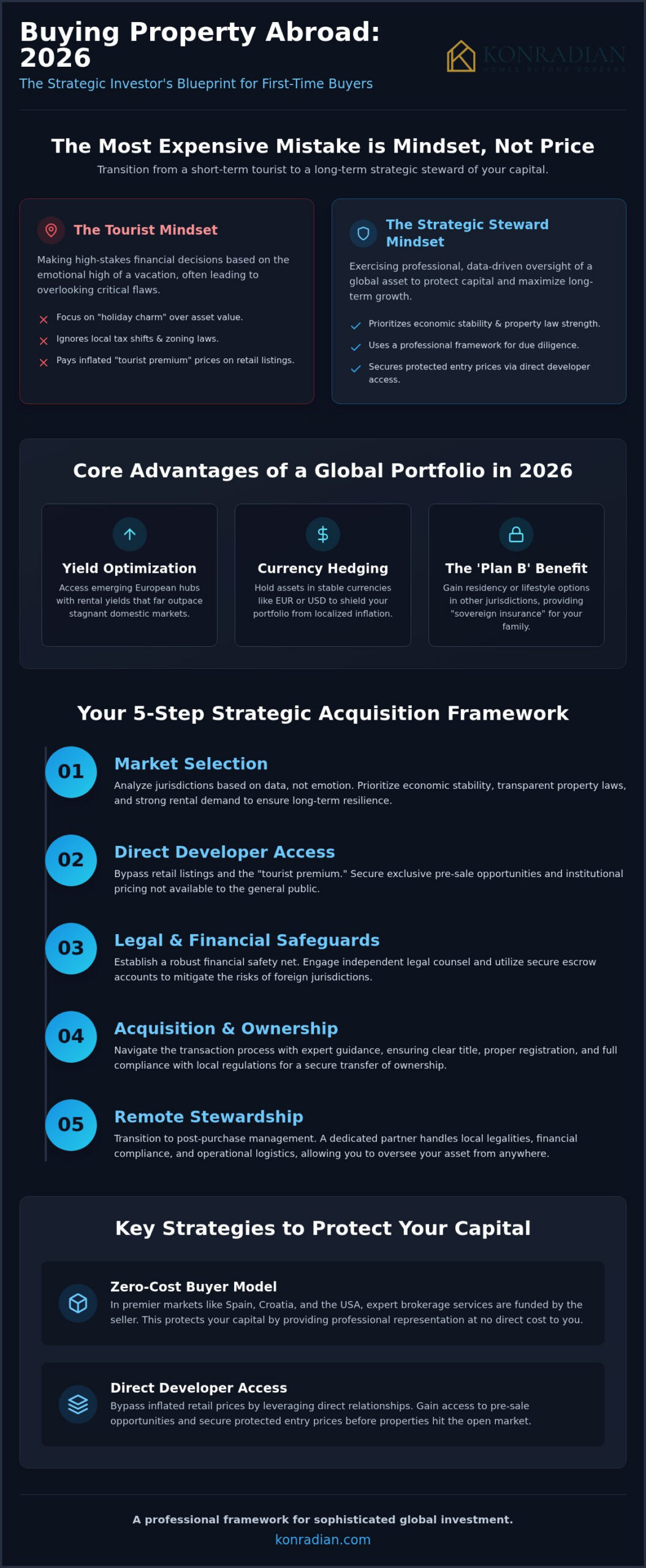
- Transition from a tourist perspective to a mindset of strategic stewardship by prioritizing economic stability and property law strength in your 2026 market selection.
- Bypass the “margarita effect” of retail listings by utilizing direct developer relationships to secure exclusive pre-sale opportunities and protected entry prices.
- Establish a robust financial safety net through the use of independent legal counsel and escrow accounts to mitigate the inherent risks of foreign jurisdictions.
- Master how to buy property abroad for the first time by following a structured acquisition framework that aligns your personal lifestyle goals with global market resilience.
- Leverage the zero-cost buyer model in premier markets like Spain, Croatia, and the USA, where expert brokerage services are funded by the seller to protect your capital.
Demystifying Property Investment Abroad: The 2026 Beginner Landscape
International property investment has evolved into a sophisticated tool for wealth diversification and a vital hedge against domestic economic volatility. As global interest rates find a new equilibrium in 2026 after the fluctuations of previous years, savvy investors are looking toward emerging market resilience in regions like Central and Eastern Europe. Understanding international real estate requires a departure from the “holiday home” mindset. Successful acquisition is about data-driven strategy; it’s a transition from dreaming about a destination to exercising professional stewardship over a global asset.
The greatest risk to your capital is what we call the Margarita Effect. This occurs when a first-time buyer makes a high-stakes financial decision based on the emotional high of a vacation. You might see a charming villa in Andalusia or a coastal plot in Croatia and imagine a life of leisure. Without a professional framework, you may overlook structural deficits, unfavorable local zoning laws, or inflated prices targeted at tourists. Learning how to buy property abroad for the first time involves stripping away this emotional layer to reveal the underlying asset value and long-term growth potential.
Why Invest Beyond Your Borders in 2026?
Diversifying your holdings across different currencies acts as a robust shield for your portfolio. If your home currency weakens, your assets in Spain or Hungary maintain your global purchasing power. The 2026 landscape offers several distinct advantages for the beginner investor:
- Yield Optimization: Emerging European hubs now offer rental yields that far outpace stagnant domestic markets in the UK or parts of the US.
- Currency Hedging: Holding assets in Euros or US Dollars provides a buffer against localized inflation and economic shifts.
- The Plan B Benefit: Many jurisdictions offer residency or lifestyle options that serve as a form of “sovereign insurance” for your family.
Common Beginner Misconceptions vs. Market Reality
Many first-time investors hesitate because they believe physical proximity is required to manage an asset effectively. They worry about language barriers or local maintenance issues. The reality is that the 2026 market is built on professional, end-to-end support systems. You don’t need to be on-site to ensure your investment thrives or to master how to buy property abroad for the first time.
Modern transactions are characterized by a shift toward digital transparency and specialized brokerage. This allows you to focus on high-level strategy while experts handle the granular details of local compliance. This model is often referred to as Remote Stewardship.
Remote Stewardship is the secure, digitally-enabled oversight of an international asset through a dedicated partner who manages local legalities, financial compliance, and operational logistics on the buyer’s behalf.
Selecting Your Market: Strategic Criteria for High-Yield Diversification
Selecting the right jurisdiction is the cornerstone of capital protection. When you’re learning how to buy property abroad for the first time, your primary filters should be economic stability and the transparency of local property laws. A market’s resilience in 2026 depends on its ability to weather global interest rate shifts while maintaining strong rental demand. You aren’t just buying a building; you’re acquiring a stake in a foreign economy. This requires a transition from emotional preference to an analytical framework that prioritizes jurisdictions with proven legal safeguards and clear title protections.
Direct Developer Access is a critical tool for securing pre-sale value. Retail listings often carry a “tourist premium” that erodes your immediate equity. By bypassing traditional retail channels, you access institutional pricing and early-phase opportunities that aren’t available to the general public. This strategy is particularly effective in high-growth zones where demand consistently outstrips supply. For those seeking to balance a European portfolio, US real estate investment from Europe provides a high-yield counterweight, offering dollar-denominated income and immense market depth.
The European Powerhouses: Spain, Croatia, and Hungary
Spain remains a mature favorite for capital appreciation, particularly in regions like Andalusia where the Property Transfer Tax is a flat 7%. It offers a sophisticated infrastructure that appeals to both lifestyle buyers and long-term investors. For a deeper dive into regional nuances, consult The Comprehensive Guide to Spanish Property Acquisition. Croatia and Hungary offer different advantages; the Adriatic coast provides high-growth potential driven by luxury tourism, while Budapest remains a resilient urban hub for those seeking stable residential yields. These markets are especially attractive for beginners because the seller typically covers the brokerage commissions, allowing you to access professional guidance at no additional cost.
The Anglo-American Opportunity: USA and UK Markets
The US market is unrivaled for generating high-yield passive income through residential assets in growth corridors. Its legal system is exceptionally investor-friendly, providing a level of security that is comforting when you’re discovering how to buy property abroad for the first time. In contrast, the UK market requires a more localized sourcing strategy. Success there depends on identifying high-demand residential zones before they reach peak pricing. It’s vital to note that fee structures vary; while the US often follows the buyer-free model, UK sourcing usually involves specific search fees. Aligning your goals with these regional financial realities is a key step in your initial strategy session.
Navigating Legalities and Financial Safeguards in Foreign Jurisdictions
Security is the silent engine of a successful international portfolio. When you’re determining how to buy property abroad for the first time, the complexity of local regulations can feel like a barrier to entry. However, a professional “Safety-Net” framework provides the necessary oversight to protect your capital. This involves the strategic coordination of independent legal counsel, local notaries, and secure escrow arrangements. These layers of protection ensure that your investment isn’t just a physical asset, but a legally unassailable one.
A critical component of this framework is the integration of legal support buying property abroad. Your legal team acts as a proactive partner, conducting exhaustive due diligence on developers to mitigate the risks associated with off-plan projects. In 2026, navigating tax implications is equally vital. For instance, non-resident investors in Spain must account for the Non-Resident Income Tax (IRNR), which stands at 19% for EU residents and 24% for others, while those in Portugal face a flat 7.5% Property Transfer Tax (IMT) as of 2026.
The Role of the Local Notary vs. Your Private Counsel
It’s a common misconception that the notary represents your interests. In most European jurisdictions, the notary is a public official whose duty is to the state, ensuring the transaction complies with local law and that taxes are collected. They don’t negotiate on your behalf or investigate potential red flags in the contract. Beginners shouldn’t rely on the seller’s legal representative, as their loyalty remains with the vendor. Your independent counsel must verify several key documents before any funds are released:
- Title Deeds (Escritura): Confirming the seller has the legal right to transfer the property.
- Habitability Certificates: Ensuring the property meets local building codes and is legally fit for occupation.
- Land Registry Extracts: Checking for hidden debts, liens, or historical encumbrances that could follow the property.
Financial Logistics: Moving Capital Across Borders
The transition from interest to ownership requires meticulous financial planning. You’ll need to obtain a local tax identification number, such as an NIE in Spain, and open a domestic bank account to facilitate transaction payments and ongoing utility costs. Managing currency risk is also essential; fluctuations between the time of your offer and the final deed signing can impact your total acquisition cost. Utilizing secure payment structures is the final piece of the puzzle. An escrow account serves as a neutral third-party holding area where funds are secured until all contractual obligations and legal verifications are satisfied. This ensures you maintain control over your capital throughout the process of learning how to buy property abroad for the first time.
The Step-by-Step Acquisition Journey for First-Time Overseas Investors
The path toward international ownership is a methodical, start-to-finish progression that prioritizes your security. It begins with an initial strategy session. These free video consultations are designed to align your long-term goals with specific market opportunities. This is the foundational stage where you discover how to buy property abroad for the first time by defining your investment thesis. You must decide if your priority is high rental yield, long-term capital appreciation, or a lifestyle-driven retreat. Once your objectives are clear, the selection phase begins. This involves curating a shortlist of exclusive listings, often leveraging direct developer relationships to access pre-sale deals that aren’t yet available on the retail market.
Viewing protocols in 2026 have become highly efficient. While a physical site visit is recommended for the final selection, high-definition virtual tours and live video walkthroughs serve as excellent screening tools. They allow you to filter out unsuitable options without the need for immediate travel. When the right asset is identified, we move to negotiation and reservation. This involves securing the property with a formal contract and a reservation deposit. This step ensures the asset is withdrawn from the market while your legal team conducts exhaustive due diligence. Mastering how to buy property abroad for the first time requires this level of disciplined adherence to a professional framework.
From Consultation to Reservation
A successful acquisition depends on a well-defined thesis. Whether you’re targeting the Adriatic coast or a US growth corridor, your strategy must be data-driven. Accessing pre-sale opportunities is a strategic advantage; it allows you to enter the market at a lower price point before the public launch. Reservation fees are a standard part of this process. These fees should legally secure the purchase price and availability, providing you with a protected window to complete all necessary financial and legal checks without the risk of being gazumped by another buyer.
Completion and Key Handover
The final signing ceremony is the culmination of the process. If you prefer a remote transaction, Power of Attorney (PoA) options allow your legal counsel to sign the final deeds on your behalf. This provides a seamless experience without the need for international travel. After the signing, your focus shifts to post-purchase obligations. You’ll need to coordinate the payment of local taxes, set up utility accounts, and manage community fees. The handover is the final, critical step. We ensure that every detail of the property matches the contractual specifications before you receive the keys. To start building your global portfolio with a professional framework, you can schedule a free strategic consultation today.
Professional Stewardship: Managing the End-to-End Investment Process
The final pillar of a secure acquisition is professional advocacy. Many investors assume they must navigate foreign markets alone or rely on agents who represent the seller’s interests. This bias often leads to unfavorable terms or overlooked risks. Understanding how to buy property abroad for the first time involves recognizing the value of a dedicated buyer-side representative. In markets like Spain, Croatia, and the USA, we operate a Zero-Cost Buyer Model. Because the seller traditionally pays the brokerage commission, you receive high-level strategic guidance and end-to-end support without adding a fee to your acquisition budget. This model ensures your interests remain the sole priority throughout the transaction.
Our LSE-educated team brings an intellectual rigor to market analysis that transcends simple sales. We don’t just find properties; we analyze them as strategic assets within your broader financial portfolio. This macro-perspective is particularly vital in the complex UK market. Unlike the commission-based models of the Mediterranean, the UK requires a proactive sourcing approach to identify high-demand residential zones. Integrating our UK property sourcing service allows you to bypass the competitive retail market and secure institutional-grade assets that provide reliable long-term yields.
The Advantage of International Mindset with Local Expertise
Success in international real estate requires bridging the gap between your expectations and local market quirks. A sophisticated global mindset allows us to translate complex foreign legalities into a framework you can trust. Our concierge model is designed to reduce investor anxiety by handling the “heavy lifting” of the acquisition journey. This includes leveraging deep-rooted developer relationships to grant you exclusive access to off-market listings. These direct connections often mean the difference between a standard retail purchase and a high-equity pre-sale opportunity.
Your Next Steps: Building a Global Portfolio
Your 2026 investment journey begins with a clear, documented strategy. We provide a start-to-finish flow that leads you from initial goal alignment to the final key handover. This comprehensive oversight is non-negotiable for those learning how to buy property abroad for the first time, as it ensures no detail is lost in translation. Whether you’re seeking a coastal retreat in the Adriatic or a high-yield residential asset in the US, professional stewardship is the key to protecting your capital. To begin mapping your path to international ownership, book your free video consultation with Konradian today and experience the peace of mind that comes from expert-led acquisition.
Securing Your Global Legacy in 2026
The transition from an aspiring investor to a successful property owner is defined by the quality of your framework. By prioritizing economic stability in markets like Spain and Croatia, and utilizing independent legal safeguards, you insulate your capital from the inherent risks of international transactions. Mastering how to buy property abroad for the first time is a journey of precision; it is a process where direct developer access and strategic market analysis replace emotional guesswork.
Our LSE-educated advisory team provides the intellectual rigor necessary to navigate these complexities, offering you direct access to exclusive developer pre-sales. We provide full end-to-end transaction support, often at no cost to the buyer in most markets, ensuring your path to ownership is both seamless and secure. The global market offers immense potential for those who approach it with professional stewardship. Secure your international investment future with a free Konradian consultation. Your global portfolio is within reach; let’s begin building it with the confidence you deserve.
Frequently Asked Questions
Is it safe for a beginner to buy property in a country where they do not speak the language?
It is entirely safe to invest in a jurisdiction where you don’t speak the language, provided you have professional stewardship in place. Your independent legal counsel and broker act as your cultural and linguistic bridge, ensuring every contract is translated and explained with precision. This protective layer allows you to focus on high-level strategy while experts handle the granular local details, effectively neutralizing the risk of miscommunication or cultural misunderstandings during negotiations.
What are the typical hidden costs associated with buying property abroad in 2026?
Typical costs beyond the purchase price include transfer taxes, notary fees, and registration. In 2026, buyers in Spain should budget for a flat 7% Property Transfer Tax in Andalusia, while Portugal has a flat 7.5% IMT rate. Total acquisition costs generally include:
- Property Transfer Tax or VAT
- Notary and Land Registry fees
- Legal and Stamp Duty charges
Understanding these fiscal realities is essential when learning how to buy property abroad for the first time.
Can I get a mortgage as a foreigner when investing in property abroad?
Foreign investors can certainly access local financing, although lending criteria are typically stricter for non-residents. Most international banks offer Loan-to-Value ratios between 60% and 70% for foreign buyers. You’ll need to provide comprehensive proof of income and tax residency documents from your home country. While we don’t provide direct lending, we can guide you toward reputable local institutions familiar with the specific requirements of international high-net-worth clients.
How do I ensure the property I buy off-plan will actually be finished?
Ensuring an off-plan project is completed requires rigorous due diligence on the developer’s track record and financial health. In jurisdictions like Spain, developers are legally mandated to provide individual bank guarantees for every stage payment made by the buyer. These guarantees, known as “Aval Bancario,” ensure your capital is protected and refundable if the project fails to meet its completion deadline or the specified quality standards outlined in your contract.
Do I need to visit the country in person to complete the property purchase?
You don’t need to be physically present to complete a transaction. Modern international real estate relies on a Power of Attorney framework, where your legal representative signs the final deeds on your behalf at the notary’s office. High-definition virtual tours and live video walkthroughs provide the necessary transparency for selection, allowing you to manage the entire acquisition journey from your home country with complete peace of mind and professional oversight.
What is the Golden Visa and which countries offer it through property investment?
The Golden Visa landscape has shifted significantly. As of April 3, 2025, Spain officially closed its program to new applicants. However, the Portugal Golden Visa remains operational in 2026 with a minimum investment of €250,000, and Italy continues to offer residency through its innovative startup or real estate investment paths. These programs provide a secure route to European residency for those seeking a “Plan B” lifestyle hedge or long-term wealth diversification.
How does the free for the buyer brokerage model actually work?
The zero-cost brokerage model is a strategic standard in markets like Spain, Croatia, and the USA, where the seller covers the professional commissions. This structure allows you to benefit from our LSE-educated advisory team and comprehensive transaction support without adding to your initial investment budget. It’s a significant advantage when discovering how to buy property abroad for the first time, as it ensures you have dedicated, professional advocacy throughout the entire acquisition process.
What happens if I want to sell my international property investment later?
Exiting an international investment involves navigating local capital gains taxes and potential non-resident withholding requirements. In 2026, selling a property in Spain incurs a 19% tax for EU residents and 24% for others on the profit. It’s essential to maintain all records of acquisition costs and property improvements, as these can often be offset against your tax liability. Our end-to-end service includes advising on these exit strategies to maximize your long-term global returns.
