


What if the most alluring retirement destination on the Adriatic coast doesn’t actually offer a specific retirement visa? For many Americans, the dream of 2,500 annual sunshine hours and a Mediterranean lifestyle often stalls against the reality of complex immigration tiers. You’ve likely realized that while the desire to move is simple, the execution involves a labyrinth of 2026 Schengen updates and the fear of making costly legal errors. This retiring to Croatia from USA guide serves as your strategic roadmap, offering a sophisticated blueprint to navigate residency through property acquisition and financial independence.
We understand that a successful transition requires more than just a plane ticket; it demands intellectual rigor and a proactive partner to handle the heavy lifting. You deserve the peace of mind that comes from professional stewardship and a clear legal path to your new coastal home. This guide details the essential 2026 ETIAS and EES protocols, breaks down the residency loophole for financially independent individuals, and provides a start-to-finish framework for securing premium real estate without the typical bureaucratic friction. Your journey to a refined life in Croatia begins with a strategy that balances elite expertise with the personalized care of a global concierge.
Key Takeaways
- Learn why the absence of a formal retirement visa is a manageable hurdle when you utilize the temporary stay permit via property ownership.
- Explore the financial advantages of the US-Croatia Double Tax Treaty and a cost of living that is often half that of the United States.
- Gain clarity on the 2026 EES and ETIAS regulations to prevent travel interruptions during your relocation process.
- Follow this retiring to Croatia from USA guide to navigate the regional real estate market, from Istria’s truffle country to Dalmatia’s historic ports.
- Understand how elite buyer-side stewardship provides zero-cost access to off-market opportunities and expert legal oversight.
The Adriatic Allure: Why Croatia is the 2026 Choice for US Retirees
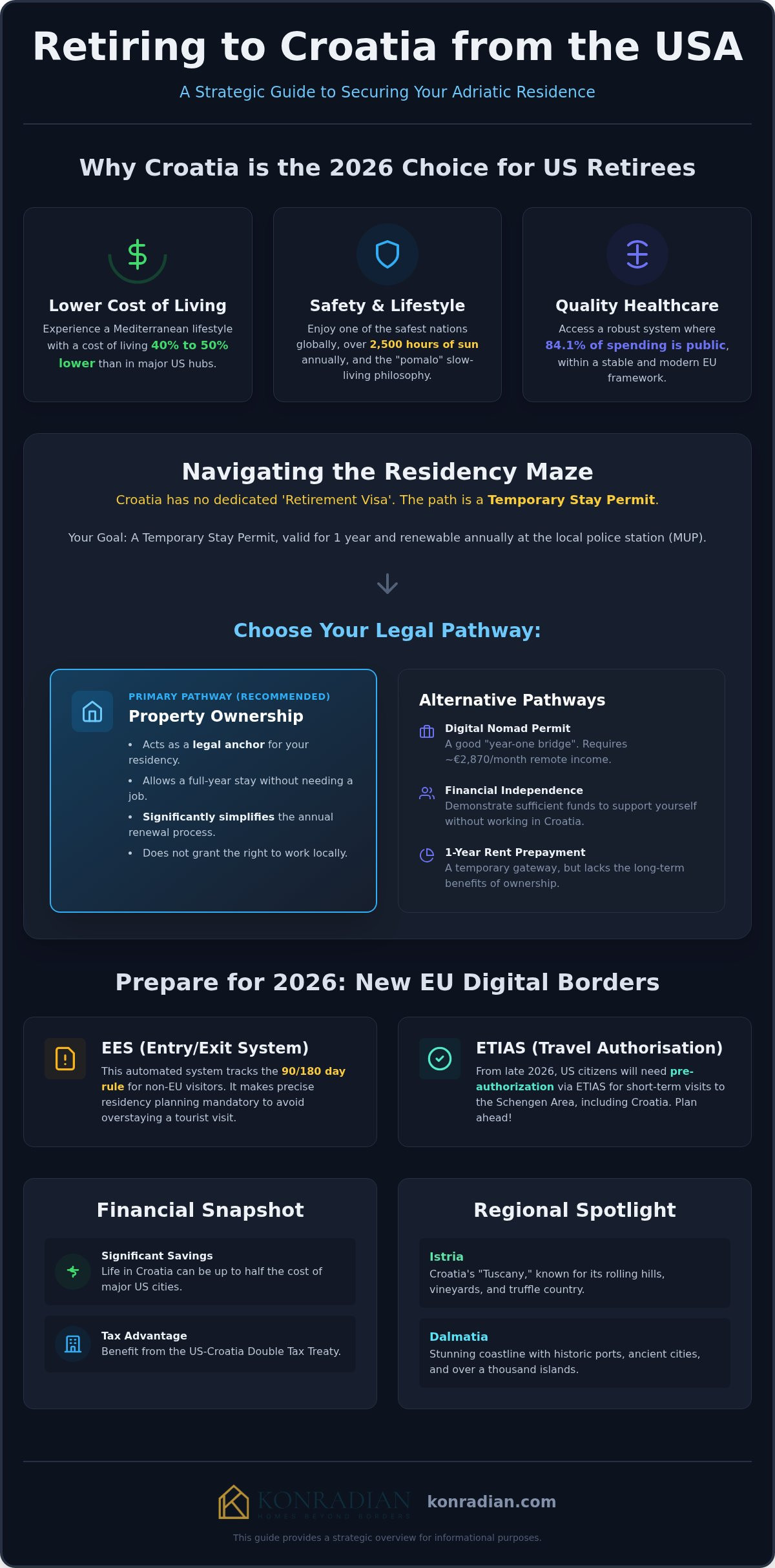
The transition from the relentless pace of American professional life to the sun-drenched shores of the Adriatic represents more than a change in geography; it’s a fundamental shift in how one experiences time. For those following a retiring to Croatia from USA guide, 2026 marks a pivotal year where geopolitical stability and high-register lifestyle quality converge. Croatia has matured into a sophisticated EU member state that offers a secure environment for wealth preservation and personal well-being. While traditional destinations like Italy or France remain popular, they often come with higher price points and more bureaucratic friction. Croatia provides a comparable Mediterranean experience with a cost of living that remains 40% to 50% lower than in major US hubs. This value proposition is reinforced by Croatia’s foreign relations and its deep integration into the European Union, ensuring that your investment is backed by a stable, Western-aligned framework.
The 2026 Mediterranean Context
The arrival of late 2026 introduces new administrative layers that American retirees must understand to ensure a seamless transition. The EU Entry/Exit System (EES) now automatically tracks the 90/180 day rule, eliminating the manual oversight of the past and making precise residency planning non-negotiable. Additionally, the implementation of the ETIAS requirement in late 2026 means that even short-term visits require pre-authorization. These changes reflect Croatia’s strategic shift toward high-value tourism and long-term expat integration. It’s no longer enough to simply arrive; you need a sophisticated blueprint to navigate these digital borders. Early residency planning isn’t just an advantage; it’s a requirement for those seeking to avoid the constraints of a standard tourist visa.
Safety, Healthcare, and Quality of Life
Croatia consistently ranks as one of the safest nations globally, providing a sense of security that is often elusive in larger Western countries. Retirees benefit from an environment defined by clean air, pristine water, and a healthcare system where 84.1% of spending is public. With over 2,500 hours of annual sunshine and a landscape featuring more than 1,200 islands, the physical environment encourages an active, health-centric lifestyle. The “pomalo” philosophy is a culturally ingrained commitment to slow living that acts as a profound mental health benefit for retirees by prioritizing presence over productivity. This mindset shift, combined with professional stewardship, allows for a retirement that is as tranquil as the Adriatic itself.
Navigating the Residency Maze: Legal Pathways for Americans
The most common misconception for those following a retiring to Croatia from USA guide is the search for a dedicated “retirement visa.” In reality, Croatia utilizes a Temporary Stay permit system that requires applicants to categorize their stay under specific legal grounds. While some expats utilize the Digital Nomad permit as a year-one bridge, which requires a monthly income of approximately €2,870, most long-term retirees opt for the financial independence or property ownership routes. The U.S. Embassy guidance on Croatian residency confirms that these permits are issued for up to one year and must be renewed annually at the local police station, known as MUP. For those not yet ready to purchase, a prepayment of rent for one year can serve as a temporary gateway, though it lacks the long-term wealth-building advantages of ownership.
The Strategic Advantage of Property Ownership
Securing a home on the Adriatic coast does more than provide a sanctuary; it acts as a legal anchor for your residency. This permit allows Americans to reside in Croatia for a full year without the need to demonstrate employment within the country. It’s essential to understand that this specific permit doesn’t grant the right to work locally, but it does simplify the renewal process significantly. By positioning property as the foundation of your stay, you transition from a visitor to a stakeholder in the local community. If you’re beginning your search, exploring Istria real estate for sale offers a glimpse into high-value opportunities that align with these residency goals.
The Step-by-Step Application Process
Navigating the local bureaucracy requires a methodical approach to ensure your application is approved without delays. The process begins with obtaining your OIB, which is the foundational identification number required for everything from opening a bank account to finalizing a property deed. Following this, you must provide several key documents:
- Proof of Adequate Housing: You’ll need a notarized rental agreement or a title deed for your property to prove you have a place to live.
- Financial Substantiation: You must show evidence of monthly funds, typically ranging from €800 to €1,000 for a single person, sourced from Social Security, pensions, or liquid savings.
- Comprehensive Health Insurance: Enrollment in the Croatian public health system (HZZO) or a qualifying private policy is mandatory for all non-EU nationals.
After five years of continuous temporary residency, you become eligible to apply for permanent residency, provided you haven’t been absent for more than ten months total during that period. Our team at Konradian specializes in streamlining these administrative hurdles, ensuring your transition is defined by ease rather than paperwork.
The Financial Blueprint: Cost of Living and Tax Considerations
Establishing a sustainable life on the Adriatic requires more than just an appreciation for the scenery; it demands a rigorous approach to fiscal stewardship. An essential component of any comprehensive retiring to Croatia from USA guide is understanding the 183-day rule. Once you surpass this threshold within a calendar year, you are typically classified as a Croatian tax resident. This status activates the protections of the US-Croatia Double Tax Treaty, a critical framework that ensures your income isn’t subject to redundant taxation by both nations. This treaty provides a sense of security for high-net-worth individuals aiming to preserve their global assets while enjoying a Mediterranean lifestyle.
Purchasing Power in 2026
The adoption of the Euro has brought a welcome layer of price stability to the Croatian market, making it an attractive environment for long-term investors. While inflation impacted the broader continent, Croatia’s real estate sector remains a robust hedge, offering tangible value that often outpaces local consumer price indices. Your purchasing power here extends significantly further than in comparable US coastal cities, allowing for a lifestyle defined by quality rather than compromise. The following comparison illustrates the typical monthly expenditure for a sophisticated retiree in 2026.
| Monthly Expense (Estimated) | Split, Croatia | Miami, USA |
|---|---|---|
| Luxury 1-Bedroom Apartment (City Center) | €1,200 – €1,600 | €3,200 – €4,500 |
| Dining & Fine Wines (Frequent) | €600 – €800 | €1,500 – €2,000 |
| Essential Utilities & High-Speed Internet | €180 – €250 | €350 – €500 |
Pensions and Social Security
Navigating the tax treatment of US-sourced retirement funds is a priority for most Americans. Under the current treaty, foreign pensions are taxed as employment income in Croatia, yet they benefit from a significant 50% reduction in the advance tax rate for amounts up to €3,981.68 per month. In 2026, foreign pensions benefit from a 50% reduction on the standard advance tax rates, effectively lowering the burden on monthly income. Despite your residency abroad, you must maintain compliance with US reporting requirements, including FBAR and FATCA filings, to ensure total transparency with the IRS.
Healthcare represents another area of substantial savings. While many retirees opt for supplemental private insurance for expedited specialist access, enrollment in the public HZZO system is mandatory. This coverage costs approximately €80 to €100 per month, following a one-time enrollment fee of roughly €1,000. This dual-layered approach ensures that you receive comprehensive care without the prohibitive premiums common in the US healthcare market.
Selecting Your Sanctuary: A Regional Real Estate Analysis
Choosing a home along the Adriatic is a decision that balances personal aspiration with strategic investment. While the entire coast offers beauty, each region caters to a distinct lifestyle profile. Dubrovnik remains the undisputed capital of luxury, offering an international flair and premium stone villas that command the highest market values. For those seeking a blend of urban history and crystal-clear waters, Dalmatia, specifically Split and Zadar, provides a vibrant atmosphere where ancient Roman architecture meets a modern, active lifestyle. These regions serve as the primary focus for any retiring to Croatia from USA guide, as they offer the infrastructure and community required for a seamless transition. However, the complexity of local land registries means that professional legal support buying property abroad is essential to ensure you acquire a “clean” title free of historical encumbrances.
Istria vs. Dalmatia: Which Coast Suits You?
Istria is frequently described as the “New Tuscany” due to its rolling hills, world-class truffle forests, and prestigious vineyards. It offers a sophisticated, year-round lifestyle that remains active even during the winter months, thanks to its proximity to Italy and Slovenia. In contrast, Dalmatia provides a more seasonal vibrancy, defined by dramatic karst mountains and a deep-seated maritime culture. Property types vary significantly between the two; Istria is famous for its authentic inland stone houses and sprawling estates, while Dalmatia specializes in waterfront apartments and contemporary luxury villas. Accessibility also differs. Pula’s airport provides a gateway to Western European capitals, while Split serves as a major hub with extensive connections to the broader Mediterranean.
The Acquisition Process for Americans
To find the perfect base for your scouting mission across these regions, visit hoteli.com.hr.
United States citizens benefit from the “Reciprocity Rule,” a legal framework that allows Americans to purchase property in Croatia because Croatian citizens enjoy similar rights in the US. This process is governed by the Ministry of Justice, which must grant formal consent for every transaction involving a non-EU buyer. While this step used to take several months, the 2026 administrative environment has become more efficient. Your strategy should prioritize direct access to developer pre-sales, which offers the highest level of security and the potential for capital appreciation before the project is even completed. This “start-to-finish” oversight ensures that every technical and legal detail is managed with precision.
Securing a high-value asset in a foreign market requires more than just a search engine; it requires a trusted partner who understands the nuances of the local landscape. At Konradian, our LSE-educated advisory team provides this level of sophisticated stewardship at zero cost to the buyer, as our commissions are covered by the seller. We invite you to explore our curated Croatian property portfolio and begin your journey toward a refined life on the Adriatic.
From Consultation to Key Handover: The Konradian Approach
The transition to a new life in Europe is a high-stakes transaction that requires more than just a real estate agent; it requires a strategic partner. At Konradian, we approach every relocation as a significant wealth-preservation event. Our LSE-educated advisory team leverages over five years of international experience to ensure that your move is both financially sound and emotionally rewarding. This retiring to Croatia from USA guide emphasizes that the complexity of the Croatian market demands a level of intellectual rigor that standard portals cannot provide. We offer direct access to developer pre-sales and exclusive off-market inventory, providing opportunities that remain invisible to the general public.
Bridging the gap between American service expectations and the nuances of Croatian administrative reality is where our expertise becomes invaluable. We act as a dedicated concierge, coordinating with a vetted network of local lawyers and tax advisors on your behalf. This cosmopolitan approach ensures that technical industry terms are translated into clear, actionable steps for you. We understand the cultural fluency required to navigate local municipalities, allowing you to focus on the aspirational aspects of your move while we manage the procedural details.
Your Next Steps to the Adriatic
Your journey begins with a methodical assessment of your goals. We invite you to define your search criteria and residency timeline through a personalized process designed for the sophisticated global citizen. The first step is a complimentary video call where we can discuss your specific needs and the legal pathways available to you in 2026. This initial consultation allows us to build a narrative of trust and transparency from the very start. We encourage you to schedule your private consultation with Konradian today to secure your future on the Adriatic coast.
Your Future on the Adriatic Coast Starts Here
The dream of an Adriatic retirement is no longer a distant aspiration but a tangible reality for those who follow a precise strategic roadmap. By understanding the 2026 residency landscape and the financial advantages of the US-Croatia Double Tax Treaty, you’ve already taken the first step toward a refined Mediterranean lifestyle. This retiring to Croatia from USA guide has highlighted how property ownership acts as a secure anchor for your new life, providing both a sanctuary and a legal foundation for your stay. Success in this transition depends on professional stewardship and market savvy.
Our LSE-educated advisory team brings over five years of international expertise and a verified record of 5-star relocation success to your corner. We handle the heavy lifting at zero cost to the buyer, ensuring your property acquisition is seamless, secure, and strategically sound. Don’t let bureaucratic friction delay your arrival in paradise. Begin your Adriatic journey with a free expert consultation and experience the peace of mind that comes from dedicated, high-level advocacy. A life of “pomalo” and pristine coastal beauty is well within your reach.
Frequently Asked Questions
Can a US citizen live permanently in Croatia?
Yes, US citizens can live permanently in Croatia by progressing from temporary residence to permanent status. Initially, you apply for a temporary stay permit, which is often anchored by property ownership. After five years of continuous residence, you become eligible for permanent residency. It is essential to manage your time abroad during this period, as you cannot be absent for more than ten months total or six consecutive months to maintain your eligibility.
How much money do I need to prove for a Croatian residency permit?
To secure a temporary residence permit as a financially independent individual, you must demonstrate adequate monthly funds. For a single applicant, the requirement typically falls between €800 and €1,000, while a couple should show roughly €1,200 to €1,500. These figures serve as proof that you can sustain your lifestyle without local employment. Providing US bank statements or pension letters is a standard step in this retiring to Croatia from USA guide.
Do I have to pay tax in Croatia on my US 401k or Social Security?
Foreign pensions and Social Security are taxed as employment income once you are classified as a Croatian tax resident. However, the US-Croatia Double Tax Treaty prevents redundant taxation. Local regulations also provide a 50% reduction on the advance tax rate for foreign pensions. Monthly income up to €3,981.68 is subject to a 20% advance tax before the reduction is applied, while amounts above that threshold are subject to a 30% rate before the reduction.
Is healthcare in Croatia good for American retirees?
Croatia provides a high standard of medical care, with public health spending accounting for 84.1% of the national total. Residents must enroll in the HZZO public system, which costs approximately €80 to €100 per month following a one-time enrollment fee of roughly €1,000. Many American retirees choose to supplement this with private insurance for faster specialist access, ensuring a healthcare strategy that is both comprehensive and significantly more cost-effective than private US alternatives.
Can I buy property in Croatia as a US citizen?
US citizens can indeed purchase real estate in Croatia thanks to the long-standing reciprocity agreement between the two countries. This process requires formal consent from the Ministry of Justice to verify that your home state offers similar rights to Croatian nationals. While this step adds a layer of administration, it is a routine part of the acquisition process that our advisory team handles to ensure your investment is protected and legally sound.
How long does the residency application process take?
The residency application process typically spans between 30 and 90 days, depending on the workload of the local police administration. We advise clients to begin gathering and translating documents at least three months before their planned arrival. Utilizing this retiring to Croatia from USA guide and professional stewardship can help navigate these bureaucratic timelines, ensuring that your transition to the Adriatic is not delayed by paperwork errors or missing certifications.
Will I need to learn Croatian to retire there?
While English is widely understood in coastal cities and among professionals, learning basic Croatian is essential for deep cultural integration and mandatory for permanent residency. You’ll find that daily interactions at local markets and government offices are smoother with a fundamental grasp of the language. Most retirees find that a modest investment in language studies pays significant dividends in personal well-being and helps in building lasting connections within their new community.
What happens to my 90-day Schengen limit once I have a residence permit?
Holding a Croatian residence permit exempts your time in Croatia from the standard 90-day Schengen limit. You retain the right to travel to other Schengen countries for up to 90 days within any 180-day period for tourism or business. This permit provides the freedom to explore the European continent while maintaining a stable, long-term home base on the Adriatic coast. It effectively bypasses the constraints of the ETIAS system for your primary residence.
