


The traditional Spanish golden visa property investment route didn’t just change; it essentially vanished on April 3, 2025, leaving a generation of international investors questioning if the door to the Mediterranean has closed forever. While the right to own property remains untouched, the legal bridge between a deed and a residency permit was dismantled by Organic Law 1/2025. It’s a jarring shift for those who viewed a villa in Marbella or an apartment in Madrid as their guaranteed ticket to the Schengen Area.
We understand the hesitation that comes when a proven path disappears, especially when you’re balancing significant capital with long-term lifestyle goals. This article will help you pivot your strategy by identifying the most lucrative residency-linked alternatives available in 2026. We will explore how to maintain your footprint in the Spanish market for capital growth while leveraging programs like Hungary’s 10-year Guest Investor Program to secure the legal peace of mind your family requires.
Key Takeaways
- Navigate the legislative landscape following the 2025 closure of the Spanish golden visa property investment route and clarify the status of existing renewal rights.
- Identify high-performance regions like the Costa del Sol where capital growth remains robust, independent of residency-linked investment schemes.
- Evaluate the 2026 criteria for the Digital Nomad and Non-Lucrative visas to determine which residency pathway aligns with your professional or retirement goals.
- Compare the strategic advantages of Hungary’s Guest Investor Program, which offers a 10-year renewable residency for a €250,000 investment.
- Discover how Konradian’s “no-cost to buyer” model provides seamless access to exclusive developer pre-sales and comprehensive legal oversight.
The 2026 Reality: Is the Spanish Golden Visa Property Investment Still Possible?
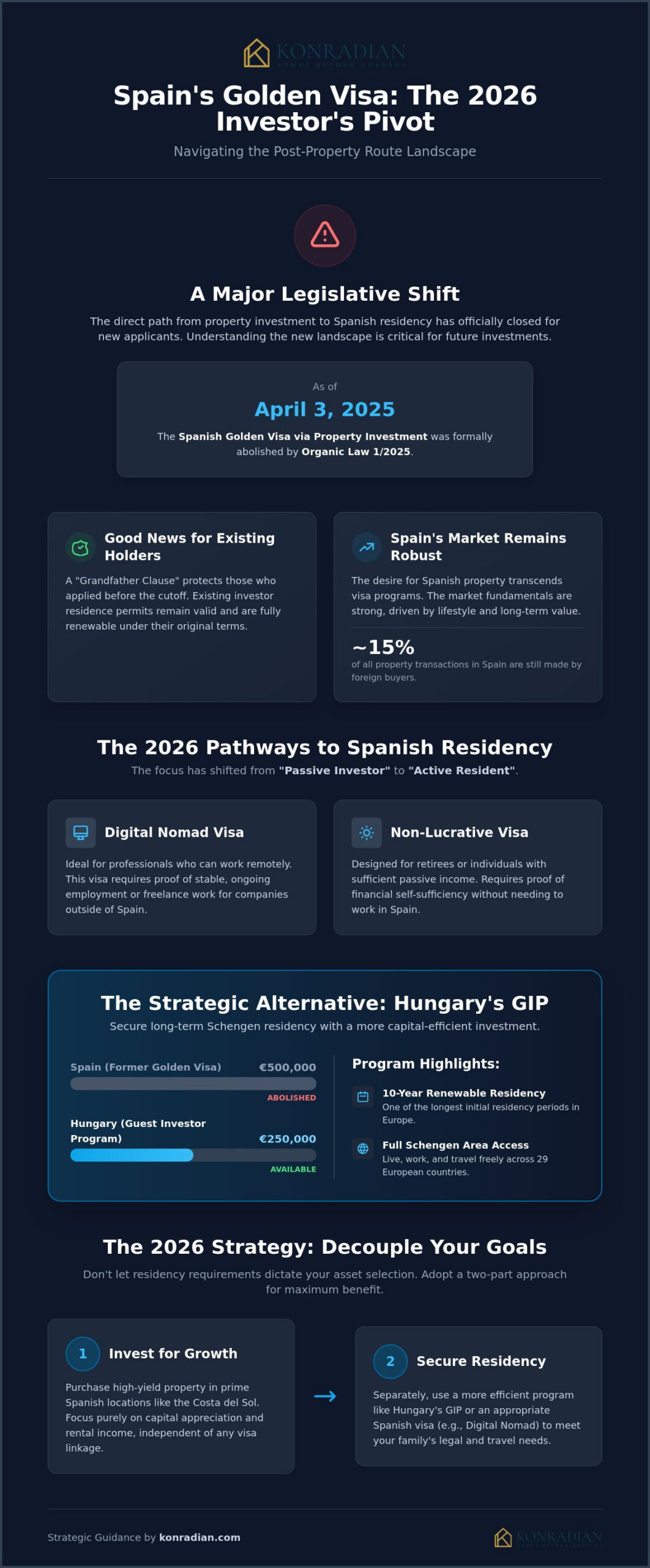
The question of whether a Spanish golden visa property investment remains viable in 2026 requires a nuanced answer. Technically, the direct real estate route, once the hallmark of European residency-by-investment, was formally abolished on April 3, 2025. Organic Law 1/2025 effectively removed the provision that allowed non-EU nationals to secure residency simply by purchasing €500,000 in property. However, the legacy of the program continues to shape the market. For many, the term “Golden Visa” has simply evolved to describe a new era of residency strategies that prioritize active integration over passive ownership.
The Legislative Shift of 2025
The closure wasn’t a sudden whim. It was a strategic response to housing pressures in Spain’s most popular urban centers. By the time the law took effect, over 6,200 visas had been issued for real estate investments, with the vast majority focused on Madrid, Barcelona, Malaga, and the Balearic Islands. The government’s primary objective was to decouple residency from speculative real estate acquisitions. Historically, Immigrant investor programs across Europe have faced similar scrutiny, leading to a broader trend of restriction. In 2026, the Spanish market has reached a new equilibrium; property values in these hubs continue to show resilience, but the buyer profile has shifted toward those seeking genuine lifestyle integration rather than a hands-off residency permit.
Who Can Still Qualify for Residency?
For those who already hold a permit or submitted their application before the 2025 cutoff, the news is reassuring. Existing investor residence permits remain valid and are renewable under the original terms. The “Grandfather Clause” ensures that anyone caught in the processing backlog isn’t penalized by the change in law. However, navigating these transitional rules requires meticulous attention to detail. Securing legal support buying property abroad is more critical now than ever, as the administrative burden for renewals and pending cases has increased.
Today’s investors must adapt to a shift from “Passive Investor” status to “Active Resident” requirements. The era of buying a property and visiting only once a year to maintain residency is largely over for new entrants. While the classic Spanish golden visa property investment model has changed, the underlying desire for a Mediterranean base remains. The focus has simply turned to pathways like the Digital Nomad Visa and the Non-Lucrative Visa. These options require a higher level of personal commitment to residing in Spain, reflecting the government’s desire for residents who contribute to the local economy and social fabric.
Why Spain Remains a Premier Property Investment Asset in 2026
Spain’s allure as a global investment destination has always been anchored in more than just a residency permit. While the news about Spain scrapping its golden visa programme dominated headlines in 2025, the underlying market fundamentals haven’t shifted. Smart capital doesn’t flee when a single incentive is removed; it recalibrates. In 2026, we see a clear separation between those who need residency and those who recognize Spain as a high-performance asset class. The end of the Spanish golden visa property investment route removed a specific buyer incentive, but it didn’t remove the Mediterranean sun, the world-class infrastructure, or the enduring lifestyle appeal that drives long-term demand.
We’ve observed a fascinating “Golden Visa Hangover” in certain micro-markets. In districts where prices were artificially inflated to meet the old €500,000 threshold, a healthy price correction has occurred. This has opened doors for savvy investors to acquire premium assets at more realistic valuations. International demand remains robust, particularly in the Costa del Sol and the Balearics. In 2024, foreign buyers accounted for approximately 15% of all property transactions in Spain. That figure has remained steady into 2026, proving that the desire for Spanish real estate transcends the need for a visa.
Strategic Asset Selection Post-Golden Visa
The strategy for 2026 focuses on yield and capital appreciation rather than meeting a legislative minimum. We’re seeing the highest returns in tourist hotspots where rental demand far outstrips supply. Investors are increasingly looking at “Pre-Sale” opportunities to lock in lower entry points before construction is completed. A disciplined approach to Spanish Property Acquisition now involves looking beyond the old Golden Visa hubs to find emerging districts with high growth potential. It’s about building a diversified wealth play that stands on its own merit, regardless of residency status.
Tax and Legal Precision in 2026
Navigating the 2026 landscape requires more than just a real estate agent; it requires strategic tax planning. The Wealth Tax environment for non-residents has become a primary consideration for our clients. Our LSE-educated advisory team works to identify undervalued districts where the tax burden is mitigated by high capital growth. Without the “standardized” legal path of the Golden Visa, professional brokerage becomes the vital shield for your capital. We ensure that every transaction is handled with the intellectual rigor of a strategic consultancy. If you’re looking to secure your next asset with this level of oversight, our team can guide you through the latest Spanish property opportunities with absolute transparency.
The 2026 Alternatives: Residency Pathways for Property Investors
While the traditional Spanish golden visa property investment route is no longer an option for new applicants, the Spanish government has provided several robust alternatives. These pathways require a shift in perspective. They move away from the “set and forget” nature of the previous program toward routes that favor active residents and remote professionals. For the strategic investor, property acquisition remains a cornerstone of these applications, serving as a powerful indicator of stability and intent during the residency process.
The Digital Nomad Visa for Investors
The Digital Nomad Visa (DNV) has emerged as the primary successor for working professionals. It’s designed for those who work remotely for companies outside of Spain or maintain a freelance portfolio of international clients. While property ownership isn’t a mandatory requirement for the DNV, it significantly strengthens an application by demonstrating a long-term commitment to the country. It also provides the applicant with a fixed address, simplifying the administrative transition.
A major draw for 2026 applicants is the continued availability of the “Beckham Law” tax regime. This allows eligible nomads to be taxed at a flat rate on their Spanish-sourced income for up to six years, rather than the standard progressive rates. This fiscal efficiency, combined with the lifestyle benefits of a Mediterranean base, makes the DNV the most popular choice for the modern, globally mobile investor. It offers a clear, renewable path to residency without the €500,000 minimum threshold previously required by the Spanish golden visa property investment model.
Non-Lucrative Residency (NLV)
The Non-Lucrative Visa remains the gold standard for retirees and those with substantial passive income. The defining characteristic of the NLV is the “no work” restriction; applicants are prohibited from engaging in professional activities within Spain. For this reason, it’s best suited for individuals who have already secured their wealth through dividends, pensions, or rental income from properties held outside of Spain. In 2026, the financial requirements are clearly defined:
- Main Applicant: Must demonstrate a minimum annual income of €28,800.
- Dependents: An additional €7,200 is required for each family member included in the application.
- Property Link: Owning a home in Spain is not required, but it provides the necessary proof of accommodation and reinforces the applicant’s financial standing.
The NLV serves as a direct bridge to permanent residency and, eventually, Spanish citizenship. It requires residents to spend at least 183 days per year in the country, which triggers tax residency. This is a critical distinction from the old golden visa, which had more flexible stay requirements. For those committed to making Spain their primary home, the NLV offers a secure and well-trodden path to a European lifestyle.
Beyond these, the Entrepreneur Visa remains an option for those linking property investment to genuine business innovation. Each of these routes has distinct tax implications and stay requirements. Choosing the right path depends on whether you prioritize tax optimization, the right to work, or the speed of the application process. Our team provides the strategic oversight needed to match your investment profile with the most advantageous residency outcome.
The New Frontier: Hungary’s Guest Investor Program (GIP)
The closure of the traditional Spanish golden visa property investment route has prompted a significant recalibration among global investors. Many who previously looked toward the Iberian Peninsula are now turning their attention to Central Europe. Hungary’s Guest Investor Program (GIP), relaunched in 2024, has emerged as the most viable successor for those seeking long-term European residency. It offers a level of security and ease that mirrors the original Spanish model, but with a financial entry point that is notably more accessible in the 2026 market.
The comparison between the two programs is stark. While the old Spanish requirement stood at a €500,000 real estate purchase, the Hungarian GIP allows for residency through a €250,000 investment in a government-approved real estate fund. This lower threshold provides a strategic advantage, allowing you to secure a 10-year renewable residency permit for roughly half the capital outlay. For the sophisticated investor, the primary benefit remains unchanged: full, unrestricted access to the Schengen Area for the main applicant and their immediate family.
Budapest vs. Madrid: An Investment Comparison
From a pure asset perspective, Budapest presents a compelling case against Madrid or Barcelona. In 2026, the price per square metre in Budapest remains significantly lower than in Spain’s major hubs, while projected rental yields are often higher. This is bolstered by Hungary’s corporate tax rate of 9%, which is currently the lowest in the European Union. Our team at Konradian provides a unique advantage here; we maintain deep, direct relationships in both Spain and Hungary. This dual-market expertise allows us to guide you through the acquisition process with the same level of precision and intellectual rigor, regardless of which border you choose to cross.
Strategic Diversification
We’re increasingly seeing clients adopt a “Best of Both Worlds” strategy. This involves securing 10-year residency through the Hungarian GIP while maintaining a lifestyle property in Spain. It’s a sophisticated way to decouple your legal residency from your primary leisure assets. By pursuing property investment Hungary through the fund route, you fulfill your visa requirements efficiently. This frees you to acquire a Spanish home based purely on its personal or capital growth merits, without the administrative pressure of residency deadlines.
Managing these cross-border legal complexities is where professional stewardship becomes indispensable. We handle the end-to-end coordination, ensuring that your Hungarian residency application and your Spanish property acquisition move in perfect sync. This holistic approach alleviates the stress of dealing with multiple jurisdictions and different sets of regulations. If you want to explore how this dual-market strategy can secure your family’s future, you can consult with our LSE-educated advisors to begin your journey.
Securing Your Spanish Investment with Konradian’s Strategic Stewardship
The transition into a post-Golden Visa market requires a fundamental shift in how you approach property acquisition. For over a decade, the Spanish golden visa property investment framework provided a standardized, albeit expensive, safety net for international buyers. In 2026, that safety net has been replaced by a need for granular market intelligence and high-level strategic oversight. Success in the current landscape isn’t defined by meeting a legislative minimum, but by identifying assets that offer genuine capital resilience and superior rental yields. We provide the intellectual rigor and local access necessary to navigate this complexity with absolute confidence.
Direct Developer Relationships
In a market no longer driven by visa-related speculation, the most significant opportunities lie in securing value at the earliest possible stage. We specialize in providing our clients with exclusive access to off-plan and pre-sale developments that aren’t yet available to the general public. This allows you to bypass the speculative markups often found in the secondary market and lock in a lower entry point. For more than five years, we’ve meticulously vetted Spanish developers to ensure that every project we represent meets our strict standards for construction quality, financial transparency, and delivery timelines. By sourcing directly from the developer, we ensure your capital is positioned for maximum growth from the moment ground is broken.
Our operational model in Spain is designed to prioritize your interests. We operate on a “zero-cost to buyer” basis, meaning our professional fees are covered by the developers rather than the investor. This doesn’t just lower your initial acquisition costs; it ensures that our LSE-educated team can focus entirely on providing the strategic guidance you need to make an informed decision. We act as your protective partner on the ground, handling the “heavy lifting” of the transaction while you maintain a broad global perspective on your portfolio.
Your International Property Concierge
The value of professional stewardship extends far beyond the signing of a contract. We provide a seamless, end-to-end experience that begins with an initial video consultation and continues long after the key handover. Our team manages every facet of the process, including legal oversight, financial navigation, and practical relocation support for those pursuing alternative residency paths. We understand that high-stakes international transactions can be inherently stressful, so we’ve built a process that projects security and ease at every step. Whether you’re pivoting to a Digital Nomad Visa or simply seeking a high-yield asset in the Costa del Sol, we ensure your journey is methodical and logical.
We invite you to experience a level of service that combines the intellectual authority of a strategic consultant with the personalized care of a dedicated concierge. You don’t have to navigate the 2026 market shift alone. Book a free video consultation with our Spanish market experts today and discover how we can secure your Mediterranean future through professional, start-to-finish stewardship.
Charting Your Mediterranean Future in a New Regulatory Era
The landscape of European residency has fundamentally shifted, but the opportunity for sophisticated asset growth remains as potent as ever. While the original Spanish golden visa property investment route has closed, the emergence of the Digital Nomad Visa and Hungary’s Guest Investor Program provides a more versatile toolkit for the global citizen. Success in 2026 is no longer about following a single legislative path. It’s about a diversified strategy that balances lifestyle desires with intellectual market rigor.
With over five years of international brokerage excellence, we offer the precise stewardship required to navigate these changes. Our LSE-educated advisory team provides exclusive access to direct developer pre-sales, ensuring you secure value before the wider market reacts. We handle the heavy lifting, from legal navigation to final key handover, so you can focus on the rewards of your investment. We invite you to secure your Spanish investment strategy with a free consultation today. The door to Europe hasn’t closed; it has simply evolved for those who know where to look.
Frequently Asked Questions
Is the Spanish Golden Visa officially cancelled in 2026?
Yes, the investor residency route through real estate was officially abolished on April 3, 2025. Organic Law 1/2025 removed the legal basis for new applications based on property purchases. While existing holders can still renew their permits, the era of the Spanish golden visa property investment as a path for new buyers has concluded. Investors must now look to alternative residency frameworks to secure their stay in Spain.
Can I still get residency in Spain if I buy a property for €500,000?
No, purchasing a property for €500,000 no longer guarantees residency rights in Spain. While you’re free to acquire real estate as a non-resident, the transaction itself doesn’t trigger a visa. To reside in the country, you’ll need to qualify for the Digital Nomad Visa or the Non-Lucrative Visa. These routes focus on your professional activity or passive income rather than the value of your property acquisition.
What is the best alternative to the Spanish Golden Visa for EU residency?
Hungary’s Guest Investor Program (GIP) is currently the most robust alternative for those seeking long-term EU residency. It offers a 10-year renewable permit for a €250,000 investment in a government-approved real estate fund. Within Spain, the Digital Nomad Visa has become the preferred choice for working professionals. It provides a legal bridge to residency while allowing you to maintain your global career from a Mediterranean base.
How does the Hungarian Guest Investor Program compare to the Spanish visa?
The Hungarian GIP offers a lower entry point and longer security than the old Spanish model. While the Spanish golden visa property investment required €500,000, Hungary’s fund route starts at €250,000. Additionally, Hungary provides an initial 10-year residency period, whereas the Spanish investor permit typically required more frequent renewals. Both programs grant full access to the Schengen Area, making Hungary a strategic pivot for residency-focused investors.
Do I need to live in Spain full-time to keep my residency under new 2026 rules?
Yes, most current residency pathways in 2026 require you to spend at least 183 days per year in Spain. This is a significant change from the old Golden Visa, which had no minimum stay requirement. Spending more than half the year in the country will also make you a tax resident. This shift reflects the government’s move toward attracting active residents who contribute to the local economy.
What are the taxes for property investment in Spain for non-residents in 2026?
Non-residents are subject to Income Tax for Non-Residents (IRPNR) on rental income, generally at a flat rate of 19% for EU residents and 24% for others. You’ll also encounter local property taxes (IBI) and potential Wealth Tax if your assets exceed specific regional thresholds. Navigating these obligations requires precision, as tax regulations can vary significantly between regions like Andalusia and the Balearic Islands.
Can Americans or UK citizens still apply for Spanish residency through investment?
Not through real estate investment, as that specific pathway is no longer available to non-EU nationals. Applicants from the US and UK typically pursue the Digital Nomad Visa if they work remotely or the Non-Lucrative Visa if they have sufficient passive income. Both groups continue to have full rights to purchase property, though the acquisition itself no longer provides the residency shortcut it once did.
How does Konradian help with the legal process of buying property in Spain?
We provide end-to-end stewardship that removes the complexity from high-stakes international transactions. Our LSE-educated team handles everything from initial developer vetting to the final legal paperwork and key handover. Because we operate on a zero-cost model for the buyer in Spain, you receive elite expertise and strategic guidance without additional professional fees. We act as your proactive partner, ensuring every transaction is seamless and secure.
