


The same US property can offer meaningful tax advantages to one owner and few immediate deductions to another. The tax benefits of owning property in the USA depend on how the home is used, whether the owner itemizes deductions, and their tax residency and ownership structure.
If you’re weighing a home for personal use against a rental investment, broad tax guidance can feel contradictory. The rules differ, and a possible deduction isn’t automatic. This 2026 guide explains the main federal tax benefits that may apply, including deductions for eligible homeowners, rental-property depreciation, and potential tax treatment when a property is sold. It also outlines why non-US tax residents may face additional considerations, such as withholding and estate tax issues.
You’ll learn which eligibility details and records can affect the outcome, what to review with a qualified international tax professional, and how to consider tax alongside property selection and your wider investment decision. This is a starting point, not an assumption that every owner qualifies for the same savings.
Key Takeaways
- The tax benefits of owning property in the USA are conditional, not guaranteed. Property use, ownership, income, residency, and jurisdiction can all affect eligibility.
- Compare a primary residence, second home, and rental investment separately. Potential tax treatment and the records you need may differ.
- Before relying on a potential benefit, clarify how the property will be used, who will own it, your tax residency, and where it is located.
- Review federal, state, and local tax rules as separate layers, and verify current eligibility requirements before investing.
- Consider tax alongside location, property condition, financing, and investment goals. A deduction alone doesn’t measure investment performance.
What Tax Benefits of Owning Property in the USA Can Mean
Tax benefits are tax treatments that may reduce taxable income or affect how a gain is calculated. They are conditional, not guaranteed savings. A deduction, exclusion, or depreciation allowance applies only when the owner, property, and circumstances meet the relevant rules. Use, legal ownership, income, tax residency, and property location can all change the result.
It also helps to distinguish federal income tax from state and local property taxes. Federal rules may affect how certain income, expenses, or gains are reported. Property taxes, by contrast, are generally assessed under state and local systems, and relief can depend on the jurisdiction and eligibility requirements. A benefit under one system doesn’t automatically reduce a bill under another.
No single tax benefit applies to every owner. The outcome depends on how the property is used, who owns it, and which tax rules apply.
For a broad overview of the relationship between policy and homeownership, Homeownership in the United States discusses measures such as mortgage-interest deductions. It offers context, not a determination of an individual owner’s eligibility. Current rules and personal circumstances matter.
Personal-use property and investment property are not taxed identically
A primary residence, a second home, and a property that produces rental income serve different purposes, and tax treatment can reflect those distinctions. Some homeowners may qualify for certain deductions, but they aren’t automatic. Eligibility can depend on factors such as whether the owner itemizes and whether an expense meets the applicable requirements. A second home may also be subject to rules that differ from those for a main residence.
Rental use adds another layer. Income and eligible expenses may be treated differently from costs associated with personal use, and depreciation may be relevant to an income-producing property. If a home is rented for part of the year or also used personally, the timing and manner of use can affect how items are reported. Keep clear records and verify the current rules before estimating a tax benefit.
Why an international owner’s tax position needs separate analysis
Owning property in the USA doesn’t by itself determine an international buyer’s tax status. US treatment can depend on whether the person is considered a US tax resident and on the source and nature of any income connected with the property. Rental income and a later sale may raise different reporting questions, so assumptions based only on citizenship or intended use can be misleading.
The owner’s country of residence may also impose its own reporting or tax obligations. Don’t assume a treaty, foreign tax credit, or exemption applies. The relevant countries, income, ownership arrangement, and individual circumstances need to be assessed. Before investing, establish the intended use and ownership structure, identify the owner’s tax residency, and consider the rules in each relevant jurisdiction. These distinctions help frame the questions to resolve before relying on projected tax treatment.
How US Property Tax Benefits Work for Homeowners and Landlords
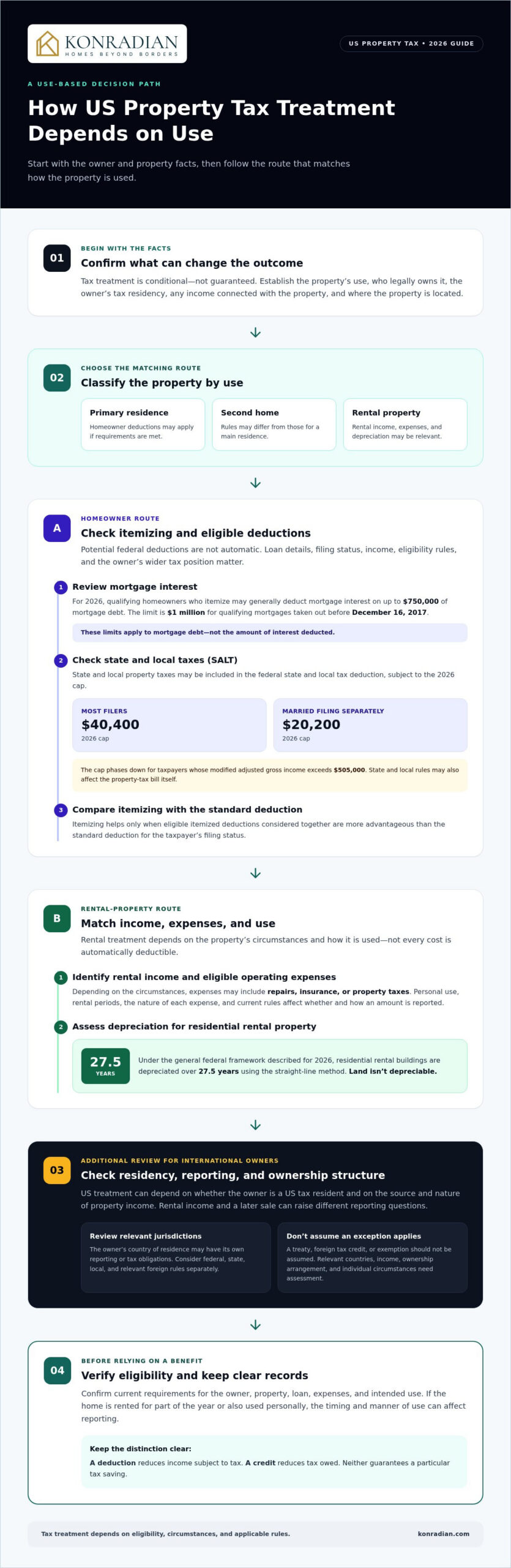
For homeowners, potential federal tax benefits may include mortgage interest or qualifying state and local taxes. These are generally deductions claimed when itemizing, not automatic reductions for every borrower. Eligibility, loan details, filing status, income, and the owner’s wider tax position all matter. Assess the tax benefits of owning property in the USA against the applicable rules and the owner’s full financial picture.
A deduction reduces the income subject to tax, while a credit reduces tax owed. Neither guarantees a particular tax saving. The actual result depends on eligibility and the taxpayer’s circumstances.
Potential deductions for a qualifying primary residence
For 2026, qualifying homeowners who itemize may generally deduct mortgage interest on up to $750,000 of mortgage debt. The limit is $1 million for qualifying mortgages taken out before December 16, 2017. These limits concern mortgage debt, not the amount of interest deducted. Eligibility also depends on the loan and property meeting applicable requirements; for buyers navigating complex financing scenarios, consulting a specialized mortgage brokerage such as LoansByJB (The Nuhome Team) can help align debt structures with overall investment goals.
State and local property taxes may be included in the federal state and local tax deduction, subject to the 2026 cap: $40,400 for most filers and $20,200 for married taxpayers filing separately. The cap phases down for taxpayers whose modified adjusted gross income exceeds $505,000. State and local rules can also affect the property-tax bill itself. Itemizing helps only when eligible itemized deductions, considered together, are more advantageous than the standard deduction for the taxpayer’s filing status.
Potential tax treatment for rental-property owners
Rental owners may be able to deduct eligible expenses connected with operating the property when calculating rental income. Depending on the circumstances, expenses may include repairs, insurance, or property taxes. This isn’t a blanket allowance. Personal use, rental periods, the nature of each expense, and current tax rules can affect whether and how an amount is reported.
Depreciation may also be available for residential rental property. Under the general federal framework described for 2026, residential rental buildings are depreciated over 27.5 years using the straight-line method; land isn’t depreciable. The property’s basis, the portion attributable to the building, and when it was placed in service affect the calculation. Depreciation claimed or allowable can also affect the tax consequences of a later sale, including potential recapture. Consider both annual reporting and eventual sale implications rather than viewing depreciation as a permanent saving.
Keep organized records of purchase and improvement costs, rental income, expenses, personal-use dates, and depreciation. These details help establish how amounts should be allocated and reported, but they don’t replace an individual review of the rules. Before relying on projected deductions, have the tax treatment assessed for the specific ownership and use scenario. Alongside that analysis, careful US property selection can help buyers assess the wider investment decision without treating tax outcomes as guaranteed.
Comparing Tax Benefits by Property Use and Investment Strategy
A property’s intended use helps identify which tax categories may be relevant, but it doesn’t settle eligibility. Use the following comparison to identify questions and records to review, not as a promise that a particular deduction or exclusion will apply. Personal use, rental periods, ownership details, and the rules in force when income is earned or a sale occurs can change the analysis.
| Property use | Potential tax categories | Conditions and records to review |
|---|---|---|
| Primary residence | Mortgage-interest and state and local tax deductions; possible gain exclusion on sale | Itemization, loan and tax records, ownership and occupancy history, and sale details |
| Second home | Potential homeowner deductions; possible rental-income and expense treatment if rented | Personal-use dates, rental days, income and expense records, and how the property is classified under current rules |
| Rental investment | Eligible rental expenses, depreciation, and tax treatment of gain or depreciation on sale | Income and expense records, purchase and improvement costs, building and land allocation, and depreciation history |
Tax treatment follows the facts, not the property label alone. A home called a “second home” may have both personal and rental use, for example. The actual pattern of use and supporting records matter.
Primary residence versus second home
For a qualifying primary residence, an owner may be eligible for certain itemized deductions, subject to current requirements. A home sale may also qualify for an exclusion of up to $250,000 of gain for a single filer or $500,000 for married taxpayers filing jointly. This is generally subject to ownership and use tests that include owning and living in the home for at least two of the five years before the sale. Confirm the rules and the owner’s eligibility before relying on an exclusion.
A second home doesn’t qualify for the primary-residence sale exclusion merely because the owner uses it personally. If it’s rented during part of the year, personal and rental use may affect how income, expenses, and deductions are treated. Keep a calendar of occupancy and rental periods, along with relevant financial records.
Rental ownership, depreciation, and future sale
For a rental investment, reportable rental income and eligible expenses help establish the property’s tax position. Depreciation may reduce taxable rental income over time, while the building’s basis, improvements, and depreciation history can affect the calculation and later sale. Depreciation-related gain may be subject to recapture, so review both annual treatment and eventual sale consequences before comparing investment scenarios.
A like-kind exchange may be relevant to some exchanges of qualifying business or investment real property, but it isn’t a general exemption from tax. Eligibility, timing, and other requirements are specific and should be verified under current rules. Keep purchase, improvement, income, expense, and depreciation records together. A qualified tax professional can assess how those facts apply to the planned use and exit strategy.
What International Buyers Should Check Before Relying on a Tax Benefit
For an international buyer, tax planning should begin with the facts of the ownership, not an assumed deduction or headline benefit. The tax benefits of owning property in the USA can depend on how the property is used, who owns it, the owner’s tax residency, where the property is located, and whether it generates income. Work through these points before building a tax assumption into an investment plan:
- Identify the intended use. Decide whether the property will be a primary residence, second home, rental investment, or a combination, and keep a record of personal and rental use.
- Set out the ownership structure. Identify the proposed legal owner or owners and consider how that structure may affect reporting and tax treatment.
- Determine tax residency. Assess the owner’s relevant tax status under applicable rules rather than relying on citizenship or location alone.
- Pinpoint the jurisdiction. Record the state, county, and local area, since rules and property-tax assessments can vary by location.
- Estimate expected income and events. Consider possible rental income, expenses, and a future sale, then identify which records will be needed to support the analysis.
Federal, state, and local tax review
Review each tax layer separately. Federal income-tax rules may govern how US-source property income, deductions, or gains are reported. State income-tax rules can add requirements, while local authorities generally determine property-tax assessments under their own processes. Don’t assume a treatment available in one state or locality applies elsewhere. Compare the rules for the specific property location and tax year rather than relying on a national generalization.
Cross-border reporting and sale planning
A non-US owner may need to address US filing questions relating to rental income and potential withholding when a US property is sold. FIRPTA may be relevant to a sale involving a foreign seller, but its application and any exceptions or procedures depend on the transaction and current IRS requirements. Confirm the rules for the planned ownership and sale. Don’t treat withholding as the final calculation of tax owed.
There may also be reporting or tax obligations in the owner’s country of residence. Coordination between tax systems can be complex, and a treaty or foreign tax credit shouldn’t be treated as automatic relief. Qualified cross-border tax advice is especially valuable before purchase, renting the property, changing its ownership structure, or selling. It can help clarify what to document and which assumptions need verification, while property selection and transaction planning address separate parts of the investment decision.
For practical support assessing a US property opportunity from Europe, explore US real estate investment from Europe as one part of your wider due diligence.
Making a US Property Decision With Tax Benefits in Context
Tax treatment can influence a US property decision, but it shouldn’t carry the investment case on its own. A potential deduction doesn’t establish that a property is well located, in sound condition, suitable for your plans, or likely to meet your investment goals. Compare the property’s fundamentals and expected performance separately from any tax estimate, then bring the two views together once the relevant assumptions have been reviewed.
Build a property-specific decision comparison
Assess each opportunity against the same practical factors: location, condition, financing assumptions, intended use, ownership structure, and likely holding period. For buyers evaluating property acquisition alongside mortgage options, consulting a full-service brokerage such as Integrity Estates Realty can help align financing strategies with specific property choices. If personal and rental use may overlap, include that in the scenario rather than treating the property as exclusively one or the other.
Beside each potential tax benefit, record the eligibility conditions, possible reporting duties, supporting documents, and unresolved questions. Keep projected rental income, operating costs, and resale assumptions distinct from tax estimates. This makes it easier to see whether a scenario remains attractive if a benefit doesn’t apply or the final treatment differs from an initial estimate.
- Property fundamentals: location, condition, and fit with your goals.
- Use and ownership: personal or rental plans, legal owner, and expected holding period.
- Tax assumptions: potential benefits, eligibility requirements, reporting considerations, and points for professional review.
This disciplined comparison helps prevent a projected tax saving from being mistaken for investment performance. A property should still make sense when assessed on its merits, with tax treatment considered as one part of the wider decision. For international buyers, the comparison should also account for cross-border reporting questions and the possibility that US and home-country rules interact in ways that require individual analysis.
Where international property guidance fits
Konradian supports international buyers exploring US real estate, from initial consultation and property selection through transaction support and key handover. In the USA, buyer support has no direct cost to the buyer, with commissions paid by developers or sellers. This practical guidance can help structure the property search and transaction process. It doesn’t replace qualified tax advice or legal conclusions.
Before committing, have a qualified professional assess tax calculations and legal questions for your circumstances, ownership structure, and intended use. This is especially relevant before purchase, a change in use or ownership, or a planned sale. Considering the property decision and its tax assumptions side by side gives you a clearer view of both the opportunity and the questions that remain.
For support with property selection and transaction planning, discuss your US property investment plans with Konradian.
Turn Your Property Criteria Into a Clear Next Step
A considered investment plan leaves room for more than one outcome. Before committing, test whether the property still fits your goals if a projected tax benefit is unavailable, the intended use changes, or your holding period shifts. Scenario planning helps keep the decision grounded in the property’s suitability, not a tax assumption alone.
The tax benefits of owning property in the USA are one part of a wider cross-border decision. For individual tax calculations and legal conclusions, seek qualified professional advice. For the property search and transaction itself, Konradian supports international buyers from selection through key handover. The company brings more than five years of international property experience, and its US buyer support has no direct cost under a seller-paid commission model.
Take the next step with a clear view of your priorities and the questions you want to resolve. Explore US property opportunities with Konradian, and move forward with a clearer investment plan.
Frequently Asked Questions
What tax benefits can a US property owner claim?
A US property owner may qualify for different tax treatments, but ownership alone doesn’t guarantee a benefit. The tax benefits of owning property in the USA can include mortgage-interest or property-tax treatment for qualifying personal-use homes, while rental owners may have eligible expense deductions and depreciation. Whether these apply depends on use, eligibility, ownership, and current federal and state rules. A mixed-use home may require separating personal and rental activity.
Can a foreigner claim US property tax deductions?
A foreign owner can have US tax obligations, but being a non-US citizen or nonresident doesn’t automatically establish eligibility for a deduction. Treatment depends on tax status, income type, property use, ownership arrangement, and applicable law. For example, a home used only personally raises different questions from one producing rental income. The owner’s home country may also require reporting the asset or related income. Get cross-border tax advice before relying on a US benefit.
Are property taxes deductible on a US tax return?
Sometimes, but paying property tax doesn’t automatically produce a federal deduction or an equal reduction in tax owed. Federal treatment depends on the taxpayer’s filing circumstances and current rules; states and localities may apply separate rules to property-tax bills or relief programs. Keep the tax bill and proof of payment, then confirm how the amount is treated on the specific return with a qualified tax professional.
Can I deduct mortgage interest on a US property if I rent it out?
Possibly, but interest tied to a rental property is analyzed under rental-income rules, rather than assumed to qualify as a personal-residence mortgage-interest deduction. If a property is rented for only part of the year, records showing rental dates and personal occupancy can matter when allocating costs. Preserve lender statements and expense records, then have the treatment reviewed under current rules. Not every loan or amount is deductible.
Does owning a US rental property reduce taxable income?
It can, if expenses and depreciation are eligible, but a rental property doesn’t automatically reduce an owner’s overall taxable income. Eligible costs and depreciation may affect taxable rental income after the rules are applied to the specific facts and records. Keep a separate rental ledger, invoices, proof of payment, and documentation of when the property was available for rent. Depreciation can also affect the calculation when the property is sold.
Do non-US residents pay US tax when selling property?
A sale by a non-US resident can raise US tax-filing and withholding questions. Whether tax is ultimately due depends on the owner’s status, gain, property use, and current rules. FIRPTA may require withholding in some transactions involving foreign sellers, but exceptions and procedures need transaction-specific review. Before closing, confirm current IRS requirements and understand how the sale is treated in the owner’s home country. Don’t presume a treaty removes US tax or withholding.
Can a US property owner use a 1031 exchange?
Potentially, if the property and transaction meet current requirements. A like-kind exchange isn’t a general tax-free option for a personal home. It may defer recognition of gain on qualifying investment or business real property, but property type, timing, and transaction steps matter. Deferral doesn’t mean the tax disappears. Have a qualified adviser assess eligibility before arranging an exchange, since the transaction may require advance planning.
