


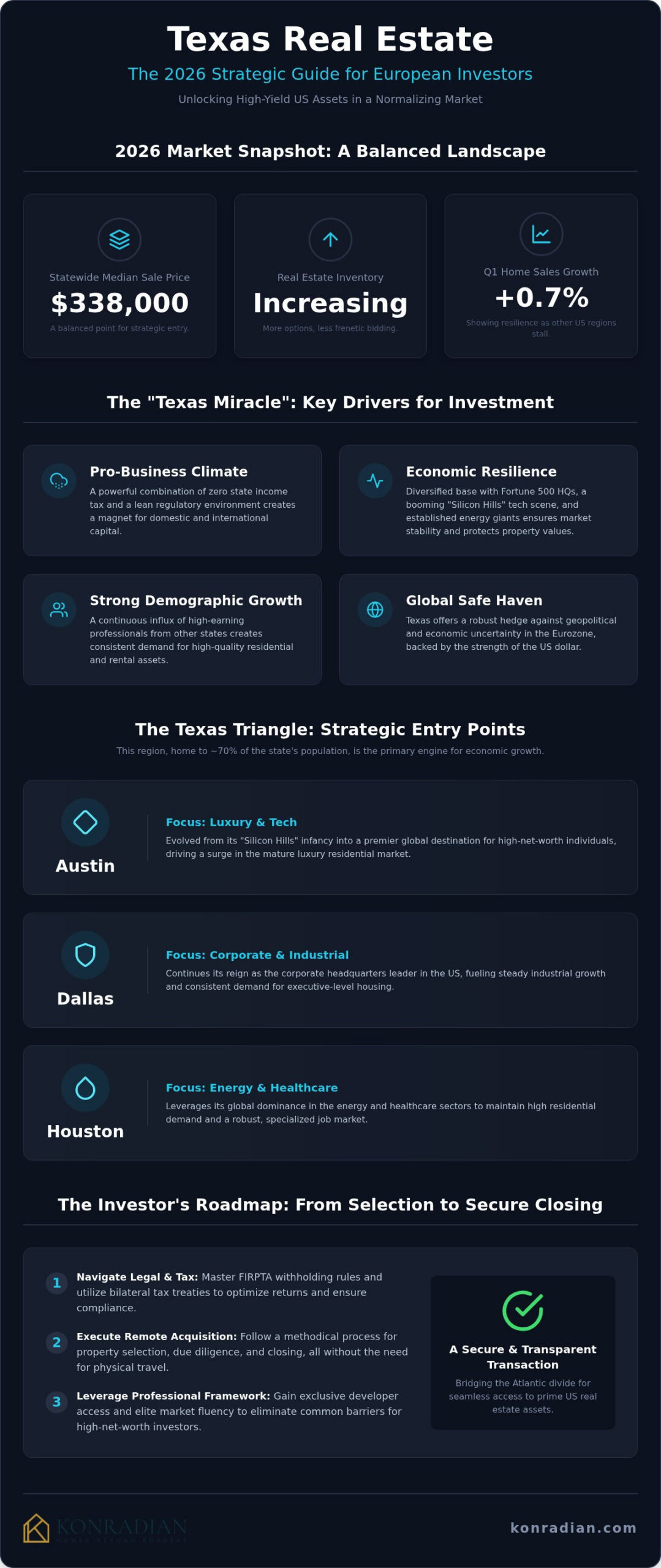
In 2026, the most strategic move for an international portfolio isn’t found in the saturated markets of London or Paris, but within the stabilizing landscape of the Lone Star State. Texas real estate for European investors has transitioned into a phase of healthy normalization, offering a rare window where inventory is up and the statewide median sale price sits at a balanced $338,000. It’s a moment defined by breathing room rather than the frenetic bidding wars of the past, yet the barrier for many remains the sheer complexity of cross-border acquisition.
You likely understand that while the potential for passive income and long-term appreciation is vast, the reality of managing FIRPTA withholdings and the inability to physically inspect properties from thousands of miles away is daunting. We promise to bridge that gap by providing a professional framework designed specifically for high-net-worth individuals seeking secure US assets. This guide examines the essential 2026 market data, breaks down the impact of new regulations like SB 17, and outlines a methodical process for a seamless transaction from abroad.
Key Takeaways
- Understand the economic drivers behind the “Texas Miracle” and why current demographic shifts continue to favor high-yield residential assets for international portfolios.
- Identify strategic entry points within the Texas Triangle, focusing on the maturation of Austin and the steady industrial growth of Dallas and Houston.
- Navigate the legal complexities of Texas real estate for European investors by mastering FIRPTA withholding rules and utilizing bilateral tax treaties to optimize your returns.
- Follow a methodical roadmap for remote property acquisition, ensuring a secure and transparent transaction without the need for physical travel.
- Leverage a professional framework that provides exclusive developer access and elite market fluency to eliminate common barriers for high-net-worth individuals.
The Texas Real Estate Boom: Why European Capital is Flowing to the Lone Star State
The sustained attraction of the Lone Star State isn’t merely a trend; it’s the result of a deliberate, decades-long economic strategy. Often referred to as the “Texas Miracle,” the state’s combination of zero state income tax and a lean regulatory environment has created a magnet for domestic and international capital alike. For those considering Texas real estate for European investors, the appeal lies in this structural stability. While European markets often struggle with stagnant growth and complex tax layers, the Economy of Texas continues to expand, driven by a pro-business philosophy that prioritizes capital preservation and growth.
Demographic shifts in 2026 underscore this momentum. Projections show a continued influx of high-earning professionals migrating from higher-tax states like California and New York. This internal migration creates a consistent demand for high-quality residential assets, ensuring that rental yields remain attractive even as other global markets face cooling periods. Unlike the volatility seen in Florida’s coastal insurance markets or the regulatory hurdles in California, Texas offers a predictable landscape for long-term stewardship. It acts as a genuine “Safe Haven,” providing a robust hedge against the geopolitical and economic uncertainties currently affecting the Eurozone.
Economic Resilience and Corporate Migration
The state’s resilience is anchored by a massive wave of corporate migration. Fortune 500 companies have relocated their headquarters to the Texas Triangle at a record pace, bringing thousands of stable, high-paying jobs to the region. This isn’t just about the energy sector anymore; the synergy between established energy giants and the burgeoning “Silicon Hills” tech scene provides a diversified economic base that protects property values. In 2026, the Texas “business-first” philosophy is evidenced by the state maintaining a 0.7% increase in home sales during the first quarter, even as many other US regions saw transaction volumes stall.
The European Investor Perspective
From a global standpoint, the US dollar remains a pillar of strength, making the timing for capital moves from the Euro particularly strategic. Many of our clients find that the value proposition here is incomparable. When you compare prime residential assets, the square-footage value in major Texas hubs far exceeds what’s available in London or Paris prime markets. You aren’t just buying a property; you’re acquiring a high-growth asset in a market that prioritizes the rights of the owner. Understanding the broader context of US real estate investment from Europe is essential for any sophisticated portfolio, and Texas stands out as the premier destination for those seeking both security and yield.
Navigating the Texas Triangle: Austin, Dallas, and Houston Market Analysis
To understand the potential of Texas real estate for European investors, one must first grasp the significance of the Texas Triangle. This geographic region, anchored by Austin, Dallas, and Houston, contains approximately 70% of the state’s population and serves as the primary engine for its economic growth. By 2026, the Triangle has matured into a sophisticated network of interconnected economies, each offering distinct advantages for international capital. Whether your objective is aggressive capital appreciation or steady, inflation-hedged income, these three metropolitan areas provide the structural diversity needed for a balanced US portfolio.
Investing across the Triangle requires a nuanced appreciation of local market cycles. While the broader state market is normalizing, the specific catalysts in each city differ significantly. Austin has evolved into a mature luxury hub, Dallas continues its reign as the corporate headquarters leader, and Houston leverages its dominance in energy and healthcare to maintain high residential demand. Identifying the right entry point depends on aligning your long-term goals with these specific urban trajectories.
Austin and the Luxury Residential Surge
Austin has moved beyond its “Silicon Hills” infancy to become a premier global destination for high-net-worth individuals. The “Tesla effect,” catalyzed by the massive Giga Texas facility, continues to drive suburban appreciation rates in eastern Travis County. As of July 2026, the median sold price in Austin reached $442,195, reflecting a steady 2.8% annual increase that signals market maturity rather than volatility. For those seeking an elite lifestyle combined with investment security, Austin’s emerging tech corridors offer exclusive pre-sale opportunities that allow investors to secure assets before they reach full market valuation.
Dallas and Houston: Industrial and Multi-Family Hubs
Dallas-Fort Worth (DFW) remains the undisputed leader in logistics and corporate relocations, benefiting from its central location and the robust US-Mexico-Canada trade corridor. With a median sale price of $390,000, Dallas provides a stable environment for investors targeting professionals who value proximity to major employment hubs. Conversely, Houston offers a unique value proposition through the Texas Medical Center, the world’s largest healthcare complex, which ensures a constant influx of high-income renters. While both cities offer compelling returns, Houston’s lower $330,000 median entry point and 0.96% effective tax rate often result in slightly higher gross rental yields compared to the steady, corporate-backed appreciation found in Dallas. If you’re looking to refine your selection, exploring tailored US investment strategies can help clarify which city best fits your risk profile.
- Austin: Best for luxury appreciation and tech-driven growth.
- Dallas: Ideal for corporate-backed stability and logistics-related demand.
- Houston: Preferred for higher gross yields and healthcare-sector resilience.
Overcoming the Atlantic Divide: Legal, Tax, and Structural Considerations
Securing high-growth assets in the US requires more than just capital; it demands a sophisticated understanding of the regulatory environment that governs foreign ownership. For those exploring Texas real estate for European investors, the primary hurdle isn’t the distance, but the structural complexity of the transaction. Success hinges on navigating the Foreign Investment in Real Property Tax Act (FIRPTA) and leveraging bilateral tax treaties to protect your yields from unnecessary erosion. By establishing a robust framework early, you ensure that your capital is positioned for maximum efficiency and security.
FIRPTA is often misunderstood as a definitive tax, but it’s actually a withholding mechanism. In 2026, the standard withholding rate remains 15% of the gross sales price for properties valued over $1 million. While this can impact liquidity during a sale, proactive planning allows many European investors to claim a refund of excess withholdings when they file their US tax returns. Additionally, the 1031 Exchange remains a powerful tool for international buyers. This provision allows you to defer capital gains taxes indefinitely, provided you reinvest the proceeds into a “like-kind” US property within the strict 180-day window, a strategy that facilitates long-term portfolio compounding.
The Legal Framework for International Buyers
A seamless acquisition begins with the right documentation. You’ll need an Individual Taxpayer Identification Number (ITIN) and a US-based bank account to manage rental income and expenses. In Texas, Title Companies play a critical role that differs from European notaries; they act as neutral third parties that guarantee clear title and handle the secure escrow of funds. Accessing professional legal support buying property abroad is the most effective way to ensure these administrative milestones are met without delaying your closing.
Tax Planning for Long-Term Yields
Texas is famous for having no state income tax, but it balances this with higher-than-average property taxes, which hover around 1.8% statewide. For a European resident, the primary tax benefit lies in the ability to combine generous US depreciation allowances with bilateral tax treaties, often resulting in a significantly lower effective tax rate on rental income than what’s available in domestic European markets. We often recommend a corporate structure, such as a US-based LLC, to provide an additional layer of liability protection and privacy. This structure also simplifies estate and inheritance tax planning, which is a vital consideration for non-resident aliens seeking to preserve wealth across generations.
- LLC Ownership: Offers privacy and shields personal assets from US-based liabilities.
- Individual Ownership: Simpler to set up but exposes the owner to higher estate tax risks.
- Tax Treaties: Essential for avoiding double taxation on dividends and rental profits.
The European Investor’s Roadmap: From Selection to Remote Closing
Acquiring property across the Atlantic used to be an exercise in logistical endurance. Today, the process of securing Texas real estate for European investors has been refined into a digital-first roadmap that prioritizes transparency and security. By removing the need for physical presence, we’ve replaced travel stress with professional stewardship. This methodical framework ensures that every decision is backed by data and every document is executed with precision, allowing you to build a high-growth US portfolio from your home office in London, Berlin, or Zurich.
The journey begins with a strategic consultation to align your portfolio goals with current market realities. Whether you’re targeting the 5% to 7% gross rental yields prevalent in 2026 or focusing on the appreciation potential of the Texas Triangle, this initial alignment dictates the sourcing phase. We then move to financial structuring, where foreign nationals typically prepare for a down payment of 25% to 40%. With an average of 60 days to close reported in the first quarter of 2026, the pace is deliberate. This timeline ensures every due diligence milestone is met without compromise, providing the peace of mind required for a high-stakes international acquisition.
Remote Sourcing and Digital Diligence
Modern technology has transformed how we evaluate assets from afar. We leverage high-definition 3D tours and drone footage to provide a transparent, 360-degree view of every property and its surrounding infrastructure. However, digital tools are only half of the equation. Having local boots-on-the-ground is essential for verifying the intangible qualities of a neighborhood that a camera might miss. Our direct developer relationships are particularly valuable here, granting you access to “Off-Market” pre-sale opportunities before they reach public listings. This insider access allows you to secure premium assets in emerging tech corridors at the most favorable entry points.
The Logistics of a Cross-Border Closing
The final stages of the roadmap are designed for maximum ease. We utilize secure digital signature platforms and mobile notary services that cater specifically to international clients, ensuring that legal documents are executed correctly according to both Texas law and your local jurisdiction. Managing the transfer of funds is handled through secure international channels to ensure capital arrives in escrow exactly when needed. Once the transaction is complete, we facilitate the transition of the asset to professional local management teams. If you are ready to begin your journey, you can explore our US real estate investment services to see how we manage every detail of the acquisition process for you.
- Step 1: Strategic Consultation and Goal Alignment.
- Step 2: Remote Sourcing and Exclusive Developer Access.
- Step 3: Due Diligence and Virtual Property Inspections.
- Step 4: Financial Structuring and Escrow Funding.
- Step 5: Remote Closing and Key Handover.
Strategic Stewardship: How Konradian Facilitates Secure US Acquisitions
Konradian serves as a sophisticated bridge for those seeking Texas real estate for European investors. Our team, educated at the London School of Economics, applies a level of intellectual rigor to the market that is rarely found in traditional brokerage. We don’t just identify properties; we curate strategic assets that align with the specific requirements of a global portfolio. By acting as a protective and proactive partner, we manage the intricate details of US acquisitions, allowing you to enjoy the benefits of ownership without the administrative burden.
Our approach is defined by quiet confidence and a commitment to transparency. With over five years of international brokerage experience, we understand that high-stakes transactions require more than just market data. They require professional stewardship. This is why our service covers every phase of the investment lifecycle, from the initial strategic consultation to the final oversight of the closing process. We handle the heavy lifting, ensuring your transition into the US market is as seamless as a domestic transaction.
One of the most strategic advantages of our framework is the fee-free model for the buyer. In the Texas market, professional representation is typically compensated by the developer or seller. This allows you to leverage our elite expertise and developer relationships without impacting your initial capital outlay. It’s a model designed to maximize your entry ROI while providing the security of a dedicated advisor who prioritizes your long-term interests and emotional well-being.
The Value of Professional Representation
In a market where inventory has reached a balanced five-month supply as of early 2026, having a buyer-side advisor is essential. While the current landscape offers more options than in previous years, it also requires a more discerning eye to separate genuine value from superficial appeal. Our direct relationships with the state’s most reputable developers grant our clients exclusive access to pre-sale opportunities. These off-market deals often provide the most compelling growth profiles, particularly in the maturing luxury sectors of Austin and the corporate corridors of Dallas.
Next Steps for the 2026 Investor
The journey toward a secure US asset begins with a focused conversation. We invite you to schedule a complimentary video consultation with our specialists to align your portfolio goals with current market opportunities. During this session, we’ll analyze your criteria and begin building a bespoke property shortlist that reflects your specific risk appetite. Our goal is to provide you with the peace of mind that comes from knowing your investment is managed by a team with global market fluency and a commitment to excellence.
Begin your Texas investment journey with a free expert consultation.
Securing Your Future in the Lone Star State
The strategic window for entering the Texas market has never been more clearly defined. By leveraging the economic resilience of the Texas Triangle and navigating the tax advantages of bilateral treaties, you can build a portfolio that stands as a resilient hedge against European volatility. Success in Texas real estate for European investors depends on moving beyond surface-level data to embrace a framework of professional stewardship and structural efficiency.
Our LSE-educated advisory team brings over five years of cross-border transaction experience to your acquisition. We’ve designed a process that is entirely fee-free for the buyer, ensuring your capital is focused solely on asset growth rather than administrative costs. We handle the complexities of remote due diligence and legal structuring, providing a seamless experience from your first inquiry to the final key handover.
Your next chapter of international growth is just a conversation away. We’re ready to help you navigate this high-growth landscape with the precision and care your capital deserves. It’s time to transition from observation to ownership with a partner you can trust.
Book a free consultation for your Texas real estate acquisition and discover the ease of professional US property ownership.
Frequently Asked Questions
Can Europeans buy property in Texas without a US visa?
Yes, you can purchase and own real estate in Texas without a US visa or residency status. US law allows foreign nationals to acquire property freely, though it’s important to note that ownership does not grant any immigration privileges or residency rights. Most of our clients manage their acquisitions and portfolios entirely from Europe by utilizing professional legal and financial frameworks to handle local requirements.
What is the average rental yield for residential property in Texas 2026?
Average gross rental yields for residential assets in Texas currently range from 5% to 7%. These returns are supported by a robust job market and a steady influx of high-earning professionals into the Texas Triangle. When evaluating Texas real estate for European investors, these yields often outperform mature European markets, especially when combined with the state’s favorable tax structure and high demand for quality housing.
How much are property taxes in Texas for international investors?
Property taxes in Texas hover around a statewide average of 1.8%, though the effective rate depends on the specific county. For instance, investors in Houston (Harris County) see an average effective rate of 0.96%, while those in Austin (Travis County) pay approximately 1.31%. While these rates are higher than in some other states, they fund essential local services and infrastructure in the absence of a state income tax.
Is it possible to get a mortgage in the USA as a European resident?
What is FIRPTA, and how does it affect my Texas property sale?
The Foreign Investment in Real Property Tax Act (FIRPTA) requires a withholding of 15% of the gross sales price when a foreign national sells a US property valued over $1 million. It’s essential to understand that this is a withholding mechanism to ensure capital gains taxes are covered, not a final tax. You can often reclaim a portion of these funds by filing a US tax return once the final tax liability is determined.
Does Texas have state income tax for international property owners?
Texas does not impose a state income tax on individuals or international property owners. This “business-first” policy is a significant advantage for those seeking to maximize their net rental income. While your profits will still be subject to US federal income tax, the lack of an additional state-level tax layer makes Texas one of the most fiscally attractive jurisdictions for international real estate investment.
How does Konradian ensure the security of a remote property purchase?
We ensure transaction security through a framework of professional stewardship and LSE-educated expertise. Our process includes transparent digital due diligence, direct developer relationships, and secure escrow funding managed through established US Title Companies. By handling the “heavy lifting” of the acquisition process, we provide a seamless, end-to-end experience that alleviates the stress and complexity of cross-border transactions for our clients.
What are the best cities in Texas for long-term capital appreciation?
Austin, Dallas, and Houston continue to be the primary drivers for long-term capital appreciation within the state. Austin benefits from a maturing tech sector, Dallas remains the leader for corporate headquarters, and Houston leverages its dominance in healthcare and energy. These cities form the Texas Triangle, an economic engine that supports sustained demand and property value growth, making them ideal for a sophisticated international portfolio.
