


A Croatian title deed is not a simple certificate of ownership; it’s a complex, three-part legal narrative that requires precise decoding to protect your capital. Investing in the Adriatic coastline is an aspirational milestone, yet the intricate bureaucracy often triggers a deep sense of unease. You likely worry about historical ownership disputes or the mysterious “active seals” that appear on property records without warning. Understanding Croatian property title deeds is the first step in replacing that confusion with the quiet confidence of a seasoned investor.
We’ll show you how to master the land registry to ensure your investment remains legally secure and entirely free of hidden liabilities. This guide breaks down the essential components of the ZK Izvadak, reveals how to spot critical red flags, and provides the clarity needed to transition from a cautious observer to a confident property owner. By the end of this analysis, you’ll possess the professional stewardship required to secure your piece of the Mediterranean with absolute peace of mind.
Key Takeaways
- Identify the ZK Izvadak as the definitive legal instrument for confirming ownership and verifying precise property boundaries.
- Decode the distinct roles of Sheets A, B, and C to uncover historical liabilities and current encumbrances hidden within the registry.
- Learn to recognize “active seals” (plomba) as immediate red flags that signal pending legal disputes or administrative blocks.
- Streamline your due diligence by understanding Croatian property title deeds through the digital “Uređena Zemlja” portal for real-time record access.
- Leverage professional stewardship to navigate complex legal narratives and secure pre-verified investments with absolute certainty.
The Anatomy of the Vlasnički List: Why It’s Your Most Important Document
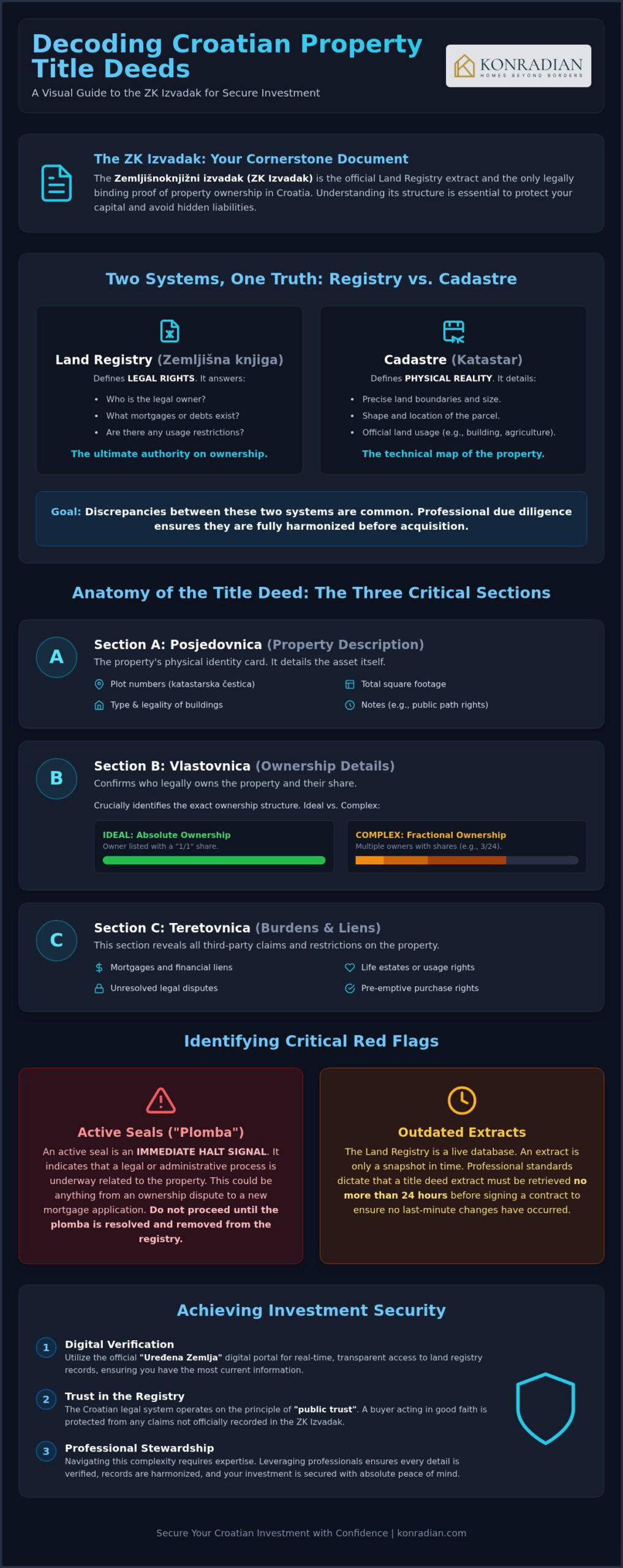
In the Croatian real estate market, the ZK Izvadak (Zemljišnoknjižni izvadak) stands as the definitive record of your investment’s legitimacy. While various documents circulate during a transaction, this official extract from the Land Registry is the cornerstone of understanding Croatian property title deeds. It provides a transparent, legally recognized history of a parcel, ensuring that your acquisition is built on a foundation of verified facts rather than mere verbal assurances. The ZK Izvadak is the only legally binding proof of ownership in Croatia as of 2026.
Land Registry vs. Cadastre: Clearing the Confusion
Investors often encounter two distinct databases: the Land Registry (Zemljišna knjiga) and the Cadastre (Katastar). The Land Registry is the ultimate authority on legal rights; it identifies who owns the property and what burdens, such as mortgages or life estates, exist. Conversely, the Cadastre focuses on the physical reality of the land, detailing its precise boundaries, size, and intended usage. A common hurdle for international buyers is a discrepancy between these two systems, where the registered owner in the Land Registry doesn’t match the user listed in the Cadastre. Resolving these inconsistencies is a critical step in the due diligence process to ensure the property you see on the map is the same one you legally own. Professional stewardship involves harmonizing these records before any funds are committed.
The Legal Weight of the Registry Extract
The Croatian legal system operates on the principle of “public trust” (načelo javne vjere). This doctrine ensures that any individual who relies on the information within the Land Registry in good faith is protected from unrecorded claims. If a debt or an ownership claim isn’t registered in the ZK Izvadak, it generally cannot be enforced against a bona fide buyer. This protection is robust, yet it demands absolute vigilance. Because the registry is a living document, an extract must be “fresh” to be reliable. Professional standards dictate that a title deed should be retrieved no more than 24 hours before a contract is signed. This precision eliminates the risk of “active seals” or new encumbrances appearing between the initial viewing and the final transaction, providing the tranquility that defines a successful high-stakes acquisition.
- Legal Certainty: The Land Registry protects you from historical claims not visible on the surface.
- Physical Accuracy: The Cadastre ensures you aren’t paying for land that doesn’t exist within the stated boundaries.
- Temporal Precision: A 24-hour extract is the only way to guarantee the current status of your potential Adriatic home.
Decoding the Three Sections: A, B, and C Sheets Explained
Every official extract in Croatia follows a rigid, three-part architecture. This standardization allows for a methodical review, where each sheet addresses a specific category of legal facts. For an international investor, the goal is to ensure these sections reflect the reality of the physical asset and the intentions of the seller. Successfully understanding Croatian property title deeds involves more than a glance; it requires a deep dive into the historical layers that define the property’s current status and future potential.
Section A: The Property Description (Posjedovnica)
This sheet acts as the physical identity card of the land. It lists plot numbers (katastarska čestica) and the total square footage of the parcel. Crucially, it notes the type of buildings present on the site. We look for specific annotations regarding “legalization” here; if a villa exists but isn’t properly recorded in Section A, it suggests a lack of building or use permits. We also scan for “public path” notes that might indicate the parcel is subject to municipal access rights. If the area on the deed doesn’t match the physical boundaries, it’s a clear sign that a professional boundary adjustment is necessary.
Section B: Ownership Details (Vlastovnica)
This is where legal title is confirmed. Understanding Croatian property title deeds requires a sharp eye for the Vlastovnica to identify the current owner and their exact ownership share. Ideally, you want to see the owner listed with a “1/1” share, indicating absolute ownership. If multiple names appear with fractional shares, such as 3/24, you’re entering a complex multi-party negotiation. We trace the history of these transitions to ensure no previous inheritance claim remains unresolved. Some properties carry pre-emptive rights, where a local municipality must be offered the property first, and this section must align perfectly with the seller’s identification to avoid delays at the notary.
Section C: Encumbrances and Burdens (Teretovnica)
Section C is the most critical area for risk management. It reveals mortgages, tax liens, or lifetime support contracts that could prevent a clean transfer of title. We also identify easements, such as a neighbor’s right to run water lines through your garden or a right of way for an adjacent vineyard. Konradian’s team performs a meticulous audit of this sheet, ensuring all burdens are cleared before the final transaction. Our Croatian real estate sales support includes verifying that every liability is legally discharged, giving you a clean slate on the Adriatic. We don’t just identify the problems; we oversee the removal of these encumbrances to protect your capital and your peace of mind.
Identifying Red Flags: Active Seals and Legal Annotations
When reviewing the ZK Izvadak, the most critical visual indicator of a potential complication is the “Plomba,” or active seal. This annotation serves as a formal notification that a change to the registry has been requested but not yet finalized. A Plomba is a pending entry that prevents a clean title transfer until resolved. For an investor, seeing this mark should trigger an immediate pause in the transaction. While some seals are merely administrative, such as a request to update a seller’s home address, others represent significant legal threats like pending mortgages or active ownership litigation. Distinguishing between these requires a methodical audit to ensure the property’s legal narrative remains intact. Understanding Croatian property title deeds means recognizing that any unresolved seal creates a risk of the transaction being blocked or the title being contested post-purchase.
The Risk of Historical Restitution Claims
Croatia’s history of property nationalization during the mid-20th century adds a layer of complexity to current transactions. Restitution laws allow former owners or their descendants to claim properties that were once seized by the state. These “hidden” heirs may not appear on the current owner list but could have active legal processes underway. Our strategy at Konradian involves a rigorous vetting process that differs by property type. While modern developer builds often come with a clear, state-verified paper trail, older stone houses in historic coastal towns require a deeper genealogical and legal investigation to ensure no dormant claims exist. We prioritize properties where the chain of ownership is unbroken and transparent, providing the security needed for a high-stakes investment.
Zoning and Usage Restrictions
Specific annotations in the registry may also indicate zoning restrictions that affect your long-term plans. Properties located within a “protected zone” or the “maritime domain” (pomorsko dobro) are subject to strict environmental and public access laws. Additionally, agricultural land (poljoprivredno zemljište) remains restricted for most non-EU citizens, often requiring the formation of a local company to facilitate the purchase. Utilizing professional legal support buying property abroad is essential for navigating these zoning nuances. We ensure that the intended use of your Adriatic retreat aligns perfectly with the legal reality recorded in the land registry, preventing costly surprises after the acquisition is complete.
- Plomba Verification: Every active seal must be explained and resolved before a deposit is paid.
- Restitution Checks: We investigate historical claims to protect against future ownership disputes.
- Zoning Alignment: Ensure your property isn’t subject to maritime domain restrictions or agricultural limitations.
The 2026 Verification Process: Digital Systems and Professional Audits
The modernization of the Croatian Land Registry has reached a pivotal milestone in 2026 with the full integration of the “Uređena Zemlja” (OSS) digital portal. This One Stop Shop facilitates understanding Croatian property title deeds by providing a unified interface for both the Land Registry and the Cadastre. Investors can now retrieve an informative extract almost instantaneously by entering the specific plot number, known as the katastarska čestica, and the relevant cadastral municipality. This digital accessibility allows for rapid initial vetting, yet it demands a discerning eye to interpret the data correctly. Digital records offer speed, but they aren’t a substitute for a comprehensive legal audit.
Utilizing the One Stop Shop (OSS) System
The OSS system serves as the Joint Information System (Zajednički informacijski sustav), bridging the gap between legal ownership records and physical land data. It’s essential to distinguish between a non-certified informative extract and a certified digital document. An informative extract is useful for preliminary research and identifying obvious encumbrances, but it lacks the legal weight required for a final transaction. A certified extract, secured via the e-Građani portal or a notary, is the version that carries the state’s guarantee of accuracy. We utilize these digital tools to provide our clients with immediate clarity on a property’s status, identifying potential deal-breakers before a physical viewing is even scheduled.
The Role of the Lawyer and Notary in 2026
While digital systems offer remarkable efficiency, they don’t replace the intellectual rigor of a professional audit. In rural parts of Croatia, digital records may still lag behind the original paper archives housed in local courts. A physical audit by a licensed lawyer remains a mandatory step to verify that no legacy entries or historical annotations were missed during the digitization process. The Public Notary (Javni bilježnik) acts as the final gatekeeper, ensuring that all signatures are valid and the transfer of title is registered correctly in the electronic system. This level of scrutiny mirrors the rigorous standards found in our Spanish Property Acquisition framework, ensuring a consistent approach to security across Mediterranean markets.
Our team handles the heavy lifting of this verification process, coordinating between digital portals and local land registry offices to secure your investment. If you’re ready to proceed with a verified purchase, explore our Croatian Real Estate Sales portfolio to find properties with pre-audited titles and guaranteed legal clarity.
- Instant Vetting: Use the OSS portal for an immediate overview of plot boundaries and ownership.
- Certified Extracts: Always demand a certified ZK Izvadak for the final contract phase.
- Physical Verification: Ensure your legal counsel checks the physical archives for properties in older municipalities.
Seamless Acquisition: How Konradian Secures Your Croatian Investment
Konradian operates with a “Security First” philosophy that transforms the often-intimidating process of international acquisition into a seamless, professional journey. We recognize that understanding Croatian property title deeds is not merely a box to check; it’s the fundamental prerequisite for any investment we represent. Our team only lists properties that have passed a rigorous internal audit, ensuring that every asset is legally clean and ready for transfer. By leveraging our LSE-educated advisors, we bridge the gap between complex local regulations and the high standards of international investors, providing a level of intellectual authority that is rare in the brokerage world.
Our end-to-end service model covers every stage of the transaction, from the initial title verification to the final key handover. This comprehensive stewardship is provided at zero cost to the buyer, as our commissions are covered by the seller. This structure ensures that our interests are aligned with your security, allowing us to act as a protective partner throughout the acquisition process. We handle the intricacies so you don’t have to, projecting an image of calm, professional oversight in a market that can often feel opaque.
Exclusive Access to Pre-Sale and Vetted Listings
Risk reduction is central to our strategy, particularly when focusing on high-demand regions like Istria real estate for sale. We maintain direct relationships with premier developers, allowing us to offer pre-sale opportunities where the legal paperwork is meticulously prepared from the outset. For new builds, we pre-vet developers to ensure that Section C is entirely clear of construction liens or legacy financing. In one notable case, our audit uncovered a “hidden” easement for a neighbor’s utility access on a coastal villa that had been omitted from recent digital records. By identifying this discrepancy in the physical archives, we protected our client from a potential legal dispute and negotiated a resolution before any funds were committed.
Your Global Partner for Local Precision
We combine the personalized care of a dedicated concierge with the strategic rigor of an international consultancy. Our advisors handle the “heavy lifting” of administrative and legal navigation, allowing you to focus on the aspirational aspects of your Adriatic investment. Our deep expertise in understanding Croatian property title deeds ensures that your journey is defined by tranquility rather than technical hurdles. We don’t just point out problems; we provide the solutions and professional oversight required to navigate the 2026 Croatian market with confidence.
If you’re ready to secure your piece of the Mediterranean with absolute peace of mind, the next step is simple. Book your free consultation today to begin a secure, professionally managed property search tailored to your long-term interests. We invite you to experience the ease of a transaction handled by experts who prioritize your emotional well-being and financial security in equal measure.
Securing Your Legacy on the Adriatic Coast
Mastering the art of understanding Croatian property title deeds allows you to move past the initial anxiety of international investment and into a position of strategic advantage. You now recognize that a clean ZK Izvadak is the only foundation for a secure transaction. You understand how to decode the layers of ownership and encumbrances that define a property’s true value. While digital portals offer immediate insights, the tranquility of a successful acquisition relies on the rigorous verification of physical archives and the resolution of any active seals before a contract is finalized.
At Konradian, we provide the elite expertise required to handle this complexity on your behalf. Our LSE-educated advisors offer comprehensive legal and financial transaction support, ensuring you gain exclusive access to pre-sale developer deals with guaranteed clean titles. We manage the heavy lifting of due diligence so you can focus on the lifestyle rewards of your Mediterranean retreat. Secure your Adriatic investment with a professional title audit—book your free consultation today. Your journey toward a secure and sophisticated property acquisition begins with professional stewardship you can trust.
Frequently Asked Questions
What is the difference between a Vlasnički list and a ZK izvadak?
In the context of understanding Croatian property title deeds, these terms refer to the same official record. The Vlasnički list is technically Sheet B of the ZK Izvadak, which is the complete extract from the Land Registry. While people often use the names interchangeably, the ZK Izvadak is the comprehensive document. It includes the property description, owner details, and any registered burdens or mortgages currently attached to the land.
Can I buy property in Croatia if the title deed shows an active “Plomba”?
You should proceed with extreme caution if a property record shows an active Plomba. This seal indicates that a legal or administrative change is currently pending in the Land Registry. Until this entry is resolved or rejected by the court, the title is not considered clean. Buying a property with an unresolved seal could leave you vulnerable to unexpected ownership claims or hidden liabilities that were in the queue before your purchase.
How long does it take to update the title deed after a purchase in 2026?
In 2026, the digital integration of the land registry has significantly reduced processing times. Once the sales contract is notarized and submitted electronically by a Public Notary, the ownership update often occurs within a few business days. However, complex cases involving historical corrections or legacy paper archives in rural municipalities can still take several weeks. Professional stewardship ensures that your application is tracked meticulously through the digital Uređena Zemlja portal.
Is a digital title deed extract legally valid for a property sale?
A digital title deed extract is legally valid for a property sale only if it is a certified document. Informative extracts retrieved for free online are useful for preliminary research, but they lack the legal weight required for a notary to finalize a transaction. Certified digital extracts feature an electronic signature and a unique QR code for verification, providing the same legal security as a traditional paper document stamped by the court.
What happens if the Cadastre and Land Registry descriptions do not match?
Discrepancies between the Cadastre and Land Registry are common hurdles that require professional harmonization. The Land Registry confirms who owns the property, while the Cadastre defines the physical boundaries and land usage. If the descriptions don’t match, it can complicate future building permits or resale efforts. We ensure these records are aligned during the due diligence phase, protecting you from purchasing a parcel that has poorly defined or contested legal boundaries.
Are there hidden costs associated with verifying Croatian title deeds?
There are no hidden costs when you utilize professional brokerage services for understanding Croatian property title deeds. While the state charges minor administrative fees for issuing certified extracts, these are nominal costs typically handled during the notary phase. Our team provides the strategic audit and verification of these documents as part of our comprehensive service model. This ensures you receive elite expertise and legal clarity without facing unexpected consulting or research invoices.
Can a foreign citizen check the Croatian Land Registry online?
Any foreign citizen can access the Croatian Land Registry online using the Uređena Zemlja (OSS) portal. By entering the specific plot number and the name of the cadastral municipality, you can view informative data regarding ownership and encumbrances from anywhere in the world. This transparency is a cornerstone of the 2026 investment landscape, though interpreting the technical legal terminology correctly often requires the guidance of a sophisticated international advisor.
Does Konradian charge for verifying the title deeds of the properties they show?
Konradian does not charge buyers for verifying title deeds or performing legal due diligence on listed properties. Our business model operates on seller-paid commissions, which means you receive end-to-end acquisition support at no additional cost. This service includes a thorough audit of the ZK Izvadak and verification of clean title status. We prioritize your long-term security and peace of mind, ensuring every property we show meets our rigorous standards for legal excellence.
