


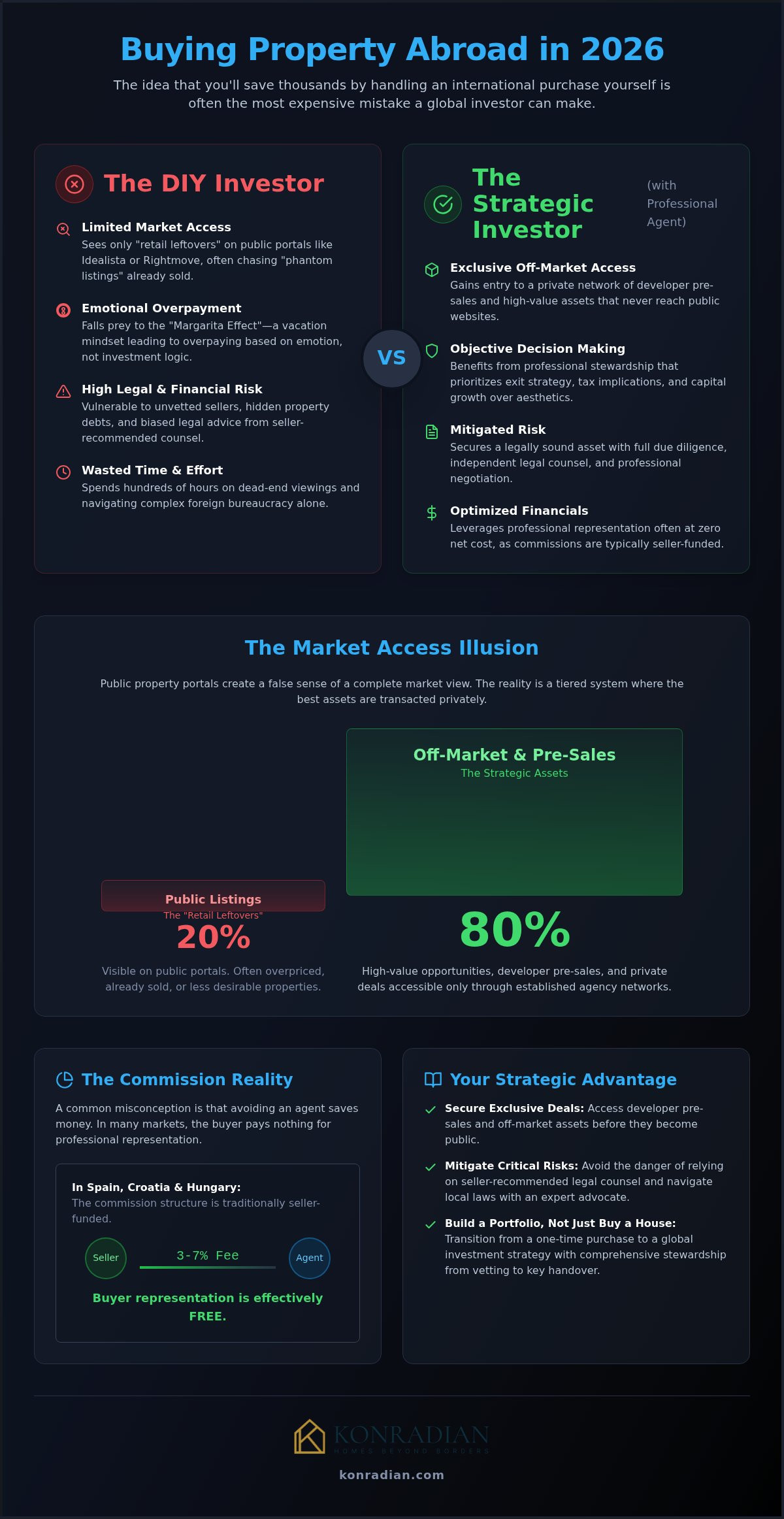
The idea that you’ll save thousands by handling an international purchase yourself is often the most expensive mistake a global investor can make. When weighing the merits of buying property abroad DIY vs agent, many buyers focus solely on upfront commission fees while overlooking the invisible costs of local bureaucracy and missed off-market opportunities.
It’s natural to want full control over your investment, especially when the allure of a sun-drenched villa or a metropolitan penthouse feels so personal. You’ve likely worried about the “margarita effect,” that emotional haze that leads to overpaying, or the stress of signing a legal contract in a language you haven’t mastered. This comparison will clarify whether a self-guided search or professional stewardship offers the best security and value for your 2026 real estate goals. We will examine the shifting tax landscapes in regions like Portugal and Spain, the reality of buyer representation, and how to gain access to exclusive developer pre-sales that never hit the public market.
Key Takeaways
- Understand the digital illusion of property portals and why buying property abroad DIY vs agent often means choosing between “retail leftovers” and high-value strategic assets.
- Learn how the seller-paid model in markets like Spain and Croatia allows you to leverage elite professional representation at zero net cost to the buyer.
- Identify the critical legal risks of a self-guided approach, specifically the danger of relying on legal counsel recommended by the seller.
- Discover how to secure exclusive developer pre-sales and off-market opportunities that are typically reserved for established agency networks.
- Master the transition from simply purchasing a house to building a global portfolio through comprehensive stewardship that handles everything from vetting to key handover.
The Allure of DIY vs. the Reality of International Markets
The digital age has created a compelling illusion of accessibility. With a few clicks, any investor can browse thousands of villas in Spain or apartments in Budapest from their living room. It’s tempting to believe that these public platforms provide a complete picture of the market. However, the decision regarding buying property abroad DIY vs agent is often the difference between viewing a curated storefront and gaining entry to the private warehouse where the real value is stored.
The Portal Trap: Why DIY Buyers See the “Leftovers”
Property portals like Idealista or Rightmove are retail environments. They are designed for the general public, which means the assets listed there have already been filtered through the local professional network. In high-demand markets across Spain and Croatia, the most lucrative deals, particularly direct developer pre-sales, are often transacted before they ever reach a public URL. DIY buyers frequently find themselves chasing “phantom listings.” These are attractive properties that have already been sold but remain online solely to harvest lead data. This leads to a skewed perception of “market value” based on properties that are no longer available or are priced at a significant retail markup. A more sophisticated approach to understanding international real estate reveals that the best investments require direct, established relationships rather than public search filters.
The Emotional Premium: Avoiding the Holiday Home Bias
The true cost of the DIY path is rarely found in a line item. It’s measured in the hundreds of hours spent on dead-end viewings and the high-stakes risk of unvetted sellers. While language proficiency is a useful tool, it’s no substitute for cultural fluency. You might be able to translate the words of a 500,000 Euro contract, but without a deep understanding of local legal customs regarding debt encumbrances and habitability certificates, you remain vulnerable. Professional guidance isn’t just about finding a house; it’s about securing a legally sound asset while preserving your most valuable resource: time.
Decoding the Mechanics: How Agent Services Work in 2026
The financial architecture of an international real estate transaction is often misunderstood by those entering the market for the first time. A common misconception in the debate of buying property abroad DIY vs agent is that avoiding a professional saves the buyer the equivalent of the commission. In reality, the cost of representation is frequently built into the seller’s marketing budget. This means a self-guided buyer often pays the same “retail” price as a represented one, but without the benefit of a professional advocate to manage the complexities of the deal.
The Commission Structure: Who Pays the Professional?
In the primary markets of Spain, Croatia, and Hungary, the commission structure is traditionally seller-funded. Developers and private sellers typically allocate between 3% and 7% of the sale price to cover brokerage fees. When you engage a specialist for Spanish property acquisition or Croatian real estate sales, the service is effectively free for the buyer. This model ensures that you receive elite-level guidance without an additional line item on your closing statement.
Conversely, in the UK market, property sourcing is often a paid advisory service. This is because the value lies in finding high-yield assets that are not yet publicly listed. Industry experts at the National Association of REALTORS® emphasize the importance of working with international clients through a structured, professional lens to ensure all parties understand these local nuances. Regardless of who pays the fee, the objective remains the same: securing an asset that meets rigorous investment standards.
DIY vs. Agent: A Financial Comparison
To truly understand the value proposition, one must look beyond the sticker price and consider the total cost of acquisition. A DIY approach often carries hidden expenses that don’t appear until the final stages of the transaction. Professionals identify these “phantom costs,” such as local transfer taxes or notary fees, during the initial consultation phase.
- DIY Approach: High time investment, risk of “Margarita Effect” overpayment, exposure to unvetted legal contracts, and limited to public retail listings.
- Professional Stewardship: Zero direct cost in most markets, access to developer pre-sales, full legal and financial vetting, and objective price negotiation.
Professional representation provides a “negotiated discount” that a DIY buyer rarely achieves. Because agents understand the local developer’s bottom line and current market inventory levels, they can often secure terms that offset any perceived savings of going it alone. If you are considering Hungarian property brokerage or a US investment, having a partner who manages the heavy lifting ensures that your capital is protected from the start. This end-to-end support transitions the experience from a stressful administrative burden to a seamless handover of a high-value asset.
Risk Mitigation: The Legal and Financial Minefield
Entering an international market without a protective shield often exposes investors to risks that are invisible until the final signing. In the context of buying property abroad DIY vs agent, the most significant danger isn’t just missing a deadline; it’s the structural conflict of interest. Many unrepresented buyers fall into the trap of using a legal professional recommended by the seller or developer. This creates a scenario where the person meant to protect your interests has a pre-existing relationship with the party across the table. True security requires an independent advisor who is culturally fluent and legally detached from the vendor.
The Security Audit: What DIY Buyers Often Miss
A comprehensive due diligence process goes far beyond a cursory glance at a contract. In coastal regions of Spain and Croatia, for example, many older properties feature illegal extensions or “out of planning” structures that can lead to heavy fines or even demolition orders for the new owner. Ensuring that the “Nota Simple” in Spain is current and accurately reflects the legal owner is a non-negotiable step. Without dedicated legal support buying property abroad, you risk inheriting debt encumbrances or habitability issues that are difficult to resolve after the funds have been transferred. We ensure every asset is vetted against the land registry and local planning laws to guarantee a clean title.
Navigating the local bureaucracy is another area where the DIY path often stalls. Obtaining a NIE number in Spain or an OIB number in Croatia is a prerequisite for any transaction, yet the administrative hurdles can take weeks for a non-resident. A professional partner handles these logistical bottlenecks. This ensures that your Anti-Money Laundering (AML) and Know Your Customer (KYC) documentation is compliant with international transfer regulations from the outset. Precision matters when dealing with international transfer compliance.
Financial Rigor: Beyond the Purchase Price
Wealth preservation requires looking past the initial acquisition cost to the long-term tax implications. A sophisticated investment strategy considers whether to structure the purchase through a personal or corporate vehicle to maximize tax efficiency. This “London School of Economics” mindset allows us to forecast liabilities like Capital Gains Tax and local property taxes, such as the IBI in Spain or Komunalna naknada in Croatia, before you commit capital. Precision in these early calculations prevents unexpected drains on your portfolio’s liquidity. By managing the heavy lifting of financial vetting and currency risk coordination, we transform a complex legal minefield into a secure, predictable transition of ownership.
The Strategic Advantage: Exclusive Access and Pre-Sales
The digital marketplace provides only a fraction of the available inventory. When evaluating buying property abroad DIY vs agent, the most significant differentiator is often the invisible market. While a self-guided buyer is limited to what is publicly listed, professional stewardship grants access to private inventories and early-stage developments that never reach a portal. This isn’t just about choice; it’s about the financial advantage of entering a project at the most favorable basis.
Developers in 2026 prioritize certainty and speed. They frequently release “First Look” opportunities to a curated network of established agencies to secure early capital. This pre-sale phase allows our clients to secure assets before they are released to the general public, often at a lower price point. Beyond the financial entry point, buying early provides the unique opportunity to influence the build. You can often customize layouts, finishes, and technical specifications during the off-plan stage, ensuring the final product aligns perfectly with your lifestyle or investment goals.
Accessing Off-Market Listings
In high-demand regions like the UK and coastal Croatia, high-net-worth sellers often prefer “quiet” sales to maintain privacy. They avoid public listings to prevent an influx of unvetted viewers. This is where a professional network becomes indispensable. Utilizing a UK property sourcing service allows you to find distressed or high-yield assets that are transacted entirely behind closed doors. Having “boots on the ground” means we find deals through local relationships and private registries that don’t exist on the internet.
Pre-Sale Opportunities in Spain and Croatia
The mechanics of Spanish Property Acquisition have evolved to favor the represented buyer. In the current 2026 market, the most prestigious new builds in Marbella or the Costa del Sol are often 40% sold before the first stone is laid. Similarly, Istria real estate for sale has become a prime target for pre-sale growth due to its rising profile among European investors. However, off-plan purchases require rigorous vetting. We apply a strategic mindset to assess the developer’s financial stability and project history, ensuring that your capital is protected throughout the construction phase.
Accessing these exclusive tiers of the market requires more than just a search engine. It requires a partner who is already in the room when the deals are being made. If you are ready to move beyond the retail market, contact us today to access our current portfolio of off-market opportunities.
Navigating Your Acquisition: Why Stewardship Wins in 2026
Choosing between buying property abroad DIY vs agent is ultimately a choice between managing a transaction and building a legacy. In the current global climate, the objective is no longer just “buying a house.” It’s about the strategic expansion of a global portfolio. A self-guided approach often leaves you reactive, responding to whatever inventory happens to be visible. Professional stewardship, however, places you in a proactive position. It ensures every acquisition is vetted for long-term capital preservation and legal security before a single Euro or Dollar is committed.
The Konradian Difference: Elite Expertise, Zero Friction
Our approach is defined by a level of intellectual rigor that standard agencies rarely match. The Konradian team, educated at the London School of Economics, treats real estate as a sophisticated asset class. We handle the “heavy lifting” that typically derails DIY attempts, from coordinating cross-border mortgages to conducting exhaustive legal vetting in local land registries. This end-to-end model removes the friction from international transactions, allowing you to focus on the strategic value of the asset while we manage the administrative complexity.
The requirements for success vary significantly by region. For instance, our guide on US Real Estate Investment from Europe illustrates the stark differences in tax efficiency and corporate structuring required in North America compared to the Mediterranean. Whether you are targeting Spanish Property Acquisition or Hungarian Property Brokerage, our 5+ years of experience ensures that your purchase is structured correctly from day one. We act as your cosmopolitan guide, providing the cultural fluency and market savvy needed to navigate diverse regulatory environments with quiet confidence.
Your Roadmap to a Secure Purchase
Transitioning from research to ownership should be a methodical, logical process. We have refined our acquisition journey into three clear phases to ensure transparency and reliability:
- Step 1: Strategic Definition. We begin with a video consultation to define your investment goals, tax residency requirements, and lifestyle preferences.
- Step 2: Curated Selection. You receive a shortlist of properties vetted against “real” market data and internal benchmarks, including exclusive pre-sale opportunities.
- Step 3: Precise Execution. Our team manages the entire transaction, providing full legal and financial oversight until the keys are in your hand.
The complexity of international real estate in 2026 demands more than just a search bar; it requires a protective partner. To move beyond the limitations of a self-guided search and secure a high-value asset with total peace of mind, schedule your free video consultation with Konradian today.
Securing Your Global Future with Strategic Precision
The choice between buying property abroad DIY vs agent fundamentally changes the trajectory of your investment. It’s not merely a matter of convenience; it’s a decision that determines the security of your capital and the quality of your future portfolio. While a self-guided search might offer a sense of independence, it frequently overlooks the legal minefields and retail leftovers common in public portals. By choosing professional stewardship, you gain a protective partner who manages the intricate mechanics of cross-border finance and local bureaucracy on your behalf.
Our LSE-educated strategic advisors leverage over 5 years of cross-border transaction expertise to secure your interests at every stage. We provide exclusive direct-to-developer pre-sale access, allowing you to acquire premium assets before they reach the general market. This level of precision ensures that your international portfolio is built on a foundation of security and strategic foresight. Begin your secure international acquisition with a free consultation and take the first step toward a seamless purchase. We look forward to helping you navigate the complexities of the 2026 market with quiet confidence and ease.
Frequently Asked Questions
Is it cheaper to buy property abroad without an agent?
It is rarely cheaper to bypass professional representation because commissions are typically built into the seller’s marketing budget from the outset. A self-guided buyer usually pays the same “retail” price as a represented one but lacks the strategic negotiation and rigorous vetting that a professional provides. Without an agent, you also risk overpaying due to a lack of access to “real” market data that isn’t visible on public portals.
How do real estate agents get paid if the service is free for the buyer?
In primary markets like Spain, Croatia, and Hungary, the developer or private seller pays the brokerage fee as a standard part of their sales costs. This model allows you to leverage elite expertise and full legal support without an additional line item on your closing statement. It’s a structure designed to ensure properties are moved efficiently through trusted professional networks.
Can I buy property in Spain or Croatia without being there in person?
You can absolutely complete the entire acquisition process remotely through a Power of Attorney (POA). We coordinate with local notaries to handle all legal signatures and administrative requirements on your behalf. Our team provides high-definition digital walkthroughs and detailed site reports, ensuring you have total clarity before making a commitment from abroad.
What are the biggest risks of DIY property buying in a foreign country?
The most significant risks include inheriting hidden debts, purchasing structures with illegal extensions, and failing to comply with local tax regulations. When weighing the merits of buying property abroad DIY vs agent, many investors overlook the complexity of local land registries. A self-guided approach often lacks the independent due diligence needed to uncover encumbrances that can devalue your asset instantly.
Do I need a separate lawyer if I am using an international real estate agency?
Independence is the cornerstone of a secure transaction. While we provide comprehensive legal and financial transaction support, we ensure your counsel is entirely unconflicted and has no ties to the seller or developer. This protective layer is essential for objective due diligence and long-term peace of mind during a high-stakes international purchase.
How do I get access to pre-sale or off-market property listings?
Exclusive listings are accessed through established professional relationships rather than public search engines. Developers often release “first look” opportunities to a curated network of agencies to secure early capital before a project is announced to the public. We provide our clients with direct access to these inventories, often securing assets at a more favorable basis than the eventual retail price.
What is the “margarita effect” in international real estate?
The “margarita effect” refers to the emotional overpayment that occurs when a buyer’s judgment is clouded by a “vacation high.” It leads to purchasing based on aesthetics and sunset views rather than investment math and exit strategies. This is a common pitfall when buying property abroad DIY vs agent, as professional stewardship provides the objective distance needed to keep the transaction grounded in financial logic.
How long does the property acquisition process typically take abroad?
The timeline from initial selection to key handover generally spans between 8 and 12 weeks. This duration accounts for the time required to obtain local identification numbers, such as a NIE in Spain or an OIB in Croatia, and the completion of exhaustive legal vetting. While the administrative pace varies by municipality, our proactive coordination ensures the process moves forward without unnecessary friction or delays.
