


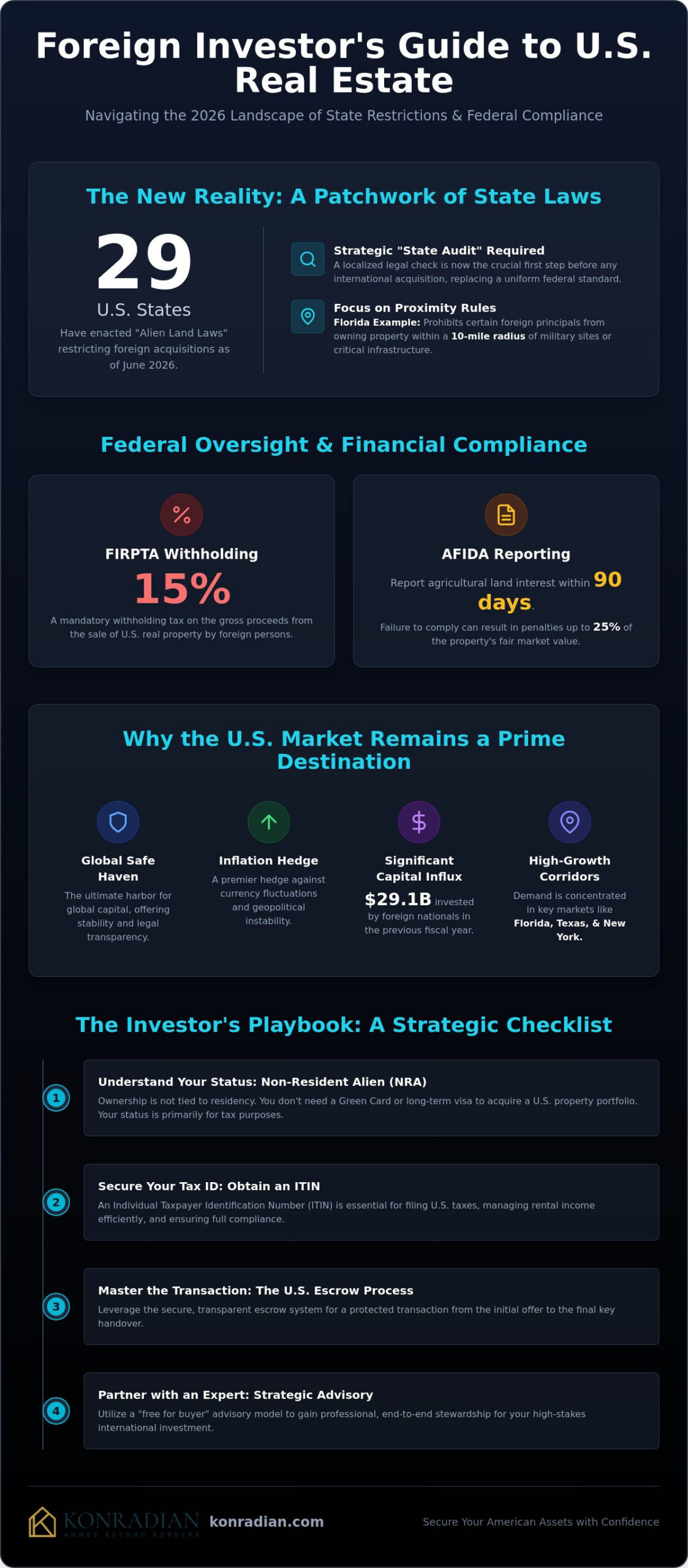
As of June 2026, 29 U.S. states have enacted laws that restrict or forbid certain international land acquisitions, effectively ending the era of a uniform federal standard for overseas investors. If you’re feeling a sense of unease regarding how these “alien land laws” or the 15% FIRPTA withholding might impact your liquidity, you’re certainly not alone. The landscape for foreign ownership of property in USA has become a sophisticated puzzle where state-level scrutiny now rivals federal oversight in its complexity.
It’s understandable to seek security when the legal ground feels like it’s shifting beneath your portfolio. This guide offers a definitive roadmap to navigate these evolving restrictions and tax traps with the poise of a seasoned global citizen. We will examine the specific legislative hurdles in high-growth regions like Florida, detail the structures necessary for tax-efficient rental income, and show you how a proactive partner can handle the heavy lifting of cross-border compliance. By the end of this analysis, you’ll have the intellectual rigor and practical strategy required to secure your American assets with absolute confidence.
Key Takeaways
- Identify how state-level “alien land laws” now impact 29 states, requiring a localized strategic audit before any international acquisition.
- Navigate the complexities of the 15% FIRPTA withholding and learn the precise steps to secure an ITIN for tax-efficient rental income.
- Evaluate why the American market remains a primary safe haven for global capital and how to manage the evolving regulations surrounding foreign ownership of property in USA.
- Master the nuances of the U.S. escrow process to ensure a secure, transparent transaction from initial offer to final key handover.
- Access a sophisticated “free for buyer” advisory model that provides end-to-end professional stewardship for high-stakes international investments.
Is the American Dream Still Open to Foreign Investors in 2026?
The U.S. real estate market maintains its position as the ultimate harbor for global capital. While headlines often focus on shifting policies, the legal foundation for foreign ownership of property in USA remains remarkably robust for most international buyers. It’s a landscape defined by stability and legal transparency, even as we witness a transition from a broad federal “open door” policy to a more nuanced, state-specific regulatory environment. This evolution doesn’t signal a market closure; rather, it marks the beginning of a more strategic era for the sophisticated investor.
Institutional and private investors alike view American soil as a vital hedge against currency fluctuations and geopolitical instability. Whether you’re targeting high-yield commercial assets in Manhattan or a luxury residence in Miami, the underlying rights to fee simple ownership haven’t vanished. The shift we’re seeing in 2026 isn’t a closure of the market, it’s a call for higher precision in how you structure your entry. Foreign investment in U.S. real estate continues to be a cornerstone of the American economy, provided the investor understands the distinction between asset classes. Residential and commercial holdings generally face fewer hurdles than agricultural land, which has become the primary focus of recent legislative activity.
Understanding Non-Resident Alien (NRA) Status
A non-resident alien is defined by the IRS as someone who is neither a U.S. citizen nor a resident for tax purposes. It’s a critical distinction to master because your status for buying property isn’t tied to your status for paying taxes. You don’t need a Green Card or even a long-term visa to acquire a portfolio. Many of the most successful investors we advise operate entirely from abroad, leveraging the fact that U.S. law doesn’t require physical residency to hold title. Your buying power is determined by your capital and your strategic structure, not the color of your passport.
The 2026 Market Outlook for International Buyers
The demand for premium assets remains concentrated in high-growth corridors. Florida continues to lead for European investors seeking lifestyle and appreciation, while Texas and New York remain essential for those focused on commercial scale. Despite the strength of the dollar, the U.S. market serves as a premier inflation hedge. As of mid-2026, foreign nationals residing outside the U.S. continue to drive a significant portion of the residential market, following an investment of $29.1 billion in the previous fiscal year. This influx of capital persists because the fundamental transparency of the American legal system provides a level of security that few other jurisdictions can match.
Navigating the New Map: State-Level Restrictions and Alien Land Laws
The regulatory environment for foreign ownership of property in USA has transformed into a patchwork of local mandates. As of June 2026, approximately 29 states have enacted legislation that restricts or limits international land interests. These “alien land laws” are no longer relics of the past; they are active, strategic tools used by state governments to oversee investment near critical infrastructure and military installations. For the global investor, this means a standard federal check is no longer sufficient. A rigorous “State Audit” is now the first step in any acquisition strategy.
Many of these restrictions focus on “foreign adversaries,” yet the geographic limitations can catch even the most well-intended buyer off guard. In Florida, for instance, certain foreign principals are prohibited from owning property within a 10-mile radius of military sites or critical infrastructure. This doesn’t just apply to vast agricultural tracts. It can impact luxury residential dwellings and commercial hubs in densely populated areas. Understanding the specific zoning and proximity of your target asset is essential to avoid legal entanglements before capital is committed.
AFIDA and Federal Reporting Requirements
While states handle the “who” and “where,” the federal government maintains strict oversight on the “what” through the Agricultural Foreign Investment Disclosure Act (AFIDA). This act requires foreign investors to report any interest in agricultural land within 90 days of the transaction. Failure to comply can lead to penalties of up to 25% of the property’s fair market value. It’s a common misconception that AFIDA only applies to large-scale farming operations. In reality, a residential purchase on the edge of a rural area can accidentally trigger these requirements if the land is deemed “agricultural” under federal definitions.
Safe Havens: States with Investor-Friendly Legislation
Despite the headlines, Florida remains a premier destination for international capital due to its high growth and favorable lifestyle. The key is navigating the legislation with precision. Some states have even moved to strengthen “Right to Own” protections, ensuring that the market remains accessible to legitimate investors who follow the rules. To navigate these complexities, many investors rely on legal support buying property abroad to vet local statutes before capital is committed.
Securing a portfolio in this environment requires more than just capital; it requires a partner who understands the nuance of every jurisdiction. While you focus on yield and appreciation, we manage the intricate FIRPTA withholding requirements and state-level compliance hurdles. If you are looking for a refined guide to help you navigate these state-level shifts, Konradian provides the end-to-end stewardship necessary for a seamless acquisition.
Financial and Tax Implications: FIRPTA, ITINs, and Structuring
Success in American real estate is determined as much by your tax structure as by the property’s location. For the international investor, the Individual Taxpayer Identification Number (ITIN) serves as the primary gateway to the market. This number is essential for filing U.S. tax returns, opening bank accounts, and ultimately reclaiming any over-withheld funds. Without an ITIN, you lack the administrative standing to manage your assets with the precision required in 2026. It’s the first step in establishing a professional footprint on American soil.
A significant hurdle for many is the Foreign Investment in Real Property Tax Act (FIRPTA). This regulation requires buyers to withhold 15% of the gross sales price when purchasing from a foreign seller. It’s a common trap that can severely impact liquidity if you aren’t prepared. However, by applying for a withholding certificate, you can often reduce this amount to your actual tax liability. Managing these nuances is critical, especially as state-level restrictions on foreign land ownership continue to add layers of compliance to the financial landscape.
Rental income management requires a choice between a 30% flat withholding on gross rents or electing to treat the income as Effectively Connected Income (ECI). Choosing ECI is generally more favorable. It allows you to deduct expenses like mortgage interest, property taxes, and depreciation, often resulting in a much lower effective tax rate. Beyond income tax, high-net-worth individuals must remain vigilant about U.S. Estate and Gift Taxes. While U.S. citizens enjoy multi-million dollar exemptions, non-resident aliens are often limited to a mere $60,000 exemption. This “hidden” risk makes professional structuring an absolute necessity to protect your family’s legacy.
Individual vs. Corporate Ownership (LLCs)
Choosing the right vehicle for foreign ownership of property in USA is a balance of privacy and simplicity. Many investors opt for a U.S. Limited Liability Company (LLC) to provide a layer of liability protection and potential tax flexibility. While the Corporate Transparency Act (CTA) now requires more rigorous beneficial ownership reporting, an LLC remains a powerful tool for those seeking a professional presence. Understanding how US real estate investment from Europe influences your global tax position will dictate whether a single-member LLC or a more complex corporate structure is appropriate.
Financing the Purchase as a Foreigner
The Strategic Acquisition Process: A Step-by-Step for 2026
Moving from the financial framework to the physical acquisition requires a clear investment thesis. Are you seeking maximum yield, long-term capital appreciation, or a lifestyle asset? In 2026, the market for foreign ownership of property in USA rewards those who define their objectives early. This clarity allows for a targeted search, ensuring every asset viewed aligns with your broader portfolio strategy. It’s about precision rather than volume.
The U.S. transaction model centers on the “Escrow” process. Unlike many European jurisdictions where funds might pass through a notary’s account, a neutral third-party title company or attorney holds all deposits. This structure provides a layer of security that’s fundamental to the American system. During this period, your due diligence must be exhaustive. It’s not just about a physical inspection. You must conduct a thorough audit of Homeowners Association (HOA) financials and secure comprehensive title insurance to protect against future claims. These steps ensure that no hidden liabilities follow the deed.
Securing an asset from abroad is now a remarkably seamless experience. Remote closings, facilitated by secure digital platforms and mobile notaries, allow you to execute the final transfer without leaving your home country. This logistical ease is a hallmark of the modern American market. It works best when your legal and financial representation is perfectly synchronized, allowing for a “hands-off” experience that doesn’t sacrifice security.
Sourcing and Developer Access
Accessing the right inventory is often the greatest challenge. Many of the most desirable assets never reach public listing sites. We prioritize direct relationships with developers to secure pre-sale access and off-market opportunities. This approach differs significantly from the comprehensive guide to Spanish property acquisition, where the process involves different bureaucratic layers and local notary customs. A buyer’s agent who speaks “International” is your most valuable asset in navigating these cultural and procedural gaps.
The Closing Table and Beyond
Budgeting for closing costs is essential. Buyers should typically anticipate 2-5% of the purchase price for title insurance, filing fees, and legal costs. Once the transaction is complete, the focus shifts to stewardship. Setting up local tax representation and reliable property management ensures your investment remains a passive, high-performing asset. Our methodology simplifies the journey into five distinct phases:
- Consultation: Aligning your investment thesis with current market opportunities.
- Selection: Curating a list of on-market and off-market assets.
- Escrow: Managing the neutral deposit process and legal due diligence.
- Closing: Executing remote signatures and final fund transfers.
- Handover: Coordinating keys and onboarding local management partners.
If you’re ready to secure your American real estate portfolio with a partner who handles the heavy lifting, contact Konradian today for a refined and secure investment experience.
Securing Your US Portfolio with Konradian’s Strategic Advisory
The transition from an international investor to a successful American property owner requires a partner who understands that high-stakes transactions are about more than just a deed transfer. Navigating the legal and financial nuances of foreign ownership of property in USA demands a level of intellectual rigor that goes beyond traditional brokerage. Our LSE-educated team provides a sophisticated advisory service that combines market savvy with the personalized care of a dedicated concierge. We act as your protective and proactive partner, ensuring that every strategic decision is backed by global awareness and practical experience.
One of the most significant advantages of the American market is our “Free for Buyer” model. In the U.S., the seller typically covers the professional fees for both the listing agent and the buyer’s representative. This allows you to leverage our elite expertise and end-to-end stewardship without a direct cost for our acquisition services. You gain access to our direct relationships with top-tier developers and exclusive, off-market listings, all while benefiting from a team that handles the “heavy lifting” across multiple time zones. We manage the administrative complexity so you can focus on the growth of your global portfolio.
Bespoke Consultations for European Investors
We recognize that your American assets don’t exist in a vacuum. A truly resilient portfolio is one that balances geographic risk and currency exposure. Whether you are currently utilizing a UK property sourcing service or exploring the high-yield potential of property investment Hungary, our advisors help you tailor a U.S. strategy that complements your European holdings. We offer personalized video consultations to align your investment thesis with the specific opportunities available in high-growth states like Florida and Texas.
A Global Mindset for a Local Market
Success in 2026 requires a cosmopolitan perspective that is culturally fluent and strategically precise. The peace of mind that comes from professional stewardship is invaluable when dealing with the evolving landscape of foreign ownership of property in USA. We provide the tranquility of knowing that your interests are being guarded by experts who understand the macro-level global context and the micro-level details of local compliance. Our steady, reassuring pace ensures that no detail is overlooked, from the initial selection to the final key handover.
Your journey into the American real estate market should be characterized by ease, security, and elite support. Book a free consultation with Konradian to start your US investment journey and experience the difference that refined, strategic advisory can make for your international portfolio.
Securing Your U.S. Portfolio with Precision
The shift toward state-level oversight and the intricacies of FIRPTA withholding have added layers of complexity to foreign ownership of property in USA. However, these hurdles are easily cleared with a methodical approach and the right intellectual foundation. By conducting a rigorous state audit and establishing a robust tax structure early, you transform potential risks into a secure, high-performing portfolio. The American market remains the premier safe haven for global capital; it offers transparency and growth that few other jurisdictions can match.
Our team brings over five years of international brokerage experience and strategic advisory expertise educated at the London School of Economics. We handle the logistical heavy lifting, from sourcing off-market developer access to navigating the final escrow process. It’s important to remember that in most U.S. transactions, our professional stewardship comes at zero cost to the buyer. You deserve a partner who prioritizes your long-term interests with quiet confidence and cultural fluency.
Schedule a complimentary US investment consultation with our LSE-educated advisors to begin your acquisition journey with absolute peace of mind. Your American legacy is within reach.
Frequently Asked Questions
Can a non-US citizen buy property in the USA in 2026?
Yes, non-US citizens maintain the legal right to purchase and own real estate in the United States. While there is no federal prohibition against international buyers, the landscape has become more localized. You must now navigate specific state-level regulations that may limit certain types of land or acquisitions near sensitive infrastructure, particularly for buyers from designated countries.
Do I need a social security number to buy a house in the US?
No, you don’t need a Social Security Number (SSN) to acquire property. International investors typically use an Individual Taxpayer Identification Number (ITIN) to fulfill their administrative and tax obligations. This number allows you to sign contracts, open domestic bank accounts, and manage your portfolio without needing U.S. residency or citizenship status.
What is the FIRPTA tax and how does it affect foreign sellers?
Can I get a mortgage in the US as a foreign national?
Yes, specific “Foreign National Loans” are available for international buyers who lack a U.S. credit history. Lenders typically require a larger down payment, often ranging from 25% to 40% of the property value. These programs are designed to accommodate global investors by using international financial statements and references to verify creditworthiness and liquidity.
Which US states have restrictions on foreign property ownership?
As of mid-2026, approximately 29 states have enacted some form of legislation impacting foreign ownership of property in USA. States like Florida, Texas, and Virginia have implemented rules that focus on land proximity to military installations or critical infrastructure. These laws often target agricultural land and specific nationalities, making a localized legal audit essential before committing capital.
How much are the typical closing costs for a foreign buyer in the US?
Buyers should generally budget between 2% and 5% of the purchase price for closing costs. These expenses include title insurance, filing fees with the local municipality, and legal representation. The process is highly transparent; you’ll receive a detailed settlement statement before the transaction concludes so you can review every fee with your advisory team.
Do I need to travel to the USA to close on a property purchase?
No, you don’t need to be physically present in the United States to finalize your purchase. Remote closings have become the standard for international investors in 2026. You can execute all necessary documents via secure digital platforms or through a mobile notary at a U.S. embassy, ensuring your acquisition remains seamless regardless of your location.
What is an ITIN and why is it required for foreign investors?
An ITIN is an Individual Taxpayer Identification Number used by the IRS for tax processing. It’s a vital tool for foreign ownership of property in USA because it allows you to report rental income and claim expenses. Having an ITIN is also the primary way to reclaim any excess funds withheld under FIRPTA when you eventually decide to sell your asset.
