


A staggering 9% of your total investment could vanish into administrative thin air if you haven’t accounted for the full spectrum of transaction fees. While the allure of the Dalmatian coast is undeniable, many international investors find their peace of mind disrupted by the unexpected hidden costs buying property in Croatia. It’s a common frustration to see a seamless acquisition clouded by confusion over the 25% VAT versus the 3% Real Estate Transfer Tax. You deserve a clear, strategic view of your financial commitment before the first contract is signed.
Key Takeaways
- Plan for a comprehensive acquisition by applying the 6-9% rule to your total budget rather than focusing solely on the listed property price.
- Differentiate between the 3% Real Estate Transfer Tax and the 25% VAT to accurately navigate the primary hidden costs buying property in Croatia.
- Ensure a secure title transfer by factoring in non-negotiable legal fees and essential administrative costs, such as certified court translations.
- Understand the specific timelines and documentation required for Ministry of Justice permissions if you are an investor from outside the European Union.
- Leverage a strategic brokerage model where commissions are covered by the seller, preserving more of your investment capital for the property itself.
The 6-9% Rule: Mapping the Croatian Property Transaction Landscape
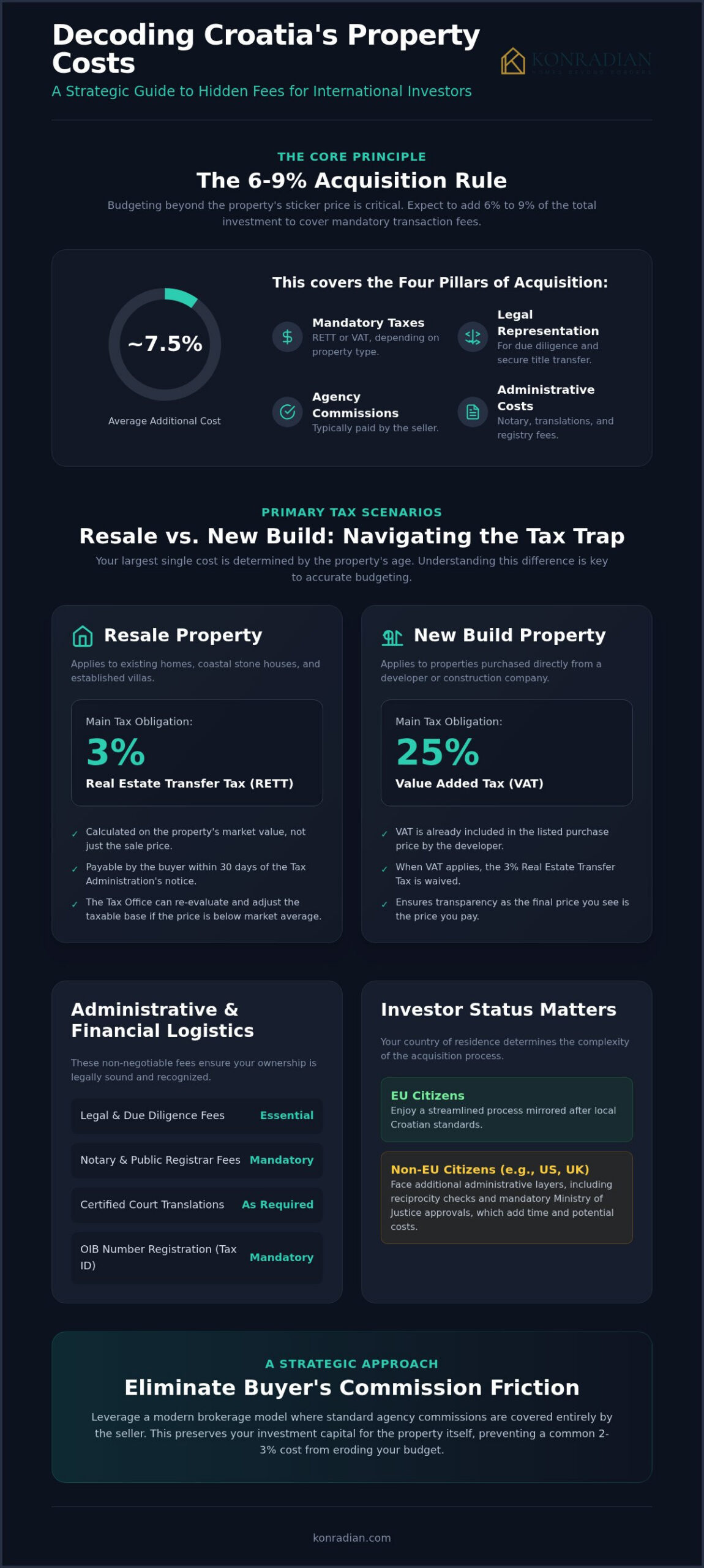
Budgeting for a property along the Adriatic coast requires a nuanced understanding of the local market’s financial architecture. Many international investors make the critical error of viewing the listed sticker price as the final sum. In reality, the hidden costs buying property in Croatia typically add between 6% and 9% to your initial investment. This standard range isn’t a suggestion; it’s a structural reality of the Croatian legal framework. To navigate this successfully, you must account for the four pillars of acquisition: mandatory taxes, legal representation, agency commissions, and administrative disbursements.
Compared to other Mediterranean hubs like Spain, where transaction costs can reach 12%, or Italy’s complex tiered system, Croatia offers a relatively competitive profile. However, your residency status plays a pivotal role. While EU citizens enjoy a process mirrored after local standards, non-EU investors from the US or UK face additional administrative layers. These include reciprocity checks and Ministry of Justice approvals, which don’t just add time but also influence the final cost of entry. Understanding these hidden costs buying property in Croatia early in your search prevents the friction that often stalls high-stakes international transactions.
Why Transaction Costs Vary Between 5% and 12%
While the 6-9% range is the benchmark for most residential deals, several variables can shift the needle. The property type is the primary driver. Purchasing raw agricultural land for development involves significantly higher due diligence, surveying, and zoning fees than acquiring a finished luxury villa. Furthermore, fixed administrative costs carry more weight on lower-priced properties, as notary and registry fees don’t always scale linearly with the purchase price. Total acquisition cost is the sum of the purchase price plus approximately 7% in mandatory fees.
The Emotional Cost of Bureaucracy
The true challenge for most investors isn’t just the capital; it’s the time-cost associated with the Croatian Land Registry, known locally as Zemljišne knjige. The process of securing your OIB (Personal Identification Number) and obtaining Ministry of Justice approval requires methodical patience and precision. This is where professional legal support buying property abroad becomes an essential investment in your peace of mind. A dedicated advisor handles the heavy lifting of bureaucratic filings, ensuring that the administrative weight doesn’t overshadow the joy of your new acquisition. By managing these expectations from the start, you replace confusion with a steady, reassuring path to ownership.
The Big Three: Taxes, Legal Fees, and Notary Costs
Once you move beyond the initial property search, the financial landscape of your acquisition becomes defined by three primary pillars. These are not merely administrative hurdles; they are the structural components that ensure your investment is legally sound and recognized by the state. While the purchase price is the most visible figure, the hidden costs buying property in Croatia are largely concentrated within these mandatory disbursements. Precision in budgeting for these items is the difference between a seamless transition and an unexpected capital shortfall.
Breaking Down the 3% Real Estate Transfer Tax
The Real Estate Transfer Tax (RETT) is a one-time payment equivalent to 3% of the property’s market value. It applies specifically to resale properties. If you are purchasing a new build from a developer, this tax is typically waived in favor of VAT, which is already included in the purchase price. However, for the majority of coastal stone houses and established villas, the 3% RETT is a certain obligation.
The timeline for this payment is methodical. Within 30 days of signing the Sale and Purchase Agreement, the Tax Administration will issue a payment slip. It’s vital to understand that the Tax Office reserves the right to re-evaluate the property. If they determine the purchase price is significantly below the local market average, they may issue a bill based on their own valuation. This discrepancy is a common source of friction that requires expert oversight to manage effectively.
Legal Fees and the Importance of Due Diligence
Engaging a dedicated lawyer is not an optional luxury in the Croatian market; it’s a non-negotiable safety net. Standard legal fees for property transactions range from 1% to 1.5% of the purchase price. This fee covers the essential “heavy lifting” of the transaction, including a comprehensive title search, verification of building permits, and the drafting of the final contract. A lawyer’s due diligence report is the single most important document for protecting your capital.
Investors often overlook the “VAT on top” rule. You must remember to add 25% VAT to all professional service invoices, a detail often overlooked in initial budget projections. This applies to your legal fees, meaning a 1% fee effectively becomes 1.25%. Ensuring you have professional Legal and Financial Transaction Support helps you account for these nuances from the start, preserving the tranquility of your investment journey.
Notary Public and Administrative Finals
The Notary Public, or Javni bilježnik, plays a neutral but vital role in the Croatian system. Their primary task is the solemnization of the contract, which gives the document full legal force for land registry purposes. Notary fees generally range from €100 to €800, depending on the complexity of the documents and the transaction value. Finally, you must account for registration and court fees. While these are relatively small, often around €35 for the Land Registry, they represent the final step in securing your ownership rights and ensuring your name is officially recorded in the Zemljišne knjige.
Resale vs. New Build: Navigating the VAT Trap
Choosing between a historic stone house and a contemporary shoreline villa is a decision that extends beyond aesthetics. It defines your entire tax profile. While resale properties attract the 3% transfer tax mentioned in the previous sections, new builds sold by entities within the VAT system are subject to a 25% Value Added Tax. This creates a significant cash flow discrepancy that investors must anticipate. If the purchase price includes VAT, you are exempt from the 3% Real Estate Transfer Tax, but the higher initial tax burden requires a more robust upfront liquidity plan.
Investors often find that Istria real estate for sale frequently features these high-end, VAT-able developments. This region’s focus on luxury infrastructure means you’ll likely encounter the VAT trap more often than in more traditional markets. Understanding the distinction between the land value and the building value is essential here. In many transactions, the land portion of the sale remains subject to the 3% RETT, while the structure itself carries the 25% VAT. This hybrid tax model is one of the most complex hidden costs buying property in Croatia and requires precise accounting to avoid overpayment.
The ‘First Inhabitant’ Definition
A property is legally classified as “new” if it has never been occupied or if less than two years have passed since its first use. This definition is a critical pivot point for your tax strategy. If you buy a two-year-old villa from a private individual, you’ll pay the 3% RETT regardless of the home’s pristine condition. Conversely, purchasing off-plan from a developer ensures the property falls under the VAT regime. Identifying these off-plan opportunities early allows for more predictable financial modeling and often provides access to pre-sale pricing advantages.
Corporate Acquisition Strategy
Administrative and Financial Logistics: The Overlooked Expenses
Beyond the structural taxes and legal fees, the logistical reality of moving capital and ensuring mutual understanding represents a significant layer of hidden costs buying property in Croatia. These expenses are often categorized as minor administrative details, yet they can collectively influence your final budget by several thousand euros. Precision in these financial logistics is what separates a standard purchase from a sophisticated acquisition. You must account for the friction of international banking, the necessity of certified translations, and the specific requirements of your residency status.
Currency exchange risks are perhaps the most underestimated financial drain. If you are transferring capital from USD or GBP into a EUR-denominated purchase, a standard bank’s exchange spread can range from 1% to 2%. On a €500,000 villa, this single oversight could cost you up to €10,000 in lost value. Additionally, international wire transfer fees and intermediary bank charges add another layer of expense. Every non-Croatian speaker is also legally required to engage an Official Court Translator. This professional must be present at the notary’s office to certify that you fully comprehend the Sale and Purchase Agreement, a service that carries its own set of fixed fees.
The Cost of Being a Non-EU Investor
Investors from outside the European Union, such as those from the US or UK, face a more rigorous administrative path. The primary hurdle is the reciprocity agreement, which verifies that your home country allows Croatian citizens to purchase property under similar conditions. Obtaining Ministry of Justice permission is a mandatory step that involves specific application fees and a processing timeline that can span several months. US investors often find that the relatively streamlined logic of buying property in USA from Europe does not apply in the Croatian context. The bureaucratic layers here require a more proactive, hands-on approach to ensure your application remains on track.
Utilities, Insurance, and Maintenance Setup
The final stage of ownership involves the practicalities of property management. For those investing in new construction or rural coastal areas, connection fees for electricity (HEP), water, and high-speed internet are essential hidden costs buying property in Croatia. New builds are also subject to the Komunalni doprinos, or Utility Contribution. This is a one-time fee paid to the local municipality to support infrastructure development. Finally, securing your asset with standard property insurance in 2026 typically costs between €400 and €1,200 annually for a premium coastal villa. Managing these logistics effectively ensures your transition into the Croatian market is as tranquil as the Adriatic itself. To navigate these complexities with professional stewardship, consider engaging expert Legal and Financial Transaction Support.
Konradian’s Advantage: Eliminating the Buyer’s Commission Friction
The traditional Croatian real estate model often places a significant financial burden on the purchaser through a standard 3% agency commission. When you add the mandatory 25% VAT on top of this fee, your acquisition budget is immediately eroded by a figure that rarely appears in the initial property listing. This is one of the most substantial hidden costs buying property in Croatia, yet it’s entirely avoidable with the right partnership. Konradian operates on a “Seller-Paid” philosophy. We believe that elite expertise should provide a financial advantage, not an additional invoice.
Our revenue is derived directly from developers and sellers. This allows us to offer end-to-end support, from the initial legal navigation to the final key handover, at no direct cost to you. This model ensures that 100% of your allocated capital remains focused on the asset itself. Beyond the financial savings, our LSE-educated advisors bring a level of intellectual rigor that traditional local agencies often lack. We don’t just show properties; we provide strategic counsel on market trends, fiscal structures, and long-term value preservation. By handling the heavy lifting, we ensure your experience is defined by tranquility rather than administrative stress.
Strategic Sourcing without the 3% Premium
We provide a protective barrier between you and the complexities of the Adriatic market. Before a property is even presented for your consideration, our team conducts a rigorous vetting process of the developer’s track record and the site’s legal standing. This proactive due diligence mitigates the risk of encountering the hidden costs buying property in Croatia that stem from unresolved title disputes or building permit irregularities. We combine an international, cosmopolitan mindset with deep local connections to identify exclusive pre-sale opportunities that never reach the public market. Konradian’s revenue is derived from the seller, ensuring the buyer’s budget is preserved for the property itself.
Your Next Steps in the Adriatic
Securing a high-stakes investment in a foreign jurisdiction requires a partner who handles the complexities while you maintain total clarity. We mirror the proven success of our Spanish Property Acquisition services, bringing that same level of refined stewardship to the Croatian coast. Whether you are seeking a primary residence or a strategic addition to your global portfolio, the process begins with a dedicated, professional conversation. Our goal is to provide a seamless transition into one of Europe’s most promising real estate landscapes.
You are invited to book a free video consultation to discuss your 2026 investment goals and explore our current pre-sale opportunities. We will provide a methodical breakdown of how our services simplify the acquisition journey while protecting your capital from the start. Secure your Adriatic investment with Konradian’s expert guidance.
Your Strategic Path to Croatian Ownership
Successful acquisition in 2026 requires more than capital; it demands a methodical understanding of the fiscal landscape. You now have the tools to distinguish between the 3% transfer tax and the 25% VAT, ensuring you aren’t blindsided by the hidden costs buying property in Croatia. By accounting for the 6-9% rule and the administrative nuances of residency, you’ve replaced uncertainty with a clear, actionable budget. This preparation is the first step toward a secure and sophisticated investment.
Our team provides the intellectual rigor and end-to-end stewardship needed to navigate these complexities. With direct access to pre-sale developer listings and comprehensive legal and financial transaction support, we handle the heavy lifting at no cost to the buyer. This ensures your capital is preserved for the property while your peace of mind remains intact. We invite you to Schedule a free consultation with our Croatian real estate experts to define your investment trajectory. The Adriatic coast offers exceptional opportunities for the prepared investor, and we look forward to guiding you toward a rewarding acquisition.
Frequently Asked Questions
What is the total percentage of hidden costs when buying property in Croatia?
Total transaction costs typically range from 6% to 9% of the property’s purchase price. This comprehensive figure includes the mandatory 3% Real Estate Transfer Tax for resale homes, legal representation, notary fees, and administrative disbursements. Budgeting for these hidden costs buying property in Croatia ensures you have sufficient liquidity to finalize the acquisition without encountering unexpected financial friction.
Do I have to pay VAT and Real Estate Transfer Tax on the same property?
No, these two taxes are mutually exclusive under Croatian law. New-build properties sold by a company within the VAT system are subject to a 25% Value Added Tax, which is usually included in the listed price. Resale properties are subject to the 3% Real Estate Transfer Tax instead. You’ll never be required to pay both on a single transaction.
Is the real estate agent’s commission always 3% in Croatia?
The standard market commission is 3% of the sale price plus 25% VAT, which the buyer typically pays. However, this isn’t a legal requirement for every transaction. Konradian utilizes a “Seller-Paid” model where the developer or seller covers the commission. This allows you to access elite advisory and sourcing services without the standard 3% buyer’s premium.
How much should I budget for a lawyer when buying a house in Croatia?
You should allocate between 1% and 1.5% of the purchase price for professional legal representation. It’s essential to remember the “VAT on top” rule; professional services are subject to a 25% VAT, meaning a 1% fee effectively costs 1.25%. This fee covers critical due diligence, title verification, and the drafting of the Sale and Purchase Agreement.
Are there extra costs for non-EU citizens buying property in Croatia?
Non-EU citizens, including investors from the US and UK, face additional administrative expenses related to reciprocity checks and Ministry of Justice permissions. You must also factor in the cost of an Official Court Translator, who is legally required to be present during the contract solemnization. While individual fees are often modest, the administrative timeline and documentation requirements are more intensive for non-EU buyers.
What happens if the Tax Administration values the property higher than my purchase price?
The Tax Administration reserves the right to re-evaluate the property if they believe the contract price is significantly below the local market average. In such cases, they will issue a tax bill based on their official assessment rather than the price you paid. This is a common occurrence in high-demand coastal regions where market values are rising rapidly.
Do I need a Croatian bank account to pay the property taxes?
A local bank account isn’t strictly mandatory for the initial tax payment, as you can settle the bill via international transfer using your OIB number. However, holding a domestic Euro account is highly recommended for the long term. It simplifies the payment of utilities, insurance, and the new annual property taxes while helping you avoid recurring international transfer fees.
Are there ongoing annual property taxes in Croatia after the initial purchase?
Yes, as of January 1, 2025, Croatia has implemented an annual property tax on non-primary residences. The rate is determined by the local municipality and ranges from €0.60 to €8.00 per square meter each year. This is one of the essential hidden costs buying property in Croatia that you must factor into your long-term maintenance budget and yield projections.
