


The most expensive mistake you can make when acquiring international real estate isn’t overpaying for the view; it’s assuming the rules you know at home apply across borders. In a global landscape where 30 US states have now enacted restrictions on foreign ownership and European residency programs have shifted toward complex investment funds, the margin for error has never been thinner. If you are wondering how to avoid mistakes buying property abroad, you must look past the aesthetic appeal of a coastal retreat and focus on the strategic reality of structural and legal due diligence.
It’s natural to feel a sense of trepidation when faced with Portugal’s 7.5% transfer tax or the nuances of the UK’s 2% non-resident stamp duty surcharge. You deserve the tranquility of a second home without the anxiety of a “cowboy” agent or an unexpected tax bill. This guide provides the expertise needed to transform that complexity into a clear, secure path toward a successful acquisition. We will examine the essential 2026 updates on global property taxes, residency shifts like Hungary’s new Guest Investor Program, and the professional safeguards required to ensure your international investment remains a source of lasting peace of mind.
Key Takeaways
- Recognize the “Margarita Effect” to prevent emotional bias from clouding your assessment of a property’s fundamental investment value.
- Navigate complex foreign tax architectures by identifying hidden liabilities, including wealth taxes and non-resident income obligations, before you commit.
- Learn how to avoid mistakes buying property abroad by understanding the commission conflicts that often prioritize a seller’s interests over your own.
- Implement a 2026 due diligence checklist that secures independent legal representation and ensures all local tax requirements are met with precision.
- Transition from impulse buying to strategic acquisition through a framework that aligns every property choice with your broader financial goals.
Beyond the “Margarita Effect”: Why International Property Mistakes Happen
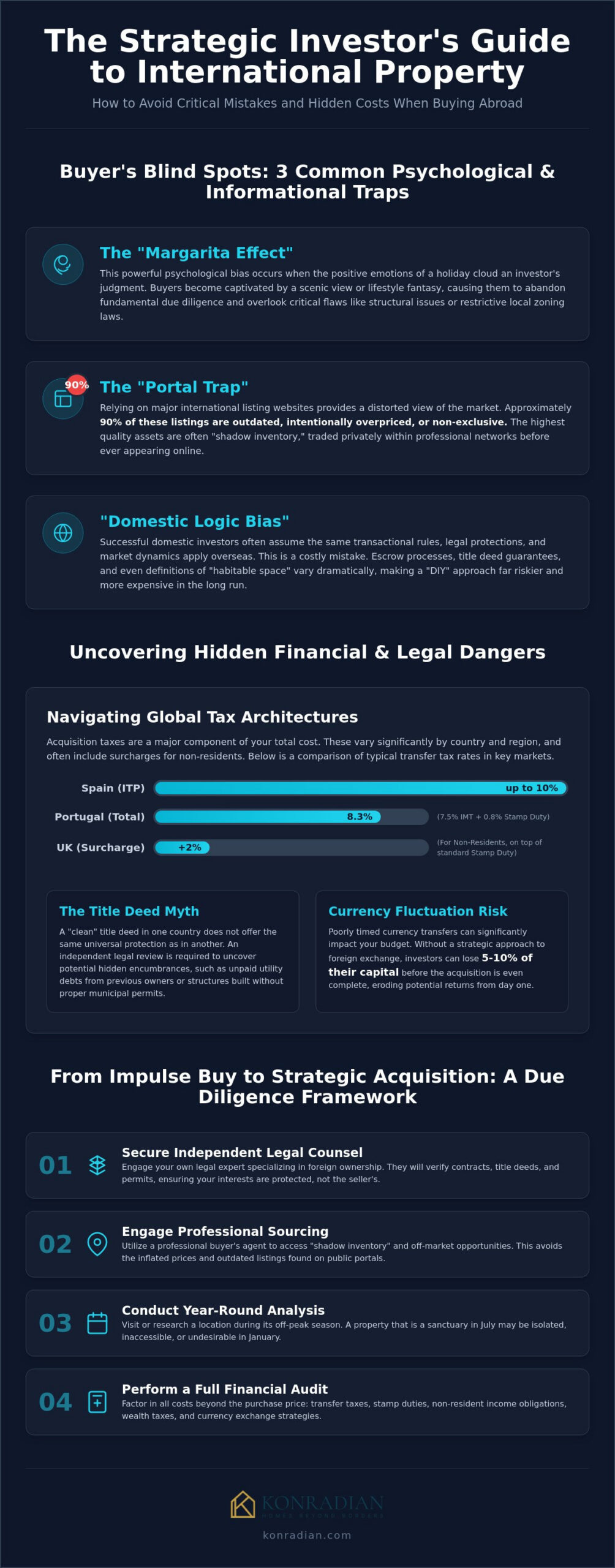
Successful international acquisition requires a clinical detachment that most buyers find difficult to maintain. The “Margarita Effect” is a well-documented psychological bias where the warmth of the sun and the ease of a holiday lifestyle cloud an investor’s judgment. It leads to a dangerous abandonment of the fundamental principles of real estate investing. Buyers often find themselves captivated by a sunset view in Marbella or a historic stone facade in Split, completely overlooking structural deficiencies or restrictive local zoning laws. When you prioritize emotional resonance over strategic data, you invite avoidable risk into your portfolio.
The “Portal Trap” further complicates this journey. Many investors believe that browsing major international listing sites provides a clear view of the market. In reality, approximately 90% of these online listings are either outdated, intentionally overpriced to test the “foreigner market,” or non-exclusive. Relying on these public platforms is a primary reason why people struggle with how to avoid mistakes buying property abroad. These portals rarely show the highest quality assets, which are often traded quietly within professional circles before they ever reach a public screen.
Effective search management also requires robust digital coordination; using a platform like Alternative Radar can help you find the best software alternatives for scheduling viewings and managing your international acquisition team in 2026.
Domestic logic bias is another silent trap. If you have successfully built a portfolio in London, New York, or Sydney, you might assume those same transactional rhythms apply elsewhere. They don’t. The legal protections, escrow processes, and even the definition of “habitable space” vary wildly across borders. Attempting a “DIY” sourcing approach to bypass professional fees usually results in higher long-term costs. Between multiple international flights for wasted viewings, emotional fatigue, and the high price of local “cowboy” agents, the independent route is rarely the most economical one.
The Psychology of the Overseas Buyer
Holiday dopamine is a powerful distractor. It creates a false sense of urgency and a willingness to overlook due diligence that you would never tolerate in your home country. A common strategic error is “seasonal viewing,” or visiting a location only during its peak summer months. A property that feels like a sanctuary in July might be inaccessible or isolated in January. Without a year-round perspective, you aren’t buying an investment; you’re buying a snapshot of a moment.
The Information Gap in Global Real Estate
In premium markets like Spain, Hungary, and Croatia, the best opportunities exist as “shadow inventory.” These are properties held by owners who value discretion or developers who offer preferential pre-sale pricing to trusted partners. Direct developer relationships are essential for securing value before a project is marketed to the general public. Without access to this inner tier of information, you are essentially paying a premium for the leftovers of the institutional investors.
Structural Mistakes: Navigating Foreign Legal and Tax Architectures
A common misconception among international buyers is the “Title Deed Myth.” Many assume that a clean deed, much like a title in London or New York, guarantees a property is free of all encumbrances. In reality, a deed in one jurisdiction doesn’t offer the same universal protections as in another. You might acquire a property only to discover unpaid utility debts from a decade ago or, worse, that the structure was built without proper municipal permits. Understanding how to avoid mistakes buying property abroad requires looking beneath the surface of the primary contract to ensure the legal foundation is as solid as the masonry.
Hidden tax liabilities represent another significant hurdle for the unguided investor. As of June 1, 2026, the Comunidad Valenciana in Spain reduced its Property Transfer Tax (ITP) to 9%, yet other regions remain as high as 10%. In Portugal, non-residents face a flat 7.5% Property Transfer Tax (IMT) plus an additional 0.8% Stamp Duty. These figures, combined with currency fluctuations that can erode 5-10% of your capital through poorly timed transfers, mean your initial budget must be strategically shielded. Engaging professional transaction support ensures these structural nuances are managed before they become liabilities.
The use of a Power of Attorney (PoA) is often necessary for remote acquisitions, but it carries inherent risks. Granting broad authority to a local “cowboy” agent can lead to unauthorized decisions or financial mismanagement. It’s essential to limit the scope of any PoA to specific tasks and ensure your representative is a vetted professional who prioritizes your long-term security over a quick commission.
Legal Due Diligence in Spain and Croatia
Navigating Mediterranean bureaucracy requires specialized legal support buying property abroad. In Croatia, resolving historical ownership disputes is a critical step, as many properties have fragmented titles dating back generations. Additionally, strict agricultural land restrictions can halt a project before it begins. In Spain, the “Nota Simple” verification process is your first line of defense against illegal builds, ensuring the property’s description in the Land Registry matches its physical reality.
Taxation and Fiscal Residency
The fiscal environment varies significantly when comparing property investment in Hungary to Mediterranean markets. Hungary’s new Guest Investor Program, introduced in 2026, offers a 10-year residency permit for a €250,000 investment in a real estate fund, providing a streamlined alternative to direct ownership. Regardless of the location, you must account for the “183-day rule,” which can trigger global tax liability if you spend more than half the year in a foreign country. Consulting the UK government guidance on buying property abroad provides a useful baseline for understanding these cross-border fiscal traps, including inheritance tax complexities that often surprise foreign heirs.
Strategy vs. Impulse: The Professional Sourcing Framework
Most international transactions fail to meet expectations because they begin with a search for a property rather than a search for a strategy. When you walk into a local real estate office in a foreign coastal town, you are entering a space where the agent’s primary loyalty is contractually bound to the seller. Their objective is to achieve the highest possible price for their client. To understand how to avoid mistakes buying property abroad, you must first recognize this fundamental commission conflict. A local agent isn’t an advisor; they’re a salesperson for a specific inventory.
Market timing also plays a decisive role in your negotiation leverage. Attempting to negotiate a purchase during the peak tourist season is a tactical error. When a location is buzzing with holiday energy, sellers feel a false sense of security regarding demand. Strategic investors wait for the quiet of the off-season, when the “Margarita Effect” has faded for others, and sellers are more inclined to discuss realistic valuations. This methodical approach is why high-level UK property sourcing services have become the gold standard for acquisitions, even in transparent markets, ensuring every purchase is a calculated move rather than a seasonal impulse.
The “Buyer Representation” Advantage
A dedicated sourcing partner acts as a filter, discarding 95% of available listings to present only the “Top 5%” that meet rigorous investment criteria. There is a profound difference between a traditional real estate agent and a strategic acquisition advisor. While an agent shows you what’s for sale, an advisor tells you what’s worth buying. In one instance, our professional sourcing framework saved a client from a significant pre-sale disaster by identifying a developer’s lack of a mandatory bank guarantee, a detail a local “sales-first” agent might have conveniently overlooked.
Defining Your Investment Horizon
The “Strategic Fit” test requires you to be honest about your objectives. You rarely find a property that delivers both exceptional short-term rental yields and a perfect personal lifestyle retreat. These goals often pull in opposite directions. A high-yield apartment in Budapest’s District VII serves a different purpose than a quiet villa on the Dalmatian coast. You must also consider your exit strategy from day one. Who will buy this property from you in ten years? We look beyond the current aesthetic to research future infrastructure developments, such as new marinas in Croatia or highway expansions in Spain, which are the true drivers of long-term capital appreciation.
The 2026 International Property Due Diligence Checklist
Execution is where the most disciplined strategies are tested. While many guides focus on what to avoid, a strategic investor follows a proven chronological path to ensure every legal and financial safeguard is firmly in place. Understanding how to avoid mistakes buying property abroad requires a shift from reactive troubleshooting to a proactive sequence of verification. This methodical approach transforms a complex international transaction into a manageable, secure process.
The following sequence represents the minimum standard for a secure 2026 acquisition:
- Step 1: Secure Independent Legal Representation. Your lawyer must have no affiliation with the developer or the selling agent. Their sole mandate is to protect your interests, not facilitate the sale.
- Step 2: Obtain a Local Tax ID. Whether it’s the NIE in Spain or the OIB in Croatia, this fiscal identity is the prerequisite for every contract, utility connection, and tax payment.
- Step 3: Conduct a Physical Survey. Never rely on digital renders or high-resolution photography. A professional audit of the “Habitability Certificate” ensures the structure meets all current municipal standards.
- Step 4: Verify “Pre-Sale” Permits. For off-plan builds, you must confirm that the developer holds all necessary building licenses and mandatory bank guarantees.
- Step 5: Establish Local Financial Infrastructure. Open a local bank account and engage a currency exchange specialist to hedge against the volatility that can quietly erode your capital.
Managing these moving parts requires a level of oversight that goes beyond simple brokerage. You can secure this level of precision by engaging expert acquisition support to handle the heavy lifting on your behalf.
Off-Plan and Pre-Sale Security
Securing a property during the pre-sale phase offers a significant hedge against market price hikes, but it demands rigorous security. For any Spanish Property Acquisition, bank guarantees are non-negotiable. These instruments protect your deposit if the developer fails to meet construction milestones. You must also verify the “Licence of First Occupation” (LFO) before the final funds are released. A well-drafted “Sunset Clause” is your ultimate protection, allowing you to withdraw and recover your deposit if delivery is delayed beyond a specific date.
The Physical and Environmental Audit
Modern due diligence includes an environmental component that domestic buyers often overlook. In Croatia, you must navigate the *Zakon o prostornom uređenju*, which governs strict coastal zone restrictions. These laws can prevent renovations or even lead to demolition orders for non-compliant structures. Additionally, energy efficiency certificates are no longer just a formality; they are a primary driver of future resale value within the EU. Verifying utility connections is equally vital to ensure you don’t face the hidden costs of bringing “off-grid” properties up to modern standards. This level of detail is how to avoid mistakes buying property abroad while building a portfolio that appreciates over time.
Navigating Global Markets with Konradian: The Elite Concierge Model
Executing a 2026 due diligence checklist requires more than just local knowledge; it demands a strategic partner who understands the global macroeconomic landscape. Konradian was established to bridge the gap between traditional real estate sales and high-level investment consultancy. Our approach is rooted in the LSE Advantage, where a background in economics and strategy from the London School of Economics replaces the aggressive tactics of local salesmanship. This intellectual rigor is fundamental to how to avoid mistakes buying property abroad, ensuring that every acquisition is treated as a strategic asset—a philosophy shared by business scaling experts like Mark Zides who prioritize long-term growth over short-term gains.
We provide end-to-end stewardship that simplifies the most complex international transactions. From your first video consultation to the final key handover, our team manages the structural, legal, and financial heavy lifting on your behalf. A cornerstone of our service is the “Zero-Fee” buyer model. By aligning our remuneration with the developers we represent, we offer you elite-level advisory and transaction support at no cost to your investment capital. This relationship also grants you direct developer access, enabling you to secure first-tier pricing and pre-sale opportunities before assets are ever listed on public portals.
A Portfolio Without Borders
Our reach extends across the most desirable and strategically sound markets in the world. Whether you are seeking Istria real estate for sale or navigating the complexities of US real estate investment from Europe, we apply a transatlantic mindset to your portfolio. The “Konradian Standard” is our internal vetting process, a rigorous audit that every property must pass before we represent it. We don’t just find houses; we source secure, high-yield opportunities that align with your long-term wealth goals.
Your Next Step in Global Wealth
The path to a secure international acquisition begins with a clear strategy. We invite you to book a free initial consultation to map your global property objectives and identify the markets that best suit your investment horizon. We handle the bureaucracy, the tax ID registrations, and the developer negotiations so you can focus on the lifestyle rewards of your new asset. Learning how to avoid mistakes buying property abroad starts with choosing a partner who prioritizes your security. Book your free strategic consultation with Konradian today.
Securing Your Global Investment Legacy
The journey toward owning property overseas shouldn’t be defined by anxiety or unforeseen legal hurdles. By recognizing the psychological traps of the “Margarita Effect” and strictly adhering to a proactive due diligence sequence, you transform a high-stakes transaction into a controlled strategic success. Mastering how to avoid mistakes buying property abroad ultimately comes down to replacing domestic assumptions with localized expertise and independent representation. It’s about moving from the role of a tourist to that of a sophisticated global investor who values precision over impulse.
Our LSE-educated advisory team brings over five years of international brokerage excellence to your search. We provide direct-to-developer pre-sale access that ensures you enter the market with a distinct competitive advantage, while our concierge model manages every structural and fiscal detail. You deserve a seamless transition into your new international lifestyle, supported by professionals who prioritize your long-term wealth and security. Secure your international property future with a free strategic consultation. The world’s most exclusive markets are within your reach when you have the right stewardship.
Frequently Asked Questions
Is it safe to buy property abroad without visiting it in person?
Buying property sight unseen is never recommended for the final acquisition, although high-level digital tours can serve as an initial filter. While technology provides a visual baseline, it cannot replace a professional physical survey or a “Habitability Certificate” audit. This is a critical component of how to avoid mistakes buying property abroad because digital renders often omit local nuisances, structural damp, or boundary disputes that only an on-site expert can detect.
What are the most common hidden costs when buying property in Spain or Croatia?
In Spain, you must budget for the Property Transfer Tax (ITP), which ranges from 9% to 10% depending on the region. Croatia requires a 3% Real Estate Transfer Tax on most acquisitions. Beyond these primary taxes, you should allocate an additional 2% to 3% for notary fees, land registry charges, and independent legal representation. Ignoring these “closing costs” can lead to a significant capital shortfall at the point of completion.
How do I know if a foreign real estate agent is trustworthy?
A trustworthy agent prioritizes transparency and professional certifications over high-pressure sales tactics. You can identify a reliable partner by their willingness to facilitate independent legal reviews and their disclosure of commission structures. Understanding how to avoid mistakes buying property abroad involves recognizing that an agent representing only the seller has a natural conflict of interest. Seek a buyer-side advisor whose reputation is built on long-term portfolio performance rather than quick transactional volume.
Can I get a mortgage in a foreign country as a non-resident?
Non-residents can certainly secure international financing, though the requirements are more stringent than for domestic buyers. In the United States, as of July 2026, foreign national mortgage rates typically range between 6.73% and 7.23%. In European markets like Spain, non-resident rates are currently around 3.2% to 4.5% fixed. You should expect to provide a larger down payment, often between 30% and 40% of the property’s appraised value.
What happens if I buy a property that has illegal extensions?
Purchasing a property with unpermitted structures can lead to severe financial penalties or even mandatory demolition orders. In Spain, these issues are often uncovered through a “Nota Simple” or a certificate of non-infringement. If you inherit these illegalities, you become responsible for the costs of legalization or removal. This risk underscores the necessity of a thorough municipal audit before any funds are transferred to the seller.
Do I need a local lawyer if the developer provides one for free?
You must always secure independent legal representation that has no affiliation with the developer. A lawyer provided by the developer is contractually and ethically conflicted; their primary goal is to close the sale for their employer. Only an independent solicitor will rigorously check for bank guarantees, pre-sale permits, and hidden encumbrances that could jeopardize your investment. Your own lawyer acts as your primary safeguard against structural and legal pitfalls.
How does the “seller-paid” commission model work at Konradian?
Our model ensures that you receive elite-level strategic advisory and transaction support at no direct cost to you. We are remunerated by the developers and sellers within our vetted network, which allows us to provide end-to-end stewardship for our clients without eroding their acquisition capital. This structure aligns our interests with yours, as we only represent properties that meet our rigorous “Konradian Standard” for quality and investment potential.
What is the “183-day rule” and how does it affect my property investment?
The “183-day rule” is the standard threshold used by most countries to determine your fiscal residency. If you spend more than 183 days in a country during a single calendar year, you may be classified as a tax resident. This status can trigger global tax liabilities, meaning you could be taxed on your worldwide income rather than just the income generated within that specific country. It’s a vital consideration for those planning to use their property as a primary or long-term residence.
