


In the world of high-stakes cross-border acquisitions, your greatest risk isn’t the market’s volatility, but the information you don’t know you’re missing. It’s natural to feel a sense of trepidation when considering a significant investment in an unfamiliar jurisdiction. You might worry about hidden legal encumbrances on a Mediterranean villa or the stability of a developer’s balance sheet in an off-plan project. This is why a comprehensive international property due diligence checklist is no longer just a recommendation; it’s the foundational layer of any sophisticated investment strategy for 2026.
We understand that you’re looking for more than just a transaction; you’re seeking the peace of mind that comes from professional stewardship and intellectual rigor. We’ve developed a precise, 50-point framework designed to master the complexities of foreign tax regimes and secure your ownership rights with absolute clarity. This guide provides a strategic audit of the legal, physical, and human variables that define a successful acquisition. You’ll gain a clear path to a risk-free transaction, allowing you to focus on the lifestyle and financial rewards of your global portfolio while we handle the heavy lifting.
Key Takeaways
- Recognize why the 2026 investment landscape demands a more rigorous verification of facts to mitigate cross-border risks and protect your capital.
- Learn to secure your ownership rights by verifying official title deeds and conducting exhaustive searches for hidden encumbrances or outstanding liens.
- Master the distinction between a property’s base price and its total cost of acquisition, accounting for nuanced tax regimes and local notary fees.
- Utilize a sophisticated 50-point international property due diligence checklist to transform complex data into a clear “Go/No-Go” decision matrix.
- Discover how professional stewardship simplifies structural surveys and boundary audits, ensuring your physical asset matches its official registry.
What is International Property Due Diligence in 2026?
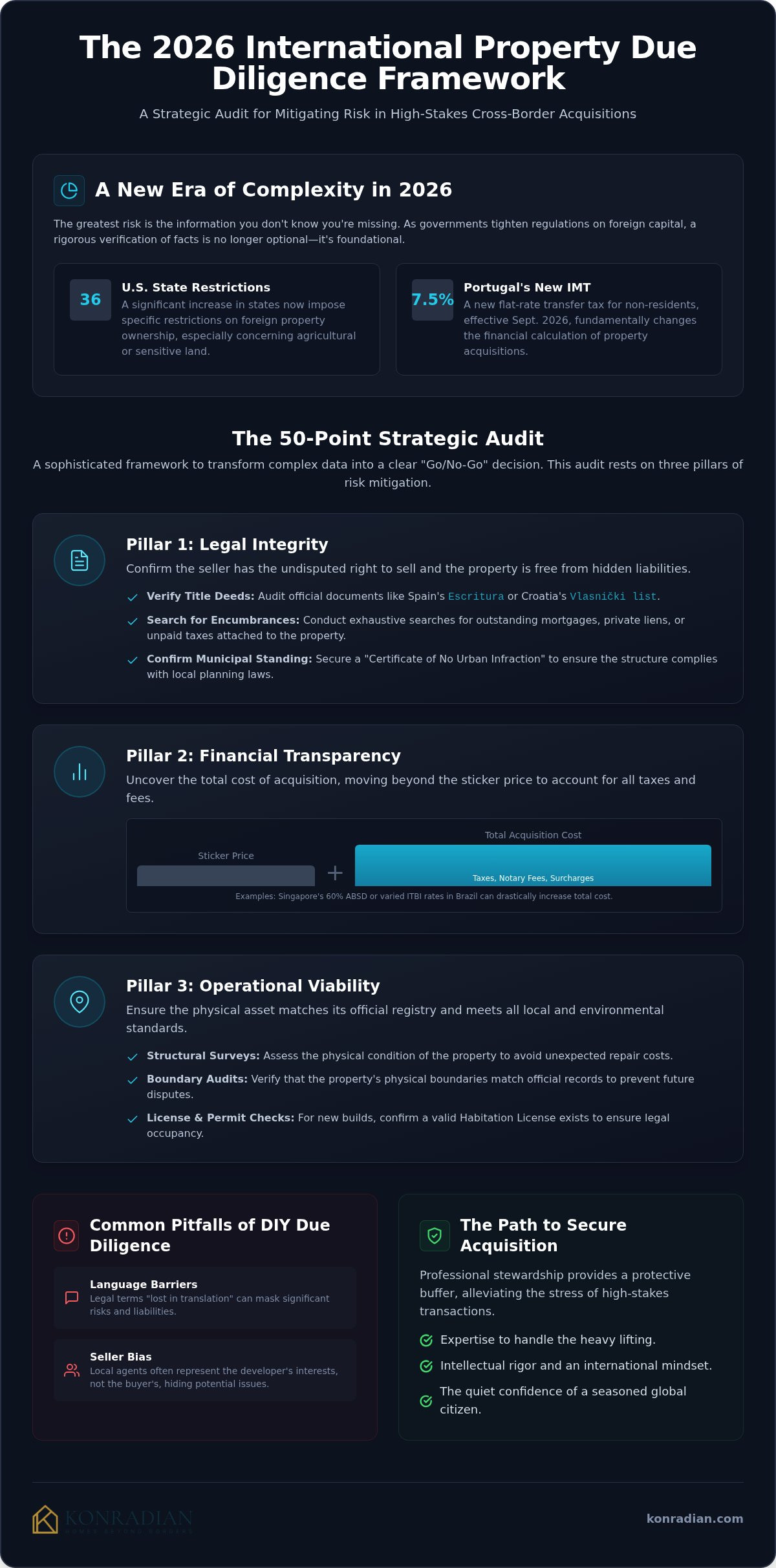
International property due diligence is the systematic verification of legal, financial, and physical facts to mitigate cross-border investment risks. While many investors understand What is Due Diligence? in their home markets, the international version is a multi-jurisdictional audit that requires a significantly higher level of intellectual rigor. It’s the difference between checking a local title and navigating the complexities of foreign ownership restrictions that vary by state, region, and country. Why now? Because the rules are shifting rapidly.
The year 2026 has introduced a new layer of complexity to these transactions. Governments are increasingly active in regulating foreign capital to protect national interests and manage housing markets. For instance, the United States now sees 36 states with specific restrictions on foreign property ownership, particularly regarding agricultural land or assets near sensitive installations. Navigating these regional complexities requires localized expertise, such as that provided by the Armani Realty Group in the Pacific Northwest. In Europe, Portugal’s new flat-rate 7.5% IMT for non-residents, which took effect in September 2026, changes the financial math of a deal overnight. Utilizing a rigorous international property due diligence checklist ensures you aren’t caught off guard by these shifting regulations or hidden legal encumbrances.
The Three Pillars of Global Risk Mitigation
A strategic audit rests on three fundamental areas of inquiry. These pillars provide a logical flow to the investigation, moving from broad legal rights to specific operational details that impact long-term value.
- Legal Integrity: This confirms that the person selling the property actually has the right to do so. It involves verifying title deeds like the Spanish Escritura or the Croatian Vlasnički list and ensuring no outstanding mortgages exist.
- Financial Transparency: This uncovers the total cost of acquisition. It goes beyond the sticker price to include transfer taxes, notary fees, and specific surcharges like the 60% ABSD in Singapore or the varied ITBI rates in Brazil.
- Operational Viability: This ensures the asset meets local zoning and environmental standards. It prevents the discovery of illegal builds or boundary mismatches after the funds have been transferred.
Why DIY Due Diligence Often Fails Abroad
Attempting this process without expert guidance often leads to expensive oversights. Language barriers are a primary culprit; legal terms frequently lose their specific meaning when translated, leading to a “lost in translation” effect that can mask significant risks. Additionally, many foreign markets operate with a heavy seller bias where local agents represent the developer’s interests rather than your own. This makes it difficult to get an objective view of the property’s true status.
Partnering with a dedicated international real estate agency provides a protective buffer. Professional stewardship alleviates the emotional stress of high-stakes transactions by providing a reliable partner to handle the heavy lifting. This allows you to approach your international property due diligence checklist with the quiet confidence of a seasoned global citizen, knowing every detail has been scrutinized by an expert eye with an international mindset.
Legal Due Diligence: Securing Title and Ownership Rights
Securing the title is the cornerstone of any cross-border acquisition. It is the moment where your international property due diligence checklist transitions from theoretical research to concrete asset protection. In Spain, this begins with a deep audit of the Escritura, while in Croatia, you must verify the Vlasnički list. These documents are the primary evidence of ownership, but they are only the starting point. A sophisticated investor knows that a clean-looking deed can still mask significant liabilities, including outstanding mortgages, private liens, or unpaid local taxes that attach to the property rather than the individual.
Beyond ownership, you must verify the property’s standing with local municipalities. This is particularly critical in coastal regions where zoning laws are often stringent and subject to change. A “Certificate of No Urban Infraction” is a non-negotiable requirement to ensure the structure doesn’t violate local planning laws. For new builds, you must confirm the existence of a valid Habitation License. Without this, you may find yourself owning a beautiful structure that lacks legal access to water or electricity. If you are purchasing remotely, vetting the Power of Attorney (PoA) ensures that your interests are represented exactly as you intended, without granting overreaching authority to third parties.
Title Verification and Encumbrance Audits
Never rely on copies of deeds provided by a seller’s agent. A professional audit involves pulling fresh records directly from the Land Registry to see the most current status of the asset. This process uncovers “hidden” charges such as unpaid community fees or the annual IBI tax in Spain, which can range from 0.4% to 1.1% of the cadastral value. Engaging an independent lawyer is the only way to ensure these checks are impartial. Understanding how to buy property in Spain legally requires this level of separation between the sales process and the legal verification process.
Developer and Partner Vetting
The 2026 market requires what we call “Human Due Diligence.” This involves a rigorous analysis of a developer’s track record and financial stability, especially for off-plan projects where insolvency is a genuine anxiety. In pre-sale deals, you must confirm that bank guarantees are in place for every staged payment. These guarantees ensure that your capital is protected even if the project stalls. Our approach provides a layer of pre-vetted security through direct developer relationships, ensuring you only engage with partners of the highest integrity. If you value this level of precision, you may wish to explore our legal and financial transaction support to streamline your next acquisition.
Financial Due Diligence: Transparency and Tax Compliance
While legal checks verify that you own the asset, financial diligence ensures you can afford the asset’s total lifecycle. A robust international property due diligence checklist must account for the significant delta between the agreed purchase price and the total cost of acquisition. In European markets like Italy or France, all-in acquisition costs often reach 9% to 15% of the price. In Florida, buyers should budget between 3% and 5% for closing costs. In other US regions, prospective homebuyers can utilize services like Arizona Home Grants Now to identify down payment assistance that helps offset these initial costs. These are not mere rounding errors; they are foundational figures that dictate the viability of your investment.
Tax structures vary wildly depending on the property’s age and location. New builds typically attract VAT (IVA in Spain), while resales are subject to Transfer Tax (ITP). In Spain, ITP ranges from 6% to 12% depending on the autonomous region. Conversely, Greece has suspended its 24% VAT on new building purchases through the end of 2026, offering a unique window for investors. You must also verify the property’s cadastral value. If you purchase at a price significantly lower than the government’s official valuation, you may face a “complementary tax” reassessment months after the transaction concludes. Currency risk adds another layer of volatility. A 2% shift in exchange rates between the deposit and completion can unexpectedly inflate your final payment by tens of thousands of dollars.
Uncovering the Hidden Costs of Buying Abroad
Successful acquisitions require a clear view of non-obvious expenses. This includes fiscal representation fees, notary charges, and the processing of local identification numbers like the Spanish NIE or the Croatian OIB. We recommend maintaining a 10-12% “transaction buffer” when pursuing Spanish Property Acquisition to cover these variables without stress. When comparing Istria real estate for sale to other Mediterranean hubs, the tax simplicity of the Croatian market often provides a more predictable financial path for the strategic buyer.
Cross-Border Tax and Wealth Preservation
A property purchase can have profound implications for your global tax residency status. Most jurisdictions apply a 183-day rule, but even shorter stays can trigger tax obligations depending on your “center of economic interests.” It is essential to review Double Taxation Treaties between your home country and the investment destination to ensure you aren’t taxed twice on the same income. For those looking to balance a European portfolio, US real estate investment from Europe offers a sophisticated route to diversification. This strategy allows you to hedge against Eurozone fluctuations while utilizing US-specific tax advantages like depreciation or DSCR financing models.
Physical and Environmental Asset Assessment
The physical audit is where the most tangible risks reside. It’s not just about the roof or the plumbing. In 2026, a physical inspection is a rigorous interrogation of the asset’s resilience against climate shifts and regulatory changes. Your international property due diligence checklist must transition from legal theory to the physical reality of the site, ensuring that the boundaries on the registry map align perfectly with the fences on the ground. Mismatches are common in older European estates, and resolving these discrepancies after the purchase is both expensive and legally draining.
Environmental risk assessments have become a non-negotiable priority for the strategic investor. As we navigate 2026, you must evaluate the property’s proximity to wildfire zones and its vulnerability to coastal erosion or flooding. These factors don’t just affect your peace of mind; they directly impact your ability to secure insurance and the long-term liquidity of the asset. A structural survey by a certified local architect or engineer serves as your first line of defense, uncovering hidden defects that a standard viewing would never reveal.
Infrastructure and Utility Verification
Confirming legal connections to essential services is a critical step that many DIY investors overlook. It is essential to verify that the property is officially connected to the electricity, water, and sewage mains. In rural Mediterranean areas, you might encounter “illegal” wells or off-grid solar setups that lack the proper permits. These unvetted systems can lead to heavy fines or a total loss of service. For the modern remote-working investor, high-speed fiber connectivity is no longer a luxury; it is a core utility that must be verified before any funds are committed.
The 2026 Sustainability Audit
Sustainability is now a financial imperative rather than a lifestyle choice. Reviewing the Energy Performance Certificate (EPC) is vital to ensure compliance with 2026 EU regulations, which are increasingly strict regarding carbon footprints and energy efficiency. Evaluating the “future-proofing” of the asset involves checking for hazardous materials like asbestos or lead, which are frequently found in older stone houses across Europe. If you are seeking assets with high ESG compliance, exploring options through a professional UK property sourcing service often provides access to new-build developments that meet these modern standards from day one.
If you require a partner to execute these technical audits with precision, we invite you to access our professional transaction support and ensure your next acquisition is physically sound.
The Strategic Path to Secure Acquisition
Completing a cross-border transaction requires more than just a signature; it requires a decisive transition from investigation to ownership. Once you’ve navigated your international property due diligence checklist, the final step is consolidating those findings into a “Go/No-Go” decision matrix. This matrix allows you to weigh identified risks, such as minor boundary mismatches or pending utility certifications, against the strategic value of the asset. It transforms a mountain of data into a clear, actionable path forward, ensuring that you never commit capital to an asset that doesn’t meet your rigorous standards for security and growth.
It’s vital to distinguish between the roles of the professionals involved in your closing. In many European jurisdictions, the notary acts as a neutral public official. While they ensure the transaction meets the legal standards of the state, they don’t act as your private advocate. Your private legal counsel remains the only party dedicated solely to protecting your interests. Before the final exchange of funds, a thorough walkthrough is essential. For new-build properties, this involves creating a “Snagging List” to document any finishing defects. This list ensures the developer remains contractually obligated to rectify issues before you accept the keys and transition the property into your portfolio.
Executing the Final Transaction
The logistics of the “Completion Meeting” are the culmination of weeks of preparation. This is where the formal exchange of deeds occurs and the final purchase price is transferred. In 2026, many investors opt for remote closings using digital signatures or a specifically tailored Power of Attorney (PoA). This allows you to secure an asset without the need for international travel, provided your PoA is vetted to prevent overreaching authority. Post-sale, the focus shifts to administrative continuity. Ensuring that all utility contracts, local tax accounts, and community fees are correctly transferred to your name prevents service interruptions and avoids the accumulation of late-payment penalties.
Partnering with Konradian for Peace of Mind
Managing a 50-point international property due diligence checklist across multiple jurisdictions is a complex undertaking that demands elite expertise. Our LSE-educated team acts as your dedicated concierge, handling the heavy lifting of structural audits, title verifications, and financial compliance on your behalf. We bring an international mindset and over five years of cross-border experience to every deal, providing the intellectual authority of a strategic consultant with the personalized care of a high-level advisor.
We believe that professional stewardship should be accessible. In markets like Spain, Croatia, and Hungary, we operate on a “no-cost to buyer” model, allowing you to access our full suite of due diligence and brokerage services without additional fees. This ensures your interests are protected by a proactive partner who prioritizes your long-term emotional and financial well-being. If you’re ready to secure your next international asset with absolute confidence, we’re here to guide the way.
Take the first step toward a risk-free acquisition. Schedule your free video consultation with Konradian today and let our experts handle the complexities of your global portfolio.
Mastering Your Global Portfolio with Confidence
International property investment in 2026 demands more than just capital; it requires a commitment to rigorous verification. We’ve explored how securing ownership rights and navigating complex foreign tax regimes form the bedrock of a successful acquisition. By applying a comprehensive international property due diligence checklist, you transition from the uncertainty of a cross-border deal to the security of a well-vetted asset. This framework allows you to approach global markets with the quiet confidence of a seasoned investor who prioritizes long-term wealth preservation.
This process ensures that every physical detail and legal nuance aligns with your financial goals. You don’t have to navigate these complexities alone. Our LSE-educated team provides sophisticated market analysis and direct access to pre-sale developer listings. We offer end-to-end support from the initial sourcing to the final legal handover, ensuring your interests remain the priority at every stage. Secure your international investment with a free Konradian consultation and discover the ease of professional stewardship. Your journey toward a seamless global lifestyle and a resilient property portfolio begins with a single, strategic conversation.
Frequently Asked Questions
What is the most common mistake in international property due diligence?
The most common mistake is over-reliance on the seller’s agent or assuming that local “standard” checks are sufficient for a high-stakes transaction. Many investors fail to realize that agents in foreign markets often represent the developer’s interests rather than the buyer’s. Failing to utilize an independent international property due diligence checklist often leads to the discovery of hidden liens or zoning violations after the deposit has already been paid.
Can I perform due diligence on a foreign property remotely?
You can absolutely perform thorough due diligence remotely by utilizing a Power of Attorney (PoA) and a trusted professional partner on the ground. Modern digital registries and high-definition video surveys allow for comprehensive inspections without the need for international travel. We manage these logistics for our clients to ensure every detail is verified and every document is authenticated before any capital is committed.
How much does a professional due diligence report typically cost?
The investment for a professional report varies significantly based on the jurisdiction and the depth of the audit required. In some Mediterranean markets, these costs are integrated into the broader legal support package, while other regions require separate fees for specialized structural or environmental surveys. It is best to view this as a foundational cost of risk mitigation that protects your much larger capital investment.
Is the notary responsible for checking the physical condition of the property?
No, the notary is a public official whose primary responsibility is the legal validity of the paperwork and the identity of the parties. They don’t visit the site or verify the structural integrity of the building. To ensure the physical asset is sound, you must engage a certified local architect or engineer to perform a structural survey and confirm that the building matches the official registry maps.
What is an escrow account, and should I use one for an international purchase?
An escrow account is a neutral third-party account where funds are held securely until all contractual conditions are met. We highly recommend using one for international purchases to provide an essential layer of security for your deposit. It ensures that the seller only receives the funds once the legal and physical audits are successfully completed and the title is ready for transfer.
How do I verify a developer’s reputation in a country where I don’t speak the language?
Verifying a developer’s reputation without local language skills requires partnering with an agency that possesses deep local networks and an international mindset. We perform “human due diligence” by reviewing a developer’s financial stability and their track record of past project completions. This proactive approach uncovers potential insolvency risks or quality issues that wouldn’t be visible through a standard web search.
Does a clean title deed mean the property is 100% legal?
A clean title deed confirms ownership but it doesn’t guarantee the property is free of planning infractions. It’s possible to own a property legally while the structure itself contains illegal extensions built without the necessary permits. A robust international property due diligence checklist must include a “Certificate of No Urban Infraction” to ensure the entire asset is fully compliant with current local zoning and building laws.
What happens if I find an issue during the due diligence period?
If an issue is discovered, you have the strategic leverage to renegotiate the purchase price, demand that the seller rectifies the problem, or walk away from the deal entirely. This is why we help clients consolidate their findings into a “Go/No-Go” decision matrix. This objective assessment allows you to determine if the issue impacts the long-term value of the asset before you are contractually bound to the purchase.
