


The most successful global investors in 2026 aren’t those with the largest capital reserves, but those who possess the most sophisticated oversight of their cross-border acquisitions. While transaction volumes across Europe and the U.S. have climbed to $890 billion, the complexity of local regulations has increased alongside them. It’s natural to feel a sense of anxiety when your capital crosses a border into a landscape of shifting tax codes and remote legal requirements. You likely recognize that the true cost of an international purchase isn’t just the price on the contract, but the risk of hidden liabilities and fragmented communication with local stakeholders. Professional international property transaction management acts as your strategic shield, transforming a chaotic process into a structured, risk-free journey.
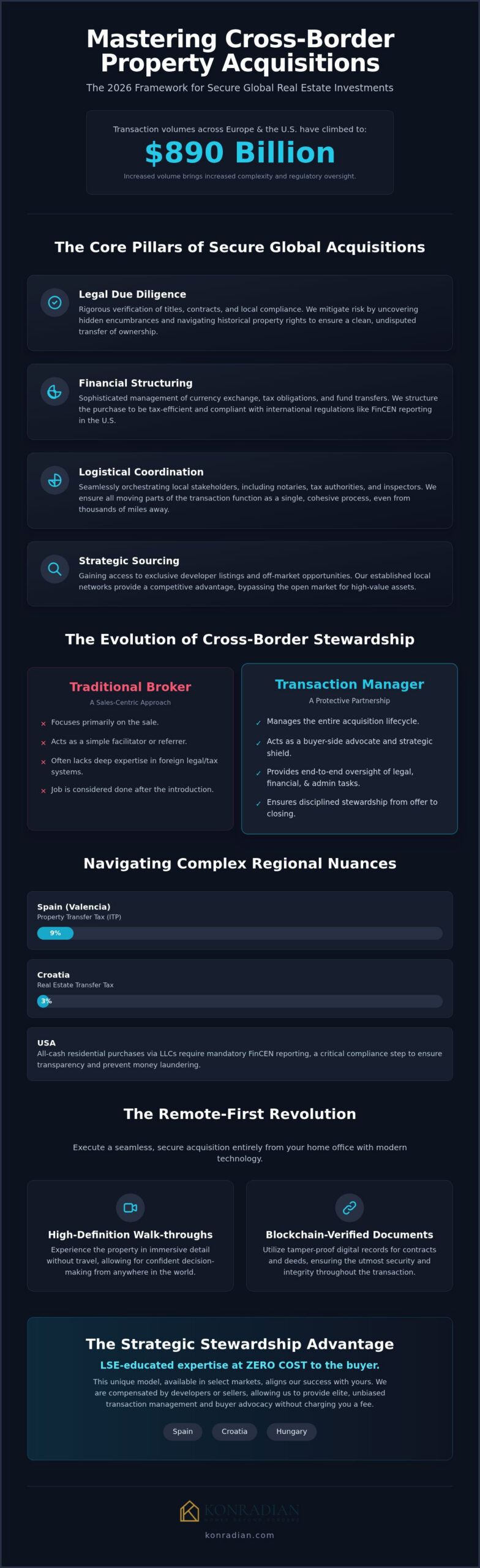
This framework provides a professional roadmap to master the legal, financial, and logistical hurdles of modern real estate. You’ll learn how to handle the 9% ITP rates in Valencia or the 3% transfer taxes in Croatia with quiet confidence. We’ll examine how a dedicated stewardship model allows you to bypass common pitfalls and gain access to exclusive developer listings before they reach the open market. This is your guide to achieving a seamless transition from global interest to secure, high-value ownership.
Key Takeaways
- Master the 2026 framework for international property transaction management to ensure every legal and financial step is overseen with professional precision.
- Learn how to navigate complex regional tax obligations and secure your capital through rigorous due diligence and sophisticated financial structuring.
- Gain insights into managing specific market nuances in Spain, Croatia, and the USA, including how to access exclusive developer listings before they reach the open market.
- Discover how to execute a seamless acquisition entirely from your home office using high-definition walk-throughs and blockchain-verified document management.
- Understand the strategic advantage of a stewardship model that offers LSE-educated expertise at zero cost to the buyer in markets like Spain, Croatia, and Hungary.
What is International Property Transaction Management?
International property transaction management is the professional orchestration of every legal, financial, and administrative requirement necessary to finalize a cross-border real estate deal. It’s a comprehensive oversight model that begins long before a contract is signed and continues until the deed is securely registered. While a traditional broker focuses on the sale, a transaction manager focuses on the safety and execution of the entire acquisition. This distinction is vital; you aren’t just buying a property, you’re traversing a foreign legal system, a different tax jurisdiction, and a unique set of administrative protocols.
The global market in 2026 demands this level of precision. With transaction volumes reaching $890 billion this year, regulatory bodies have introduced stricter oversight to ensure transparency. For instance, all-cash residential purchases through LLCs in the United States now require FinCEN reporting, and Spain has introduced new rent caps in specific zones. A simple brokerage model often lacks the intellectual rigor to manage these shifting variables. Professional international property transaction management acts as a strategic bridge, aligning your interests with local stakeholders such as notaries, tax authorities, and developers while ensuring no detail is overlooked.
When reviewing an international real estate overview, one quickly discovers that the complexity of these deals often stems from the lack of a standardized global closing process. Domestic closings are typically linear and familiar. International closings, however, are multi-dimensional; they require simultaneous management of currency exchange, foreign tax identification numbers, and local compliance checks. Your transaction manager ensures these moving parts function as a single, cohesive process.
The Evolution of Cross-Border Stewardship
The industry has moved beyond simple referrals toward comprehensive end-to-end oversight. In the past, an agent might simply pass a client to a local lawyer and consider their job done. Today, global transparency standards and the rise of sophisticated global citizens have shifted the role toward buyer-side advocacy. This evolution ensures that the professional managing your deal is not just a facilitator but a protective partner who understands the macro-economic implications of your investment. It is a transition from a sales-centric approach to one of disciplined stewardship.
Why Investors Fail Without Professional Oversight
Failure in the international market rarely stems from a lack of capital; it stems from misunderstood contracts and local language barriers. Investors often find themselves overwhelmed by unverified developer claims or hidden encumbrances on a title that a standard check might miss. In emerging coastal markets, modern regulations can conflict with historical property rights, leading to costly delays or legal liabilities. Without a dedicated manager to conduct deep-tier due diligence, these risks remain invisible until they become expensive. Transaction management is the mitigation of cross-border friction.
The Core Pillars of Secure Global Acquisitions
Securing a high-value asset across borders requires more than a successful negotiation; it demands a rigorous management of the 3 to 6 month period between the initial offer and the final handover. While many investors focus solely on the search, the true value of international property transaction management lies in the disciplined oversight of the closing phase. This period is often where domestic investors encounter the most friction, as they face unfamiliar protocols for title verification, currency transfers, and local administrative filings. By treating the acquisition as a managed project rather than a simple purchase, you ensure that every legal and financial safeguard is active and verified before a single euro or dollar is committed.
A secure acquisition rests on four distinct pillars: legal due diligence, financial structuring, logistical coordination, and strategic sourcing. Each pillar serves to eliminate the ambiguity that often plagues cross-border deals. For example, logistical coordination ensures that independent valuations and structural inspections are completed to international standards, even when the buyer is thousands of miles away. Meanwhile, strategic sourcing provides a distinct advantage by leveraging direct developer relationships to secure pre-sale opportunities in competitive markets like the Costa del Sol or the Dalmatian Coast.
Legal and Regulatory Verification
The legal landscape of international real estate is rarely uniform. In Croatia, for instance, verifying that a property complies with strict maritime and coastal zoning laws is a critical step that must precede any deposit. A professional manager oversees an independent legal audit to ensure the title is free of historical encumbrances or unresolved inheritance claims. For remote buyers, managing a Power of Attorney (PoA) is a standard yet delicate procedure. We ensure your PoA is drafted with precise limitations, granting just enough authority to local representatives to execute the transaction without compromising your broader legal security.
Financial Flow and Tax Optimization
Managing the movement of capital requires a sophisticated understanding of both global compliance and regional tax obligations. You’ll need to pass rigorous KYC (Know Your Customer) and AML (Anti-Money Laundering) checks, which have become increasingly stringent in 2026. Transaction management simplifies this by preparing your documentation to meet the specific standards of foreign banks and notaries. It’s also vital to understand the local tax impact; for example, resale properties in Spain’s Valencian Community currently carry a 9% ITP (Property Transfer Tax), while Croatia maintains a flat 3% rate. In markets such as Spain, Croatia, and Hungary, we utilize a commission model where the seller or developer covers the service fee, providing you with elite legal and financial transaction support at zero additional cost to your acquisition budget.
Managing Regional Nuances: Spain, Croatia, and the USA
Expert international property transaction management requires a granular understanding of local bureaucracy. While the desire for a Mediterranean villa or a Manhattan pied-à-terre is universal, the administrative paths to ownership are vastly different. Successful acquisition depends on anticipating these regional frictions before they stall your progress. In Spain, this begins with the NIE (Número de Identidad de Extranjero) process, a mandatory tax identification step that can take weeks if not managed with foresight. For investors looking at new developments, navigating Spanish pre-sale contracts requires a protective hand to ensure that bank guarantees for stage payments are fully compliant with current 2026 regulations.
The Mediterranean Corridor: Spain and Croatia
The allure of Southern Europe often masks a complex legal reality. When comparing the legal support buying property abroad for coastal versus urban assets, the level of scrutiny changes significantly. In Croatia, the “Stone House” allure often comes with historical title complications. Modern coastal regulations are strict; you must verify that a renovated ruin actually sits on building land and isn’t subject to protected maritime zone restrictions. We utilize deep-tier local expertise to identify secure Istria real estate for sale, ensuring that every coastal villa meets the 2026 annual property tax requirements, which now range from €0.60 to €8.00 per square meter. Managing these timelines is an art; while a Spanish deed might be registered relatively quickly, Croatian processes often require a more patient, methodical stewardship.
The Transatlantic Move: Investing in the USA
Acquiring property in the American market demands a high-velocity approach. Unlike the slower pace of Southern Europe, the US market moves with a precision that requires immediate financial readiness. A strategic overview of US real estate investment from Europe reveals that the primary safety net is Title Insurance, a concept that replaces the notary-heavy systems of the EU. The financial management rhythm is also distinct; you must account for state-specific nuances, such as the varied transfer taxes in Florida compared to the rigorous co-op boards of New York. Starting in 2026, all-cash purchases through entities like LLCs must also be reported to FinCEN, adding a layer of transparency that we handle on your behalf to maintain a seamless closing flow.
Beyond the coastlines and the US metros, Hungary remains a compelling hub for Central European investors. Budapest, in particular, continues to offer high-yield opportunities in the rental sector. The transaction process here is efficient, yet it still requires a sophisticated brokerage approach to navigate the local municipality approvals required for foreign buyers. By applying a consistent framework across these diverse markets, we ensure that your global portfolio grows without the traditional “growing pains” of cross-border expansion.
Remote-First Revolution: Managing Transactions Without Travel
The cosmopolitan investor of 2026 views time as their most finite resource. In a global market where opportunities along the Spanish coast or within the American Sunbelt can disappear in days, the traditional requirement of multiple physical visits is no longer practical. Modern international property transaction management has evolved to meet this need, utilizing a “remote-first” approach that prioritizes speed without sacrificing security. By leveraging high-definition property walk-throughs and virtual consultations, you can oversee an entire acquisition from your home office. This digital shift isn’t just about convenience; it’s a disciplined method of reducing the logistical friction, carbon footprint, and travel costs associated with cross-border investing.
While technology provides the interface, success still relies on having a trusted local representative to act as your “eyes and ears” on-site. This representative performs the sensory due diligence that a camera might miss, ensuring that the tranquil villa you see on screen isn’t adjacent to a hidden source of neighborhood noise or future construction. Remote management has become the standard for the cosmopolitan investor, allowing for a level of portfolio agility that was previously impossible.
The Virtual Viewing Framework
A sophisticated virtual viewing goes far beyond a simple video call. It’s a structured diagnostic process designed to verify build quality, natural light patterns, and the surrounding infrastructure. We coordinate with independent third-party inspectors who provide objective reports on everything from HVAC efficiency to structural integrity. For those investing in new developments, this framework allows you to verify developer progress in real-time. You receive verified updates on construction milestones, ensuring that the project remains on schedule and compliant with the specific permits we’ve already audited. This layer of oversight ensures you’re never making a decision based on marketing materials alone.
Digital Closing Protocols
The final stages of a transaction are now managed through secure document portals and encrypted communication channels. In 2026, blockchain-verified document management provides an immutable record of every signature and filing, offering a level of security that exceeds traditional paper-based systems. Managing the financial flow is equally streamlined. We work with regulated currency specialists to handle international wire transfers; this ensures you receive the most competitive exchange rates while remaining fully compliant with global AML standards. This methodical approach ensures that your capital moves safely and efficiently. If you’re ready to explore how these digital tools can secure your next investment, you can start your remote-first acquisition at Konradian today.
Konradian’s Stewardship: Elite Expertise for Global Citizens
In a global market defined by regulatory complexity and high-speed shifts, the role of a traditional broker is no longer sufficient for the sophisticated investor. Konradian operates as a dedicated partner, providing a level of international property transaction management that prioritizes your long-term interests over a single sale. We understand that true luxury lies in the absence of stress. By handling the heavy lifting of legal audits, financial compliance, and logistical coordination, we allow you to focus on the strategic growth of your portfolio. Our approach is one of quiet confidence; we don’t just facilitate deals, we provide the professional stewardship required to navigate the world’s most desirable markets with ease.
With over five years of cross-border experience, our team bridges the gap between high-level financial strategy and practical real estate execution. We recognize that every acquisition is a significant milestone, whether you’re securing a coastal retreat in Dalmatia or a high-yield asset in Budapest. This is why our support is end-to-end, beginning with an intellectual deep-dive into your objectives and concluding only when your new asset is fully secured and registered.
A London School of Economics Approach
Our leadership brings the rigor of an LSE education to the real estate sector, applying disciplined economic analysis to every property selection. This academic foundation allows us to move beyond surface-level aesthetics to provide a holistic investment outlook. We analyze market cycles, yield projections, and shifting tax codes to ensure your capital is positioned for resilience. This data-driven methodology informs our UK property sourcing service, where we identify opportunities that align with global economic trends rather than local hype. In a fragmented market, this international mindset is your greatest asset, ensuring that every decision is backed by intellectual rigor and market savvy.
The Path to Your Next Global Asset
The journey to a secure acquisition should be as refined as the property itself. Our Spanish Property Acquisition process is designed to remove the administrative burden from the buyer entirely. By leveraging direct relationships with top-tier developers in Spain and Croatia, we provide our clients with exclusive access to pre-sale opportunities and off-market listings before they reach the general public. This insider access is matched by a unique financial model; in Spain, Croatia, and Hungary, our services are provided at zero cost to the buyer, as we are remunerated directly by the developers. This ensures you receive elite transaction oversight without adding to your acquisition budget. If you’re ready to master the complexities of the 2026 market, book your free video consultation with Konradian today and take the first step toward a seamless global acquisition.
Securing Your Global Legacy in 2026
Mastering the complexities of cross-border real estate requires a shift from simple brokerage to a disciplined stewardship model. By prioritizing rigorous legal due diligence and strategic financial structuring, you eliminate the friction that often stalls international acquisitions. Whether you’re navigating the Mediterranean’s specific tax codes or the high-velocity markets of the United States, professional international property transaction management ensures your capital is protected. It provides the clarity needed to act with quiet confidence in a fragmented global landscape.
At Konradian, we combine the intellectual rigor of LSE-educated advisors with 5+ years of cross-border success to handle the heavy lifting on your behalf. Our clients benefit from exclusive pre-sale access and a remote-first framework that prioritize transparency and peace of mind. You don’t have to navigate these hurdles alone. Begin your journey with a free professional consultation to see how we can transform your global investment vision into a secure reality. The world’s most desirable markets are within reach when you have a trusted partner by your side.
Frequently Asked Questions
What exactly does an international property transaction manager do?
An international property transaction management professional oversees the entire lifecycle of a cross-border acquisition, from initial due diligence to the final deed registration. They coordinate between local lawyers, tax authorities, and developers to ensure every regulatory requirement is met. By managing these complex workstreams, they provide a protective layer that mitigates risk and ensures a seamless transition of ownership for the investor.
Is it safe to buy property abroad without visiting the site in person?
It’s entirely safe to purchase property remotely when using a structured verification framework. In 2026, high-definition virtual tours and independent third-party inspections allow for a level of detail that often exceeds a brief physical visit. A dedicated local representative acts as your eyes and ears on-site, verifying everything from build quality to neighborhood tranquility before any capital is committed to the deal.
How much do transaction management services cost for the buyer?
For buyers in specific markets like Spain, Croatia, and Hungary, professional transaction management is typically provided at zero cost. The service is remunerated through commissions paid by developers or sellers, allowing you to access elite expertise without increasing your acquisition budget. In other regions, such as the US, you can explore Real Estate Brokerage Commissions to better understand how local representation is compensated. This model ensures you receive high-level stewardship and legal oversight while maintaining the financial efficiency of your global investment.
What are the most common legal mistakes when buying property in Spain or Croatia?
The most frequent errors involve misunderstood tax obligations and unverified property titles. In Spain, failing to secure a NIE early can stall a transaction for weeks. In Croatia, investors often overlook strict maritime zoning laws or historical inheritance claims on coastal assets. Professional international property transaction management prevents these issues by conducting deep-tier audits before the first deposit is ever made.
Can I get a mortgage for an international property purchase?
Foreign investors can often secure financing, though the terms vary significantly by jurisdiction. While we don’t provide direct lending, we guide you through the financial documentation required by local banks to prove your creditworthiness. Each market has its own LTV standards for non-residents. You’ll need to verify current regional lending criteria during the early stages of your acquisition to ensure your capital is positioned correctly.
How long does a typical international property transaction take to close?
A typical cross-border transaction takes between three and six months to finalize. This timeline accounts for the rigorous due diligence, local administrative filings, and the coordination of international capital transfers. While some markets like the USA move with higher velocity, Southern European acquisitions often require a more methodical pace to ensure every legal safeguard is correctly registered and verified before the final handover.
What documents are required for a foreigner to buy property in the USA?
Foreign buyers in the United States generally need a valid passport and verified proof of funds. Starting in 2026, all-cash purchases made through entities like LLCs or trusts must also be reported to FinCEN to ensure full transparency. While the US process is efficient, you’ll need to coordinate closely with a title company to manage the closing disclosures and ensure all state-specific tax filings are handled accurately.
Why should I use an agency with direct developer access?
Direct developer relationships provide you with a significant competitive advantage, specifically exclusive access to pre-sale opportunities before they reach the open market. This allows you to secure the most desirable units within a development at the most favorable price points. These direct ties ensure a more transparent communication flow regarding construction milestones and bank-guaranteed payment structures, providing essential peace of mind throughout the build.
