


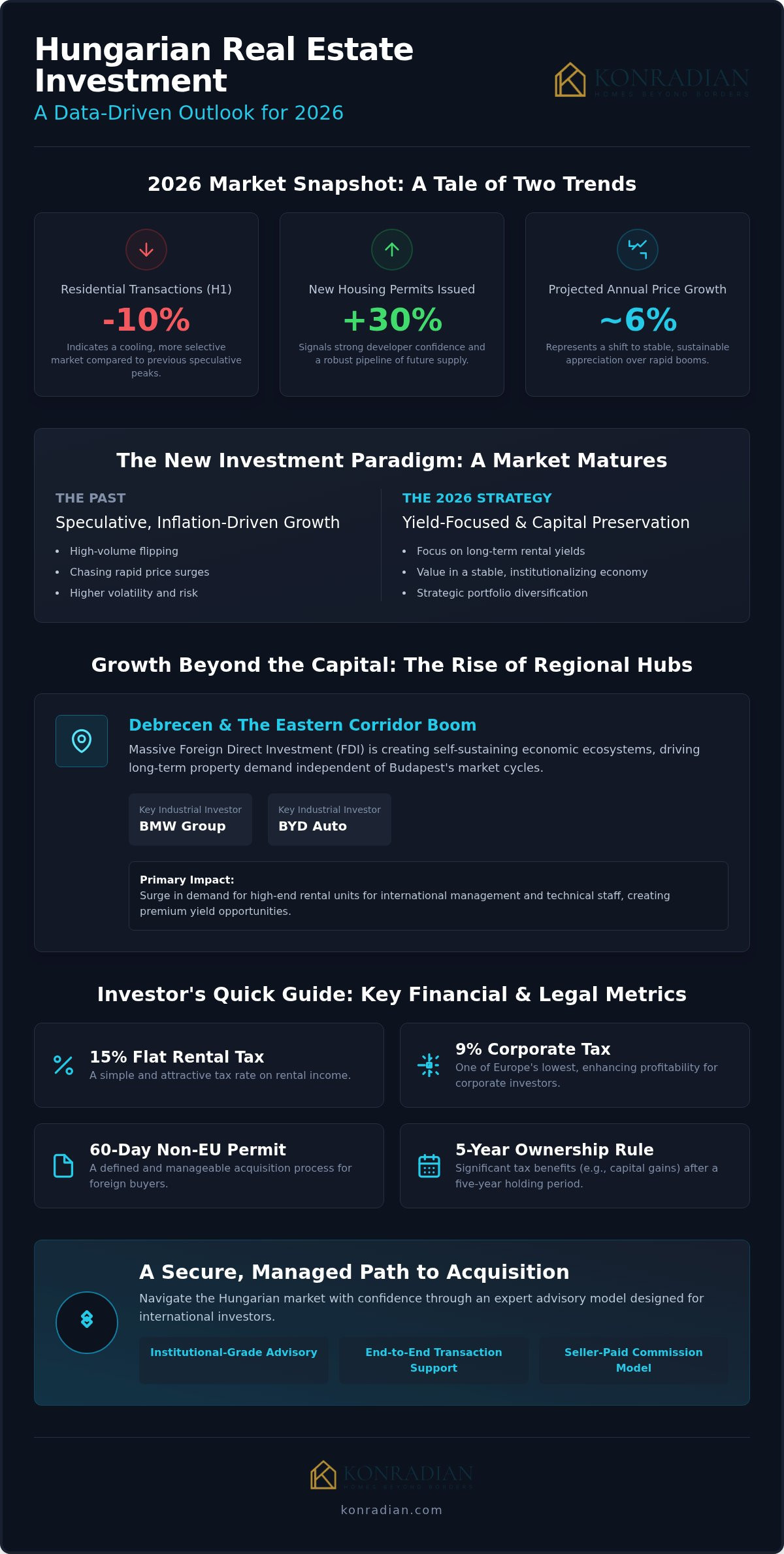
If you’re looking at the 10% dip in residential transactions during the first half of the year, you might think the window of opportunity has closed. However, the 30% surge in housing permits suggests a market that isn’t fading, but rather maturing into a new phase of stability. You’ve likely spent the last decade watching Budapest prices climb, and now you’re asking: is Hungarian real estate a good investment 2026? It’s natural to feel a sense of hesitation, especially when weighing the complexities of currency fluctuations against the promise of steady 6% annual price growth.
This analysis provides the data-driven clarity you need to move beyond speculation. We’ll explore the shift from high-volume flipping to long-term yield strategies, focusing on the districts where rental demand remains resilient despite broader market cooling. You’ll discover how the 2025 changes to the Golden Visa program have reshaped the buyer profile and where regional industrial hubs are now outperforming the capital. From navigating the 60-day permit process for non-EU buyers to understanding the tax benefits of the five-year ownership rule, we’ll map out a secure, managed path for your next acquisition through our expert advisory model.
Key Takeaways
- Understand the market transition from speculative, inflation-driven growth to a mature landscape focused on capital preservation and steady yield.
- Identify high-growth regional hubs fueled by massive industrial investments from BMW and BYD that now offer compelling alternatives to traditional Budapest districts.
- Analyze the data to determine if Hungarian real estate is a good investment 2026, specifically regarding the 15% flat rental tax and currency stability.
- Navigate the updated 2026 legal requirements for the Guest Investor Programme and the specific permit processes required for non-EU acquisitions.
- Discover how to access institutional-grade advisory and end-to-end transaction support at no cost through a seller-paid commission brokerage model.
Analyzing the Hungarian Property Market Performance in 2026
The Hungarian property market in 2026 has successfully transitioned from a period of rapid, inflation-driven price surges to a state of yield-focused maturity. For many international buyers, the core question is Hungarian real estate a good investment 2026 when compared to traditional Mediterranean choices like Spain or Croatia. While the coastlines of Southern Europe offer lifestyle appeal, Hungary provides a sophisticated play for capital preservation and diversification. The market is no longer about chasing a speculative boom; it’s about identifying value within a stable, institutionalizing economy.
Currency dynamics play a central role in this strategy. The Hungarian Forint (HUF) has experienced periods of volatility, yet this creates unique opportunities for foreign investors to maximize their purchasing power. When the HUF dips against the Euro, entry costs for prime Budapest assets become significantly more attractive. This currency play, combined with a 9% corporate tax rate, makes Hungary a compelling alternative to more saturated Western markets for those seeking portfolio diversification as their main 2026 thesis.
The Macroeconomic Landscape of Hungary in 2026
The gradual release of EU funds has served as a vital catalyst for market liquidity, funding the large-scale infrastructure projects that underpin urban property values. Local demand is bolstered by consistent real wage growth, which provides a safety net for rental stability even during broader European slowdowns. Hungary’s convergence thesis suggests that its property values will continue to move toward parity with Central European neighbors as GDP growth remains resilient throughout 2026. A detailed Hungarian economic overview highlights how this industrial strength creates a reliable foundation for long-term real estate holds.
Supply vs. Demand: Why Inventory Remains Tight
Despite a 22% increase in new home completions in the first half of 2026, inventory levels in high-demand districts remain remarkably low. The issuance of 16,588 construction permits indicates future growth, but the immediate reality is a supply-constrained market that supports existing valuations. High interest rates for local mortgages, which hovered between 6% and 8% for HUF loans this year, have dampened local buying power. This shift has forced many residents into the rental sector, maintaining high occupancy rates for savvy investors. To understand how these supply constraints fit into a broader timeline, you can explore our strategic guide on property investment Hungary.
Key Growth Drivers for Hungarian Real Estate: Beyond the Capital
While Budapest often commands the spotlight, the broader question of whether is Hungarian real estate a good investment 2026 is increasingly answered by developments in the provinces. Massive foreign direct investment (FDI) has shifted the focus toward regional industrial clusters. This isn’t just about factory floors; it’s about the entire ecosystem of housing, services, and infrastructure that follows a multi-billion euro commitment from global giants like BMW and BYD. These projects act as long-term anchors for local property values, creating demand that is often insulated from the fluctuations of the capital city’s tourism market.
Infrastructure plays a pivotal role in this expansion. The 2026 outlook for high-speed rail and motorway expansions suggests a country that is becoming more integrated, reducing the commute penalty for regional cities. This connectivity is a primary reason why many sophisticated advisors believe is Hungarian real estate a good investment 2026, especially for those targeting long-term regional appreciation. Additionally, the shift toward sustainable, green-certified buildings has become a non-negotiable requirement for institutional-grade yields. Modern Hungarian housing market data reflects a clear premium for energy-efficient properties, as both tenants and buyers prioritize long-term utility savings.
Debrecen and the Eastern Corridor Boom
Debrecen has firmly established itself as Hungary’s second capital for strategic investment. The arrival of the BMW plant has created a surge in demand for high-end rental units to house international management and technical staff. This influx has pushed regional price-to-rent ratios into a range that often outperforms Budapest’s historical averages. Investors are finding that the Eastern Corridor offers a combination of lower entry points and higher immediate yields, provided they target the right micro-locations near the new industrial zones. The presence of a high-quality international workforce ensures a reliable tenant base that values premium finishes and professional stewardship.
Lake Balaton: The Luxury Vacation Home Market
Lake Balaton remains the definitive staple for domestic wealth and a growing favorite for the German elite. In 2026, the demand for secondary residences has reached a plateau of exclusivity; beachfront plots are a finite resource, and their scarcity creates a natural floor for property values. While some investors look toward Istria real estate for sale for Mediterranean vibes, Balaton offers a unique, year-round appeal rooted in Central European tradition and high-end wellness tourism. If you’re considering a move into these high-growth regional markets, Konradian’s localized expertise can help you identify off-market opportunities that align with your portfolio goals.
Investment Comparison: Budapest Districts vs. Emerging Regional Hubs
Deciding where to allocate capital requires a balance between immediate liquidity and long-term ROI. When asking is Hungarian real estate a good investment 2026, the answer often depends on whether you prioritize capital preservation or aggressive yield. Budapest’s Districts 5 and 6 continue to serve as the market’s “Safe Haven.” These areas attract investors who value security above all else, as demand for prime real estate in the city center remains consistently high. Conversely, Districts 8 and 9 have entered a more mature phase of gentrification in 2026. While they were once considered “hidden gems,” they now offer a stable middle ground for those looking for moderate growth without the premium entry costs of the inner city.
A comprehensive Hungarian residential property market analysis suggests that while prices have stabilized, the market remains highly fragmented. This fragmentation creates a “Yield Gap” that savvy investors are beginning to exploit. While prime Budapest apartments typically generate gross rental yields between 4% and 5%, emerging regional hubs like Debrecen and Szeged often see returns in the 6% to 8% range. However, this higher yield comes with a trade-off; liquidity in the provinces is lower, and volatility can be higher if local industrial demand shifts. For a sophisticated investor, the goal is to blend these assets to create a resilient, high-performing portfolio.
Budapest 2026: Navigating New Rental Regulations
The short-term rental landscape has shifted significantly due to local district regulations. In Districts 6 and 7, new restrictions on Airbnb-style rentals have forced many investors to pivot toward long-term professional lets. District 13 has emerged as a primary beneficiary of this shift, becoming a hub for digital nomads and corporate tenants who seek modern, well-connected apartments. In these prime Budapest locations, a net yield of approximately 3.5% to 4% is a realistic expectation after accounting for taxes and professional brokerage support.
The Regional Advantage: Lower Entry Points, Higher Upside
The cost per square metre in cities like Debrecen or Szeged remains significantly lower than the Budapest average of €2,600, providing a more accessible entry point for portfolio diversification. These “University Cities” offer a reliable investment strategy centered on multi-unit student housing, where demand is constant and less sensitive to tourism cycles. The influx of international faculty and students creates a stable rental floor. Seasoned investors are using 2026 as a pivotal year to diversify into these secondary cities, capturing the upside of Hungary’s regional industrial expansion while Budapest prices consolidate.
Navigating the Legal and Financial Landscape: Taxes, Yields, and Residency
Understanding the regulatory environment is essential when evaluating if is Hungarian real estate a good investment 2026. While the market offers attractive yields, the legal framework for international buyers has become more nuanced. A significant shift occurred in January 2025, when the Guest Investor Programme removed direct real estate ownership as a qualifying route for residency. In 2026, those seeking residency must opt for a €250,000 investment in an approved real estate fund or a €1,000,000 donation. For most private investors, this means the focus has returned to pure asset performance rather than residency-driven acquisitions.
The financial commitment begins with the 4% transfer tax, known as Vagyonszerzési illeték, which is calculated on the property’s market value. Strategically, Hungary remains one of the most tax-efficient jurisdictions in Europe for long-term holders. Capital Gains Tax (SZJA) is set at a flat 15%, but this liability tapers over time. If you hold the property for five years, the tax on your profit drops to 0%. This five-year rule is a cornerstone of the 2026 investment thesis, rewarding those who prioritize stability over short-term speculation.
Tax Efficiency and Transaction Costs
Closing costs typically range between 5% and 6% of the purchase price, encompassing the 4% transfer tax, legal fees, and land registry charges. For rental income, you’ll face a flat 15% personal income tax. However, sophisticated investors often weigh the benefits of purchasing through a local company to take advantage of Hungary’s 9% corporate tax rate. Deciding which structure suits your portfolio requires a high-level security audit, which is why we provide specialized legal support buying property abroad to ensure every transaction is structured for maximum efficiency.
The Residency Question: Is Property the Key?
While direct property ownership no longer grants a Golden Visa, maintaining a physical Hungarian address is still a practical necessity for administrative ease and long-term residency permits. For non-EU citizens, the acquisition permit process remains a standard requirement. This administrative step typically takes 30 to 60 days and involves a modest fee of HUF 50,000. Our team manages the “heavy lifting” of these Land Registry (Földhivatal) permissions, providing a seamless experience that removes the traditional friction of international transactions. If you’re ready to secure a high-yield asset with professional stewardship, contact Konradian today to begin your strategic acquisition.
Strategic Acquisition: How Konradian Secures Your Hungarian Investment
Determining if is Hungarian real estate a good investment 2026 is only the first step in a successful wealth-building journey. The execution of that strategy requires a partner who understands both the macro-level economic shifts and the micro-level legal hurdles of the local Land Registry. We provide a sophisticated, end-to-end brokerage service that prioritizes your peace of mind. Unlike traditional agencies, we operate on a “Free for Buyer” model. Our commissions are paid by the seller; this ensures that our institutional-grade advisory and transaction support don’t eat into your initial capital.
Our LSE-educated advisory team brings a level of intellectual rigor rarely found in private property markets. We don’t just show you apartments. Instead, we conduct deep-dive strategic analyses into yield potential, district gentrification, and long-term exit strategies. By maintaining direct relationships with Hungary’s top developers, we offer our clients exclusive access to pre-sale listings and off-market opportunities that never reach public portals. This proactive approach allows you to secure prime assets before they are subject to open market competition.
A Concierge Approach to International Real Estate
We act as a dedicated global advisor, providing a single point of contact for your interests across Hungary, Spain, and Croatia. This multi-market perspective allows us to filter every listing through a strict “Strategic Investor” lens rather than relying on surface-level tourist appeal. Every step of the process is managed through our Slovakian-registered entity, MALAGA RE s.r.o., providing a familiar legal framework and an added layer of security for your international transactions. From the initial video consultation to the final key handover, we handle the heavy lifting of legal filings and developer negotiations.
Starting Your 2026 Hungarian Portfolio
Your journey toward a high-yield Hungarian asset begins with a clear definition of your investment criteria. During our initial consultation, we’ll align on your goals for capital appreciation, rental yield, and risk tolerance. Our digital viewing tools and remote shortlisting process allow you to evaluate properties with precision, even if you aren’t physically present in Budapest or Debrecen. We ensure that every legal requirement, including the non-EU buyer permit, is handled with meticulous attention to detail. To explore how we can secure your position in this maturing market, schedule your complimentary strategic consultation for the Hungarian market today.
Securing Your Position in the 2026 Hungarian Market
The transition of Hungary’s property landscape from rapid price acceleration to a state of yield-focused maturity offers a unique window for the strategic investor. By shifting focus toward regional industrial hubs and navigating the 2026 regulatory updates with precision, you can build a portfolio that balances capital preservation with robust rental returns. The data suggests that for those prioritizing a five-year holding strategy and tax efficiency, the answer to whether is Hungarian real estate a good investment 2026 remains a definitive yes. Success in this market requires more than just a local contact; it demands institutional-grade rigor and a proactive approach to off-market opportunities.
Our London School of Economics educated advisors provide the elite expertise needed to manage the complexities of international acquisition. We offer end-to-end support at zero cost to the buyer, utilizing direct developer access to secure exclusive pre-sale deals. You deserve a partner that handles the heavy lifting of land registry permissions while you focus on your long-term wealth goals. Secure your high-yield Hungarian investment with Konradian—Consult our experts today. We look forward to guiding you through a seamless, professional acquisition process that prioritizes your peace of mind.
Frequently Asked Questions
Is Hungarian real estate a good investment for foreigners in 2026?
Yes, the market has matured into a stable landscape that offers a 6% annual growth rate and a flat 15% tax on rental income. While the rapid price surges of the previous decade have leveled off, the question of whether is Hungarian real estate a good investment 2026 is answered by the country’s resilient industrial growth. Foreign investors benefit from a transparent legal system and a maturing economy that provides a reliable alternative to saturated Western markets.
Can US citizens buy property in Hungary without a residency permit?
US citizens can certainly acquire residential property in Hungary without holding a residency permit. The process requires a standard acquisition permit from the relevant government office, which our team manages as part of our end-to-end service. This administrative step typically takes 30 to 60 days and involves a fee of HUF 50,000. It’s a procedural requirement rather than a barrier, ensuring your ownership is correctly recorded in the Hungarian Land Registry.
What are the rental yields for apartments in Budapest in 2026?
In 2026, gross rental yields for prime Budapest apartments typically fluctuate between 4% and 5%. After accounting for local taxes and maintenance, investors should expect a net yield of approximately 3.5% to 4%. Areas like District 13 and the gentrifying parts of Districts 8 and 9 remain high-demand zones for professional tenants. These yields are supported by a stabilizing rental market that saw a 5% nationwide increase in the year leading up to July 2026.
How much are the closing costs and taxes when buying a house in Hungary?
Buyers should budget approximately 5% to 6% of the purchase price for total closing costs. The largest component is the 4% property transfer tax, known as Vagyonszerzési illeték. The remaining 1% to 2% covers legal fees for the mandatory sales contract and land registry registration charges. Because our brokerage model is seller-paid in the Hungarian market, you won’t face additional agency fees, allowing you to allocate more capital toward the asset itself.
Does buying a house in Hungary automatically grant me a residence permit?
Direct property ownership no longer grants residence permits under the 2026 Guest Investor Programme. Since January 2025, the “Golden Visa” routes have shifted to a €250,000 investment in a regulated real estate fund or a €1,000,000 donation to a higher-education institution. While owning a house provides a necessary physical address for administrative purposes, it doesn’t trigger an automatic right to residency. We help clients navigate these distinctions to ensure their acquisition aligns with their relocation goals.
Is it better to invest in Budapest or regional cities like Debrecen in 2026?
Budapest remains the premier choice for liquidity and capital preservation, but regional cities like Debrecen offer superior yields. Driven by massive industrial investments from companies like BMW and BYD, Debrecen’s rental market often achieves gross yields of 6% to 8%. Investors must decide if they prefer the “Safe Haven” status of the capital’s District 5 or the higher growth potential of the Eastern Corridor’s emerging hubs. Both are viable components of a diversified 2026 portfolio.
What happens if I sell my Hungarian property before 5 years?
If you sell your property within five years, you’ll be subject to a 15% Capital Gains Tax on the realized profit. This taxable amount is reduced for every year of ownership, eventually reaching 0% after five full years. This policy encourages stable, long-term investment rather than short-term speculation. It’s one of the primary reasons why we advise our clients to view Hungarian property as a minimum five-year commitment to maximize their net returns and tax efficiency.
How does Konradian offer its services for free to the buyer?
Konradian operates on a seller-paid commission model, meaning the developer or property owner covers our professional fees upon a successful transaction. This structure allows us to provide LSE-educated advisory, legal navigation, and strategic property sourcing at zero cost to the buyer. We maintain direct relationships with top developers to secure pre-sale access, ensuring our clients receive premium service and institutional-grade rigor without the burden of traditional buyer-side brokerage fees.
