


What if your next property acquisition wasn’t just a vacation retreat, but a calculated hedge against global volatility? Most investors view international real estate through the lens of leisure, yet the most successful acquisitions in 2026 are those treated as sophisticated cross-border transactions. You likely recognize that identifying the best countries for second home investment requires more than a beautiful coastline; it demands a rigorous analysis of tax structures, legal protections, and long-term yield potential. The inherent stress of managing foreign jurisdictions or encountering language barriers in legal contracts is a valid concern that often stalls even the most ambitious portfolios.
This guide will show you how to strategically select, finance, and secure your international property to diversify your wealth and elevate your lifestyle. You’ll gain a clear understanding of how to manage the acquisition process with the precision of a global citizen. We will explore the nuanced benefits of residency programs in Spain and Hungary, the high-yield potential of the US market, and the strategic sourcing opportunities within the UK and Croatia. From initial selection to final deed, we provide the clarity needed to transform a complex international venture into a seamless, high-yield reality.
Key Takeaways
- Learn why treating your international property as a strategic dual-purpose asset provides a vital hedge against global economic volatility in 2026.
- Discover the best countries for second home investment by analyzing the enduring demand in Spain and Croatia alongside the emerging capital growth in Hungary.
- Understand how to secure immediate equity through direct developer access and off-plan opportunities that maximize long-term capital appreciation.
- Navigate the complexities of international law and currency logistics with a structured approach to due diligence that ensures a secure, transparent transaction.
- Leverage a sophisticated brokerage model where seller-paid commissions in Spain, Croatia, Hungary, and the USA allow for expert guidance at no cost to the buyer.
The Strategic Case for a Second Home Abroad Investment in 2026
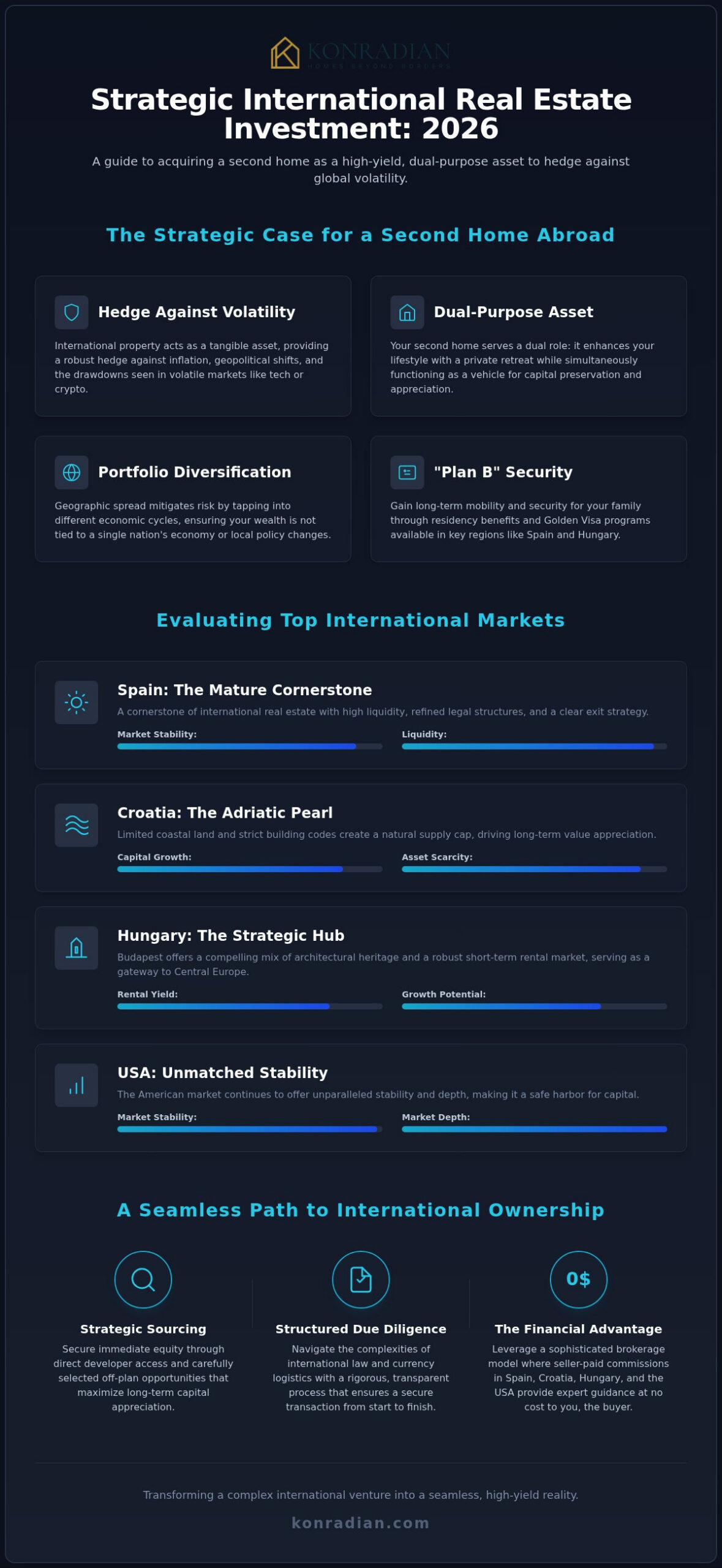
2026 represents a watershed moment for the global property market. As traditional financial instruments face increasing volatility, sophisticated investors are pivoting toward tangible assets that serve a dual purpose: lifestyle enhancement and capital preservation. This shift moves beyond the “Margarita Effect,” that common trap where a holiday impulse leads to a sub-optimal purchase. A strategic acquisition requires a cold, analytical look at the best countries for second home investment to ensure the asset performs as a robust hedge against inflation and geopolitical shifts.
While equities offer liquidity, international real estate provides a physical floor for your portfolio. Understanding the various rules on foreign ownership is the first step in treating your second home as a serious financial instrument rather than a mere discretionary expense. By securing property in 2026, you’re not just buying a view; you’re acquiring a stable, non-correlated asset that historically resists the sharp drawdowns seen in the tech or crypto sectors.
Lifestyle vs. Financial Incentives
The value of a second home is measured in more than just rental yield. There’s a profound “psychological dividend” in owning a private retreat where you control the environment. However, the financial logic is equally compelling. Investing in Euro or Dollar-denominated assets allows for effective currency hedging, protecting your purchasing power across different jurisdictions. Many of our clients also prioritize “Plan B” security, looking at residency benefits or Golden Visas in regions like Spain or Hungary to secure long-term mobility for their families.
Portfolio Diversification Through Geographic Spread
Relying solely on a domestic market leaves your wealth vulnerable to local policy changes and economic downturns. Geographic spread allows you to access different growth cycles; for instance, the mature, steady appreciation of the UK or US markets can balance the high-growth potential of emerging Mediterranean hubs. It’s about being a global citizen who isn’t tied to the fate of a single nation’s economy. Geographic diversification is the ultimate risk-mitigation tool for 2026 investors. By spreading your interests across the best countries for second home investment, you ensure that your lifestyle and your legacy remain protected regardless of local market conditions.
Evaluating Top International Markets: Spain, Croatia, and Beyond
Selection of a destination is the most personal part of the journey, yet it must remain anchored in data. Identifying the best countries for second home investment involves balancing mature stability with emerging opportunity. Spain offers a blueprint for established success, while Croatia provides a unique entry point for those seeking scarcity and coastal appreciation. Our LSE-educated team applies a rigorous analytical framework to these regions, ensuring your choice is based on economic fundamentals rather than vacation sentiment.
The Mediterranean Advantage: Spain and Croatia
Spain remains a cornerstone of international real estate. Its high liquidity and refined legal structures provide a sense of security for high-stakes transactions. It’s a mature market where the exit strategy is as clear as the acquisition. In contrast, Croatia offers “The Adriatic Pearl” effect. Limited coastal land and strict building regulations create a natural supply cap that drives long-term value. For those focusing on the northern coast, exploring Istria real estate for sale reveals a region where Italian-influenced architecture meets modern luxury developments. Both markets benefit from our seller-paid commission model, ensuring your capital goes directly into the asset rather than into brokerage fees.
High-Yield Alternatives: Hungary and the USA
Investors looking beyond the coast often find Budapest to be a compelling strategic hub. Hungary’s capital attracts capital through a mix of architectural heritage and a robust short-term rental market. It serves as a gateway for those wanting exposure to Central European growth cycles. Across the Atlantic, the American market continues to offer unmatched stability and depth. The Sunshine State remains a primary target for 2026, as US real estate investment from Europe focuses on high rental demand and transparent title insurance. The US market is particularly attractive for those seeking high cash-on-cash returns from professionalized rental sectors.
Comparing these regions requires a look at fiscal efficiency and entry barriers. Central Europe often provides lower entry costs and simplified ownership for EU citizens, while North America demands a more complex tax structure but offers significantly higher rental demand. Understanding these local restrictions is where professional stewardship becomes essential to avoid unforeseen liabilities. If you’re weighing the stability of Florida against the growth of Budapest, a tailored consultation can help you determine which of the best countries for second home investment fits your long-term goals.
Navigating the Financial and Legal Framework of Buying Abroad
Selecting from the best countries for second home investment is only the first step; the true success of your acquisition rests on the integrity of the legal and financial framework you establish. International real estate practices vary significantly between jurisdictions. In Spain and Croatia, for instance, the role of the Public Notary is central to the transaction, yet they don’t always perform the deep-level due diligence a buyer requires. You must ensure that land registries are scrutinized for historical debts, utility arrears, or planning restrictions that could compromise your title.
Managing currency risk is another critical layer of a sophisticated transaction. Fluctuations between the Euro, Dollar, and Pound can shift your purchase price by significant margins between the offer and completion. Utilizing specialized FX brokers instead of traditional retail banks often secures better rates and smoother logistics for international wire transfers. This proactive approach to financial planning prevents the erosion of your capital before the keys are even in your hand.
Legal Support and Security
A local Power of Attorney (PoA) is often the most practical tool for a remote investor. It allows your legal representative to sign documents, open local bank accounts, and register the property on your behalf without requiring your physical presence for every administrative step. This doesn’t just add convenience; it ensures that deadlines in the purchase contract are met precisely. Verifying property titles and checking for hidden encumbrances is a non-negotiable phase of the process. For a comprehensive security audit, consult our guide on legal support buying property abroad to understand how we protect your interests from initial deposit to final deed.
The Hidden Costs of Acquisition
Budgeting for an international purchase requires looking beyond the headline price. You should typically set aside between 7% and 12% of the purchase price to cover transfer taxes, VAT, and legal fees. These percentages fluctuate depending on whether you’re buying a new-build from a developer or a resale property. Konradian’s seller-paid model eliminates traditional brokerage fees for the buyer in Spain, Croatia, Hungary, and the USA, allowing you to reallocate those funds toward higher-specification finishes or legal enhancements.
Ongoing maintenance and management represent the final financial pillar. While we don’t offer direct property management, we advise clients to factor in local community fees, non-resident property taxes, and insurance. Understanding these recurring costs ensures that your investment in the best countries for second home investment remains a source of tranquility rather than a financial burden. We help you map out these obligations early in the process to ensure full transparency and long-term viability.
Maximizing ROI: Rental Yields vs. Capital Appreciation
Investing in the best countries for second home investment requires a shift from viewing property as a simple passive income stream to treating it as a managed asset. Gross rental yields often look attractive on paper, yet the true measure of success is the net yield after accounting for local management fees, maintenance, and taxes. In markets like Spain or Hungary, professional management can consume 15% to 25% of gross revenue. Failure to account for these operational realities can turn a high-yield opportunity into a break-even venture. We help you look past the marketing brochures to calculate a realistic net return based on actual market data.
The choice between short-term vacation rentals and long-term residential leases often dictates your management intensity and yield profile. Short-term rentals in coastal Croatia or Florida offer higher peak returns but come with increased wear and tear and seasonal vacancy risks. Conversely, long-term leases in urban hubs like Budapest or the UK provide a steady, predictable cash flow with lower turnover costs. Your strategy should align with your appetite for involvement and your long-term liquidity needs.
Identifying High-Growth Pre-Sale Opportunities
Capital appreciation is often maximized at the very beginning of a property’s lifecycle. Direct developer access allows strategic investors to secure units before they reach the public market, often at a significant discount to the projected completion value. This “First-Mover” advantage is particularly potent in developing coastal regions where infrastructure improvements are planned. We mitigate construction risk by partnering only with vetted developers who have proven track records of delivery. By securing equity at the pre-sale stage, you’re not just waiting for market growth; you’re creating it through strategic timing.
Managing the Asset Remotely
Owning property across borders shouldn’t mean constant travel for administrative oversight. Sophisticated investors utilize technology to track occupancy and maintenance from their primary residence. While Konradian focuses on the acquisition, we emphasize the necessity of hiring professional local property management to ensure a hands-off ROI. Balancing personal usage with rental availability is a delicate calculation. Restricting your own stays to the shoulder seasons can significantly optimize annual income without sacrificing the lifestyle benefits of ownership. To explore how pre-sale access can enhance your portfolio in the best countries for second home investment, contact our strategic advisory team for a detailed market analysis.
Liquidity is the final pillar of a successful investment. Planning your exit strategy in 2026 involves understanding local capital gains tax structures and the maturity of the resale market. Whether you’re targeting short-term vacation yields or long-term residential stability, your acquisition must be structured with the end in mind. This foresight ensures that when you choose to divest, you do so with maximum capital preservation and minimal legal friction.
The Konradian Approach: A Seamless Path to International Ownership
The complexity of international law doesn’t have to be your burden. While identifying the best countries for second home investment is a critical first step, the execution of that investment requires a level of precision that few individual buyers can manage alone. Our team, educated at the London School of Economics, applies a rigorous analytical framework to ensure every property aligns with your broader financial objectives. We combine this intellectual rigor with the personalized care of a dedicated concierge, handling the heavy lifting of cross-border transactions so you can focus on the lifestyle rewards of your new asset.
One of the most significant advantages of our service is the Zero-Cost Buyer Model. In Spain, Croatia, Hungary, and the USA, our commissions are paid entirely by the sellers. This structure allows you to access elite strategic advice and transaction support without adding to your acquisition costs. We provide end-to-end stewardship, moving from an initial video consultation to the final key handover with a steady, reassuring pace. Our deep relationships with developers also grant you exclusive access to off-market listings and pre-sale deals that never reach public portals.
Our Professional Acquisition Process
We follow a methodical three-step process designed to eliminate the inherent stress of buying abroad. It begins with a strategic consultation where we align your lifestyle preferences with a hard-data financial audit. Once your goals are defined, we provide a curated selection of vetted listings, including high-yield opportunities in the best countries for second home investment. The final phase involves comprehensive transaction support, where our team coordinates with legal and financial experts to verify titles, manage currency logistics, and ensure a secure, transparent closing.
Why a Dedicated Buyer Advisor is Essential
Relying on local agents often leads to a conflict of interest, as their primary duty is to the seller. As your dedicated buyer advisor, we act as a protective partner, bridging the language and cultural gaps that often complicate negotiations. We ensure you’re never navigating foreign legal contracts or tax laws in isolation. Our role is to provide a sense of security and ease, transforming a high-stakes international transaction into a seamless experience. You deserve an advocate who prioritizes your long-term interests and emotional well-being throughout the entire journey. Book your free consultation to start your Spanish Property Acquisition or Croatian investment journey with the confidence of professional stewardship.
Securing Your Global Legacy in 2026
The transition from a global observer to an international property owner requires a shift from holiday inspiration to strategic execution. You now understand that a second home is a powerful tool for geographic diversification and wealth preservation. Whether you’re targeting the high-yield potential of Budapest or the scarcity-driven value of the Croatian coast; identifying the best countries for second home investment is only the first step. Success depends on navigating complex legal frameworks and securing exclusive entry points through direct developer access.
With over five years of cross-border experience and an LSE-educated advisory team, we provide the intellectual rigor needed to manage these high-stakes transactions. We handle the heavy lifting of due diligence and negotiation, ensuring your path to ownership is both secure and seamless. It’s time to transform your global aspirations into a tangible, high-performing reality. Your future retreat and the security of your portfolio deserve nothing less than professional stewardship.
Secure your international property future with a free Konradian consultation and take the first step toward a more diversified portfolio. Your international legacy is closer than you think.
Frequently Asked Questions
Is it safe to buy a second home abroad without visiting the property in person?
It’s entirely safe to purchase property remotely if you utilize a local Power of Attorney and a trusted advisor to conduct due diligence. Many of our clients secure pre-sale deals in the best countries for second home investment through our detailed video walkthroughs and legal audits. We verify every title and developer contract to ensure your interest is protected without requiring your physical presence for every administrative milestone.
What are the main tax implications of owning an investment property in a foreign country?
You’ll typically encounter local property taxes, income tax on any rental revenue, and capital gains tax upon sale. Most jurisdictions we operate in, such as Spain and the USA, have double taxation treaties in place to prevent you from being taxed twice on the same income. It’s essential to budget for these recurring costs and understand how local fiscal residency rules might impact your global tax liability.
How does Konradian offer its services for free to the buyer?
Our services are free for buyers in Spain, Croatia, Hungary, and the USA because we operate on a seller-paid commission model. The developer or seller pays a percentage of the transaction price to us upon completion. This allows you to benefit from our LSE-educated strategic advice and end-to-end transaction support without incurring additional brokerage fees. Please note that buyer-side advisory fees apply only to our UK property sourcing services.
Can I get a mortgage in a foreign country as a non-resident?
Non-residents can often secure financing in foreign markets, though loan-to-value ratios typically range between 50% and 70%. While Konradian doesn’t provide direct mortgage lending, we offer legal and financial transaction support to help you navigate local banking requirements. Lenders will scrutinize your global income and credit history, so having a structured portfolio and clear financial documentation is vital for a successful application during your property search.
What is the difference between a Golden Visa and a standard residency permit?
A Golden Visa is a residency-by-investment program that grants you living rights in exchange for a significant capital contribution, such as real estate. Unlike standard residency permits, Golden Visas often have minimal physical stay requirements, making them ideal for global citizens who don’t plan to relocate immediately. We help you evaluate these options in the best countries for second home investment to ensure your purchase secures your long-term mobility and security.
How do I choose between a beachfront villa and a city apartment for investment?
Your choice should align with your specific ROI goals and personal usage needs. Beachfront villas in regions like Croatia offer high capital appreciation due to land scarcity, while city apartments in hubs like Budapest provide higher year-round occupancy and liquidity. We analyze local market data to determine which asset type offers the best net rental yield and fits your long-term exit strategy within your chosen jurisdiction and lifestyle requirements.
What happens if I decide to sell my property abroad in five years?
Selling an international property requires an understanding of local resale liquidity and capital gains tax obligations. You’ll need to work with a broker to list the property and ensure all original purchase documents are in order for the new buyer’s due diligence. Planning your exit strategy at the time of acquisition ensures that you can divest efficiently while preserving the capital growth achieved during your five-year ownership period.
Does Konradian handle the legal paperwork for me?
We provide comprehensive legal and financial transaction support by coordinating with qualified local professionals on your behalf. While we aren’t a law firm, we oversee the entire process, from reviewing contracts to ensuring land registry filings are completed correctly. This end-to-end stewardship bridges the gap between local legal requirements and your expectations, ensuring every document is handled with the precision required for a high-stakes international transaction and total peace of mind.
