


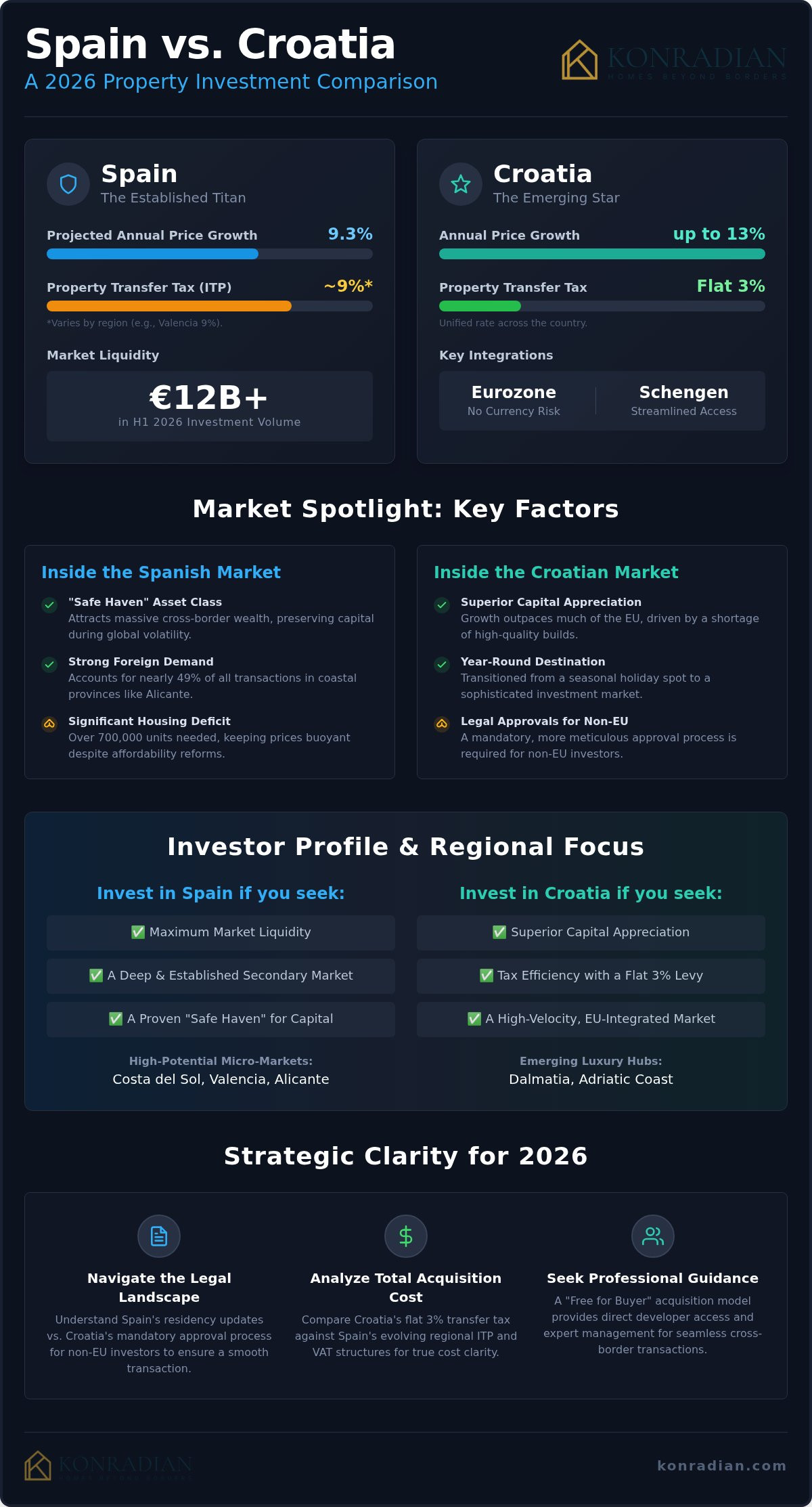
What if the most secure path for your 2026 portfolio isn’t the established markets of the Costa del Sol, but the emerging coastline of the Adriatic? While Spain remains a titan of liquidity with investment volumes reaching over 12 billion Euro in early 2026, Croatia is quietly outperforming expectations with annual price growth reaching up to 13%. Deciding on a Spain vs Croatia property investment requires looking past the sunny surface to understand how shifting regulations and tax reforms impact your long-term wealth.
It’s natural to feel a sense of hesitation when facing Spain’s regulatory shifts or the perceived legal complexities of the Croatian market. You want to ensure you aren’t overpaying in a saturated region while seeking a transaction that feels seamless and expertly managed. This guide provides a definitive comparison to help you discover which Mediterranean powerhouse offers the best ROI and tax efficiency for your 2026 strategy. We’ll examine the total cost of acquisition, from Valencia’s 9% transfer tax to Croatia’s unified property levies, giving you the strategic clarity needed to invest with absolute peace of mind.
Key Takeaways
- Contrast Spain’s record-breaking market liquidity with Croatia’s superior capital appreciation to align your 2026 portfolio with the most profitable growth trajectories.
- Navigate the financial nuances of a Spain vs Croatia property investment by comparing Croatia’s flat 3% transfer tax against Spain’s evolving regional ITP and VAT structures.
- Gain strategic clarity on the 2026 legal landscape, including the mandatory approval processes for non-EU investors in Croatia and the latest residency updates in Spain.
- Identify high-potential micro-markets by comparing the long-term lifestyle appeal of established regions like Costa del Sol with emerging luxury hubs like Dalmatia.
- Discover how a professional “Free for Buyer” acquisition model provides you with direct developer access and seamless cross-border transaction management at no additional cost.
The Shifting Mediterranean Landscape: Spain vs. Croatia Property Investment in 2026
The Mediterranean remains the world’s premier investment hub, not merely for its climate, but for its consistent ability to preserve capital during global volatility. In 2026, the region continues to attract a massive share of cross-border wealth, yet the strategy for deployment has shifted. Investors no longer look for simple holiday homes; they seek strategic assets that balance tax efficiency with reliable growth. This Spain vs Croatia property investment dilemma represents a choice between two distinct economic cycles: the deep, liquid maturity of the Spanish market and the high-velocity, EU-integrated trajectory of Croatia.
For British, American, and Asian investors, shifting regulations have added layers of complexity to the acquisition process. While Spain navigates national housing reforms, Croatia has fully embraced its role within the Eurozone and Schengen Area, creating a more transparent, albeit legally specific, environment. Understanding the comparative price levels across these borders is essential for calculating true entry costs and long-term lifestyle maintenance for your portfolio.
The 2026 Spanish Market Outlook
Spain is currently grappling with a significant housing deficit of over 700,000 units. This supply-demand imbalance keeps prices buoyant even as the government introduces affordability reforms in major urban hubs like Madrid and Barcelona. Despite national debates regarding tax structures for non-residents, coastal regions remain remarkably resilient. In provinces like Alicante, foreign demand accounts for nearly 49% of all transactions. Investors still view the Spanish coast as a “safe haven” asset class, evidenced by the record-breaking €12.034 billion in property investment recorded in the first half of 2026.
The Croatian Growth Story
Croatia has successfully transitioned from a seasonal holiday market to a sophisticated year-round investment destination. Its integration into the Eurozone has removed currency risks, while Schengen membership has streamlined access for the European elite. The residential sector has shown impressive stamina, with early 2026 data indicating a 2% quarterly price growth. This isn’t just speculative; it’s driven by a shortage of high-quality, energy-efficient builds. While the number of total transactions slowed slightly in 2025, the value of premium assets continues to climb, offering capital appreciation that currently outpaces much of the broader European Union.
Choosing between these two powerhouses requires a clear-eyed look at your objectives. Spain offers the peace of mind that comes with a massive, established market. Croatia offers the excitement of a region still finding its ceiling, where strategic entry can yield significant rewards for those who don’t mind a more meticulous legal approval process.
Market Dynamics: Comparing Appreciation, Rental Yields, and Liquidity
Croatia’s property market is moving at a velocity that defies broader European trends. While the continent sees a modest recovery, Croatia recorded price growth between 10% and 13% leading into early 2026. Spain remains a powerhouse in its own right with a projected 9.3% increase this year, yet the two markets serve different strategic functions within a portfolio. When evaluating a Spain vs Croatia property investment, you’re choosing between the rapid capital appreciation of an emerging star and the deep, reliable liquidity of an established titan.
Liquidity is where Spain truly excels. The record €12.034 billion in transactions during the first half of 2026 demonstrates an incredibly active secondary market. This volume ensures that investors can exit positions with relative ease compared to the smaller, more exclusive Croatian market. Understanding Spain’s investment climate is vital for those prioritizing this ease of movement, as the legal frameworks are designed to support high-volume international capital and institutional interest.
Yield Analysis: Tourism vs. Long-term
Net yields for beachfront apartments in 2026 are increasingly dictated by local licensing. Spain has implemented more restrictive short-term rental laws in saturated hubs, making year-round city demand in Valencia a more stable play for many. Conversely, Croatia maintains a more investor-friendly stance toward seasonal rentals in Dalmatia. While Split offers exceptional high-season returns, Valencia provides the security of 12-month occupancy. Strategic investors are currently looking at “pockets” along the Dalmatian Coast where infrastructure improvements are expected to drive yields upward as the region matures into a year-round destination.
Entry Costs and Price per Square Meter
Prime real estate in Marbella often commands a premium for its global brand, yet Dubrovnik’s limited supply of historic and luxury builds has pushed prices to comparable levels. In early 2026, the national average in Croatia reached approximately €2,900 per square meter, though prime coastal spots are significantly higher. The real advantage in this climate lies in securing pre-sale opportunities. Accessing developments before they reach the open market allows for entry points well below final valuations. If you are looking to secure these exclusive opportunities, you can explore our current property acquisition services to gain direct access to developer-led projects. This proactive approach ensures your ROI is protected from the moment of acquisition, providing the peace of mind that comes with professional stewardship.
Navigating the Legalities: Taxes, Residency, and Ownership Structures
The legal framework of a Spain vs Croatia property investment is often where a strategic vision meets administrative reality. Investors must look beyond the purchase price to calculate the true impact of transaction taxes and annual holding costs. In Croatia, the property transfer tax is a straightforward flat rate of 3% for resale properties. Spain presents a more fragmented landscape; for instance, the standard ITP rate in Valencia was reduced to 9% in June 2026, though this rises to 11% for luxury assets exceeding €1 million. This regional variance makes legal support when buying property abroad an essential component of your risk management strategy to avoid hidden liabilities and ensure a secure acquisition.
Annual holding costs also diverge significantly. Spain’s IBI (Annual Property Tax) ranges from 0.4% to 1.1% of the cadastral value depending on the municipality. Croatia, as of January 2025, implemented a unified annual tax for non-primary residences ranging from €0.60 to €8.00 per square meter. While these figures may seem marginal, they dictate the long-term net yield of your portfolio. Professional stewardship ensures these costs are forecasted accurately before you commit capital.
Tax Efficiency for International Investors
New builds require careful capital planning due to VAT disparities. Spain applies a 10% VAT on residential new builds, whereas Croatia applies a 25% VAT, which effectively negates the 3% transfer tax. Double taxation treaties are in place for both nations, ensuring your rental income isn’t eroded by dual-jurisdiction levies. In Spain, the ITP tax on resale properties is governed by autonomous regions, resulting in rates that fluctuate between 6% and 11% depending on the specific location and property value.
Ownership and Residency Pathways
The 2026 landscape for residency has become increasingly nuanced. Spain’s Golden Visa remains a focal point of discussion for non-EU investors, though evolving regulations require a partner who stays current on legislative shifts. Croatia offers a different hurdle; non-EU buyers, including British and American citizens, must obtain approval from the Minister of Justice, a process that can take several months. Holding property through a Croatian company can sometimes streamline the acquisition of multiple assets, while individual ownership remains the standard for lifestyle-focused buyers. Navigating these procedures requires a proactive partner to handle the heavy lifting, providing the peace of mind that comes from expert oversight.
Geographic Matchmaking: Finding Your Ideal Investment Region
Geographic matchmaking is about more than just a view; it’s about aligning a location’s infrastructure with your specific financial exit strategy. When considering a Spain vs Croatia property investment, the choice often narrows down to micro-regions that mirror each other’s lifestyle appeal but offer vastly different entry points. While the Costa del Sol provides an unparalleled social calendar and mature amenities, the Dalmatian coast offers a raw, high-growth potential that is increasingly rare in Western Europe. For those looking to diversify beyond the Mediterranean, exploring property investment in Hungary serves as an excellent urban hedge, offering stable yields in a central European hub to balance coastal volatility.
Connectivity plays a vital role in 2026 valuations. Spain’s established airport networks in Malaga and Alicante support a massive volume of year-round tourism, whereas Croatia’s coastal hubs are seeing rapid expansions to accommodate a growing digital nomad population. This shift in infrastructure is transforming regions like Zadar and Šibenik from seasonal stops into viable year-round investment pockets. Choosing the right region requires a balance between the security of established demand and the upside of emerging infrastructure projects.
The Coastal Powerhouses
The Malaga-Marbella corridor remains the gold standard for Spanish Property Acquisition, sustained by a record-breaking volume of international demand. This region’s infrastructure is designed for the global elite, featuring world-class private schools and medical facilities. Conversely, Istria real estate for sale has become the “new Tuscany” for luxury investors. Its proximity to Central Europe and its burgeoning reputation for truffles and high-end olive oil have driven price growth that rivals established Spanish hubs. Secondary markets such as Zadar are also gaining traction, offering a more accessible entry into the Adriatic market before further institutional capital arrives.
Lifestyle vs. Yield Profiles
Yield profiles are heavily influenced by the “authenticity factor” of a region. Croatia’s market is defined by meticulously restored stone houses that command high premiums in the rental market due to their unique character and limited supply. Spain’s strength lies in its modern, sustainable developments that focus on energy efficiency, a key driver for 2026 buyers. Identifying regions with the highest year-on-year appreciation requires a deep dive into local development plans and climate resilience trends. If you’re ready to refine your search, you can explore our current property acquisition services to find a region that perfectly matches your lifestyle and ROI objectives.
Strategic Acquisition: Why Professional Brokerage is Non-Negotiable
The decision to proceed with a Spain vs Croatia property investment is only the first step in a much larger strategic journey. While selecting the right region is vital, the method of acquisition often dictates the ultimate success of the venture. Many investors fall into the trap of relying solely on local agents who, while knowledgeable about their specific street, lack the global perspective required to manage high-stakes international capital. A sophisticated investor needs a partner who understands how a villa in Istria or an apartment in Valencia fits into a broader, multi-jurisdictional portfolio.
Friction is the enemy of ROI. From the initial search to the final key handover, the process of buying across borders involves navigating disparate legal systems, currency fluctuations, and varying developer standards. Professional stewardship alleviates this stress by handling the heavy lifting of due diligence and transaction management. By utilizing direct developer relationships, investors gain access to off-market pre-sale lists, allowing them to secure assets before they reach the public market and face the inevitable price appreciation of 2026.
The End-to-End Service Advantage
Our LSE-educated advisory team provides a level of intellectual rigor that goes beyond simple sales. We analyze market timing and selection with the same precision found in our UK property sourcing services, ensuring that every Mediterranean acquisition meets strict criteria for long-term security. One of the most significant strategic advantages is the “Free for Buyer” model. In both Spain and Croatia, commissions are typically paid by the developers or sellers, meaning you receive elite, end-to-end representation without increasing your capital outlay. This structure ensures complete transparency and allows us to act as a dedicated concierge for your interests.
Your 2026 Investment Roadmap
Securing a premier Mediterranean asset in 2026 shouldn’t require constant travel or administrative exhaustion. We’ve refined the remote purchase process to ensure absolute security, utilizing high-definition video consultations and digital document management to keep you informed at every stage. Your roadmap begins with a clear definition of your investment goals, followed by a curated selection of properties that match your specific yield and appreciation profiles. The final step is a seamless transition of ownership, managed by experts who prioritize your emotional well-being and financial success. Secure your Mediterranean investment with Konradian’s expert advisory today.
Securing Your Mediterranean Legacy in 2026
The choice between these two coastal powerhouses ultimately depends on whether your 2026 strategy prioritizes the deep liquidity of the Spanish coast or the high-velocity appreciation found in the Adriatic. Navigating a Spain vs Croatia property investment requires a clear understanding of regional tax variations and the specific legal hurdles for non-EU residents. By aligning your portfolio with these shifting market dynamics, you can secure assets that offer both immediate lifestyle value and long-term financial resilience.
At Konradian, our LSE-educated advisory team provides the strategic edge needed to identify undervalued opportunities before they reach the open market. We provide direct access to developer pre-sales and operate on a model that is entirely free for the buyer in these markets. We handle the heavy lifting of cross-border transactions, from initial sourcing to final key handover, ensuring your journey is as seamless as the Mediterranean lifestyle itself.
Book a Free Video Consultation for your Spain or Croatia Investment to begin refining your 2026 acquisition strategy. We look forward to helping you build a secure and prosperous international property portfolio.
Frequently Asked Questions
Is it better to buy property in Spain or Croatia for rental income in 2026?
The choice depends on your yield strategy; Croatia offers higher seasonal returns in coastal Dalmatia, while Spain provides stable year-round demand in urban hubs like Valencia. Spain’s high-season market is more heavily regulated, making year-round city lets a safer play for many. Conversely, Croatia’s flat 10% tax on 70% of rental income provides a clear fiscal advantage for residential landlords seeking to maximize net returns.
Do foreigners need special permission to buy property in Croatia?
Yes, non-EU citizens, including those from the UK and US, must obtain formal approval from the Minister of Justice before finalizing their acquisition. EU citizens enjoy the same rights as local buyers, but the “reciprocity” rule applies to others. This administrative step is a standard part of the process that typically takes several months, so professional legal oversight is essential to ensure your documentation meets the Ministry’s specific requirements.
What are the main taxes when buying a house in Spain vs. Croatia?
Croatia charges a flat 3% property transfer tax on resale properties, while Spain’s rates vary by region, such as Valencia’s 9% ITP. For new builds, Spain applies a 10% VAT, whereas Croatia applies 25%. Annual taxes also differ; Spain utilizes the IBI (0.4% to 1.1% of cadastral value), while Croatia has a unified tax for non-primary residences ranging from €0.60 to €8.00 per square meter as of 2025.
Can I get a Golden Visa in Spain or Croatia in 2026?
Spain’s Golden Visa program is currently undergoing significant legislative review, while Croatia doesn’t offer a direct property-based residency scheme. Spain remains the primary focus for non-EU investors seeking a residency pathway, though the requirements have become more stringent recently. In Croatia, residency is typically tied to employment or business ownership rather than a simple real estate purchase, requiring a different strategic approach for international buyers.
Is real estate cheaper in Croatia than in Spain?
No, the price gap has closed significantly, with Croatia’s national average reaching approximately €2,900 per square meter in early 2026. While Spain’s average resale price sits around €3,092 per square meter, prime coastal regions in both nations often command similar premiums. A Spain vs Croatia property investment comparison shows that while entry points are comparable, Croatia’s smaller market size often leads to higher price volatility in the luxury segment.
What is the “Free for Buyer” model in international real estate?
The “Free for Buyer” model means the purchasing investor pays no commission to the brokerage, as the developer or seller covers the professional fees. This model is a standard feature of our acquisition services in both Spain and Croatia. It allows you to access LSE-educated advisory support and direct developer pre-sales without adding to your initial capital outlay, ensuring a more efficient allocation of your investment funds.
How does the 100% Spanish property tax proposal affect non-EU investors?
Current 2026 data confirms that while national tax debates exist, no “100% tax” on property has been implemented for non-EU residents. Instead, non-residents face an imputed income tax of 19% for EU residents and 24% for non-EU residents on properties that aren’t rented out. Investors should focus on resilient regions like Alicante, where foreign demand remains high and regional tax incentives often offset national-level policy shifts.
Which Croatian region has the highest property appreciation?
The Istria region currently leads the market, frequently called the “new Tuscany” due to its luxury villa growth and proximity to Central Europe. Dalmatian hubs like Zadar and Šibenik are also seeing significant appreciation, driven by infrastructure improvements and a 2% quarterly price growth in the residential sector. These regions offer the highest upside for investors targeting capital gains rather than immediate rental liquidity in a Spain vs Croatia property investment strategy.
