


In 2025, foreign buyers accounted for a record 20% of all property sales in Spain, yet many of these investors are now facing a reality where the Golden Visa has ended and new tax obligations have arrived. Building a robust international real estate portfolio for expats has become a sophisticated exercise in risk management and strategic foresight. You likely recognize that diversification is no longer optional for the global citizen. It’s a fundamental requirement for lasting security. Still, the fear of hidden legal traps or the uncertainty of being taxed twice on the same income can often stall even the most ambitious acquisition plans.
This 2026 strategic guide offers the refined clarity you need to move forward with quiet confidence. You’ll learn how to construct a portfolio that balances the high yields of the US market with the enduring lifestyle appeal of the Mediterranean and the structural stability of the UK. We provide a precise framework for selecting properties across diverse regions, from the sun-drenched coasts of Andalusia to the emerging opportunities in Croatia; this overview leads you through the essentials of minimizing tax leakage and leveraging professional stewardship to secure the world’s most resilient property assets.
Key Takeaways
- Identify why 2026 represents a pivotal shift in global interest rate cycles and how to position your assets for long-term resilience.
- Apply the 40/40/20 strategic framework to achieve an ideal equilibrium between high-yield US income and stable European lifestyle properties.
- Master the nuances of an international real estate portfolio for expats by utilizing Double Taxation Treaties to minimize tax leakage across multiple jurisdictions.
- Evaluate the specific entry costs and rental demand drivers in Spain, Croatia, and the USA through a professional comparative lens.
- Streamline your acquisition process by leveraging direct developer access and eliminating traditional buyer-side fees in key global markets.
What is an International Real Estate Portfolio for Expats?
An international real estate portfolio for expats represents more than a simple list of deeds. It’s a curated collection of cross-border assets managed with a specific focus on yield, capital growth, and personal utility. While a domestic investor might look for a single rental property near their home, the expat investor looks at the globe. This approach requires a shift in mindset. You’re no longer just a homeowner; you’re a strategic allocator of global capital. To understand the foundational concepts, one might ask, What is International Real Estate? in its broadest sense. For our purposes, it is the practice of acquiring property in jurisdictions that offer legal security and market resilience.
The year 2026 has emerged as a pivotal moment for this strategy. Shifting interest rate cycles in major economies have created a landscape where the cost of borrowing and the potential for capital appreciation are in a state of productive tension. Building an international real estate portfolio for expats this year allows you to lock in assets in markets like Spain or Croatia while they still offer significant upside. Ultimately, such a portfolio serves as a strategic hedge against local economic volatility, protecting your wealth from the whims of a single government or currency.
Distinguishing between different asset types is essential for balance. We often categorize these as “pure investment” assets, such as high-yield US rentals, and “lifestyle investments,” like Mediterranean villas that provide personal enjoyment alongside long-term value. A sophisticated portfolio doesn’t choose one over the other. It integrates both to ensure your financial goals and your lifestyle aspirations are met simultaneously.
The Shift from Local to Global Wealth
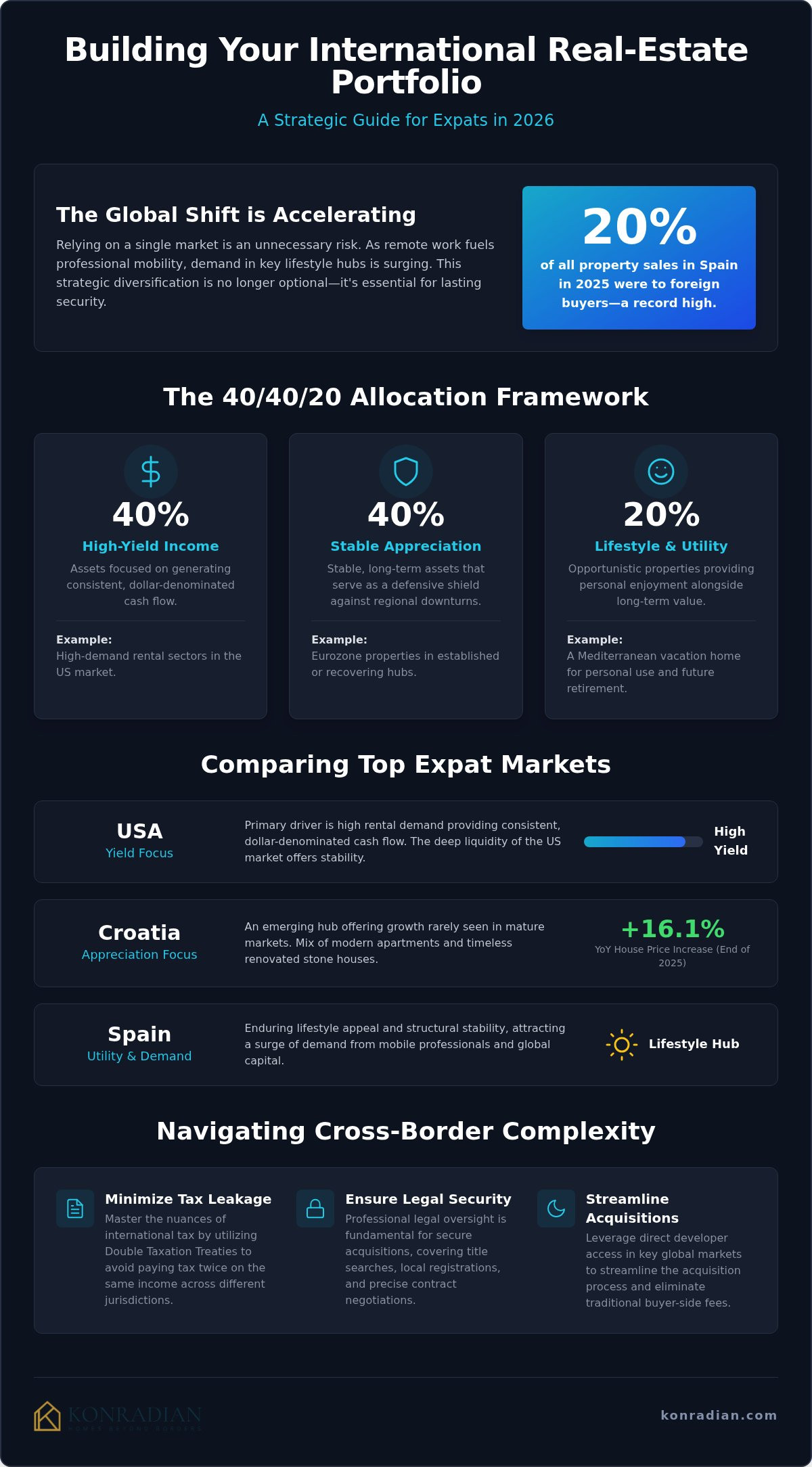
Relying on a single market is an unnecessary risk. If your primary residence, your income, and your investments are all tied to one country, you’re vulnerable. Modern wealth requires geographic and currency diversification. By holding assets in USD, EUR, and GBP, you insulate yourself against currency fluctuations that could erode your purchasing power. This global shift is accelerated by remote work. As professionals gain more mobility, demand for “second home” markets in Spain and Croatia has surged. In 2025, foreign buyers reached a record 20% of all property sales in Spain, proving that the world’s elite are already moving their capital toward stable, high-quality lifestyle hubs.
Core Objectives: Yield vs. Appreciation vs. Utility
Successful portfolios balance three distinct goals. First, there’s “Yield.” This is the primary driver in the US real estate market, where high-demand rental sectors provide consistent, dollar-denominated cash flow. Second, “Appreciation” focuses on emerging or recovering hubs. Croatia, for example, saw a 16.1% year-on-year increase in house prices at the end of 2025, offering a level of growth rarely seen in more mature markets. Finally, the “Utility” factor considers the personal benefit. This involves selecting properties that can serve as a Mediterranean vacation home now and a secure retirement base in the future.
Strategic Pillars of International Portfolio Construction
Constructing an international real estate portfolio for expats requires a structural logic that goes beyond simple property selection. We recommend a 40/40/20 rule as a sophisticated starting point for balanced growth. This allocation suggests placing 40% of your capital in high-yield income generators, 40% in stable, long-term capital appreciation assets, and the remaining 20% in opportunistic or high-utility lifestyle properties. By balancing the stability of the Eurozone with the deep liquidity of the US market, you create a defensive shield against regional downturns. True diversification also extends to asset classes. Mixing modern, off-plan apartments in coastal Spain with authentic, renovated stone houses in Croatia ensures your portfolio captures both contemporary rental demand and timeless architectural value.
Security remains the cornerstone of every cross-border transaction. The complexity of managing multiple legal jurisdictions makes legal support buying property abroad a fundamental necessity. Professional oversight ensures that title searches, local tax registrations, and contract negotiations are handled with precision. This proactive stewardship protects your capital from hidden liabilities and ensures that each acquisition strengthens the overall integrity of your holdings.
Income Generation: The US Rental Engine
The United States remains the global gold standard for generating consistent, dollar-denominated cash flow. High-growth states like Florida provide a fertile ground for investors seeking rental income backed by a transparent legal framework. When you’re considering US real estate investment from Europe, it’s vital to understand the specific tax and reporting requirements that apply to foreign owners. Resources regarding Navigating U.S. Real Estate Investment clarify these fiscal responsibilities, ensuring your income remains tax-efficient. This reliable income engine provides the liquidity often needed to fund or maintain lifestyle assets in other regions.
Capital Growth: Emerging and Resilient European Markets
While the US often provides the income, Europe offers remarkable capital growth opportunities through strategic holds. Identifying undervalued coastal regions in Croatia allows for 5 to 10 year investment horizons that capitalize on increasing international demand. Croatia recorded a 16.1% year-on-year increase in house prices in late 2025, signaling a market with significant upward momentum. Similarly, ongoing infrastructure improvements in Spain continue to bolster property values in mature tourism hubs. For those seeking specific entry points, exploring Istria real estate for sale reveals how emerging regions can transform the growth profile of your assets. If you’re ready to refine your strategy, a private consultation can help define an allocation tailored to your specific goals.
Comparing Top Expat Markets: Spain, Croatia, and the USA
Selecting the right jurisdictions for an international real estate portfolio for expats involves a rigorous comparison of entry costs, fiscal obligations, and long-term rental demand. Each market serves a specific role within a diversified strategy. Spain remains the primary choice for those prioritizing a mature tourism infrastructure and a high quality of life. In contrast, Croatia has emerged as a hidden gem for investors seeking authentic luxury and aggressive coastal appreciation. For those focused on the sheer mechanics of cash flow, the USA remains a powerhouse, offering professional management structures and yields that are difficult to replicate in European markets.
A professional comparison framework typically evaluates three core pillars. First, we look at entry friction, such as the 7% Property Transfer Tax (ITP) found in Spain’s Andalusia region compared to the 3% transfer tax in Croatia. Second, we assess the ongoing tax burden, including the new annual property tax in Croatia and the imputed income tax for non-residents in Spain. Finally, we analyze rental demand drivers. While Spain benefits from a massive, established tourism base, the US market offers the stability of long-term professional tenants in high-growth states like Florida.
Spain vs. Croatia: Choosing Your Mediterranean Anchor
Deciding between Spanish Property Acquisition and a Croatian coastal deal often comes down to your personal balance of risk and lifestyle utility. Spain’s market is highly liquid and predictable. Although the Spanish Golden Visa program officially ended in April 2025, the market’s fundamental appeal hasn’t wavered, with foreign buyers still accounting for 20% of sales. Croatia offers a different value proposition. With a 16.1% year-on-year price growth recorded at the end of 2025, it’s a market with significant momentum. Direct developer access is the preferred entry point in both regions, as off-plan deals allow expat investors to secure prime locations before they reach the general resale market. This “front-of-the-queue” access is a cornerstone of our procurement strategy.
The UK and Hungary: Strategic Portfolio Additions
A truly resilient international real estate portfolio for expats often includes tactical additions beyond the Mediterranean. Utilizing a UK property sourcing service allows you to tap into high-yield student housing or professional lets in regional hubs, while London real estate continues to serve as a safe haven for long-term wealth preservation. For those seeking a lower entry point with capital city prestige, property investment Hungary offers a compelling case. Budapest provides a unique blend of historical charm and modern rental demand, often at a fraction of the cost per square meter found in Western European capitals. These markets provide the necessary variety to ensure your portfolio isn’t overly dependent on a single economic zone or currency.
Navigating Cross-Border Complexity: Taxes, Law, and Logistics
Managing an international real estate portfolio for expats involves more than just selecting beautiful properties; it requires a deep understanding of the jurisdictional friction that occurs between the point of sale and the final handover. One of the most common oversights is the failure to account for “hidden costs.” These aren’t just administrative fees. They include significant levies like the 10% VAT and 1.2% stamp duty on new-build properties in Andalusia, or the 25% VAT applied to developer sales in Croatia. When these figures are overlooked, they can quickly erode the initial yield projections of your investment.
Navigating these costs is made simpler through Double Taxation Treaties (DTTs). These agreements ensure you aren’t taxed twice on the same rental income by your home country and the country where the property is located. However, the most critical safeguard is your choice of representation. Relying on a seller’s agent is a fundamental conflict of interest; they’re incentivized to close the deal at the highest price. A dedicated buyer’s agent acts as your fiduciary, ensuring your interests are protected during negotiations. This professional stewardship also facilitates remote acquisition. You don’t need to be physically present to build a global footprint. With the right oversight, you can manage inspections, legal filings, and title transfers from anywhere in the world.
Legal Safeguards for International Buyers
Due diligence is the bedrock of secure acquisition. This involves more than a cursory glance at land registries. In Spain and Croatia, the notary system acts as a public record of the transaction, but the notary doesn’t represent you personally. They ensure the document is legal, not that the deal is strategically sound for you. Independent legal counsel is essential to verify foreign titles and ensure there are no historical encumbrances or “hidden” debts that could jeopardize your investment. We prioritize these checks to provide the peace of mind that comes from professional stewardship.
Tax Efficiency in a Multi-Country Portfolio
Tax planning should precede the purchase. For instance, non-resident owners of properties in Spain that aren’t rented out must pay an imputed income tax, typically 24% for non-EU citizens. If you do rent the property, EU residents benefit from a lower 19% rate and expense deductions, while non-EU residents pay 24% on gross income without deductions. Understanding how your residency status, whether as a traditional expat or a digital nomad, influences these liabilities is key to preserving your net yield. If you’re concerned about the legal or fiscal implications of your next move, our team provides comprehensive legal and financial transaction support to ensure a seamless acquisition.
The Konradian Approach: Seamless Global Portfolio Management
Building an international real estate portfolio for expats requires more than high-level theory; it demands a partner with the capacity to execute across borders with absolute precision. We provide a direct brokerage model that simplifies the transition from strategic planning to physical ownership. A primary advantage of our approach is the elimination of the buyer-side fee in Spain, Croatia, the USA, and Hungary. In these specific jurisdictions, our professional services are typically compensated by the seller or the developer. This ensures that you receive elite-level representation and market savvy without the additional cost burden often found in high-end sourcing.
Our leadership team, educated at the London School of Economics (LSE), applies a rigorous analytical framework to every acquisition. We don’t just identify beautiful homes; we evaluate the long-term resilience and fiscal health of the underlying market. This intellectual rigor, combined with over five years of international market experience, provides a superior strategic edge for expats who prioritize both security and capital growth. We maintain a steady, reassuring pace throughout the process, ensuring that every detail is addressed before it becomes a concern.
Your Global Concierge for Real Estate
We act as your sophisticated global citizen advisor, handling the heavy lifting so you don’t have to. Our direct developer relationships allow you to access pre-sale deals and off-plan units before they ever hit the open market. This exclusive access is vital in competitive regions where the highest-quality assets are often claimed before the general public is aware of them. We provide a single point of contact to coordinate every aspect of your acquisition:
- Legal due diligence and comprehensive title verification
- Financial transaction support and local tax registration
- Logistics and relocation assistance for lifestyle buyers
- Strategic portfolio mapping through free initial video consultations
This end-to-end promise means we’re present at every milestone. We begin with a deep dive into your current holdings and move through procurement, negotiation, and closing. We don’t leave you at the contract signing; we stay involved through the entire process, ensuring that the final handover is as tranquil as the initial consultation.
We understand that a global lifestyle often involves managing care for loved ones across different continents; for those with family requirements in Australia, engaging with specialized NDIS providers like 24/7 Care Services ensures that your personal peace of mind is as secure as your property investments.
Taking the First Step Toward Diversification
The most effective way to start is with a single anchor property that aligns with your primary objective. Whether that’s a high-yield US rental or a coastal retreat in Istria, we ensure the process is seamless and secure. A typical international acquisition in 2026 takes between three and six months from the initial search to the key handover. We manage the complexity of multiple jurisdictions, allowing you to focus on your global lifestyle while we secure your future wealth. If you’re ready to move from observation to action, Schedule your free video consultation with Konradian today. We’ll help you map out your goals and identify the world’s most resilient markets for your specific needs.
Securing Your Global Footprint in 2026
Building a resilient international real estate portfolio for expats requires a transition from passive ownership to strategic asset allocation. You’ve seen how balancing high-yield US rentals with the capital appreciation of Mediterranean hubs creates a robust shield against regional volatility. Success in this landscape depends on navigating the legal and fiscal nuances of multiple jurisdictions with precision, ensuring that regulatory shifts or tax obligations don’t compromise your long-term returns.
Our LSE-educated advisors provide the intellectual rigor needed to manage these complexities. By leveraging direct developer pre-sale access and our zero-buyer-fee model in Spain, Croatia, and the USA, you gain an immediate advantage in the world’s most sought-after markets. We handle the heavy lifting, from initial due diligence to the final key handover, providing a seamless end-to-end experience that prioritizes your peace of mind. Build your global property portfolio with a free Konradian consultation. The world’s most resilient markets are within reach; start your journey toward a truly global legacy today.
Frequently Asked Questions
Is it better to buy property as an individual or through a company?
The choice depends on your long-term objectives and the specific jurisdiction of the asset. In the United States, investors often utilize an LLC to provide a layer of liability protection and facilitate easier management of rental income. Conversely, for a lifestyle property in Spain or Croatia, individual ownership is frequently more straightforward. We recommend a tailored analysis of your total assets to determine which structure offers the most efficient tax and legal protection for your specific circumstances.
What are the most common mistakes expats make when buying real estate abroad?
The most frequent error is relying on the seller’s agent for guidance, which creates a fundamental conflict of interest. Many investors also underestimate the impact of local taxes, such as the 25% VAT on new builds in Croatia or the imputed income tax for non-residents in Spain. Failing to perform independent due diligence on land registry titles can also lead to inheriting historical debts or legal encumbrances that are difficult to resolve after the sale.
How do I manage an international property portfolio while living in another country?
Successful remote management relies on a combination of professional acquisition oversight and reliable local property management. While our team handles the complex “heavy lifting” of the purchase and legal transition, we advise clients to appoint a dedicated local manager for day-to-day tenant relations and maintenance. This dual-layered approach ensures your international real estate portfolio for expats remains a source of passive income rather than a logistical burden.
Which country offers the best ROI for expat property investors in 2026?
The “best” ROI is subjective and depends on whether you prioritize cash flow or capital appreciation. For consistent, dollar-denominated rental yield, high-growth US states like Florida remain the premier choice. If your goal is capital growth, Croatia recorded a 16.1% year-on-year price increase in late 2025, making it a standout for appreciation. A balanced international real estate portfolio for expats typically integrates both markets to hedge against regional economic shifts.
Are there specific mortgage options for expats buying in Spain or Croatia?
Non-resident mortgages are widely available in Spain, typically offering a Loan-to-Value (LTV) ratio of 60% to 70%. In Croatia, the process is more nuanced; while EU citizens enjoy similar terms to locals, non-EU nationals may face stricter requirements and should prepare for higher down payments. We don’t provide direct lending, but we can guide you toward reputable local banks that specialize in cross-border financing for international buyers.
How does the “zero-fee” model work for buyers at Konradian?
Our buyer-side services in Spain, Croatia, the USA, and Hungary are typically compensated through commissions paid by the property developer or the seller. This means you receive our LSE-educated strategic oversight, legal coordination, and direct developer access without an additional service fee. This model ensures that our interests are aligned with yours in securing the highest quality assets while keeping your acquisition costs transparent and predictable.
What is the impact of the Golden Visa changes on property investment in 2026?
The closure of the Spanish Golden Visa program in April 2025 shifted the market focus from residency to pure investment fundamentals. Investors are now selecting properties based on rental yield, tourism demand, and lifestyle utility rather than as a vehicle for a residency permit. This transition has actually stabilized the market by attracting committed, long-term investors who are focused on the enduring value of Mediterranean real estate.
Can I buy property in the USA from Europe without a US social security number?
You can absolutely acquire US property without a social security number by obtaining an Individual Taxpayer Identification Number (ITIN). This allows you to fulfill your tax obligations and manage your investment legally from abroad. It’s important to be aware of the Foreign Investment in Real Property Tax Act (FIRPTA), which requires a 15% withholding on the gross sales price when you eventually sell, acting as a prepayment of your tax liability.
