


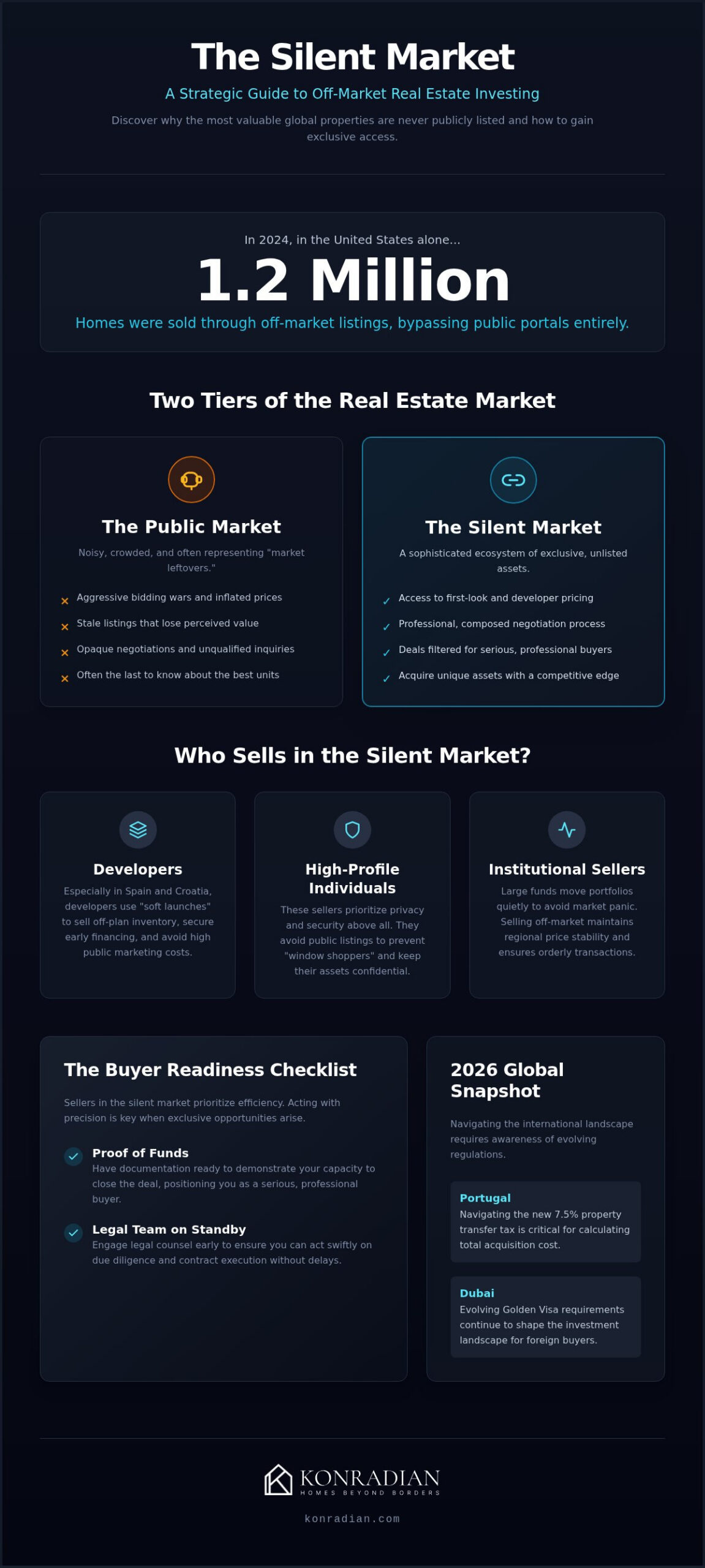
In 2024, 1.2 million homes in the United States were sold through off-market listings, quietly bypassing the noise of public portals. This silent market isn’t a secret club. Instead, it’s a strategic choice by developers and sellers to maintain asset value while filtering for serious, professional buyers. If you’ve spent months refreshing outdated listings or losing out in aggressive bidding wars, you’ve likely realized that the most exceptional opportunities never actually hit the open market. Finding a high-quality off-market property abroad requires moving beyond the digital storefronts that everyone else is watching.
Key Takeaways
- Learn why the most valuable global assets never reach public portals and how to position yourself within the silent market to secure off-market property abroad.
- Discover how to capitalize on developer pre-sales and soft-launch pricing in Spain and Croatia, securing a first-mover advantage before public marketing begins.
- Master the mechanics of private negotiations to avoid the bidding wars common in Florida and Budapest, ensuring a more professional and transparent acquisition process.
- Understand the importance of buyer readiness, including proof of funds and legal standby, to act with precision when exclusive opportunities arise.
- Explore the strategic benefits of a no-cost-to-buyer model that provides direct access to elite, unlisted inventory through established developer relationships.
The Silent Market: What Off-Market Property Abroad Really Means
The 2026 real estate landscape has evolved into two distinct tiers. On the surface, you find the noisy, crowded public portals. Beneath that lies the “silent market,” a sophisticated ecosystem where an off-market property abroad is traded with precision and privacy. This isn’t merely a “secret club” for the ultra-wealthy; it’s a professional strategy used by sellers to maintain asset integrity. When a property is listed publicly, it immediately begins to lose its “freshness” in the eyes of professional investors. In contrast, unlisted assets retain a sense of exclusivity that often commands a cleaner, more professional transaction process.
The Public Portal Paradox
Public portals often represent the “leftovers” of the market. By the time professional photography is finished and a listing goes live, the most desirable units in a development have usually been secured by “first-look” investors. This creates a stale listing problem. If a property sits on a portal for more than a few weeks, its perceived value drops, even if the asset itself is flawless. Additionally, public site algorithms often lead to inflated price bubbles. Sellers frequently list at aspirational prices to test the market, causing a bidding frenzy that rarely reflects the asset’s true ROI.
Who are the Off-Market Sellers?
Understanding the motivation behind a private sale allows you to negotiate with greater clarity. Most off-market inventory comes from three primary sources:
- Developers: Many developers in Spain and Croatia prefer “soft launches.” They often sell a portion of their off-plan property inventory to secure early financing without the high marketing costs of a public campaign.
- High-Profile Individuals: These sellers prioritize security. They don’t want “window shoppers” touring their homes or photos of their private spaces accessible to the entire internet.
- Institutional Sellers: Large funds move portfolios quietly. Listing dozens of units in a single district simultaneously could trigger market panic; selling them off-market maintains regional price stability.
The Mechanics of Exclusivity: How Properties Bypass Public Portals
Securing an off-market property abroad isn’t a matter of luck; it’s a result of understanding the institutional “whisper network” that operates between developers and specialized sourcing partners. Most high-value transactions occur in this space to maintain market stability. When a developer launches a new project, they rarely start with a public listing. Instead, they circulate the details among a vetted pool of buyers. This allows them to secure initial funding and prove demand without the high costs or risks of a public marketing campaign. Understanding the advantages of off-market real estate allows investors to move with the same agility as institutional funds, capturing value before it’s diluted by public exposure.
Developers prefer this route because it filters for “buyer readiness.” Dealing with a professional buyer who has their legal team and proof of funds on standby is more efficient than managing hundreds of unqualified inquiries from a public portal. This efficiency creates a quieter, more professional negotiation environment where the focus remains on the asset’s long-term ROI rather than the noise of a bidding war. For those looking to build a portfolio, acting as a strategic sourcing partner provides a direct line to these unlisted opportunities.
Developer Soft-Launches in Spain and Croatia
In markets like the Costa del Sol or the Dalmatian coast, the “Friends and Family” phase is where the most significant gains are made. Developers in Malaga and Split often release their most desirable sea-view plots to private networks months before any international portals are updated. Pre-sale access is a tool for capital appreciation. By the time a project is publicly announced, the “soft-launch” investors have already seen a lift in value as the developer moves to the next pricing tier.
The Privacy Premium in Luxury Markets
In the UK and USA, luxury sellers often avoid public listings to protect their digital footprint. A public listing creates a permanent record of interior photos and price history that many high-profile individuals find intrusive. More importantly, it avoids the “days on market” counter. On public sites, a listing that hasn’t sold in thirty days is often viewed as “stale,” giving buyers leverage to lowball their offers. Discreet sales bypass this entirely, maintaining the prestige of high-value neighborhoods and allowing the seller to hold their price with quiet confidence.
Strategic Advantages: Evaluating the ROI of Off-Market Acquisitions
Evaluating the return on investment for an off-market property abroad requires a shift from emotional appeal to tactical analysis. While public portals drive prices up through artificial scarcity and manufactured bidding wars, the private market offers a more controlled environment. You aren’t competing with fifty other inquiries; you’re engaging in a one-to-one dialogue. This lack of competition translates directly into negotiation leverage. Sellers in this space often value a discreet, certain close over a slightly higher, but more volatile, public offer.
This price protection is vital in high-demand zones like Florida or Budapest. In these markets, public listings often trigger a frenzy that pushes final sale prices well above bank valuations. By accessing assets before they trend on search engines, you secure the “market timing” advantage. You’re buying into a neighborhood’s potential before the algorithm pushes it to the masses. This strategy ensures you’re acquiring quality inventory with unique features that never need the broad reach of public marketing to find a buyer.
Off-Market vs. On-Market: A Tactical Comparison
The competition levels on public sites naturally lead to rushed due diligence. In the off-market ecosystem, the pace is more deliberate. This allows for comprehensive legal support buying property abroad, ensuring that every contract detail is scrutinized without the pressure of a 24-hour bidding deadline. The “First-Look” discount is another quantifiable benefit. In pre-sale scenarios, investors often capture a 5 to 10 percent price advantage simply by being the first to commit capital before the developer’s public marketing budget is even deployed.
Portfolio Diversification through Private Channels
Institutional investors rarely use public portals because they require scale and specificity. Private channels allow you to find unique US real estate investment from Europe that fits specific yield profiles. Navigating US regulations for foreign investors is significantly easier when the seller is accustomed to working with international funds rather than retail buyers. Similarly, securing high-yield property investment in Hungary often depends on local networks that prioritize discreet transfers of multi-unit buildings. These assets offer a level of stability and exclusivity that remains insulated from the volatility of the open market.
The Global Sourcing Framework: How to Secure Private Listings Safely
Securing an off-market property abroad requires more than just a connection; it demands a rigorous verification framework to protect your capital. The primary risk in the silent market isn’t the asset itself, but the “middleman chain” that often surrounds it. A professional acquisition starts by distinguishing between a direct broker holding a signed mandate and a casual intermediary passing on second-hand information. Without a direct line to the seller or developer, you risk entering a negotiation based on outdated terms or inflated price expectations. Real exclusivity is found through direct relationships, not through a series of redirected emails.
Your standing as a buyer is determined by your readiness to act. In private circles, “window shopping” isn’t tolerated. You must have your proof of funds and a specialized legal team on standby before the first viewing is even arranged. This professional posture signals to developers in Spain or Croatia that you’re a serious contender, often granting you access to even deeper tiers of unlisted inventory. When you present as a prepared investor, the market opens in ways that public portal browsers never experience.
The 4-Step Verification Process
To navigate the silent market with confidence, we employ a methodical verification process for every asset:
- Step 1: Authenticating the mandate. We confirm the broker has the legal right to sell and isn’t just “fishing” for interest.
- Step 2: Assessing the “why.” We determine if the seller is prioritizing privacy or seeking a quick exit, which dictates our negotiation strategy.
- Step 3: Comparative Market Analysis (CMA). Since there are no public data points, we value the property using internal data and recent private transactions.
- Step 4: Securing the “Right of First Refusal.” We aim to secure a legal window that allows you to match other private offers, protecting your interest in the asset.
Legal Due Diligence for Discreet Transactions
Formal contracts are non-negotiable because off-market doesn’t mean off-the-books. Managing escrow and deposits across borders requires a deep understanding of local laws, such as the specific notary requirements in Dalmatia or the deposit structures in Andalusia. Securing an international asset requires the kind of LSE-level rigor that ensures every clause protects the buyer’s long-term interests. For those targeting the British market, a dedicated UK property sourcing service acts as the necessary filter to verify off-market data against real-world valuations. If you’re ready to move beyond the public portals, engaging a strategic sourcing partner is the most secure way to navigate these complexities.
Navigating the Elite Market with Konradian’s Strategic Advisory
Securing an off-market property abroad requires more than just access; it demands a partner who applies intellectual rigor to every transaction. At Konradian, we act as your strategic sourcing partner, moving beyond the role of a traditional broker to provide high-level advisory and localized expertise. Our LSE-educated team brings a sophisticated analytical approach to complex international deal structures, ensuring that every acquisition is backed by data-driven insights rather than just marketing promises. This level of precision is essential when navigating markets where public data is scarce and privacy is the primary currency.
One of the most significant advantages we provide is our “No-Cost-to-Buyer” model for acquisitions in Spain and Croatia. Because we are compensated directly by the developers and sellers, you gain access to premium, unlisted inventory without the burden of additional sourcing fees. This model ensures that our interests are fully aligned with yours, focusing on the long-term performance and security of the asset. By leveraging our direct relationships with top-tier developers, we bypass the open market entirely, providing you with a cleaner and more professional acquisition path.
Our results speak to the efficacy of this private network. For example, we recently assisted investors in securing Istria real estate for sale well before the summer rush began. By accessing these assets during the pre-release phase, our clients were able to choose the most desirable units and lock in pricing that was unavailable to the public. This first-mover advantage is the cornerstone of our strategy, allowing you to capture value before it is diluted by broader market exposure.
End-to-End Sovereignty for the International Buyer
We provide a seamless, start-to-finish experience designed to eliminate the complexity of cross-border transactions. From the initial video consultation to the final key handover, our team handles the heavy lifting of due diligence, negotiation, and legal coordination. You gain direct access to “pre-release” lists from our partners in Spain and Croatia, ensuring you are always the first to see high-potential opportunities. This refined, concierge-level approach provides the peace of mind that comes from knowing your interests are protected by experienced professionals at every stage.
Your Invitation to the Private Market
The silent market is open to those who prioritize strategy and discretion. We invite you to book a free strategic consultation to explore our current portfolio of unlisted assets. During this initial session, we will provide specific market insights and begin tailoring a property sourcing plan that aligns with your unique investment goals. Secure your private consultation with Konradian today and step beyond the limitations of public portals to find your next global asset.
Securing Your Competitive Advantage in the Silent Market
The decision to pursue an off-market property abroad represents a commitment to precision over convenience. By moving beyond public portals, you avoid the artificial price inflation and competitive fatigue that define the open market. Instead, you gain the ability to engage in professional, one-to-one negotiations for assets that retain their full prestige and value. Success in this private tier requires a combination of buyer readiness and a partner with the intellectual rigor to navigate complex international deal structures.
Konradian provides this bridge through our LSE-educated advisory team and direct developer pre-sale access. Whether you are seeking exclusive plots in Dalmatia or pre-release units in Malaga, our approach ensures you are the first to see high-potential opportunities. We maintain a no-cost-to-buyer model for Spanish and Croatian acquisitions, ensuring our interests are fully aligned with your long-term success. Access Exclusive Off-Market Opportunities with Konradian and begin your journey toward a more professional acquisition experience today. The most exceptional global assets are waiting for those who know where to look.
Frequently Asked Questions
Is it legal to buy off-market property abroad?
It is entirely legal to acquire property through private channels in most international jurisdictions. An off-market transaction is simply a private sale between two parties that occurs without public advertising. These deals still require formal registration, notary oversight, and compliance with local tax laws. While the sourcing is private, the legal transfer of ownership remains a public record once the deed is signed and registered with the relevant land registry.
Why would a seller choose not to list their property publicly?
Sellers often prioritize discretion to protect their personal privacy and the digital footprint of their home. High-profile individuals or institutional funds may want to avoid “window shoppers” or the stigma of a property sitting on a portal for too long. By keeping an off-market property abroad unlisted, they maintain a sense of exclusivity and can negotiate with a vetted pool of serious buyers without the pressure of public performance metrics.
Do I have to pay extra fees to access off-market listings?
You don’t necessarily have to pay additional fees for private access. At Konradian, we operate on a no-cost-to-buyer model for acquisitions in Spain and Croatia, as we are compensated by the sellers or developers. While some boutique sourcing agents in other markets might charge a retainer or success fee, our strategic relationships allow us to provide premium, unlisted inventory as a standard part of our professional advisory service.
Are off-market properties cheaper than those on public portals?
Off-market properties aren’t always cheaper in absolute terms, but they often offer superior value through price protection. By bypassing public portals, you avoid the bidding wars that artificially inflate prices in competitive markets. Additionally, developer soft-launches provide first-look pricing that is typically lower than the eventual public release price. This allows you to capture capital appreciation early in the project’s lifecycle before the general market is even aware of the off-market property abroad.
How can I verify the value of a property if it isn’t listed online?
Valuing an unlisted asset requires a methodical Comparative Market Analysis using private transaction data and local market insights. Since public portals only show asking prices, which are often inflated, we rely on actual sale records and internal databases to determine a property’s true worth. Professional appraisals and our team’s analytical rigor ensure that your offer is based on documented ROI potential rather than the speculative trends found on public search engines.
Can I buy off-market property in Spain and Croatia remotely?
You can absolutely complete an acquisition remotely through a legally binding Power of Attorney. We utilize high-definition video tours, drone footage, and digital documentation to provide a comprehensive view of the asset from abroad. Our team handles the local heavy lifting, including site inspections and notary coordination, ensuring a seamless transaction. This start-to-finish oversight allows you to secure prime assets in Malaga or Split without the need for immediate international travel.
What is a developer soft-launch, and how do I get on the list?
A soft-launch is a strategic phase where developers offer a limited number of units to a private network before the public marketing campaign begins. This allows the developer to secure initial funding while offering investors the most desirable plots at preferential rates. To get on these lists, you must work with a strategic sourcing partner like Konradian. Our direct relationships with top-tier developers ensure our clients receive the first notification of new projects in Spain and Croatia.
Do I need a special lawyer for off-market transactions?
You don’t need a specific type of lawyer, but you do need legal counsel experienced in high-stakes international private sales. Off-market deals often involve more complex contracts, such as Right of First Refusal clauses or specific escrow arrangements. Our advisory includes coordinating with vetted legal teams who understand these nuances. This ensures that your interests are protected with the same level of professional stewardship found in institutional-grade real estate transactions.
