


In the Croatian real estate market, paperwork isn’t just a bureaucratic hurdle; it’s a strategic shield that protects your capital from historical title disputes. Understanding the paperwork needed to buy a house in Croatia is the most critical step in ensuring your investment remains secure. You likely feel a sense of trepidation when faced with the legendary complexity of local regulations. It’s natural to worry that a single missing certificate or a misunderstood pre-contract could jeopardize your Mediterranean investment. We understand that the fear of red tape can be more daunting than the search for the property itself.
This guide provides the definitive checklist for 2026. You’ll gain the clarity required to master the bureaucracy with confidence, knowing your investment is protected by law. We’ll examine the chronological list of documents, from the essential OIB and the critical occupancy permit, or uporabna dozvola, to the final deeds. You will also learn how the anticipated 2026 OECD updates and the role of the public notary work together to ensure a seamless, secure acquisition of your new home.
Key Takeaways
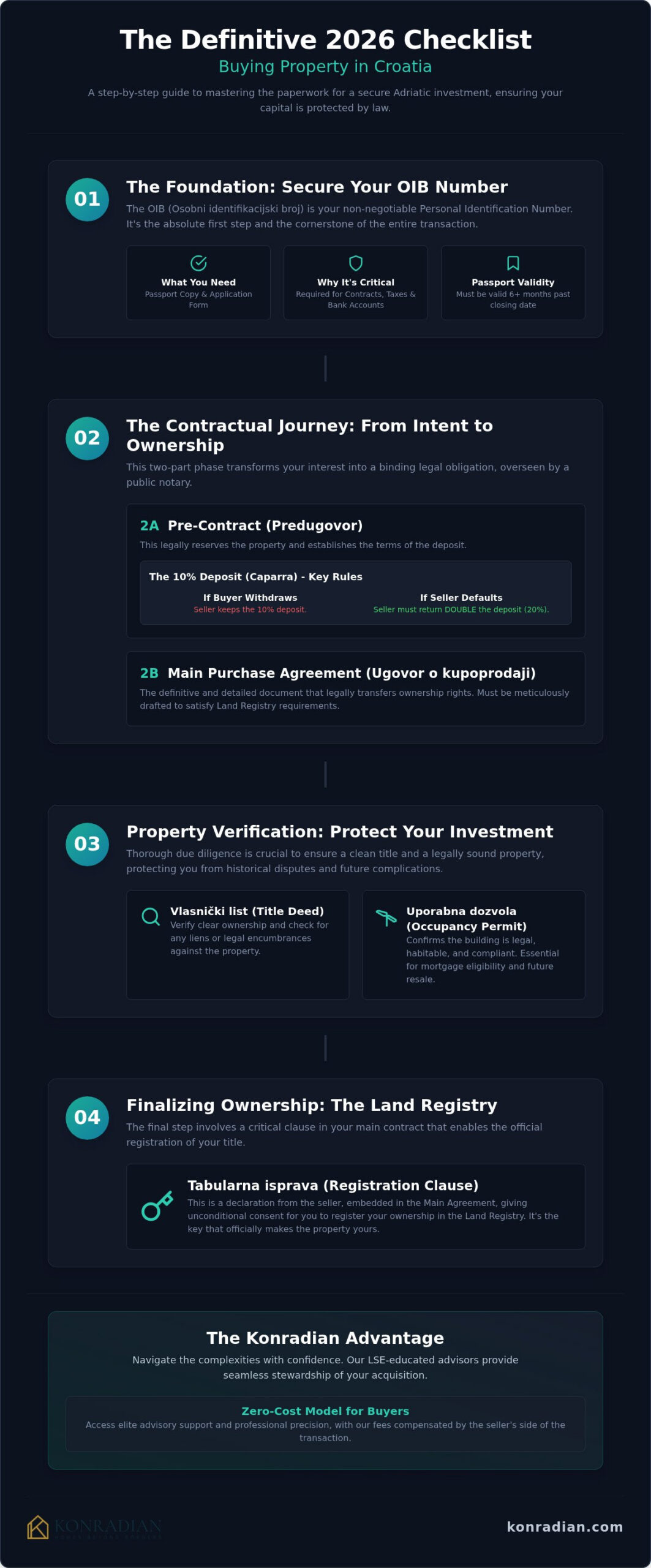
- Secure your OIB (Personal Identification Number) as your first priority, as it serves as the non-negotiable foundation for every legal and financial step in the transaction.
- Distinguish between the Pre-Contract, which legally reserves the property, and the Main Purchase Agreement that serves as the definitive transfer of ownership rights.
- Prioritize due diligence by verifying the Vlasnički list and ensuring an occupancy permit is present to protect your investment and future mortgage eligibility.
- Master the specific paperwork needed to buy a house in Croatia, including the Tabularna isprava, to successfully register your title in the Land Registry.
- Utilize a zero-cost model for buyers to access elite advisory support, ensuring your acquisition is managed with professional precision and quiet confidence.
The Foundation: Essential Personal Identification Documents
Every secure real estate acquisition in the Adriatic begins with a single eleven-digit number. The OIB, or Osobni identifikacijski broj, is the absolute cornerstone of the transaction process. Without this personal identification number, you cannot sign a binding contract, settle taxes, or register your title. It’s the most vital piece of paperwork needed to buy a house in Croatia. While a standard tourist passport allows you to view villas and sign non-binding letters of intent, the OIB is required the moment a financial commitment is made. It’s your digital footprint within the Croatian system, ensuring that every euro moved is tracked and legally accounted for.
Obtaining Your OIB (Personal Identification Number)
The OIB serves as a universal tax and tracking number for foreign investors. The OIB is the primary link between a foreign buyer and the Croatian Tax Administration. To obtain one, you’ll need a clear copy of your passport and a completed application form submitted to the local Tax Office (Porezna uprava). Konradian acts as your dedicated concierge in this regard. Our LSE-educated advisors handle the heavy lifting, securing your OIB remotely before you even land in Split or Zadar. This proactive approach eliminates administrative delays and allows for a seamless transition into the contractual phase. This number is also essential for opening a local bank account. A domestic account provides the transaction transparency required by modern anti-money laundering regulations, aligning your investment with Croatia’s economic outlook as a stable and sophisticated market for international capital.
Valid Identification for International Buyers
Your passport is your primary identification, but its requirements are specific and non-negotiable. EU citizens enjoy a streamlined path due to shared European regulations, while non-EU “Third Country” citizens may face additional reciprocity checks depending on their home nation. Regardless of your origin, your passport must remain valid for at least six months beyond your planned closing date. If your identification or supporting documents aren’t in English or Croatian, certified translations by a court-appointed translator are mandatory. We ensure every document meets the strict standards of the Croatian Notary. This attention to detail protects your interests, ensuring that the paperwork needed to buy a house in Croatia is flawless from day one. Our zero-cost model for buyers means you receive this elite level of legal and financial support without any additional fees, as our expertise is compensated by the seller’s side of the transaction.
Phase One: The Contractual Paperwork (Pre-Contract to Final Deed)
Once your OIB is secured, the acquisition moves into the contractual phase. This stage transforms your intent into a binding legal obligation. In Croatia, the process is bifurcated into two distinct documents: the Pre-Contract and the Main Purchase Agreement. Both require the oversight of a Croatian Javni bilježnik, or public notary. It’s essential to understand that the notary validates the identity of the parties and the authenticity of their signatures; they don’t typically vet the commercial fairness of the deal. This is why professional stewardship from our LSE-educated advisors is your primary safeguard against unfavorable terms.
The Pre-Contract (Predugovor) and Deposit
The Pre-Contract serves as the legal reservation of the property. It’s the first major piece of paperwork needed to buy a house in Croatia. Typically, this involves a 10% standard deposit, often referred to as the “Caparra”. This deposit isn’t merely a gesture of good faith; it carries heavy legal weight. If you, as the buyer, withdraw without a legal cause defined in the contract, the seller is entitled to keep the entire sum. Conversely, if the seller defaults, they’re legally obligated to return double the amount to you. We provide legal support buying property abroad to ensure these clauses are drafted with precision, protecting your capital from unforeseen vendor defaults.
The Main Purchase Agreement
The Main Purchase Agreement (Ugovor o kupoprodaji) is the definitive transfer of rights. This document must be incredibly detailed to satisfy the Land Registry’s requirements. It must include a precise description of the property as recorded in the land books, the final purchase price, and clear payment deadlines. A critical inclusion is the “Tabularna isprava” or Tabular Statement. This is a specific clause where the seller confirms they’ve been paid in full and unconditionally allows the buyer to register the ownership. Many high-end Istria real estate for sale opportunities already utilize vetted templates, but our team reviews every line to ensure no hidden encumbrances remain. We handle the heavy lifting of these negotiations, ensuring your peace of mind is never compromised by vague legal phrasing. If you’re seeking a seamless experience, our team can help you secure your Croatian investment with absolute confidence.
Phase Two: Property Verification and Due Diligence Documents
While the contractual phase establishes your legal intent, the verification phase confirms the property’s actual status. In the Croatian market, physical possession doesn’t always equal legal ownership. You must look beyond the aesthetics of a coastal villa to examine its legal DNA. This stage requires a meticulous review of the Vlasnički list and technical permits to ensure your capital remains protected. These documents form the most critical part of the paperwork needed to buy a house in Croatia, as they reveal any hidden liabilities that could compromise your title or future resale value.
Decoding the Land Registry Certificate (Vlasnički list)
The Vlasnički list, or Land Registry Certificate, is the only proof of ownership that matters in a Croatian court. It’s divided into three essential segments that require expert interpretation. Part A (Description) details the property’s physical dimensions and purpose. Part B (Ownership) confirms the current registered owner and their specific share. Part C (Encumbrances) is where you’ll find active mortgages, lifetime rights of use, or legal disputes. The “C” section must be entirely “clean” of any encumbrances or third-party claims before the final payment is triggered. A common issue we encounter is a mismatch between the land registry and the cadastre records; our team prioritizes the alignment of these two systems to guarantee a bulletproof title.
The Usage Permit and Building Legality
Technical compliance is no longer a secondary concern in 2026. The Uporabna dozvola, or Usage Permit, verifies that the property was built according to its building permit and is legally fit for its intended use. If you’re planning to finance your purchase, be aware that most banks will immediately reject a mortgage application if this permit is missing. For those investing in historic stone houses or older coastal villas, a “Legalisation Certificate” acts as the necessary substitute. Konradian prioritizes properties with pre-vetted usage permits to protect your investment from future administrative fines. This is particularly vital for investors interested in the rental market, as new 2026 regulations require a valid occupancy permit and compliance with updated EU energy standards to maintain a short-term rental license.
Your due diligence must also account for the Energetski certifikat, which rates the building’s energy efficiency. Beyond the technicalities, we conduct deep historical title checks to ensure no “hidden” heirs from the 1990s era can emerge to challenge your ownership. This level of rigor is part of our commitment to professional stewardship. We handle the heavy lifting of these investigations, providing you with a clear, chronological verification process that ensures the paperwork needed to buy a house in Croatia is handled with quiet confidence and intellectual rigor.
Phase Three: Financial Compliance and Ownership Transfer
The final phase of your acquisition is where financial obligations crystallize into legal ownership. While previous stages focused on intent and verification, this stage centers on the definitive exchange of value for title. Managing the paperwork needed to buy a house in Croatia at this juncture requires absolute precision, particularly regarding tax liabilities and the unique Croatian requirement of the Tabular Statement. Errors here can lead to significant delays in the Land Registry or unexpected tax reassessments. Our process ensures that every financial milestone is documented to satisfy both the Tax Administration and the municipal courts.
The Tabular Statement (Tabularna isprava)
The Tabular Statement is perhaps the most misunderstood yet vital document in the Croatian buying process. It represents the seller’s unconditional consent for you to register your ownership in the Land Registry. Without this specific notarized document, the court won’t recognize the transfer, regardless of how much capital you’ve transferred. A common pitfall for unguided investors is releasing the full purchase price before securing a notarized Tabularna isprava. To mitigate this risk, we typically ensure this document is held in escrow or signed in the presence of a notary only when final payment is confirmed. Our team handles the coordination of these high-stakes moments, ensuring your capital is never exposed. If you’re ready for a secure transaction, partner with Konradian to manage your acquisition with professional stewardship.
Tax Declarations and RETT
In Croatia, the Real Estate Transfer Tax (RETT) is set at 3% of the property’s market value for resale assets. It’s a straightforward rule, but the filing process is time-sensitive. The public notary is legally required to report the sale to the Tax Administration within 30 days of the contract signing. You don’t need to file a separate declaration, but you must be prepared for the Tax Administration’s valuation process. They reserve the right to determine the “Market Value” independently of your “Contract Price” if they believe the price on the paperwork needed to buy a house in Croatia is below current market standards.
Once the assessment is complete, you’ll receive a tax bill that must be settled within 15 days to avoid interest charges. For international investors, we provide clear guidance on how to execute these payments from abroad, ensuring you remain in full compliance with local fiscal laws. Finally, your legal representative will submit the “Proposal for Registration” (Prijedlog za uknjižbu) to the municipal court. This submission, accompanied by the proof of payment (Potvrda o uplati) and the Tabular Statement, is the final hurdle before you’re officially recorded as the owner in the Land Registry.
The Konradian Advantage: Seamless Stewardship of Your Acquisition
Managing the paperwork needed to buy a house in Croatia doesn’t have to be a source of anxiety. At Konradian, we transform this complex process into a seamless, end-to-end experience through professional stewardship. Our LSE-educated advisors act as your dedicated concierge, handling the heavy lifting of the bureaucracy while you focus on the potential of your investment. Because we operate on a seller-paid model, you receive elite legal and financial support at zero cost to you. This ensures your acquisition is protected by premium oversight without adding to your transaction budget.
Remote Purchases and Power of Attorney
Modern investors often prefer to manage their portfolios from a distance. We facilitate this through a “Special Power of Attorney” (PoA) specifically drafted for property acquisition. This document allows us to represent you at the local Notary and Tax Administration without requiring your physical presence in Split or Dubrovnik for every signature. You’ll need to sign the PoA in your home country and have it apostilled; a process that confirms the document’s international validity. Once received, we manage all local appointments, ensuring the paperwork needed to buy a house in Croatia is executed with precision. We also leverage direct access to top-tier developers, whose pre-sale documentation is often more standardized and rigorously pre-vetted than private resale listings.
Why a Strategic Advisor Beats a Local Agent
A typical local agent focuses on the transaction; we focus on your long-term wealth strategy. Our advisors bring an international mindset that bridges the gap between local Croatian nuances and global investment standards. Whether you’re familiar with US real estate investment from Europe or UK sourcing protocols, we speak your language. We provide a level of intellectual rigor that goes beyond simply showing properties. We verify titles, negotiate clauses, and ensure financial compliance with a level of detail that only a dedicated concierge can provide. This proactive approach ensures that every document, from the initial OIB to the final Tabular Statement, is handled with quiet confidence. To begin your secure acquisition, book a free video consultation with Konradian to start your Croatian journey and experience the peace of mind that comes from professional stewardship.
Securing Your Future on the Adriatic Coast
Mastering the paperwork needed to buy a house in Croatia transforms an intimidating bureaucratic journey into a controlled, strategic acquisition. Success lies in the details, from the foundational OIB to the critical Tabular Statement that crowns your ownership. By verifying usage permits and aligning land registry records early, you protect your capital from historical disputes and ensure your property remains a liquid, high-value asset. You don’t have to manage these complexities alone. Our strategic LSE-educated advisory team provides a sophisticated, end-to-end service at no cost to the buyer. We offer exclusive access to pre-sale developer listings and handle every legal nuance with the precision of a dedicated concierge.
This professional stewardship allows you to invest with quiet confidence, knowing every document is vetted and every deadline is met. Whether you are seeking a coastal villa or a historic stone home, the right preparation ensures a seamless transition to ownership. Your Mediterranean dream is entirely within reach when backed by elite expertise and a protective partner. We invite you to take the first step toward a secure and effortless purchase.
Secure your Croatian investment with a free expert consultation
Frequently Asked Questions
Do I need a lawyer to buy a house in Croatia in 2026?
While Croatian law doesn’t strictly mandate that a buyer hires an independent lawyer, engaging professional support is the only way to ensure your capital is protected. Konradian provides comprehensive legal and financial transaction support as part of our end-to-end service. Our LSE-educated team manages the heavy lifting of due diligence, ensuring every contract clause favors your long-term interests. This elite level of stewardship is available at no cost to the buyer in the Croatian market.
How long does the paperwork process take from offer to title deed?
The timeline for gathering the paperwork needed to buy a house in Croatia typically spans two to six months. EU citizens move faster. Non-EU buyers often face longer waits due to Ministry of Justice reciprocity checks. Once the Main Purchase Agreement is notarized, the Land Registry usually processes the title transfer within several weeks. We prioritize efficiency by preparing all personal and property documents in advance to minimize administrative delays.
What is an OIB and why is it required for foreign buyers?
An OIB (Osobni identifikacijski broj) is a unique eleven-digit personal identification number assigned by the Croatian Tax Administration. It acts as a universal tracking number for all legal and financial activities within the country. Foreign buyers must obtain an OIB to sign contracts, open bank accounts, or pay utility bills. Our team handles the remote acquisition of your OIB. This allows you to establish your legal presence in Croatia before your arrival.
Can I buy property in Croatia remotely without being physically present?
You can acquire property in Croatia without being physically present by utilizing a Special Power of Attorney. This document must be signed and apostilled in your home country to grant our advisors the authority to represent you at notary appointments and government offices. We manage the entire digital and physical submission process, ensuring your acquisition proceeds smoothly while you remain abroad. This remote model is a standard feature of our sophisticated concierge service.
What is a Tabular Statement (Tabularna isprava)?
The Tabular Statement, or Tabularna isprava, is a specific notarized document where the seller confirms they’ve received the full purchase price. It serves as their unconditional consent for the buyer to register the property title in the Land Registry. Without this document, the court will not recognize you as the legal owner. We ensure this vital piece of paperwork is secured and held safely until final transaction milestones are successfully met.
Are there different paperwork requirements for EU vs. non-EU citizens?
EU citizens enjoy the same purchasing rights as Croatian nationals, requiring only standard identification and an OIB. Non-EU citizens must generally obtain consent from the Ministry of Justice. This process is based on reciprocity between Croatia and their home nation. With Croatia’s anticipated 2026 OECD entry, many international buyers will soon benefit from streamlined conditions. We provide tailored advice to navigate these specific regulatory paths based on your unique citizenship and investment goals.
What are the hidden costs of the paperwork and notary process?
Beyond the purchase price, buyers should budget between 5% and 8% for total transaction costs on resale properties. This includes the 3% Real Estate Transfer Tax and notary certification fees of approximately €40. While Konradian’s advisory services are seller-paid and free for the buyer, administrative taxes and state fees are mandatory. We provide a transparent breakdown of the paperwork needed to buy a house in Croatia to prevent financial surprises.
How do I verify if a Croatian property has a clean title?
Verifying a clean title requires a meticulous examination of the Vlasnički list, or Land Registry Certificate. You must confirm that the seller is the sole registered owner in Part B and that Part C is free of mortgages or active lawsuits. Our due diligence involves cross-referencing these records with the cadastre to ensure physical and legal boundaries align perfectly. This strategic oversight provides the security necessary for a high-stakes international investment.
