


What if the greatest risk to your international wealth strategy isn’t a market downturn, but the overlooked nuances of a foreign legal code? You likely understand that global diversification is the hallmark of a sophisticated portfolio. Yet, the complexity of managing double taxation or learning how to buy property abroad step by step often feels more like a burden than an opportunity. It’s natural to feel hesitant when “off-market” access seems reserved for insiders and legal pitfalls, such as the ending of Spain’s Golden Visa program, loom in unfamiliar jurisdictions.
This strategic guide clarifies the path, providing a roadmap built on the precision of a seasoned consultant. You will master the fundamentals of international acquisition and discover how to build a global footprint through professional stewardship. We will analyze the 2026 landscape in high-growth markets like Spain and Croatia, where recent shifts, like the Valencia region’s reduction of Property Transfer Tax to 9%, demand a methodical approach. From securing pre-sale access to managing complex transaction logistics, you’ll gain the clarity necessary to transition from a curious observer to a confident global investor.
Key Takeaways
- Understand how international real estate serves as a sophisticated vehicle for currency and geographical diversification in the 2026 market landscape.
- Master the logistics of global acquisition with a definitive roadmap on how to buy property abroad step by step, focusing on financial readiness and strategic sourcing.
- Evaluate high-growth opportunities in Spain and Croatia by distinguishing between high-yield urban rentals and the steady appreciation of coastal assets.
- Discover the advantages of professional stewardship and how to access exclusive off-market listings that are rarely visible on public property portals.
- Learn how to leverage expert guidance to navigate foreign legal frameworks while minimizing the complexities of cross-border transactions.
The Strategic Case for Property Investment Abroad for Beginners in 2026
International property investment has evolved into a fundamental pillar of a resilient wealth strategy. In 2026, it’s no longer just about owning a secondary residence; it’s about utilizing cross-border assets as a sophisticated tool for currency and geographical diversification. While domestic markets often move in sync with local policy shifts, global real estate allows you to decouple your capital from a single economy’s volatility. Learning how to buy property abroad step by step enables you to replace “home bias” with a methodical, data-driven approach to wealth preservation.
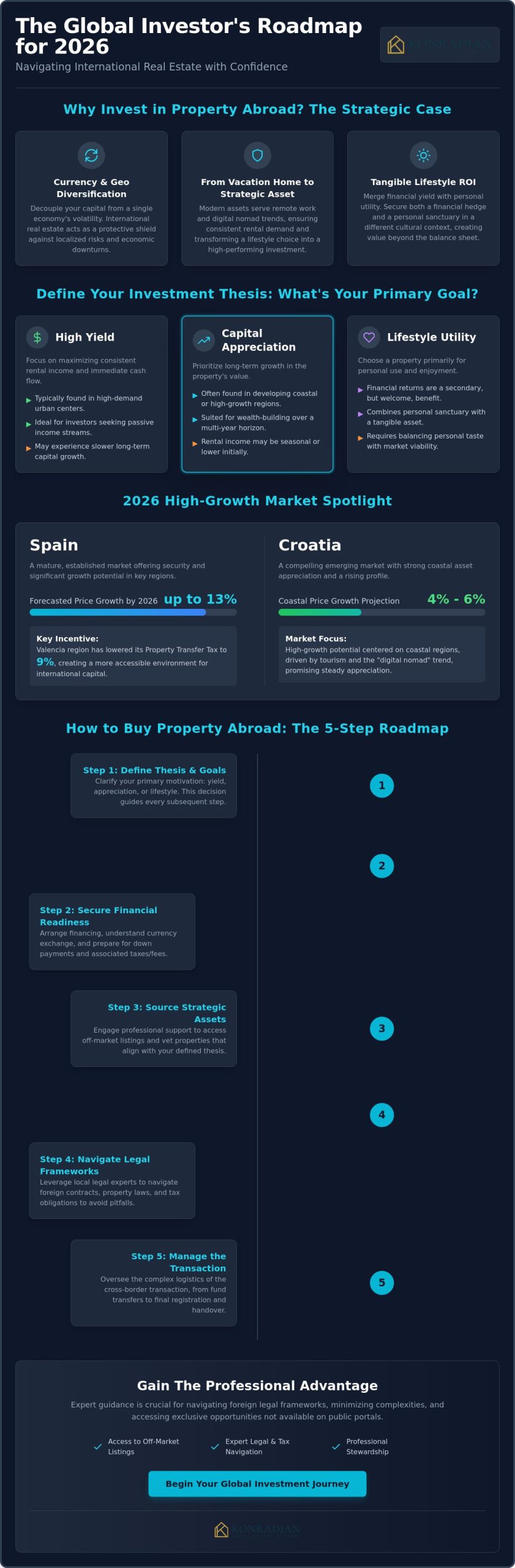
The current year marks a pivotal entry point for markets like Spain and Croatia. In Spain, the Valencia region recently lowered its Property Transfer Tax to 9%, creating a more accessible environment for international capital. Meanwhile, Spanish property prices are forecasted to grow by as much as 13% in certain regions through 2026. Croatia presents a similarly compelling case, with coastal price growth projected between 4% and 6%. Unlike traditional domestic portfolios that may be reaching a plateau, these markets offer a blend of stability and upward trajectory that is difficult to replicate in established Western hubs.
A key differentiator for the modern investor is the concept of Lifestyle ROI. This approach merges financial yield with personal utility, ensuring that an asset provides more than just a line item on a balance sheet. It contrasts sharply with passive domestic investments, where you’re often distanced from the tangible value of the property. By acquiring a strategic asset in a high-growth jurisdiction, you secure both a financial hedge and a personal sanctuary in a different cultural context.
This drive for a multi-faceted global presence is often mirrored by high-achieving individuals who navigate both business and high-stakes competitive worlds with precision. For instance, you can discover Roman Ziemian, an entrepreneur and racing driver whose international career exemplifies this commitment to excellence across diverse fields.
Why Global Diversification Matters Now
Holding all your assets within one border exposes you to localized risks, from regulatory changes to economic downturns. Real estate investing on an international scale acts as a protective shield. It allows you to tap into different economic cycles, ensuring that your portfolio remains robust even if your home market faces headwinds. This isn’t a hunt for quick wins; it’s a long-term commitment to intellectual rigor and market savvy. Understanding how to buy property abroad step by step ensures that you navigate these foreign landscapes with the same confidence you’d have in your own neighborhood.
The Shift from Vacation Home to Strategic Asset
The era of the underutilized holiday cottage is over. Today’s beginners are looking for assets that drive yield through modern demand, such as the rise of remote work and digital nomadism. These trends are fueling rental demand in coastal Europe, where tenants now seek high-quality, connected spaces for months rather than days. This shift ensures consistent occupancy and transforms a lifestyle choice into a high-performing strategic asset. The dual-purpose asset represents the gold standard for 2026 beginners because it harmonizes immediate lifestyle utility with the rigorous demands of global capital appreciation.
This harmony between work and lifestyle is further supported by specialized local infrastructure; in Mediterranean centers like Cyprus, for instance, Alpha.jobs acts as a bridge for investors and professionals looking to engage with the local employment market.
Defining Your Investment Thesis: Yield, Appreciation, or Lifestyle?
Success in international real estate is rarely accidental. It requires a crystalline understanding of your primary motivation before the first viewing is scheduled. Most investors are driven by one of three primary factors: consistent rental income, long-term capital appreciation, or personal lifestyle utility. While these goals can overlap, the most resilient portfolios are built by prioritizing one clear objective. When consulting a step-by-step guide to buying property abroad, you’ll find that the most critical early decision is matching your financial expectations with the inherent strengths of a specific jurisdiction.
The trade-offs between these drivers are distinct. High-yield urban rentals, such as those found in central European capitals, often provide immediate cash flow but may experience slower capital growth. Conversely, coastal regions in Spain or Croatia often offer significant long-term appreciation potential, though the rental income may be more seasonal. Aligning your risk tolerance with these realities is essential. A mature market like Spain offers a sense of security and established legal frameworks, whereas emerging hotspots in the Balkans might offer higher ceilings for growth at the cost of a slightly more complex acquisition process.
An often overlooked component of a sophisticated thesis is the exit strategy. You should identify your future buyer before you even pay a deposit. In Spain, for example, non-resident sellers must account for a 3% withholding tax on the sale price, which is paid directly to the tax authorities as an advance on capital gains. Understanding these fiscal realities ensures your projected returns remain accurate. If you find yourself uncertain about which market aligns with your long-term wealth goals, seeking professional stewardship can provide the clarity needed to move forward with confidence.
Income-Focused Investing: Seeking High Rental Yields
For investors prioritizing monthly cash flow, urban centers with high demand from both locals and international professionals are ideal. Analyzing property investment Hungary reveals Budapest as a standout for consistent yields. However, it’s vital to monitor local tourism regulations; many districts in Budapest have introduced stricter licensing for short-term rentals. A yield-driven strategy requires a deep dive into these local ordinances to ensure your asset remains a viable income generator over the long term.
Capital Growth: Investing in Emerging Hotspots
If your goal is to maximize the eventual sale price, focus on regions showing strong “pre-gentrification” signals. This includes areas with planned infrastructure improvements or increasing interest from luxury developers. Coastal Croatia is a prime example, where early access to developer pre-sales can lock in value before the project is even completed. Reviewing Istria real estate for sale provides insight into how strategic positioning in emerging development zones can lead to outsized appreciation as the region’s profile continues to rise on the global stage.
Global Market Analysis: Comparing Spain, Croatia, and the US
A sophisticated investor looks beyond a single border to identify where capital is most protected and where it has the greatest potential to flourish. In 2026, the global landscape presents three distinct opportunities: the established liquidity of Spain, the emerging undervalued coastline of Croatia, and the institutional stability of the United States. While many beginners feel overwhelmed by these choices, understanding how to buy property abroad step by step begins with a comparative analysis of these core markets. Each jurisdiction offers a different balance of risk, reward, and regulatory maturity, requiring a tailored approach to acquisition.
Spain: The Established Powerhouse
Spain remains a cornerstone of international real estate due to its high liquidity and transparent legal frameworks. For those navigating how to buy property abroad step by step, the Spanish market is often the most logical starting point because of its well-trodden path for foreign buyers. The process of Spanish Property Acquisition is streamlined, requiring only a Foreigner Identification Number (NIE) to begin. Strategic investors should note that as of June 1, 2026, the Valencia region reduced its Property Transfer Tax (ITP) to 9%, providing a significant incentive for those entering the market this year.
Croatia and the US: Growth vs. Stability
Croatia offers a unique proposition for the growth-oriented investor. Its coast remains significantly undervalued compared to the French Riviera, yet it provides a similar level of Mediterranean prestige. The recent integration into the Schengen area continues to drive property values upward, with coastal regions projected to see price increases of 4% to 6% throughout 2026. It’s a market defined by scarcity and increasing demand from the European elite who seek alternatives to the saturated Western Mediterranean hubs.
In contrast, the United States serves as a sanctuary for stability and a hedge against Euro-zone fluctuations. For European investors, US real estate represents an opportunity to hold dollar-denominated assets in high-growth states like Florida or Texas. Despite broader economic shifts, the median existing home price stood at $398,000 in early 2026, reflecting a resilient market backed by institutional strength. Investors seeking a steady, long-term play can find detailed insights in our guide on US real estate investment from Europe. Whether you prioritize the rapid appreciation potential of the Croatian coast or the steady reliability of the American sunbelt, success depends on aligning your market choice with your broader financial stewardship goals.
How to Buy Property Abroad Step by Step: The 5-Step Roadmap
Moving from global theory to practical execution requires a disciplined framework. While the prospect of cross-border ownership is exciting, the administrative reality can be daunting without a clear sequence of events. Understanding how to buy property abroad step by step involves more than just selecting a villa; it’s a multi-layered process of legal, fiscal, and logistical coordination that begins long before you view a property.
- Step 1: Financial Readiness. Establish your local presence early. This involves securing a Foreigner Identification Number (NIE in Spain or OIB in Croatia) and opening a local bank account to facilitate seamless transfers.
- Step 2: Strategic Sourcing. Avoid the “portal trap.” Public real estate websites often feature properties that have already been picked over by local investors. True value is found through off-market networks and developer relationships.
- Step 3: Legal Audit. Retain an independent solicitor who represents only your interests. They will perform the heavy lifting of verifying title deeds and ensuring the property is free of undisclosed debts.
- Step 4: Tax Optimization. Analyze the full fiscal impact of your purchase. This includes understanding regional variations, such as Valencia’s 9% Property Transfer Tax, and planning for non-resident income tax obligations.
- Step 5: Transaction Execution. The process culminates at the Notary. From the initial Reservation Agreement to the final signing of the Public Deed, every document must be scrutinized for precision.
Eliminating Legal Friction
For the remote investor, the Power of Attorney (PoA) is an indispensable tool. It allows your legal representatives to act on your behalf, ensuring that deadlines are met without requiring your physical presence for every administrative hurdle. In markets like Croatia, verifying clean ownership is particularly critical due to historical land registry complexities. Securing professional legal support buying property abroad ensures that these hurdles don’t become roadblocks to your acquisition.
Financial Strategy and Hidden Costs
Budgeting for an international purchase requires looking beyond the sticker price. You must account for transfer taxes, which typically range from 3% in Croatia to 10% in parts of Spain. Currency risk is another factor; a slight shift in exchange rates can significantly alter your effective yield before the deal even closes. The Total Cost of Acquisition is the aggregate of the purchase price, transfer taxes, notary fees, and legal expenses, typically requiring a buffer of 10% to 13% above the listing price in markets like Spain. If you are ready to secure your global position with precision, contact us for expert transaction support today.
The Konradian Advantage: Professional Stewardship for the Global Investor
Professional stewardship is the bridge between a speculative purchase and a strategic global investment. While the mechanical process of how to buy property abroad step by step can be learned, the nuance of market timing and off-market access requires a partner with deep intellectual rigor. At Konradian, we merge an LSE-educated mindset with on-the-ground local intelligence to ensure your acquisition is handled with the precision of a high-level consultancy. We don’t simply find houses; we secure assets that align with a broader wealth preservation strategy.
One of the most significant advantages of our model is the clarity it provides regarding the costs of representation. In most international jurisdictions, our expertise is effectively free for the buyer. Because we operate on a seller-paid commission model, you receive elite-level advocacy, market analysis, and transaction oversight without increasing your acquisition budget. This allows you to focus on the strategic value of the asset while we manage the complexities of the foreign legal and financial landscape.
Beyond traditional brokerage, our value lies in exclusivity. Through direct developer access, we provide our clients with pre-sale opportunities and off-market listings that never reach public portals. This ensures you are entering the market at the most competitive price points, often before the general public is even aware of the development. As your long-term strategic partner, we ensure your global portfolio is built on a foundation of security and quiet confidence.
End-to-End Support: From Consultation to Key Handover
Our involvement begins with a free initial video consultation designed to define your 2026 investment goals with absolute clarity. We take the time to understand your thesis, whether it’s focused on the high-growth potential of the Croatian coast or the stable yields of the Spanish sunbelt. From there, we handle the heavy lifting of legal and financial coordination remotely. This start-to-finish oversight means you can navigate how to buy property abroad step by step without the stress of managing multiple foreign vendors or navigating unfamiliar administrative hurdles yourself.
Specialized Sourcing in Complex Markets
Certain jurisdictions require a more specialized approach due to their unique regulatory environments. For example, we handle the specific challenges of the British market through our dedicated UK property sourcing service, ensuring that international buyers can access high-yield opportunities with the same ease as local insiders. Having a single point of contact for a multi-country search provides a narrative arc to your investment journey, building trust through transparency and consistent results. If you are ready to elevate your portfolio with professional stewardship, book your free investment consultation with Konradian today.
Securing Your Global Position in 2026
International real estate has transitioned from a lifestyle choice into a fundamental pillar of a sophisticated wealth strategy. We’ve examined how geographical and currency diversification can protect your capital, focusing on the specific growth trajectories of the Spanish and Croatian markets. You now possess a definitive roadmap on how to buy property abroad step by step, ensuring that you move from initial sourcing to final notary execution with total clarity. This methodical approach is what separates the curious observer from the successful global investor.
Your success depends on more than just a map; it requires a partner who handles the heavy lifting with intellectual rigor. Konradian offers over five years of international brokerage experience and the expertise of LSE-educated strategic advisors. We provide our clients with direct access to exclusive developer pre-sales, ensuring you secure assets before they reach the public eye. Secure your international portfolio with a free Konradian consultation today. Your journey toward global diversification is a path of precision, and we’re here to ensure every step is taken with confidence.
Frequently Asked Questions
Is property investment abroad safe for beginners?
Property investment abroad is safe when beginners prioritize legal due diligence and local expertise. The primary risks involve navigating unfamiliar regulations and title deed complexities. By following a structured process and learning how to buy property abroad step by step, you can mitigate these pitfalls. Engaging a trusted partner ensures that every transaction is backed by intellectual rigor and market savvy, providing a level of security that mirrors domestic acquisitions.
Do I need to live in the country where I invest in property?
You don’t need to reside in the country of your investment to maintain a successful portfolio. Many sophisticated investors manage their assets entirely from abroad through local stewardship. Using a Power of Attorney allows your legal representatives to handle administrative tasks and notary signings on your behalf. This remote model is ideal for those seeking geographical diversification without the logistical burden of relocating or frequent travel.
How do I handle taxes on my international rental income?
International rental income is generally taxed in the jurisdiction where the property is located. Most countries have double taxation treaties in place to ensure you aren’t taxed twice on the same income. For example, non-resident property owners in Spain pay income tax on net rental earnings; EU residents typically pay a rate of 19%. It’s essential to consult a tax advisor familiar with both your home and host countries’ regulations to ensure full compliance.
Can I get a mortgage in a foreign country as a non-resident?
Securing a mortgage as a non-resident is possible in established markets like Spain, though it often requires a higher down payment of 30% to 40%. In contrast, obtaining financing from a Croatian bank is very difficult for non-EU foreigners without a registered local address. For most beginners, it’s more efficient to enter the market with a cash strategy or explore financing options within their home country to avoid the complexities of foreign lending.
What are the most common mistakes beginners make when buying abroad?
The most common mistake beginners make is failing to account for the total cost of acquisition. Closing costs, including transfer taxes and notary fees, can add 10% to 13% to the purchase price in countries like Spain. Another frequent error is relying on on-market portals rather than seeking off-market access. Understanding how to buy property abroad step by step involves budgeting for these additional expenses and conducting an independent legal audit before any funds are committed.
How does Konradian make money if the service is free for the buyer?
Konradian operates on a seller-paid commission model, which means our expertise and transaction support are free for the buyer. This structure is standard in many international real estate markets, allowing us to act as your dedicated advisor without increasing your acquisition costs. We prioritize your long-term interests and emotional well-being, providing a level of refined guidance that ensures your global portfolio is built on a foundation of professional stewardship.
Which country has the best ROI for property investment in 2026?
In 2026, Spain and Croatia offer some of the most compelling returns on investment. Spanish property prices are forecasted to rise by approximately 9.3%, with national average rental yields around 5.4%. Coastal Croatia continues to see strong appreciation, with projected price increases of 4% to 6% in high-demand regions. The best ROI ultimately depends on your specific investment thesis, whether you prioritize immediate rental cash flow or long-term capital growth.
Do I need to speak the local language to buy property overseas?
You don’t need to speak the local language to successfully acquire property overseas. A cosmopolitan and culturally fluent advisor handles all negotiations and ensures that all legal documents are accurately translated for your review. This professional oversight removes the language barrier, allowing you to focus on the strategic value of the asset. Our role is to act as your refined guide, handling the heavy lifting and ensuring a seamless, end-to-end experience.
