


Did you know that residential property prices in Hungary have surged by 230% since 2010, leading the entire European Union in growth? While these figures highlight a compelling opportunity for diversification, the path to property investment for US citizens in Europe often feels obscured by shifting regulations and intricate foreign legal systems. You likely recognize that a well-curated European asset provides a vital hedge against domestic volatility, yet the prospect of managing currency fluctuations and unfamiliar tax treaties can feel overwhelming. It’s natural to seek the security of a stable market while worrying about the “heavy lifting” involved in navigating the end of Spain’s Golden Visa or the specific reciprocity requirements in Croatia.
This guide provides the strategic clarity you need to move from interest to acquisition with quiet confidence. You’ll discover how to secure high-yield, cash-flowing assets in resilient markets while ensuring your portfolio remains compliant with both local mandates and US tax obligations. We’ll examine the 2026 landscape for Spanish, Croatian, and Hungarian markets; detail the importance of professional stewardship; and explain how to access exclusive listings that never reach the public eye. By the end, you’ll have a sophisticated roadmap for building an international presence that prioritizes long-term financial health and personal peace of mind.
Key Takeaways
- Identify the strategic advantages of moving capital into European hard assets to achieve portfolio diversification and hedge against domestic volatility.
- Navigate the essential distinction between residency permits and fee simple ownership to ensure your property investment for US citizens in Europe remains a secure, long-term asset.
- Evaluate high-performing markets including Spain’s tourism-driven rental sector and the significant capital appreciation potential found along Croatia’s Adriatic coast.
- Understand the critical steps of the acquisition process, from initial due diligence to the final title transfer, managed through professional legal and financial stewardship.
- Leverage an expert-led brokerage model that provides access to exclusive, non-public property listings while removing the financial burden of buyer-side commissions.
The Landscape of European Property Investment for US Citizens in 2026
The 2026 market presents a unique window for the American investor. As domestic markets face fluctuating interest rates and compressed yields, the European continent offers a compelling alternative for capital preservation. Property investment for US citizens in Europe has evolved into a strategic necessity rather than a lifestyle luxury. It’s about moving beyond the limitations of a single-currency portfolio and securing tangible, high-quality assets in jurisdictions with centuries of proven resilience.
US investors are increasingly prioritizing hard assets that provide both immediate rental income and long-term capital appreciation. This shift is driven by a desire for stability that the volatile domestic stock market often fails to provide. By acquiring property in established and emerging European hubs, you aren’t just buying a building; you’re securing a position in a global economy. This strategic allocation ensures that your wealth remains protected against localized downturns while benefiting from the unique growth cycles of the Eurozone.
Market Momentum: Why Europe in 2026?
European markets currently demonstrate a remarkable level of composure compared to the rapid shifts seen in the US. Coastal Mediterranean regions and Central European hubs have become focal points for those seeking growth. While the US deals with inventory shortages and pricing corrections, markets like Hungary have seen residential prices grow by 230% since 2010, according to Eurostat data. This growth isn’t speculative; it’s supported by robust tourism and a growing digital economy that values “Old World” charm combined with modern infrastructure. The appeal of these assets lies in their scarcity and the enduring demand for premium locations in historic cities and scenic coastlines.
In addition to South American opportunities, those seeking a worldwide reach for premium assets can discover JBJ Global Real Estate, which offers a curated selection of luxury apartments and villas across high-demand global markets.
Diversification Beyond the US Dollar
Holding Euro-denominated assets serves as a sophisticated hedge against domestic inflation. When you diversify your holdings geographically, you reduce your exposure to any single country’s economic policy. Understanding the nuances of foreign ownership of assets is the first step toward this global posture. Within the context of international real estate, portfolio diversification is the strategic allocation of capital across different legal jurisdictions and currencies to mitigate risk and capture non-correlated growth opportunities.
Owning physical land in a stable European jurisdiction provides a psychological and financial security that paper assets cannot match. It’s a proactive approach to wealth management. By focusing on property investment for US citizens in Europe, you gain access to exclusive markets where the demand for premium, well-located real estate remains consistently high. This strategy ensures your wealth is not only preserved but positioned to thrive in an increasingly interconnected global landscape.
Navigating Legal Realities: Ownership, Residency, and Tax
The legal architecture of European real estate differs significantly from the American common law system. While the prospect of property investment for US citizens in Europe is lucrative, it requires a clear understanding of civil law structures and the specific mandates of each jurisdiction. Most European nations offer “fee simple” ownership, granting you full rights to the land and structures. However, the path to securing these rights involves distinct procedural hurdles that vary by country. Professional stewardship is essential to navigate these complexities with ease.
Ownership Rights for Americans
Americans can generally own land in Europe, but the requirements are not uniform. In Croatia, the “principle of reciprocity” applies. You must be from a US state that allows Croatian citizens to purchase property, and you’ll need formal approval from the Croatian Ministry of Justice. Spain offers a more direct path, though both countries utilize a Notary as a central figure. Unlike US notaries, a European Notary is a highly trained legal professional who validates the transaction’s legality and ensures all taxes are paid. This system provides a high level of security for foreign investors, provided you have professional representation to manage the documentation.
The Residency vs. Investment Intersection
It’s vital to distinguish between a financial asset and a residency permit. The landscape changed dramatically in 2025. Spain’s “Golden Visa” program was officially terminated on April 3, 2025, by Organic Law 1/2025. Direct property purchase no longer provides a shortcut to residency in Spain. Similarly, Hungary’s “Guest Investor” program now favors real estate funds over direct ownership. For most sophisticated investors, an “Investment First” strategy is the most prudent. Focus on the asset’s yield and stability first; residency can often be handled through separate digital nomad or long-stay visas that don’t tie your legal status to a single physical asset.
Taxation remains a critical component of any international strategy. US citizens are taxed on their worldwide income, meaning rental yields from a villa in Split or an apartment in Budapest must be reported to the IRS. You must also comply with FBAR and FATCA reporting if your foreign accounts exceed certain thresholds. While bilateral tax treaties generally prevent double taxation, there are exceptions. The US-Hungary tax treaty was terminated in 2024, increasing the risk for those invested there. For those seeking a secure transition, Konradian provides legal support buying property abroad to ensure every mandate is met with precision.
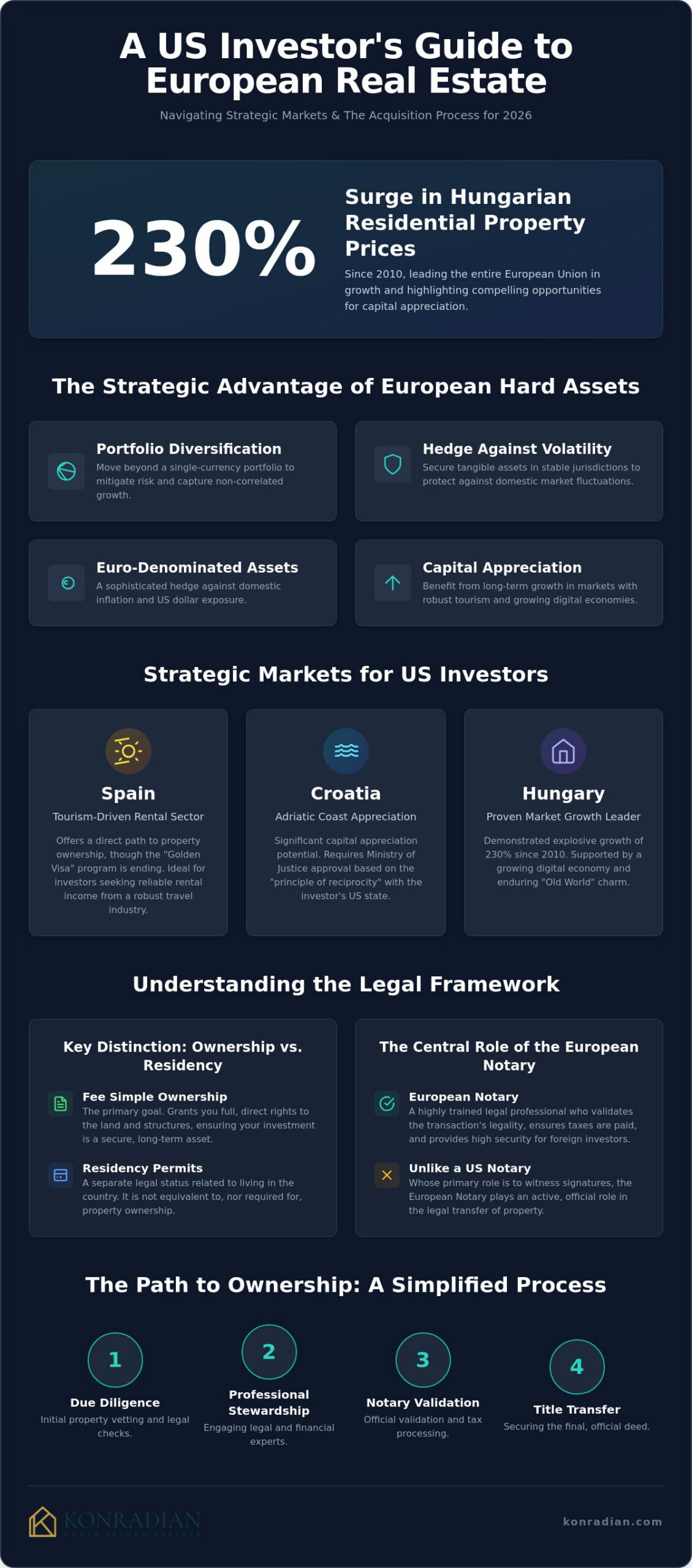
Strategic Markets for US Investors: Spain, Croatia, and Hungary
Selecting the right jurisdiction requires a balance of yield stability and capital growth potential. In 2026, the most successful property investment for US citizens in Europe often bypasses the over-saturated capital cities of Western Europe. Instead, capital is flowing toward the Mediterranean coast and the strategic urban centers of Central Europe. These markets offer a blend of lifestyle appeal and institutional-grade returns that are increasingly difficult to find in the domestic US market. Success here isn’t just about location; it’s about accessing the right tier of assets before they reach the public market.
Spain and Croatia: Coastal Wealth
Spain remains a perennial favorite for its tourism-driven rental yields. While the Golden Visa path was terminated in 2025, the underlying demand for premium coastal property remains robust. Strategic Spanish Property Acquisition involves looking beyond public listings to secure assets in high-demand regions where supply is strictly regulated. Buyers should budget for Property Transfer Tax (ITP) between 7% and 11.5%, depending on the region, alongside approximately 2% to 3% in closing costs. These exclusive opportunities are rarely found on public portals, requiring a partner with deep local roots to identify and secure.
Croatia offers a different trajectory, characterized by high capital appreciation and a simplified tax structure. The Adriatic coast, particularly Istria, has become a primary target for sophisticated capital. Istria real estate for sale represents a “hidden gem” opportunity where limited supply meets growing international interest. Unlike the public market, the highest yields are often found through direct relationships with developers. Accessing pre-sale opportunities allows investors to secure beachfront assets before they reach the general public, often with more favorable entry points than established Spanish hubs. With a property transfer tax of only 3%, the entry friction is notably lower than in neighboring Mediterranean markets.
Hungary: The Urban Growth Play
Budapest serves as a vital hub for international business and a growing population of digital nomads. The city offers a lower entry point compared to Western European capitals, yet it has led the EU in property price growth, with a staggering 230% increase since 2010 according to Eurostat. This urban growth play is ideal for those seeking long-term rental demand in a culturally rich environment. However, property investment Hungary requires careful navigation of the current tax landscape following the 2024 termination of the US-Hungary tax treaty. Despite this, the structural demand for quality urban housing continues to drive impressive results for those who prioritize professional stewardship over DIY acquisition.
Comparing these jurisdictions reveals a clear strategic choice. Spain offers the security of a mature tourism market. Croatia provides the potential of an emerging luxury destination. Hungary delivers the highest historical price growth on the continent. By focusing on developer-direct access, you can bypass the “retail” market entirely and secure institutional-grade assets that provide a resilient foundation for your international wealth portfolio.
The Acquisition Process: From US Dollars to European Title
Securing a foreign asset shouldn’t feel like a leap into the unknown. The transition from identifying a high-yield opportunity to holding the keys requires a methodical, step-by-step approach that prioritizes security and transparency. For those engaged in property investment for US citizens in Europe, the process typically begins with a high-level strategic consultation, followed by a curated search for assets that meet rigorous performance criteria. Once a property is identified, the focus shifts to the logistical precision of the transaction itself, ensuring every legal and financial detail is handled with professional stewardship.
Purchasing property from thousands of miles away is now a standard practice for sophisticated investors. Remote acquisition is made possible through a Power of Attorney (PoA), which allows your legal representative to sign documents and register titles on your behalf. While some jurisdictions are adopting digital signatures, the PoA remains the gold standard for secure, remote transactions. This allows you to maintain your domestic schedule while your European team handles the “heavy lifting” on the ground.
Due Diligence and Secure Transactions
The foundation of any successful acquisition is exhaustive due diligence. This involves verifying property titles in the local Land Registry, ensuring no hidden encumbrances exist, and confirming that all building permits are in order. US buyers often benefit from an independent legal review that translates complex civil law requirements into clear, actionable insights. An escrow account in a European transaction typically involves a neutral third party, such as a notary or specialized legal counsel, holding funds in a secure, dedicated account until all contractual conditions for the title transfer are met. To navigate these safeguards, investors often seek legal support buying property abroad to ensure every mandate is fulfilled with precision.
Financing and Capital Movement
Financing as a non-resident requires a realistic outlook. In markets like Spain, US citizens should expect to make a minimum down payment of 30% to 40% of the property’s value. While local mortgages are available, many investors prefer the speed and simplicity of a cash purchase, especially when targeting exclusive, pre-sale developer listings. Moving large sums across borders requires careful management to avoid excessive bank fees and compliance delays. Using specialized currency exchange services can save thousands compared to traditional bank rates. For those who also maintain domestic portfolios, understanding US real estate investment from Europe can provide a holistic view of how to balance capital across two continents. If you’re ready to secure your next international asset with confidence, explore our end-to-end brokerage services today.
Securing Your Investment with Konradian’s Strategic Advisory
Navigating the complexities of an international transaction requires more than just a local agent; it demands a partner who understands the global implications of your capital movement. Konradian provides a sophisticated bridge for property investment for US citizens in Europe, combining the intellectual rigor of an LSE-educated team with the practical experience of over five years in international brokerage. We act as your protective steward, ensuring that the distance between your home and your asset never compromises the quality of your acquisition. Our approach is rooted in a global mindset that prioritizes long-term wealth preservation and personal peace of mind.
In Spain, Croatia, and Hungary, we operate on a “no cost to buyer” model. This is possible through our direct relationships with top-tier developers who compensate the brokerage, allowing you to access premium assets without the burden of additional commissions. This model provides you with exclusive entry into non-public property listings and pre-sale developer deals that are typically unavailable to the general public. By prioritizing your interests, we ensure you secure a high-performing asset while we handle the intricate legal and financial “heavy lifting” from 5,000 miles away. Our goal is to make property investment for US citizens in Europe as seamless as a domestic transaction.
End-to-End Stewardship
A sophisticated global citizen requires more than a search tool; they need a dedicated concierge. Our process is designed to be methodical and logical, moving from initial video consultations to comprehensive legal navigation and strategic financial advice. We provide a start-to-finish experience that alleviates the inherent stress of cross-border transactions. Whether you’re reviewing a digital walkthrough of a coastal villa or discussing the implications of local tax mandates, our team provides the intellectual authority and personalized care necessary for a secure investment. This proactive partnership ensures every detail is managed with precision and transparency.
Strategic Sourcing in the UK
The United Kingdom presents a different market dynamic that requires a specialized, targeted approach. Our UK property sourcing service focuses on identifying high-yield opportunities in London and key regional hubs that offer resilient returns. Unlike our Mediterranean brokerage model, the UK market utilizes a buyer-side fee structure. This ensures that our advice remains entirely objective and aligned with your specific investment goals. We provide professional representation in a competitive environment, giving you the leverage needed to secure prime British real estate with the same level of global awareness and precision we bring to our European mainland operations.
Architecting Your International Real Estate Legacy
The 2026 landscape offers a distinct window for American capital to find stability and growth in the Old World. By focusing on markets with robust fundamentals and navigating legal complexities with precision, you can secure a legacy asset that provides both immediate yield and long-term security. Success in property investment for US citizens in Europe depends on moving beyond public listings and leveraging institutional-grade insights. This strategic posture ensures your wealth is protected against domestic volatility while capturing the unique appreciation of the Mediterranean and Central European hubs.
Konradian stands as your proactive partner in this journey. Our LSE-educated advisors provide the intellectual rigor required for high-stakes transactions, while our direct relationships grant you exclusive developer pre-sale access. In Spain, Croatia, and Hungary, our services are provided at zero cost to buyers, ensuring your capital is directed entirely toward your asset. We handle the intricacies of title verification and financial compliance so you don’t have to manage the logistical complexities alone. Book your free video consultation with Konradian today to begin the transition toward a secure, high-yield European future. Your international presence is within reach.
Frequently Asked Questions
Can a US citizen buy property in Europe without a residency permit?
US citizens can absolutely purchase property without a residency permit in most European nations. Ownership rights are typically “fee simple,” which means you hold full legal title to the land and any structures upon it. While property investment for US citizens in Europe doesn’t automatically grant a right to reside, it establishes a significant financial footprint in the Eurozone that can be managed entirely from abroad.
How is property investment in Europe taxed for US citizens?
You are taxed on your worldwide income by the IRS, which includes any rental yields or capital gains from European assets. You must report these earnings on your US tax return and file a Report of Foreign Bank and Financial Accounts (FBAR) if your aggregate foreign holdings exceed $10,000. While bilateral treaties usually prevent double taxation, the 2024 termination of the US-Hungary tax treaty has increased the reporting complexity for investors in that specific market.
Do I need to travel to Europe to complete a property purchase?
You don’t need to be physically present to finalize an international transaction. By utilizing a Power of Attorney (PoA), your local legal representative can sign deeds, open bank accounts, and register the title on your behalf. This allows for a secure, remote acquisition process while you remain in the US, provided you have professional stewardship to manage the “heavy lifting” on the ground.
Is it possible to get a mortgage in Europe as an American investor?
Obtaining a mortgage is possible, though non-resident US citizens should expect more rigorous lending criteria than domestic buyers. In markets like Spain, lenders typically require a down payment of 30% to 40% of the property’s value. Many sophisticated investors choose cash acquisitions to bypass the administrative burden of foreign lending and to secure exclusive, pre-sale developer opportunities more quickly.
What are the closing costs for property investment in Europe?
Closing costs vary significantly by jurisdiction and should be factored into your initial capital allocation. In Spain, resale properties typically incur a Property Transfer Tax (ITP) between 7% and 11.5%, plus an additional 2% to 3% for notary and legal fees. Croatia offers a more streamlined entry for property investment for US citizens in Europe, featuring a flat 3% property transfer tax on residential acquisitions.
Which European country is best for real estate investment in 2026?
The ideal market depends on your specific financial goals. Hungary has led the EU in price growth with a 230% increase since 2010, while Croatia’s Adriatic coast offers exceptional capital appreciation potential in a supply-constrained environment. Spain remains a premier choice for those seeking consistent, tourism-driven rental yields in a mature and highly resilient market.
How does Konradian provide services for free to the buyer?
Konradian utilizes a developer-led commission model in Spain, Croatia, and Hungary. In these markets, the seller or developer compensates the brokerage for the acquisition, allowing us to provide expert advisory and end-to-end transaction support at no cost to the buyer. This ensures you receive institutional-grade guidance and access to off-market listings without increasing your acquisition costs.
What is a Golden Visa and is it still available for US citizens?
A Golden Visa is a residency-by-investment program, but its real estate options have changed dramatically. Spain officially terminated its property-linked residency route in April 2025, and Hungary now requires investment in approved funds rather than direct real estate. Greece remains one of the few remaining options with a direct property path, with investment thresholds starting at €250,000 for specific restoration projects.
