


While the sun-drenched Adriatic coast captures the headlines, the most resilient opportunities for real estate investment in Zagreb Croatia are currently outperforming seasonal vacation rentals in both long-term yield and capital appreciation. You’ve likely felt the apprehension of investing in coastal properties where rental income vanishes the moment the summer tourists depart. It’s a valid concern, particularly when navigating the intricate Minister of Justice approval process or struggling to find genuine value in a market where transaction volumes have decreased by 42 percent over the past year.
This guide provides a strategic roadmap to secure high-yield assets in Zagreb’s most promising districts, such as Trešnjevka, where annual price growth is reaching 18 percent. You’ll learn how to navigate the acquisition process with elite, fee-free representation that prioritizes your long-term interests and minimizes transaction costs. We will break down the latest 2026 regulatory changes, explain the path to professional legal oversight, and reveal how to access exclusive developer pre-sale deals that remain hidden from the general public.
Key Takeaways
- Contrast the seasonal volatility of the coast with Zagreb’s resilient year-round economic engine to secure more predictable annual yields.
- Identify the high-growth micro-markets, from the prestige of Lower Town to the infrastructure-driven potential of Novi Zagreb, for your real estate investment in Zagreb Croatia.
- Navigate the acquisition blueprint with confidence by understanding the critical legal milestones, including OIB registration and the 2026 Minister of Justice approval timelines.
- Learn how to leverage a sophisticated concierge model to secure premium assets with zero buyer-side commission and professional legal oversight.
- Gain a competitive edge with direct access to off-market developer pre-sales and strategic tax structures that maximize your long-term capital appreciation.
The Strategic Case for Real Estate Investment in Zagreb Croatia (2026)
The Adriatic coast often blinds investors with its sapphire waters, yet the sophisticated capital is flowing inland. While the coast deals with the seasonal volatility of a four month window, the capital city operates as a relentless, year round economic engine. Making a real estate investment in Zagreb Croatia in 2026 is no longer a speculative play; it’s a strategic move into the administrative and corporate heart of the European Union’s newest fully integrated member. With a forecasted GDP growth of 2.5 percent in 2026, the city’s economic resilience provides a safety net that seasonal tourism cannot match.
Croatia’s entry into the Schengen Area and the Eurozone has fundamentally altered property values. These milestones have removed currency risk and streamlined cross border commerce, making Zagreb’s economic position in Croatia more dominant than ever. The city isn’t just the political capital. It’s a hub for tech giants, international diplomatic missions, and the nation’s premier educational institutions. This concentration of power creates a unique balance where capital appreciation meets steady rental yields. Investors are increasingly prioritizing this stability over the boom and bust cycles of seaside holiday rentals.
Year-Round Demand vs. Coastal Seasonality
Coastal investors often find themselves in a cash flow sprint, attempting to cover annual expenses within a narrow summer window. Zagreb offers a marathon of consistency. The corporate and diplomatic sectors demand premium housing twelve months a year, ensuring high occupancy rates that coastal landlords can only envy. Additionally, the rise of the digital nomad has favored Zagreb. These professionals seek the urban infrastructure, high speed connectivity, and cultural depth that the capital provides, rather than the isolated charm of a seaside village in winter. This year round demand creates a predictable income stream that supports long term portfolio growth; to satisfy the lifestyle expectations of premium tenants, many investors choose to enhance their assets with high-end regional equipment like HiFi racks Serbia.
Infrastructure and Urban Renewal in 2026
The cityscape is currently undergoing a significant transformation. Ongoing post earthquake reconstruction efforts have catalyzed a wave of modern, earthquake resistant new builds that are setting new benchmarks for quality. Key infrastructure projects, including enhanced transport links and emerging tech hubs, are driving up values in previously overlooked districts. However, the complexity of urban titles means that securing legal support buying property abroad is essential when evaluating these assets. This ensures that your real estate investment in Zagreb Croatia is built on a foundation of clear ownership and structural integrity, protecting your capital as the city evolves.
Market Dynamics: Yields, Appreciation, and 2026 Forecasts
The pricing landscape for real estate investment in Zagreb Croatia has reached a sophisticated inflection point in 2026. Data from the first quarter shows residential prices for existing homes surged by 16.1 percent year on year, while new build properties saw a 9.7 percent increase. While the national average sits around €2,850 per square meter, premium districts in Zagreb often command between €4,500 and €6,500 per square meter for high tier assets. This appreciation is fueled by a persistent shortage of quality supply, creating a competitive environment where the transaction volume has slowed but values remain buoyant.
Purchasing power in 2026 is heavily influenced by the new creditworthiness rules effective as of July 1, 2026. These regulations cap monthly mortgage repayments at 45 percent of income, ensuring a stable but more selective buyer pool. According to the U.S. State Department on Croatia, the nation maintains a stable investment climate, which bolsters investor confidence despite these tighter lending criteria. For the full year of 2026, property prices are forecasted to rise by approximately 8.5 percent, with projections suggesting values could be up to 45 percent higher by 2031. This long term trajectory makes the current entry point particularly attractive for those prioritizing capital preservation.
Targeting High-Yield Rental Segments
Investors must choose between high intensity short term rentals and stable corporate contracts. Short term yields in the historic center remain attractive, yet they require active management and specific amenities. Properties equipped with secure underground parking and modern elevator access in older districts command a significant premium in the rental market. When comparing these figures to property investment Hungary, Zagreb offers a more compact, supply constrained market that often results in higher tenant retention for premium corporate units. The diplomatic sector in Zagreb remains a cornerstone of the rental market, providing reliable, high register income that is largely immune to economic shifts.
The Shift Toward Luxury New Builds
There’s a clear investor migration toward smart home integrated developments. Modern tenants in 2026 view A+ energy efficiency ratings as non negotiable, primarily due to rising energy costs and a growing focus on sustainability. This shift makes developer reputation a critical factor in securing pre sale value. Reliable developers with a history of delivering earthquake resistant, high tech structures are seeing their projects sell out before the foundation is even poured. If you are looking to navigate these premium opportunities, exploring our curated portfolio can provide the necessary bridge to these exclusive developments where quality and location intersect perfectly.
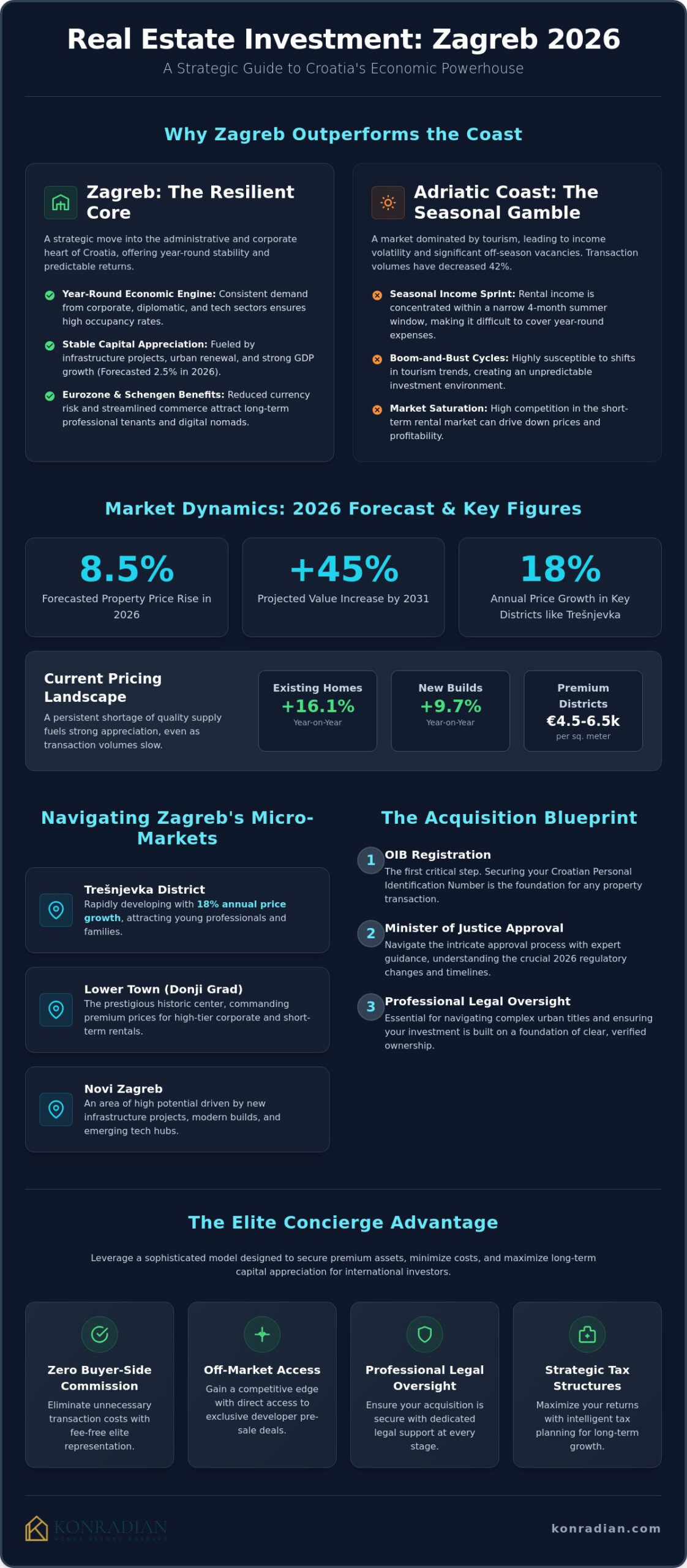
Navigating Zagreb’s Micro-Markets: Neighborhood Comparison
Successful property acquisition requires a granular understanding of the city’s districts. While the BTI 2026 Croatia Country Report underscores the nation’s overall economic stability, Zagreb’s micro-markets offer vastly different risk-reward profiles. Identifying the right neighborhood is the difference between a stagnant asset and a high performing portfolio. For those considering a real estate investment in Zagreb Croatia, the choice often begins with a tension between historic prestige and modern efficiency.
Donji Grad: The Heart of Historic Yields
Donji Grad, or Lower Town, remains the city’s most prestigious address. It’s characterized by grand Austro-Hungarian architecture and high ceilings that appeal to luxury short term rental markets. However, the investment landscape here has changed. Post earthquake regulations now place a significant premium on buildings that have undergone structural reinforcement. Modernized units in these historic shells are rare and highly sought after. Investors should look for properties that include the ultimate city center luxury: a balcony or terrace. These outdoor spaces are exceptionally scarce in the historic core and can significantly increase both rental rates and resale value.
Novi Zagreb: Corporate Hub and Modern Living
Moving south across the Sava River, Novi Zagreb presents a different narrative. This area has become the primary destination for international tech firms and corporate headquarters. The districts surrounding Bundek Park offer high quality new developments that cater to professional tenants who prioritize energy efficiency and underground parking. The ROI on these modern units is often more transparent than in the historic center. Unlike the Istria real estate for sale market, which targets lifestyle buyers seeking coastal retreats, Novi Zagreb is a pure utility play. It’s designed for the modern workforce, offering a seamless blend of office proximity and green space.
Lifestyle and Growth: Jarun, Maksimir, and Trešnjevka
For long term family rentals, Jarun and Maksimir are the gold standards. These neighborhoods offer proximity to the city’s largest parks and international schools, ensuring low vacancy rates. However, the most aggressive growth is currently found in Trešnjevka. As of mid 2026, this district is seeing annual price appreciation between 15 and 18 percent. It’s a “next best” neighborhood that has transitioned from a practical residential area to a trendy urban hub. Similarly, Špansko is attracting attention for its modern infrastructure and relative affordability. These emerging districts represent the future of Zagreb’s urban expansion, providing a strategic entry point for investors focused on long term capital gains rather than immediate prestige. Understanding these nuances is essential when conducting a real estate investment in Zagreb Croatia to ensure your capital is positioned in the path of growth.
Beyond the logistical aspects of urban growth, the lifestyle appeal of these districts is increasingly defined by access to regional holistic resources. For residents looking to balance their professional success with personal well-being, Sinhronica7 provides a sophisticated sanctuary for spiritual growth and energetic healing within the broader region.
The Acquisition Blueprint: Legal Permissions and Tax Structures
The path to a successful real estate investment in Zagreb Croatia is defined by a series of precise administrative milestones. It begins with the acquisition of your OIB (Osobni identifikacijski broj), a personal identification number required for all legal and tax activities within the country. While this is a straightforward administrative task, it serves as the essential key to opening bank accounts and signing binding agreements. Without this number, no transaction can move forward.
Once your OIB is secured, the process transitions to the Pre-Contract (Predugovor). This document outlines the terms of sale and typically involves a 10 percent deposit. In the Croatian market, this deposit often serves as a “kapara,” which can be forfeit if the buyer withdraws without cause, or returned in double if the seller defaults. It’s a mechanism that ensures both parties remain committed while the necessary legal checks and title verifications are finalized.
The culmination of the purchase is the Final Contract and the issuance of the “Tabularna Isprava.” This document is the seller’s formal statement that the purchase price has been paid in full and that they consent to the buyer registering their ownership in the Land Registry. Professional legal oversight is non-negotiable at this stage to verify a “clean title” and ensure no hidden encumbrances or historic claims exist on the property, protecting your capital from unforeseen liabilities.
Reciprocity and the Foreign Buyer
Your citizenship dictates the specific mechanics of the purchase process. EU citizens enjoy a streamlined path that mirrors that of local buyers. However, citizens from the US, UK, and other non-EU nations must obtain approval from the Minister of Justice, which verifies reciprocity between Croatia and their home country. To bypass the administrative timelines associated with this approval, many international investors opt to purchase property through a Croatian limited liability company (d.o.o.). This structure not only accelerates the acquisition but can also provide significant tax efficiencies for those building a multi-unit portfolio.
Associated Transaction Costs
Beyond the purchase price, investors must account for several standardized costs. These include notary fees, land registry charges, and legal fees for contract drafting. Acquisitions of existing properties are subject to a 3 percent Real Estate Transfer Tax (RETT). New builds, however, fall under the VAT system at a rate of 25 percent, though this is usually included in the developer’s list price. Notably, as of January 1, 2025, young buyers purchasing their first newly built home can reclaim 50 percent of the paid VAT. While traditional agencies charge a 3 percent buyer commission, our model removes this burden entirely, as we are compensated by the seller. To secure your portfolio with this elite, fee-free representation, connect with our advisory team for a strategic consultation.
Elite Acquisition: How Konradian Secures Your Zagreb Portfolio
Konradian acts as the essential bridge for international investors seeking a real estate investment in Zagreb Croatia. Our approach combines the intellectual authority of an LSE-educated advisory team with the personalized care of a dedicated concierge. We handle the heavy lifting of market analysis and risk mitigation, allowing you to focus on the strategic growth of your portfolio. From the initial video consultation to the final key handover, our process is designed to provide a seamless, end-to-end experience that alleviates the inherent complexity of high-stakes international transactions. We provide the intellectual rigor of a strategic consultant while maintaining the warmth of approachable hospitality.
Direct Developer Access and Pre-Sales
Accessing the most lucrative opportunities in the capital requires moving beyond public listings. We leverage deep, direct relationships with Zagreb’s premier developers to offer our clients first-look access to new developments. Securing a property during the pre-sale phase can lead to immediate equity upon project completion, particularly in districts where demand consistently outstrips supply. This strategic entry point is a cornerstone for those building a diversified global portfolio, mirroring the sophisticated strategies required for US real estate investment from Europe. These insider opportunities ensure your capital is positioned for maximum appreciation from the moment the foundation is poured.
Your Fee-Free Concierge in Croatia
The traditional brokerage model in Croatia often imposes a 3 percent commission plus VAT on the buyer. We’ve chosen a more investor-centric path. Our services are compensated by the developer or seller, ensuring your capital goes entirely toward the asset rather than administrative fees. This model doesn’t just minimize your transaction costs; it aligns our interests with your long-term success. Our cosmopolitan team brings a global citizen mindset to every transaction, ensuring you feel secure even if you’re thousands of miles away. We act as a protective and proactive partner, handling the nuances of local regulations so you don’t have to. To begin your journey with professional stewardship, book your free video consultation for Zagreb real estate today.
Securing Your Position in the Croatian Capital
The transition from a speculative observer to a strategic owner requires more than just capital. It demands a nuanced understanding of the city’s micro-markets and a clear path through the regulatory landscape. Zagreb has proven itself as the nation’s most resilient economic engine, offering a level of year-round stability that the seasonal coast simply cannot replicate. By focusing on modern, high-tier assets in districts like Trešnjevka or Novi Zagreb, you’re positioning your portfolio for both immediate yield and significant long-term appreciation.
A real estate investment in Zagreb Croatia shouldn’t be a source of stress. Our LSE-educated advisors provide the intellectual rigor needed to navigate 2026’s market dynamics with absolute confidence. We offer direct developer pre-sale access and a zero buyer-side brokerage fee model, ensuring your resources are directed entirely toward your asset’s value. We’re here to act as your protective partner, managing every detail from initial search to the final handover of keys. Secure your Zagreb investment with a free expert consultation and take the first step toward a seamless acquisition experience. Your future in the capital is waiting.
Frequently Asked Questions
Can US and UK citizens buy real estate in Zagreb Croatia?
Yes, US and UK citizens can acquire property based on reciprocity agreements between their home nations and Croatia. This process requires a formal application for approval from the Minister of Justice. While the administrative steps are precise, they are a standard part of the acquisition journey for non-EU investors seeking a high-quality urban asset.
What is the average rental yield for apartments in Zagreb city center?
Rental yields for premium city center apartments typically range between 3 percent and 5 percent for long-term corporate leases. Short-term yields can be higher but involve increased management intensity. Many investors find that the real value of a real estate investment in Zagreb Croatia lies in the combination of these steady yields and the robust capital appreciation seen in emerging districts.
Do I need to be physically present in Croatia to complete a property purchase?
You don’t need to be physically present to complete your purchase. Most international transactions are handled through a Power of Attorney (PoA), allowing your legal representative to sign documents on your behalf. We frequently coordinate these remote acquisitions, ensuring that every step, from the pre-contract to the final key handover, is executed with professional oversight and security.
How long does the Minister of Justice approval process take in 2026?
The Minister of Justice approval process typically takes several months to finalize in 2026. Because this timeline can vary based on the specific reciprocity agreement, many non-EU investors choose to purchase through a Croatian company (d.o.o.) to bypass this wait. This strategic approach allows for an immediate transfer of ownership and provides a more efficient path to market entry for international buyers.
What are the main taxes I should expect when buying a new-build in Zagreb?
When purchasing a new-build property, you should expect to pay Value Added Tax (VAT) at a rate of 25 percent, which is usually included in the developer’s asking price. If the property is within the VAT system, you are exempt from the 3 percent Real Estate Transfer Tax (RETT). Understanding these nuances is critical for accurate financial planning during your real estate investment in Zagreb Croatia.
Is it better to buy property in Zagreb as an individual or through a company?
Buying through a Croatian limited liability company (d.o.o.) is often the preferred route for strategic investors. This structure allows for the recovery of the 25 percent VAT on new builds and provides a more streamlined acquisition process for non-EU citizens. While individual ownership is possible, the company route offers superior tax efficiency and scalability for those building a larger professional portfolio.
Are there any restrictions on renting out my Zagreb property to tourists?
Renting to tourists is permitted, provided the property undergoes a formal categorization process to meet specific hospitality standards. It’s important to note that the regulatory landscape for short-term rentals is becoming more formalized in 2026. Investors must ensure their property complies with local zoning laws and tax obligations to maintain a legal and profitable operation within the city.
What happens if a property in Zagreb does not have a “clean title”?
If a property lacks a clean title, it cannot be safely registered in the Land Registry, posing a significant risk to your capital. This often occurs due to unresolved inheritance claims or historic encumbrances. Our advisory process prioritizes rigorous legal due diligence to ensure every asset possesses a Tabularna Isprava, which is the essential document guaranteeing your rights as the undisputed owner.
