


In the evolving landscape of 2026, traveling across an ocean to sign a physical property deed isn’t just an inconvenience; it’s often the least secure way to finalize a high-stakes investment. While the tradition of the physical handshake persists in some minds, the modern remote property closing process abroad has evolved into a sophisticated orchestration of digital trust and legal precision. We understand the weight of this transition. You likely feel a persistent anxiety regarding foreign notary requirements or the validity of a Power of Attorney (POA) when you aren’t there to oversee the ink hitting the paper. The fear of a legal loophole or a banking delay can turn an aspirational purchase into a source of significant stress.
This strategic guide serves as your professional framework for mastering cross-border transactions from anywhere in the world. We’ll provide the clarity you need to navigate international regulations with quiet confidence, ensuring your path to ownership is seamless and legally watertight. You’ll learn how to manage foreign bank accounts, utilize verified legal representatives, and execute a start-to-finish closing that prioritizes your security. From the specific digital notary shifts in Croatia to the established protocols in Spain, Hungary, and the UK, we’ll detail exactly how to secure your global assets without ever leaving your home office.
Key Takeaways
- Understand how the remote property closing process abroad has transitioned from an emergency measure into a premium, secure standard for global investors.
- Learn the critical role of the Special Power of Attorney (SPOA) and the Hague Apostille in ensuring your signature carries legal weight across borders.
- Discover the 2026 advancements in Remote Online Notarization (RON) and blockchain-backed land registries that offer enhanced security and transparency.
- Master the specific administrative requirements for key markets, such as obtaining a Spanish NIE or a Croatian OIB, without the need for physical travel.
- Explore how an LSE-educated strategic advisor acts as a dedicated concierge to orchestrate every detail from initial legal filings to the final acquisition.
The Evolution of the Remote Property Closing Process Abroad
A remote closing allows a buyer to finalize a real estate transaction without physical presence, utilizing digital tools and trusted legal representation to bridge the geographical gap. In 2026, the remote property closing process abroad has transitioned from a reactive emergency measure to a premium standard for international real estate. It’s no longer a temporary solution for restricted travel; it’s a deliberate choice made by sophisticated investors who value precision and efficiency over traditional ceremony. This shift is supported by the Hague Convention and modernized international notarization standards, which provide the legal framework necessary for documents signed in one country to hold full weight in another. This global standardization has paved the way for investment in unique, purpose-driven developments like The ARK, a regenerative village in Costa Rica that leverages these secure protocols to connect with a worldwide community of conscious owners.
Why Remote Closing is the New Standard for Global Investors
Elite investors prioritize the elimination of the “travel tax.” Forging a deal shouldn’t require multiple long-haul flights, hotel stays, and days away from one’s primary business. Beyond cost savings, digital audit trails offer a level of security that paper documents often lack. Every signature, timestamp, and verification is logged, creating a transparent history of the transaction. This agility is vital when acting on high-demand opportunities, such as pre-sale property Croatia or competitive Spanish acquisitions. In these markets, the ability to close remotely allows you to secure a prime asset before domestic buyers can even schedule a viewing.
The Core Components of a Remote Purchase
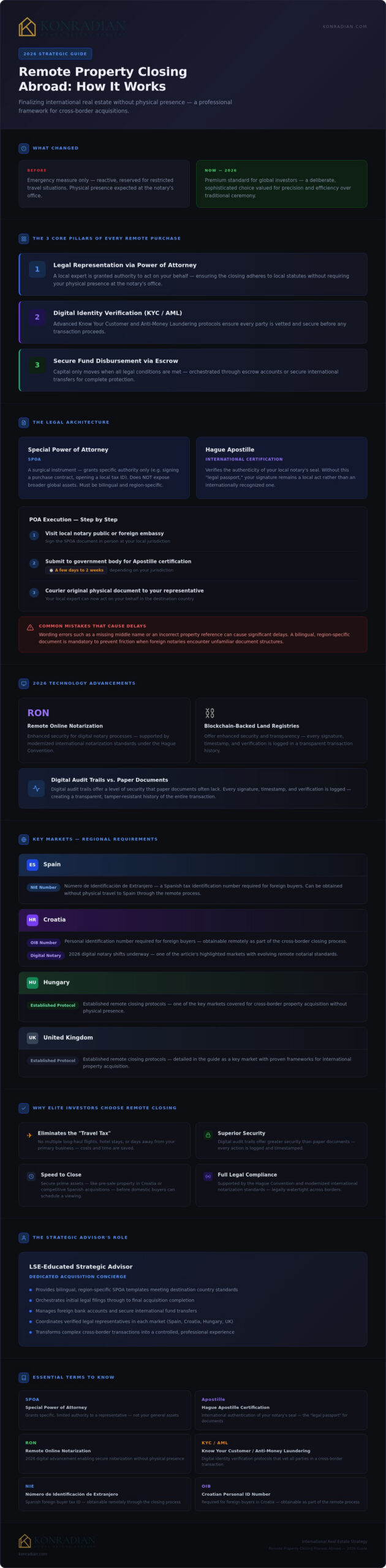
The foundation of any successful remote acquisition rests on three strategic pillars. First is robust legal representation through a power of attorney. This document grants a local expert the authority to act on your behalf, ensuring that the remote property closing process abroad adheres to local statutes without requiring your presence at the notary’s office. Second, digital identity verification through advanced KYC (Know Your Customer) and AML (Anti-Money Laundering) protocols ensures that every party is vetted and secure. Finally, the orchestration of fund disbursement through escrow accounts or secure international transfers guarantees that capital only moves when all legal conditions are met. This methodical approach transforms a complex cross-border trade into a controlled, professional experience.
The Legal Pillars: Power of Attorney and Notarial Oversight
The legal architecture of a cross-border transaction rests on the validity of the Special Power of Attorney (SPOA). Unlike a general power of attorney, an SPOA is a surgical instrument. It grants your representative specific authority to perform defined actions, such as signing a purchase contract or opening a local tax ID, without exposing your broader global assets. For the remote property closing process abroad to function, this document must be recognized across borders. This recognition is achieved through the Hague Apostille, an international certification that verifies the authenticity of your local notary’s seal. Without this “legal passport,” your signature remains a local act rather than an international one.
Drafting requires meticulous precision. A bilingual, region-specific document is mandatory to ensure both the issuing and receiving notaries understand the scope of authority. If you’re coordinating with a strategic advisor, they will typically provide a template that meets the exact linguistic and legal standards of the destination country. This prevents the friction that often arises when foreign notaries encounter unfamiliar document structures.
Executing the Power of Attorney (POA)
Executing the POA begins with a visit to your local notary public or a foreign embassy. Once you’ve signed the document, it must be sent to the relevant government body for the Apostille. This legalization process can take anywhere from a few days to two weeks, depending on your jurisdiction. You then courier the original physical paper to your representative. Common mistakes in wording, such as a missing middle name or an incorrect property reference, can cause significant delays in a Spanish Property Acquisition. Precision at this stage prevents the transaction from stalling at the final hurdle.
The Role of Legal Support Buying Property Abroad
Securing professional legal support buying property abroad is essential for the final verification phase. Your representative must review the final deed, known as the Escritura in Spain or the Vlasnički list in Croatia, before applying the remote signature. This review ensures that the property is sold with a “Clean Title,” free of historic debts or undisclosed liens. By limiting the POA’s scope to this specific transaction, you maintain control. The remote property closing process abroad is designed to provide security, but only when professional oversight confirms that every legal obligation has been met before funds are released.
Essential Digital Tools for a Secure Cross-Border Closing
Technology has transformed the remote property closing process abroad from a complex paper-chase into a streamlined digital experience. Remote Online Notarization (RON) stands at the forefront of this evolution in 2026. It allows buyers to meet with notaries via secure video link, where identity is verified and documents are signed electronically in real-time. While traditionalists once viewed this as a workaround, it’s now a preferred method for its speed and unalterable digital audit trail. Some jurisdictions are even integrating blockchain technology into their land registries. This shift replaces vulnerable paper deeds with immutable digital records, ensuring that your ownership is recorded with absolute transparency and permanence.
Verifying Identity in a Digital World
Meeting stringent Anti-Money Laundering (AML) requirements remotely requires more than a simple scan of your passport. Modern platforms like Proof or DocuSign now integrate with international legal standards to provide biometric identity verification. This often includes a “liveness” test, which uses sophisticated software to confirm the person on the screen is a real individual and not a deepfake or static image. These tools protect the integrity of the remote property closing process abroad by ensuring every participant is exactly who they claim to be. Your sensitive financial data and passport details are protected through end-to-end encryption within secure portals. These same portals serve as the primary hub for high-resolution document sharing and final virtual property walkthroughs before the signature is applied.
Financial Security and Fund Transfers
The final movement of capital is the most sensitive phase of any transaction. Sophisticated buyers utilize escrow accounts to hold deposits and final payments, ensuring funds are only released when the notary confirms all legal conditions are met. This structure provides a vital layer of protection against fraud and non-performance. Managing currency exchange risks is equally critical during the closing period. Fluctuations can impact the final cost significantly, so utilizing specialized transfer services or forward contracts is a common strategic move. Once the transfer is confirmed, the digital “key handover” occurs. This is the moment when the registry update is initiated, and your legal ownership is finalized without you ever having to visit a physical bank or local office.
Navigating Regional Differences: Spain, Croatia, and the USA
Success in the remote property closing process abroad requires more than digital signatures; it demands a deep understanding of local administrative gatekeepers. Each jurisdiction maintains its own specific protocols that can stall a transaction if not managed with precision. In Spain, this involves the Gestoria, a specialized agency that handles tax filings and property registrations. In Hungary, the legal framework is particularly rigid. The law requires specific attorney-countersigned contracts to validate property investment Hungary, ensuring that a qualified legal expert has vetted the document’s compliance with local statutes before it reaches the registry.
Spain and Croatia: The Mediterranean Remote Framework
Acquiring property in the Mediterranean often begins with securing a local tax identification number. We facilitate the acquisition of the Spanish NIE or the Croatian OIB remotely, removing the need for a physical embassy visit. Once these IDs are in place, we assist in opening a local bank account. This is a prerequisite for managing the “Plusvalia” tax in Spain or registry fees in Croatia. A critical nuance in the Croatian market is the “Tabular Statement.” This notarized document from the seller confirms they’ve received the full purchase price. Without this specific statement, the Land Registry won’t transfer the title. Our team ensures these documents are prepared and executed without the buyer ever stepping foot in the country.
The US Market: A Digital Pioneer for European Buyers
For those pursuing US real estate investment from Europe, the process is heavily digitized but follows a distinct terminology. It’s vital to distinguish between “Settlement,” the calculation of all costs, and “Closing,” the final transfer of ownership. The Title Company acts as a neutral third party, holding funds in escrow and providing Title Insurance. This insurance is a cornerstone of the US system, protecting your investment against future claims. European investors frequently utilize “Mobile Notaries” or Remote Online Notarization (RON) to execute deeds. This allows for a swift, secure conclusion to the transaction from a home office in London, Budapest, or Madrid.
Managing these regional complexities requires a partner who understands the local landscape. You can schedule a strategic consultation with Konradian to ensure your remote acquisition is handled with professional stewardship from start to finish.
Orchestrating Your Remote Purchase with Konradian
Navigating the remote property closing process abroad requires more than just a local agent; it demands a strategic partner with an international mindset. At Konradian, our LSE-educated advisors apply a level of rigor usually reserved for institutional consulting to your personal property portfolio. We don’t just find a property. We orchestrate the entire acquisition lifecycle. Through our direct developer relationships, we provide exclusive access to pre-sale units in high-growth corridors before they ever reach the open market. This proactive approach ensures you’re investing in assets with the highest potential for appreciation and yield.
Our buyer-first philosophy is central to our operation. In Spain and Croatia, our comprehensive advisory service is provided at no cost to the buyer. This allows you to leverage our elite expertise without adding to your transaction costs. We act as your dedicated concierge, handling the complex logistics so you can focus on the broader goals of your investment strategy. We believe that professional stewardship should be accessible, providing a protective layer between you and the complexities of foreign markets.
A Seamless Journey from Selection to Signature
The journey begins with remote vetting that goes far beyond a simple listing page. We utilize high-definition video walkthroughs and commission independent inspections to verify every detail of the asset’s condition and surroundings. Once a selection is made, our team coordinates with a network of vetted local lawyers and notaries to ensure the legal pillars are perfectly aligned. For those looking at the British market, our UK property sourcing service operates on a dedicated fee-based structure, providing the same strategic depth for high-yield acquisitions in the 2026 landscape. We handle the documentation flow from start to finish, ensuring no detail is overlooked.
Your Global Strategic Partner
Managing the emotional and logistical heavy lifting of an international purchase is where our team excels. We understand that transparency is the foundation of trust. Every step of the remote property closing process abroad is documented, verified, and communicated with clarity. You won’t find yourself chasing updates or wondering about the status of a specific filing. We provide the peace of mind that comes from professional stewardship, ensuring your global footprint expands with security and ease. If your expansion includes the Swiss market, you can visit JSRE Sàrl to benefit from their deep expertise in property valuation and sales within Geneva. Your path to a seamless international acquisition starts with a single conversation. We invite you to book a free consultation to begin your journey toward secure, remote property ownership.
The 2026 real estate landscape has proven that physical distance is no longer a barrier to securing high-value international assets. By mastering the remote property closing process abroad, you transition from a traditional buyer to a sophisticated global investor. Success in this arena relies on a precise orchestration of legal frameworks like the Special Power of Attorney and advanced digital verification tools. Whether you’re navigating specific registry requirements in Croatia or securing a pre-sale opportunity in Spain, the right professional stewardship ensures your transaction is both seamless and watertight.
Konradian provides the elite expertise necessary to handle the logistical heavy lifting of cross-border acquisitions. Our LSE-educated advisors bring over five years of specialized experience and direct developer relationships to every deal, offering you exclusive access to the market’s most promising opportunities. We invite you to book a free strategic consultation with Konradian to explore how our concierge model can protect your interests and simplify your path to ownership. Your next international investment is within reach; we’re here to ensure you close with absolute peace of mind.
Frequently Asked Questions
Is a remote property closing as legally binding as an in-person signing?
A remote property closing process abroad is fully legally binding when executed through a valid Special Power of Attorney (SPOA). This legal instrument allows a trusted representative to sign the deed on your behalf before a foreign notary. Ownership is recognized by national land registries with the same authority as an in-person signature. Our strategic advisors ensure that every document meets the precise legislative requirements of the destination country.
What is the Hague Apostille and why is it required for my remote purchase?
The Hague Apostille is an international certification that verifies the authenticity of a signature or seal on a public document. It’s essential for a remote purchase because it allows your locally signed Power of Attorney to be legally recognized by a foreign notary. Without this legal passport, the destination country can’t verify that your document was signed before a legitimate official in your home jurisdiction.
Can I open a foreign bank account remotely to facilitate the closing?
You can typically open a foreign bank account remotely by granting your legal representative the authority to act on your behalf via a Power of Attorney. This is a standard part of our concierge service in markets like Spain and Croatia. Having a local account is often a prerequisite for paying local taxes and the final purchase price, ensuring the financial side of the transaction remains seamless.
How do I verify the condition of the property if I am closing remotely?
Verifying property condition remotely requires a combination of high-definition video walkthroughs and independent professional inspections. We coordinate detailed site visits where every aspect of the asset is documented, from structural integrity to the quality of finishes. These reports provide the transparency needed to sign the final deed with confidence. Our direct relationships with developers also ensure that you receive verified data on projects before completion.
What are the specific risks of buying property abroad without being present?
The primary risks include potential fraud, undisclosed property liens, or discrepancies between the listing and the actual asset condition. You can mitigate these concerns by engaging professional legal and financial transaction support. We conduct thorough due diligence to verify a clean title and ensure that the Power of Attorney is strictly limited in scope. This protective oversight prevents the common pitfalls associated with unmanaged cross-border transactions.
How long does the remote closing process typically take compared to in-person?
The timeline for a remote property closing process abroad is generally comparable to an in-person transaction, though you should account for an additional seven to ten days for document courier. While digital tools speed up the signature phase, the physical Apostille process remains a fixed administrative step. Most of our clients find that the time saved on international travel more than offsets these minor logistical requirements.
Do I need a local lawyer even if the agency offers transaction support?
While you always need professional legal representation, Konradian includes legal and financial advisory as part of our end-to-end service for buyers in Spain, Croatia, and Hungary. Our LSE-educated team works alongside vetted local lawyers to review deeds and ensure compliance. This integrated approach provides a single point of accountability, removing the need for you to source and manage independent legal counsel in a foreign language.
Are digital signatures like DocuSign accepted by notaries in Spain and Croatia?
Standard e-signatures like DocuSign are generally not accepted for the final transfer of property deeds in Spain and Croatia. These jurisdictions require a physical signature, either from you or from your representative via an Apostilled Power of Attorney. However, digital signatures are highly effective for preliminary reservation agreements. This allows you to secure an asset quickly while the formal legal paperwork is prepared for the final notary appointment.
