


The true price of a Mediterranean villa is rarely the figure printed on the sales brochure. For many international investors, the actual capital requirement can swell by as much as fifteen percent once the final deed is signed. Understanding the specific closing costs when buying property in Spain is not just a matter of administrative diligence; it’s a strategic necessity to protect your global portfolio from eroding under the weight of unforeseen levies. You’ve likely spent years building your wealth with precision, and a lack of local tax transparency shouldn’t be the factor that puts your peace of mind at risk.
We believe that high-stakes transactions deserve a level of professional stewardship that transforms complexity into a seamless experience. This guide will provide you with the intellectual framework to master these financial intricacies, ensuring you identify every tax, fee, and silent cost before a contract ever reaches your desk. We’ll analyze the 2026 landscape of regional tax disparities, break down the mandatory professional fees, and provide a clear line-item budgeting strategy. By the end of this article, you’ll have the clarity required to move forward with a secure, no-surprise transaction that prioritizes your long-term interests and emotional well-being.
Key Takeaways
- Establish a comprehensive budget that accounts for the total delta between the offer price and final ownership; it’s the only way to ensure a no-surprise transaction.
- Navigate the nuanced regional variations of closing costs when buying property in Spain, where taxes differ significantly between Andalusia, Madrid, and the Valencian Community.
- Identify the silent financial impact of currency volatility and the specific role of European Notaries to protect your capital from unexpected five-figure shifts.
- Anticipate the post-acquisition horizon by planning for annual non-resident income taxes and local communal levies that apply even to vacant holiday homes.
- Leverage a professional sourcing model that provides elite representation and pre-sale developer access at no direct cost to the buyer in specific European markets.
Beyond the Purchase Price: Navigating Upfront Taxes and Closing Fees
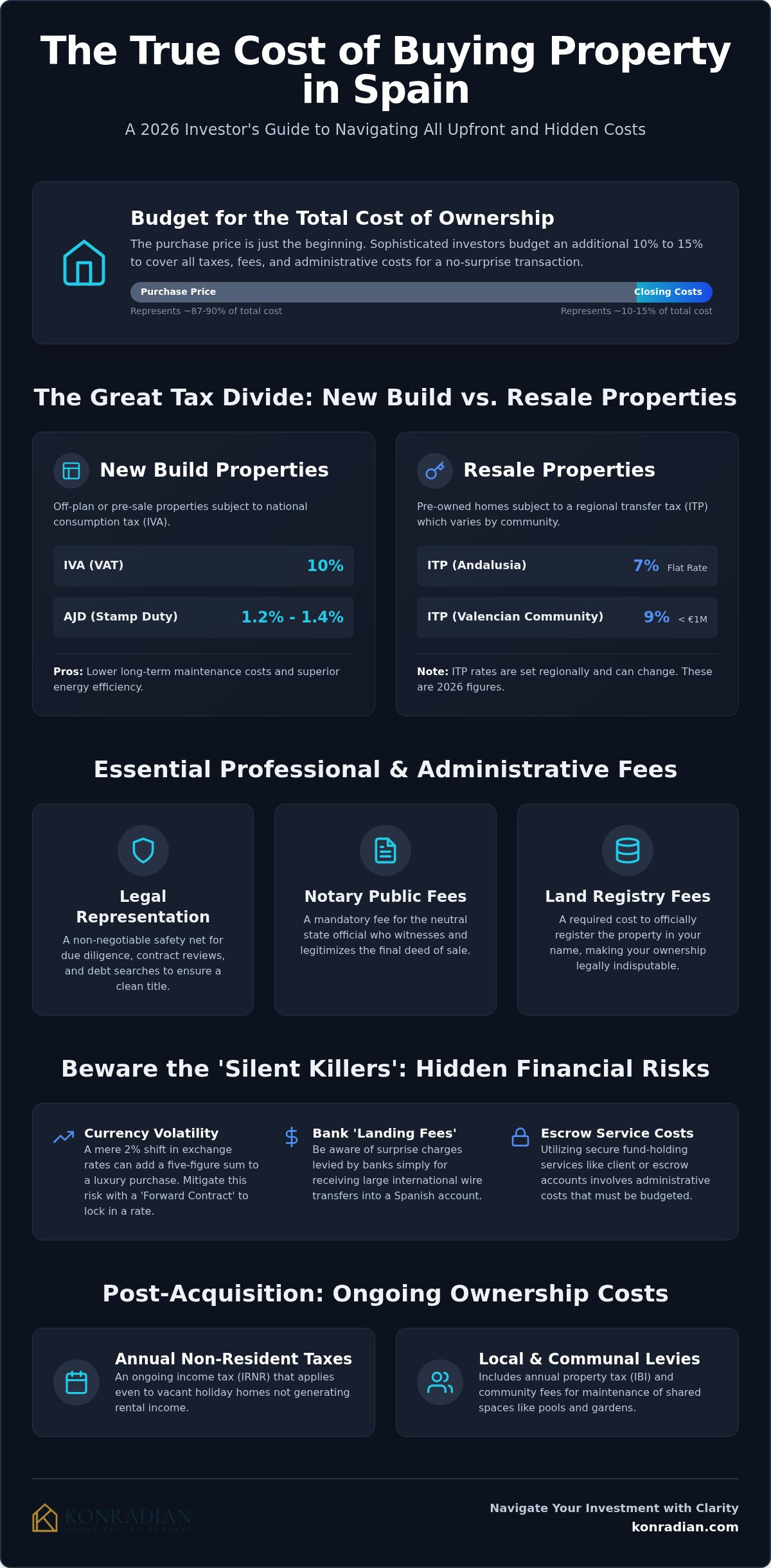
Closing costs represent the total financial delta between your accepted offer price and the moment you hold the keys in hand. When calculating the closing costs when buying property in Spain, sophisticated investors should budget between 10% and 15% of the purchase price to ensure a seamless transition. This overhead includes regional taxes, notary fees, and registry costs that vary depending on the property’s location and its status as a new or resale build. The Land Registry fee is a mandatory expense that makes your ownership legally indisputable. It’s governed by national scales, specifically Royal Decree 1427/1989, to ensure transparency across all provinces.
Resale vs. New Build: The Great Tax Divide
The 2026 fiscal environment creates a distinct path for buyers depending on the property’s history. While IVA is a national consumption tax applied to new residential constructions, ITP is a regional transfer tax levied on the acquisition of pre-owned homes. Buying off-plan or pre-sale often carries a higher upfront tax burden because you’ll pay 10% IVA plus Documented Legal Acts (AJD) tax, which ranges from 1.2% to 1.4% in regions like Andalusia or Valencia. These new builds typically offer lower long-term maintenance costs and superior energy efficiency. Resale properties are subject to Spanish property taxes known as ITP, where rates have recently shifted. As of June 2026, the Valencian Community reduced its ITP to 9% for properties under one million euros; meanwhile, Andalusia maintains a simplified flat rate of 7%.
The Legal Safety Net: Lawyer and Solicitor Fees
Securing independent legal representation is a non-negotiable step for international buyers. A standard legal fee typically covers comprehensive due diligence, contract reviews, and essential debt searches to ensure no hidden encumbrances are attached to the title. Expert legal support buying property abroad prevents catastrophic scenarios where a buyer might unknowingly inherit the previous owner’s unpaid taxes or community debts. This protective layer acts as a proactive partner in your investment. It handles the heavy lifting of local compliance so you can focus on the lifestyle benefits of your acquisition. Your lawyer will also coordinate with the Notary Public to verify that every document meets the strict requirements of the state gatekeepers.
The Financial ‘Silent Killers’: Currency Volatility and Notarial Systems
Beyond regional taxes, two factors often quietly erode a buyer’s budget: the fluctuation of global markets and the mandatory involvement of the state notary. These elements are critical components of the total closing costs when buying property in Spain. A mere 2% shift in the EUR/USD or GBP/EUR exchange rate can add a five-figure sum to a luxury purchase overnight. This volatility is often compounded by banking “landing fees,” which are surprise charges banks levy just for receiving large international transfers into a Spanish account. Additionally, utilizing specialized client accounts or escrow services for secure fund holding involves administrative costs that must be factored into your strategic budget.
Managing Exchange Rate Risk in 2026
Sophisticated investors utilize a “Forward Contract” strategy to mitigate market risks. This financial tool allows you to lock in an exchange rate today for a completion date months in the future, providing absolute certainty on the final price in your home currency. Traditional high-street banks often lack this flexibility and typically charge a wider “spread,” which is the difference between the mid-market exchange rate and the rate they offer you. Working with a specialist currency broker rather than a retail bank can save significant capital on the transaction. For those seeking to optimize their entry point, our team provides the strategic financial guidance needed to navigate these complex structures without stress.
The Notary: An Essential European Expense
In the Spanish system, the Notary Public acts as a neutral state official who ensures the transaction complies with local laws. This role is distinct from your personal lawyer; a common misconception that can lead to inadequate protection. While your lawyer protects your specific interests, the Notary verifies the state land records and witnesses the signing of the public deed. Their fees are regulated by a national sliding scale, often ranging between €900 and €1,200 for properties valued at €500,000. A comprehensive legal guide to buying property in Spain clarifies that while the Notary is essential for the legal transfer, they don’t perform the deep due diligence or debt searches that an independent solicitor provides. Factoring these professional requirements into your budget early ensures your closing costs when buying property in Spain remain predictable and manageable.
Market-Specific Variations: Spain, Croatia, and Hungary Compared
The landscape of European real estate is not a monolith; rather, it’s a patchwork of regional regulations that require a sophisticated approach to budgeting. While we’ve discussed the general closing costs when buying property in Spain, the specific province you choose can shift your tax liability by thousands of euros. In Madrid, the general ITP rate remains a competitive 6%. Conversely, the Valencian Community, encompassing the popular Costa Blanca, recently adjusted its rate to 9% for properties valued under one million euros as of June 2026. Understanding these nuances is a core part of mitigating risks when buying Spanish property. This regional disparity means a €600,000 investment in Madrid carries a significantly lower tax burden than the same purchase in Alicante or Valencia.
International investors often contrast these European models with the US system. In the United States, a Closing Agent or Title Company manages the escrow and title insurance. In Europe, the Civil Law Notary serves as the state gatekeeper, focusing on the legality of the deed rather than providing the comprehensive title insurance common in American transactions. This fundamental difference underscores why independent legal oversight is vital for non-resident buyers.
Investing in the Adriatic: Croatia Unique Costs
Croatia’s integration into the Eurozone has brought a new level of transaction transparency to the Adriatic coast. Most acquisitions here are subject to a Real Estate Transfer Tax (RETT) of 3%, though new builds may be subject to VAT instead. When exploring Istria real estate for sale, buyers must also account for administrative stamps and court registry fees that facilitate the ownership transfer. A specific “silent killer” in the Croatian market is the zoning status; converting land from agricultural to residential use can trigger substantial administrative fees that aren’t always apparent at the first viewing.
The Hungarian Advantage: Tax Efficiency in Budapest
Budapest remains one of the most tax-efficient hubs for international capital in 2026. The standard acquisition tax is generally 4%, though various exemptions exist for first-time buyers or those purchasing newly constructed apartments. Our latest property investment in Hungary guide highlights how these overheads compare favorably to the double-digit percentages found in Western Europe. In the Hungarian process, the Ügyvéd (Attorney) plays the central role, drafting the contract and managing the land registry submission directly. This streamlined approach, combined with our “Free for Buyer” model in Spain, Croatia, and Hungary, ensures that your capital is preserved for the investment itself rather than lost to avoidable administrative friction.
The Post-Acquisition Horizon: Ongoing Ownership and Management Costs
Strategic budgeting extends beyond the immediate transaction. While you’ve carefully calculated the initial closing costs when buying property in Spain, the ongoing fiscal responsibilities are equally vital for maintaining your investment’s health. Spain’s annual property tax, known as IBI (Impuesto sobre Bienes Inmuebles), is a municipal levy based on the property’s cadastral value. This differs from the Hungarian communal tax system, which often varies significantly by district. Non-resident owners must also navigate the Non-Resident Income Tax (IRNR). For holiday homes that sit empty, the Spanish state applies an ‘imputed rent’ tax. As of 2026, this is taxed at 19% for EU residents and 24% for non-EU citizens, such as UK or US investors. Appointing a fiscal representative ensures you avoid state fines and remain compliant with local filings.
If your property is part of a development or urbanization, monthly community fees are a reality. These cover luxury amenities such as communal pools, manicured gardens, and 24-hour security. These costs are the price of exclusivity and collective tranquility. They must be factored into your long-term carrying costs to ensure the property remains a source of ease rather than a financial burden.
The Cost of Distance: Security and Setup
Managing a property from a distance necessitates professional support. A key holding service is a mandatory expense for remote owners, providing secure access for maintenance and emergency inspections. You’ll also encounter utility connection fees when transitioning water and electricity accounts into your name. Comprehensive insurance is another pillar of security. This should include building cover, contents protection, and third-party liability. The latter is particularly critical if you intend to offer the property for rental in the future, as it protects your assets against unforeseen claims.
Financing and Mortgage Overhead
For those utilizing leverage, mortgage overhead adds another layer to the budget. In 2026, arrangement fees for non-resident loans typically range from 0.5% to 1% of the loan amount, though some competitive offers now waive this fee entirely. European lenders frequently mandate life insurance as a condition of the loan, which adds a recurring monthly premium. Additionally, a mandatory valuation (Tasación) by an independent appraiser is required by law. This appraisal typically costs between €300 and €600. Identifying these silent costs early allows for a secure, no-surprise transaction. To ensure your international acquisition is handled with professional precision, you can explore our end-to-end acquisition support.
Strategic De-risking: How Professional Sourcing Eliminates Hidden Surprises
Professional oversight is the ultimate hedge against market friction. While many investors view closing costs when buying property in Spain as an inevitable financial burden, strategic sourcing converts these expenses into a manageable component of a larger growth plan. Our “Free for Buyer” model in Spain, Croatia, and Hungary ensures you receive elite representation without adding to your upfront capital requirements. Since developers and sellers typically cover our commission in these markets, you gain access to a dedicated partner whose only priority is your long-term interest. This arrangement allows you to benefit from direct developer relationships and pre-sale access; here, capital appreciation often offsets the initial tax liability before you even take possession of the property.
A managed acquisition provides a single point of contact for both legal and financial oversight, which significantly reduces the billable hours often lost to fragmented communication. Consider the high cost of a DIY mistake. An overlooked debt search or a miscalculated regional tax can result in five-figure state fines or inherited liabilities. In contrast, a managed process provides a seamless, end-to-end experience that prioritizes your peace of mind and financial security. We handle the heavy lifting of local compliance, allowing you to focus on the aspirational benefits of your new international asset.
The Value of an LSE-Educated Strategy
Our approach moves beyond the traditional role of a real estate agent. We function as strategic investment consultants, applying the rigorous financial analysis you expect from an LSE-educated team to every potential acquisition. This level of intellectual rigor is essential when navigating cross-border complexities. For instance, US real estate investment from Europe requires a fundamentally different fee structure and legal framework than Mediterranean markets. We provide the strategic clarity needed to pivot between these diverse global opportunities with confidence, ensuring your portfolio remains robust and diversified.
Your 2026 Acquisition Roadmap
Securing your international portfolio begins with a transparent assessment of your specific goals. Our process is designed to lead you logically from a broad global perspective to a personal, secure investment outcome. We follow a methodical path to ensure no detail is overlooked.
- Step 1: A free video consultation to establish your “Total Cost of Ownership,” including all projected closing costs when buying property in Spain.
- Step 2: We vet developer contracts with precision to identify and eliminate hidden construction escalation clauses or unfavorable terms.
- Step 3: Our team coordinates with notaries and legal experts to finalize the transaction with absolute transparency.
Your journey toward a secure, no-surprise transaction starts with professional stewardship. You can book your free international property consultation with Konradian to begin building your strategic 2026 budget today.
Securing Your Global Legacy with Financial Precision
Navigating the international real estate market requires more than just a keen eye for architecture; it demands a rigorous understanding of the fiscal landscape. By identifying regional tax disparities and mitigating the silent impact of currency volatility, you protect your capital from avoidable erosion. Mastering the closing costs when buying property in Spain is the first step toward a secure, no-surprise transaction that preserves your long-term wealth. Our LSE-educated advisory team brings over five years of market experience to your acquisition, providing the intellectual rigor needed to handle the heavy lifting of local compliance.
We provide end-to-end support at no direct cost to the buyer in Spain, Croatia, and Hungary, while offering exclusive pre-sale pricing through our direct developer relationships. This strategic approach transforms a complex administrative process into a seamless, high-yield experience. Your future property should be a source of tranquility and pride, not a collection of unforeseen liabilities. Secure your international investment with a free expert consultation today. We look forward to acting as your trusted guide in the global market.
Frequently Asked Questions
What is the average total percentage of closing costs when buying property abroad?
Buyers should generally budget between 10% and 15% of the purchase price to cover all taxes and fees. This percentage encompasses various outlays, including transfer taxes, notary fees, and legal costs. In Spain specifically, the total typically falls between 8% and 13% depending on the region and property type. Establishing this budget early ensures a no-surprise transaction and protects your capital from unexpected administrative friction during the final stages of acquisition.
Do I have to pay a commission to Konradian when buying in Spain or Croatia?
No, buyers don’t pay a commission to Konradian when purchasing in Spain, Croatia, or Hungary. Our services are funded through commissions paid directly by the developers or sellers upon a successful transaction. This model allows you to receive elite, end-to-end advisory support and legal navigation at no direct cost. It’s a strategic advantage that ensures your investment capital is preserved for the property itself rather than lost to advisory fees.
What is a Notary fee and is it mandatory in Europe?
A notary fee is a mandatory charge for the public official who witnesses the signing of the deed and ensures the legality of the transaction. In Spain, these fees are regulated by a national scale and are non-negotiable. For a property valued at €500,000, you can expect to pay between €900 and €1,200. While the notary acts as a state gatekeeper, they don’t replace the need for independent legal representation to protect your specific interests.
Can I avoid exchange rate fees by paying in my home currency?
Most international property transactions must be completed in the local currency, meaning you can’t avoid exchange processes by paying in your home currency. However, you can mitigate fees by using a specialist currency broker instead of a traditional bank. Brokers offer tighter spreads and tools like forward contracts to lock in rates. This strategy prevents market volatility from adding five figures to your purchase price during the months between the deposit and completion.
Are there hidden taxes for owning a second home that I do not rent out?
Yes, non-resident owners in Spain are subject to an annual imputed income tax even if the property remains vacant. The state assumes a theoretical benefit from your ownership and taxes it accordingly. This is calculated based on a percentage of the property’s cadastral value. Failing to account for this can lead to state fines, so appointing a local fiscal representative is a vital step in maintaining your long-term compliant ownership.
What is the Imputed Income Tax in Spain for non-residents?
The Non-Resident Income Tax (IRNR) applies to property owners who don’t reside in Spain. If the property isn’t rented, the tax is calculated on 1.1% or 2% of the cadastral value. As of 2026, the tax rate is 19% for EU and EEA residents, while non-EU residents, including those from the UK and USA, pay 24%. Understanding these specific closing costs when buying property in Spain is essential for accurate annual budgeting.
How do closing costs differ between the UK and mainland Europe?
The primary difference lies in the tax rates and the role of the notary. While the UK utilizes Stamp Duty Land Tax, mainland European markets like Spain and Croatia often have higher transfer taxes ranging from 7% to 10%. Additionally, the European model relies on the Civil Law Notary as a state official, whereas the UK process is managed primarily through solicitors. These structural variations mean that total closing costs when buying property in Spain are generally higher than those in the UK.
Is it cheaper to buy a new build or a resale property in terms of taxes?
Resale properties are often slightly cheaper in terms of upfront taxes because they’re subject to ITP, which can be as low as 7% in regions like Andalusia. New builds attract 10% VAT plus an additional Stamp Duty (AJD) of roughly 1.2% to 1.4%. While the initial tax burden is higher for new constructions, these properties often provide better energy efficiency and lower maintenance costs. This trade-off should be analyzed as part of your total cost of ownership.
